Cookies help us run our site more efficiently.

By clicking “Accept”, you agree to the storing of cookies on your device to enhance site navigation, analyze site usage, and assist in our marketing efforts. View our Privacy Policy for more information or to customize your cookie preferences.

NASA’s PACE Data Is Redefining Our View of Earth’s Climate and Oceans

News Feed
Sunday, April 21, 2024

NASA’s PACE (Plankton, Aerosol, Cloud, ocean Ecosystem) spacecraft in orbit over Earth. Credit: NASA GSFCNASA’s new PACE satellite provides essential data on ocean health, air quality, and climate effects, enhancing scientific understanding and supporting global environmental monitoring.NASA is now publicly distributing science-quality data from its newest Earth-observing satellite, providing first-of-their-kind measurements of ocean health, air quality, and the effects of a changing climate.The Plankton, Aerosol, Cloud, ocean Ecosystem (PACE) satellite was launched on February 8, and has been put through several weeks of in-orbit testing of the spacecraft and instruments to ensure proper functioning and data quality. The mission is gathering data that the public now can access at https://pace.oceansciences.org/access_pace_data.htm. NASA’s PACE satellite’s Ocean Color Instrument (OCI) detects light across a hyperspectral range, which gives scientists new information to differentiate communities of phytoplankton – a unique ability of NASA’s newest Earth-observing satellite. This first image released from OCI identifies two different communities of these microscopic marine organisms in the ocean off the coast of South Africa on February 28, 2024. The central panel of this image shows Synechococcus in pink and picoeukaryotes in green. The left panel of this image shows a natural color view of the ocean, and the right panel displays the concentration of chlorophyll-a, a photosynthetic pigment used to identify the presence of phytoplankton. Credit: NASAPACE data will allow researchers to study microscopic life in the ocean and particles in the air, advancing the understanding of issues including fisheries health, harmful algal blooms, air pollution, and wildfire smoke. With PACE, scientists also can investigate how the ocean and atmosphere interact with each other and are affected by a changing climate.“These stunning images are furthering NASA’s commitment to protect our home planet,” said NASA Administrator Bill Nelson. “PACE’s observations will give us a better understanding of how our oceans and waterways, and the tiny organisms that call them home, impact Earth. From coastal communities to fisheries, NASA is gathering critical climate data for all people.”“First light from the PACE mission is a major milestone in our ongoing efforts to better understand our changing planet. Earth is a water planet, and yet we know more about the surface of the moon than we do our own oceans. PACE is one of several key missions – including SWOT and our upcoming NISAR mission – that are opening a new age of Earth science,” said Karen St. Germain, NASA Earth Science Division director.PACE’s OCI instrument also collects data that can be used to study atmospheric conditions. The top three panels of this OCI image depicting dust from Northern Africa carried into the Mediterranean Sea, show data that scientists have been able to collect in the past using satellite instruments – true color images, aerosol optical depth, and the UV aerosol index. The bottom two images visualize novel pieces of data that will help scientists create more accurate climate models. Single-Scattering Albedo (SSA) tells the fraction of light scattered or absorbed, which will be used to improve climate models. Aerosol Layer Height tells how low to the ground or high in the atmosphere aerosols are, which aids in understanding air quality. Credit: NASA/UMBCThe satellite’s Ocean Color Instrument, which was built and managed by NASA’s Goddard Space Flight Center in Greenbelt, Maryland, observes the ocean, land, and atmosphere across a spectrum of ultraviolet, visible, and near infrared light. While previous ocean color satellites could only detect a handful of wavelengths, PACE is detecting more than 200 wavelengths. With this extensive spectral range, scientists can identify specific communities of phytoplankton. Different species play different roles in the ecosystem and carbon cycle — most are benign, but some are harmful to human health — so distinguishing phytoplankton communities is a key mission of the satellite.PACE’s two multi-angle polarimeters, HARP2 and SPEXone, measure polarized light that has reflected off clouds and tiny particles in the atmosphere. These particles, known as aerosols, can range from dust to smoke to sea spray and more. The two polarimeters are complementary in their capabilities. SPEXone, built at the Netherlands Institute for Space Research (SRON) and Airbus Netherlands B.V., will view Earth in hyperspectral resolution – detecting all the colors of the rainbow – at five different viewing angles. HARP2, built at the University of Maryland, Baltimore County (UMBC), will observe four wavelengths of light, with 60 different viewing angles.Early data from the SPEXone polarimeter instrument aboard PACE show aerosols in a diagonal swath over Japan on Mar. 16, 2024, and Ethiopia on Mar. 6, 2024. In the top two panels, lighter colors represent a higher fraction of polarized light. In the bottom panels, SPEXone data has been used to differentiate between fine aerosols, like smoke, and coarse aerosols, like dust and sea spray. SPEXone data can also measure how much aerosols are absorbing light from the Sun. Above Ethiopia, the data show mostly fine particles absorbing sunlight, which is typical for smoke from biomass burning. In Japan, there are also fine aerosols, but without the same absorption. This indicates urban pollution from Tokyo, blown toward the ocean and mixed with sea salt. The SPEXone polarization observations are displayed on a background true color image from another of PACE’s instruments, OCI. Credit: SRONWith these data, scientists will be able to measure cloud properties — which are important for understanding climate — and monitor, analyze, and identify atmospheric aerosols to better inform the public about air quality. Scientists will also be able to learn how aerosols interact with clouds and influence cloud formation, which is essential to creating accurate climate models.Early images from PACE’s HARP2 polarimeter captured data on clouds over the west coast of South America on Mar. 11, 2024. The polarimetry data can be used to determine information about the cloud droplets that make up the cloudbow – a rainbow produced by sunlight reflected by cloud droplets instead of rain droplets. Scientists can learn how the clouds respond to man-made pollution and other aerosols and can measure the size of the cloud droplets with this polarimetry data. Credit: UMBC“We’ve been dreaming of PACE-like imagery for over two decades. It’s surreal to finally see the real thing,” said Jeremy Werdell, PACE project scientist at NASA Goddard. “The data from all three instruments are of such high quality that we can start distributing it publicly two months from launch, and I’m proud of our team for making that happen. These data will not only positively impact our everyday lives by informing on air quality and the health of aquatic ecosystems, but also change how we view our home planet over time.”The PACE mission is managed by NASA Goddard, which also built and tested the spacecraft and the ocean color instrument. The Hyper-Angular Rainbow Polarimeter #2 (HARP2) was designed and built by the University of Maryland, Baltimore County, and the Spectro-polarimeter for Planetary Exploration (SPEXone) was developed and built by a Dutch consortium led by Netherlands Institute for Space Research, Airbus Defence, and Space Netherlands.

NASA’s new PACE satellite provides essential data on ocean health, air quality, and climate effects, enhancing scientific understanding and supporting global environmental monitoring. NASA is...
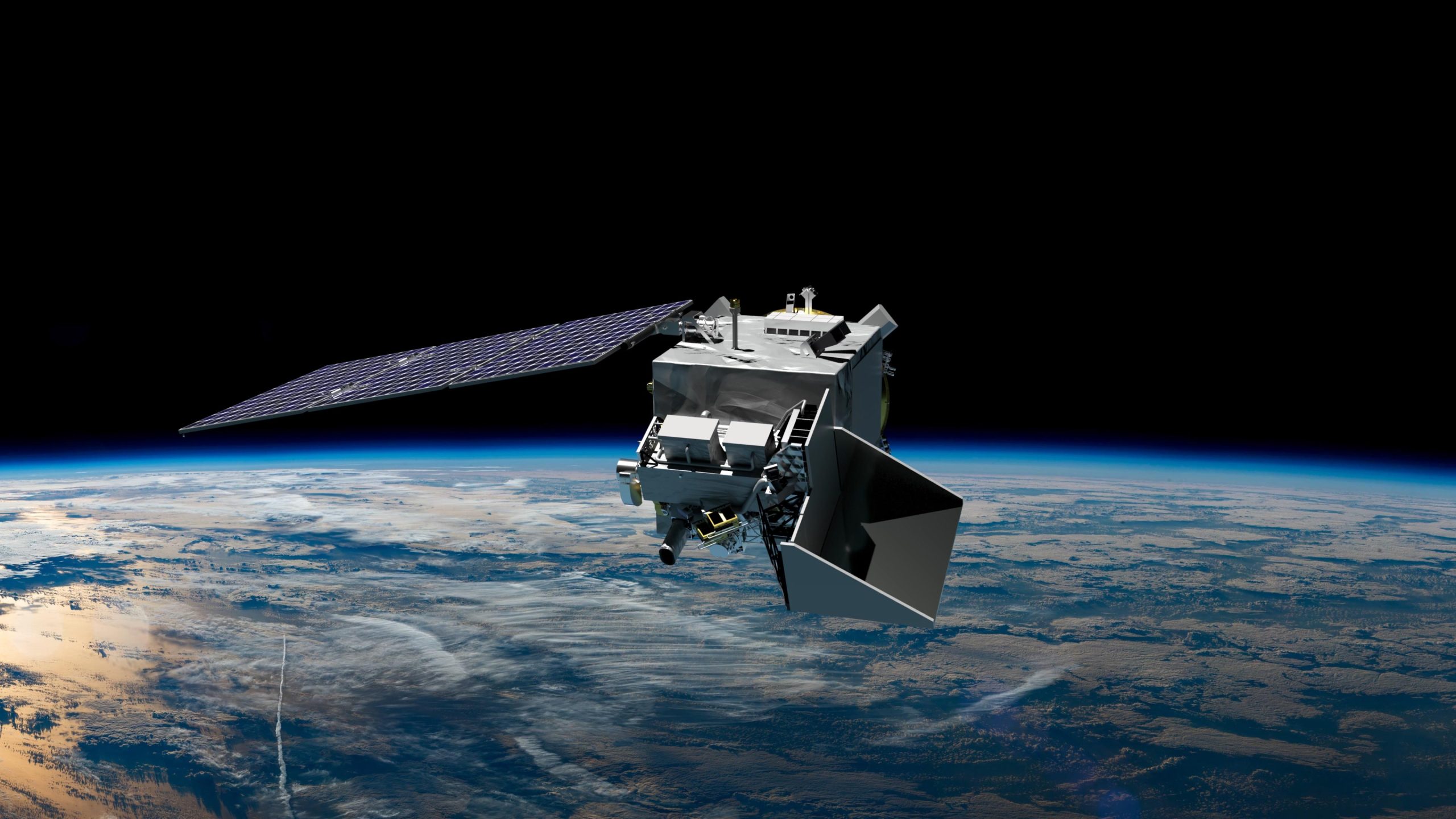
NASA PACE Satellite In Orbit Over Earth

NASA’s PACE (Plankton, Aerosol, Cloud, ocean Ecosystem) spacecraft in orbit over Earth. Credit: NASA GSFC

NASA’s new PACE satellite provides essential data on ocean health, air quality, and climate effects, enhancing scientific understanding and supporting global environmental monitoring.

NASA is now publicly distributing science-quality data from its newest Earth-observing satellite, providing first-of-their-kind measurements of ocean health, air quality, and the effects of a changing climate.

The Plankton, Aerosol, Cloud, ocean Ecosystem (PACE) satellite was launched on February 8, and has been put through several weeks of in-orbit testing of the spacecraft and instruments to ensure proper functioning and data quality. The mission is gathering data that the public now can access at https://pace.oceansciences.org/access_pace_data.htm.
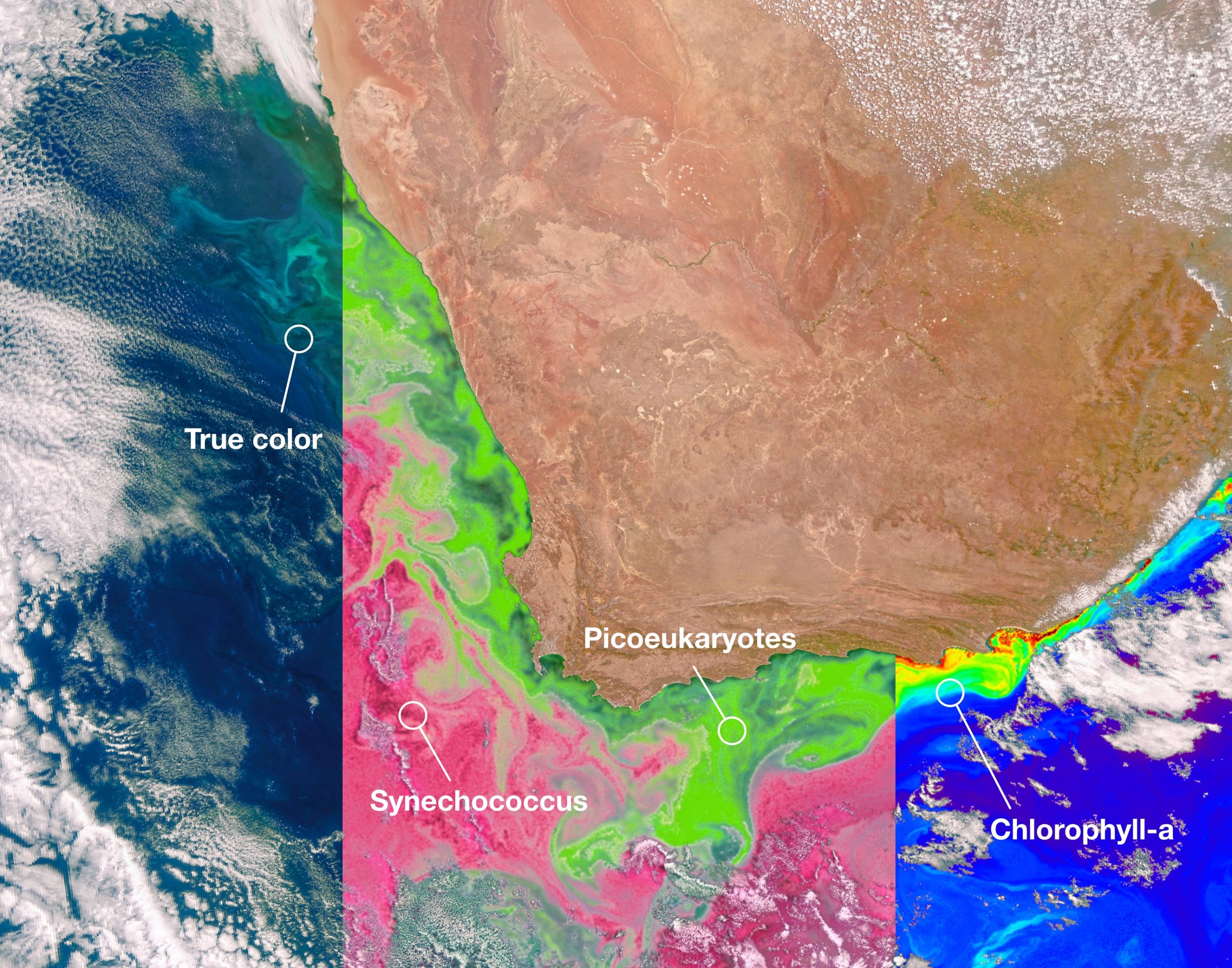
NASA PACE Satellite’s Ocean Color Instrument Hyperspectral Range

NASA’s PACE satellite’s Ocean Color Instrument (OCI) detects light across a hyperspectral range, which gives scientists new information to differentiate communities of phytoplankton – a unique ability of NASA’s newest Earth-observing satellite. This first image released from OCI identifies two different communities of these microscopic marine organisms in the ocean off the coast of South Africa on February 28, 2024. The central panel of this image shows Synechococcus in pink and picoeukaryotes in green. The left panel of this image shows a natural color view of the ocean, and the right panel displays the concentration of chlorophyll-a, a photosynthetic pigment used to identify the presence of phytoplankton. Credit: NASA

PACE data will allow researchers to study microscopic life in the ocean and particles in the air, advancing the understanding of issues including fisheries health, harmful algal blooms, air pollution, and wildfire smoke. With PACE, scientists also can investigate how the ocean and atmosphere interact with each other and are affected by a changing climate.

“These stunning images are furthering NASA’s commitment to protect our home planet,” said NASA Administrator Bill Nelson. “PACE’s observations will give us a better understanding of how our oceans and waterways, and the tiny organisms that call them home, impact Earth. From coastal communities to fisheries, NASA is gathering critical climate data for all people.”

“First light from the PACE mission is a major milestone in our ongoing efforts to better understand our changing planet. Earth is a water planet, and yet we know more about the surface of the moon than we do our own oceans. PACE is one of several key missions – including SWOT and our upcoming NISAR mission – that are opening a new age of Earth science,” said Karen St. Germain, NASA Earth Science Division director.
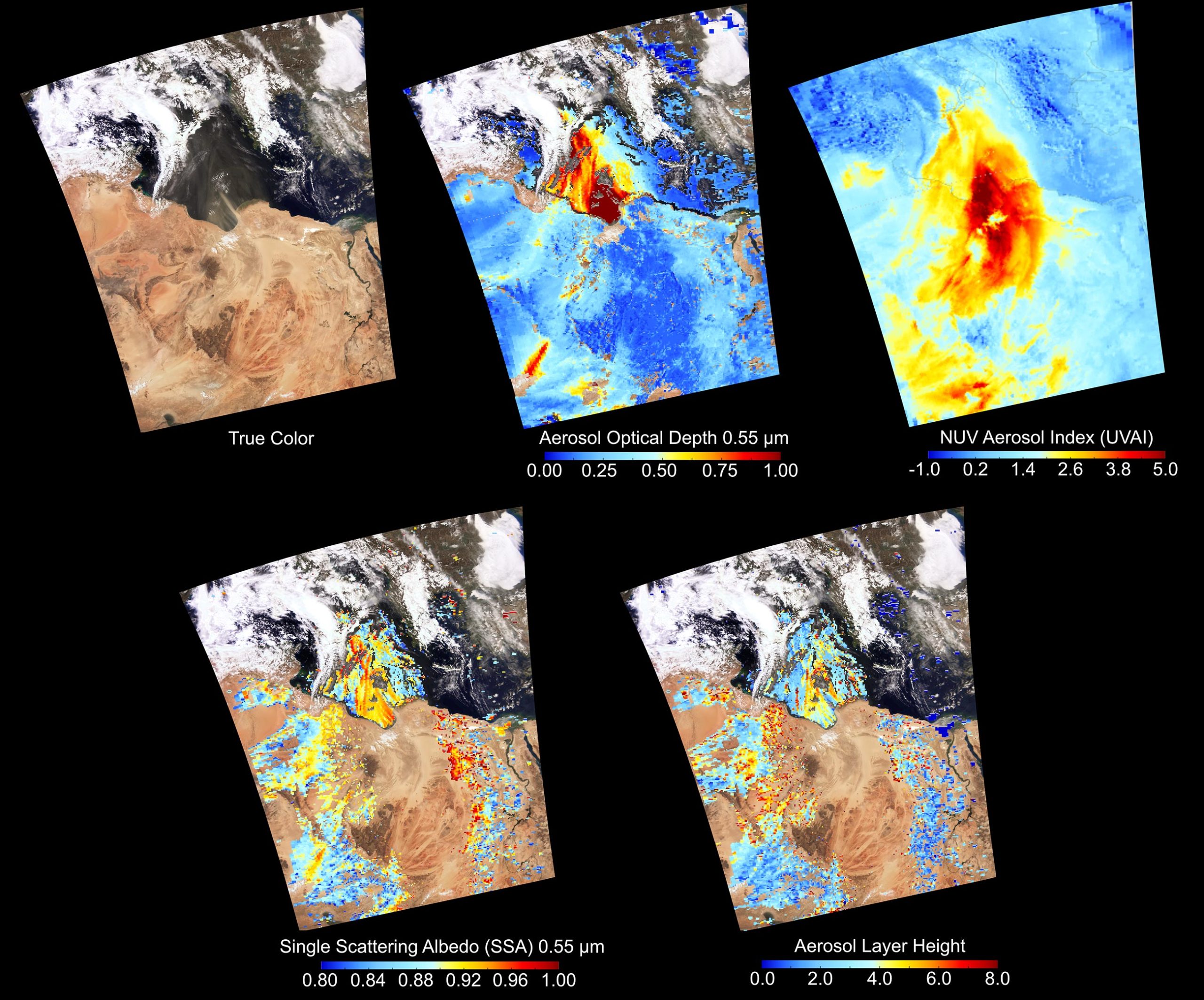
PACE OCI Instrument Data Examples

PACE’s OCI instrument also collects data that can be used to study atmospheric conditions. The top three panels of this OCI image depicting dust from Northern Africa carried into the Mediterranean Sea, show data that scientists have been able to collect in the past using satellite instruments – true color images, aerosol optical depth, and the UV aerosol index. The bottom two images visualize novel pieces of data that will help scientists create more accurate climate models. Single-Scattering Albedo (SSA) tells the fraction of light scattered or absorbed, which will be used to improve climate models. Aerosol Layer Height tells how low to the ground or high in the atmosphere aerosols are, which aids in understanding air quality. Credit: NASA/UMBC

The satellite’s Ocean Color Instrument, which was built and managed by NASA’s Goddard Space Flight Center in Greenbelt, Maryland, observes the ocean, land, and atmosphere across a spectrum of ultraviolet, visible, and near infrared light. While previous ocean color satellites could only detect a handful of wavelengths, PACE is detecting more than 200 wavelengths. With this extensive spectral range, scientists can identify specific communities of phytoplankton. Different species play different roles in the ecosystem and carbon cycle — most are benign, but some are harmful to human health — so distinguishing phytoplankton communities is a key mission of the satellite.

PACE’s two multi-angle polarimeters, HARP2 and SPEXone, measure polarized light that has reflected off clouds and tiny particles in the atmosphere. These particles, known as aerosols, can range from dust to smoke to sea spray and more. The two polarimeters are complementary in their capabilities. SPEXone, built at the Netherlands Institute for Space Research (SRON) and Airbus Netherlands B.V., will view Earth in hyperspectral resolution – detecting all the colors of the rainbow – at five different viewing angles. HARP2, built at the University of Maryland, Baltimore County (UMBC), will observe four wavelengths of light, with 60 different viewing angles.

PACE SPEXone Polarimeter Instrument Early Data

Early data from the SPEXone polarimeter instrument aboard PACE show aerosols in a diagonal swath over Japan on Mar. 16, 2024, and Ethiopia on Mar. 6, 2024. In the top two panels, lighter colors represent a higher fraction of polarized light. In the bottom panels, SPEXone data has been used to differentiate between fine aerosols, like smoke, and coarse aerosols, like dust and sea spray. SPEXone data can also measure how much aerosols are absorbing light from the Sun. Above Ethiopia, the data show mostly fine particles absorbing sunlight, which is typical for smoke from biomass burning. In Japan, there are also fine aerosols, but without the same absorption. This indicates urban pollution from Tokyo, blown toward the ocean and mixed with sea salt. The SPEXone polarization observations are displayed on a background true color image from another of PACE’s instruments, OCI. Credit: SRON

With these data, scientists will be able to measure cloud properties — which are important for understanding climate — and monitor, analyze, and identify atmospheric aerosols to better inform the public about air quality. Scientists will also be able to learn how aerosols interact with clouds and influence cloud formation, which is essential to creating accurate climate models.

PACE HARP2 Polarimeter Early Data

Early images from PACE’s HARP2 polarimeter captured data on clouds over the west coast of South America on Mar. 11, 2024. The polarimetry data can be used to determine information about the cloud droplets that make up the cloudbow – a rainbow produced by sunlight reflected by cloud droplets instead of rain droplets. Scientists can learn how the clouds respond to man-made pollution and other aerosols and can measure the size of the cloud droplets with this polarimetry data. Credit: UMBC

“We’ve been dreaming of PACE-like imagery for over two decades. It’s surreal to finally see the real thing,” said Jeremy Werdell, PACE project scientist at NASA Goddard. “The data from all three instruments are of such high quality that we can start distributing it publicly two months from launch, and I’m proud of our team for making that happen. These data will not only positively impact our everyday lives by informing on air quality and the health of aquatic ecosystems, but also change how we view our home planet over time.”

The PACE mission is managed by NASA Goddard, which also built and tested the spacecraft and the ocean color instrument. The Hyper-Angular Rainbow Polarimeter #2 (HARP2) was designed and built by the University of Maryland, Baltimore County, and the Spectro-polarimeter for Planetary Exploration (SPEXone) was developed and built by a Dutch consortium led by Netherlands Institute for Space Research, Airbus Defence, and Space Netherlands.

Read the full story here.
Photos courtesy of

Takeaways From AP’s Report on Potential Impacts of Alaska’s Proposed Ambler Access Road

A proposed mining road in Northwest Alaska has sparked debate amid climate change impacts

AMBLER, Alaska (AP) — In Northwest Alaska, a proposed mining road has become a flashpoint in a region already stressed by climate change. The 211-mile (340-kilometer) Ambler Access Road would cut through Gates of the Arctic National Park and cross 11 major rivers and thousands of streams relied on for salmon and caribou. The Trump administration approved the project this fall, setting off concerns over how the Inupiaq subsistence way of life can survive amid rapid environmental change. Many fear the road could push the ecosystem past a breaking point yet also recognize the need for jobs. A strategically important mineral deposit The Ambler Mining District holds one of the largest undeveloped sources of copper, zinc, lead, silver and gold in North America. Demand for minerals used in renewable energy is expected to grow, though most copper mined in the U.S. currently goes to construction — not green technologies. Critics say the road raises broader questions about who gets to decide the terms of mineral extraction on Indigenous lands. Climate change has already devastated subsistence resources Northwest Alaska is warming about four times faster than the global average — a shift that has already upended daily life. The Western Arctic Caribou Herd, once nearly half a million strong, has fallen 66% in two decades to around 164,000 animals. Warmer temperatures delay cold and snow, disrupting migration routes and keeping caribou high in the Brooks Range where hunters can’t easily reach them.Salmon runs have suffered repeated collapses as record rainfall, warmer rivers and thawing permafrost transform once-clear streams. In some areas, permafrost thaw has released metals into waterways, adding to the stress on already fragile fish populations.“Elders who’ve lived here their entire lives have never seen environmental conditions like this,” one local environmental official said. The road threatens what remains The Ambler road would cross a vast, largely undisturbed region to reach major deposits of copper, zinc and other minerals. Building it would require nearly 50 bridges, thousands of culverts and more than 100 truck trips a day during peak operations. Federal biologists warn naturally occurring asbestos could be kicked up by passing trucks and settle onto waterways and vegetation that caribou rely on. The Bureau of Land Management designated some 1.2 million acres of nearby salmon spawning and caribou calving habitat as “critical environmental concern.”Mining would draw large volumes of water from lakes and rivers, disturb permafrost and rely on a tailings facility to hold toxic slurry. With record rainfall becoming more common, downstream communities fear contamination of drinking water and traditional foods.Locals also worry the road could eventually open to the public, inviting outside hunters into an already stressed ecosystem. Many point to Alaska’s Dalton Highway, which opened to public use despite earlier promises it would remain private.Ambler Metals, the company behind the mining project, says it uses proven controls for work in permafrost and will treat all water the mine has contact with to strict standards. The company says it tracks precipitation to size facilities for heavier rainfall. A potential economic lifeline For some, the mine represents opportunity in a region where gasoline can cost nearly $18 a gallon and basic travel for hunting has become prohibitively expensive. Supporters argue mining jobs could help people stay in their villages, which face some of the highest living costs in the country.Ambler mayor Conrad Douglas summed up the tension: “I don’t really know how much the state of Alaska is willing to jeopardize our way of life, but the people do need jobs.”The Associated Press receives support from the Walton Family Foundation for coverage of water and environmental policy. The AP is solely responsible for all content. For all of AP’s environmental coverage, visit https://apnews.com/hub/climate-and-environmentCopyright 2025 The Associated Press. All rights reserved. This material may not be published, broadcast, rewritten or redistributed.Photos You Should See – December 2025

How a species of bamboo could help protect the South from future floods

In the face of mounting climate disasters, tribes, scientists, and Southern communities are rallying around a nearly forgotten native plant.

In early 2024, Michael Fedoroff trekked out to Tuckabum Creek in York County, Alabama. The environmental anthropologist was there to help plant 300 stalks of rivercane, a bamboo plant native to North America, on an eroded, degraded strip of wetland: a “gnarly” and “wicked” area, according to Fedoroff. If successful, this planting would be the largest cane restoration project in Alabama history. He and his team got the stalks into the ground, buttressed them with hay, left, and hoped for the best.  A few days later, rains swept through the area and the river rose by 9 feet. “We were terrified,” said Fedoroff. He and his team raced back to the site, expecting to find bare dirt. Instead, they found that the rivercane had survived — and so, crucially, had the stream bank. Rivercane used to line the streams, rivers, and bogs of the Southeast from the Blue Ridge Mountains down to the Mississippi Delta. Thick yellow stalks and feathery leaves reached as high as 20 feet into the sky, so dense that riders on horseback would travel around rather than venturing through. In the ground underneath cane stands, rhizomes — gnarled stems just below the soil surface — extended out to cover acres.  When Europeans settled the land that would become North Carolina, Virginia, Georgia, and Alabama, they ripped up trees and vegetation to make way for agriculture and development. Pigs ate rivercane rhizomes and cows munched on developing shoots. Now, thanks to this dramatic upheaval in the landscape, more than 98 percent of rivercane is gone. Of those plentiful dense stands, called canebrakes, only about 12 are left in the whole nation, according to Fedoroff.  But as the Tuckabum Creek project demonstrated, rivercane was an essential bulwark against the ravages of floods. That vast network of tough underground stems kept soil and stream banks in place more effectively than other vegetation, even when rivers ran high. And as the South faces mounting climate-fueled disasters, like Hurricane Helene last year, a small and dedicated network of scientists, volunteers, Native stakeholders, and landowners is working to bring this plant back.  During Helene, the few waterways that were lined by rivercane fared much better than those that weren’t, said Adam Griffith, a rivercane expert at an NC Cooperative Extension outpost in Cherokee. “I saw the devastation of the rivers,” said Griffith. He had considered stepping back from his involvement in rivercane restoration, but recommitted himself after the hurricane. “If the native vegetation had been there, the stream bank would have been in much better shape,” he said.  Rivercane growing along the Cane River in Yancey County, North Carolina, created an “island” where it held the stream bank in place during Hurricane Helene. These photos show the river before and after the storm. Adam Griffith These enthusiasts are ushering in a “cane renaissance,” according to Fedoroff, who directs the University of Alabama program that hosts the Rivercane Restoration Alliance, or RRA, a network of pro-rivercane groups. The RRA and its allies are replanting rivercane where it once flourished, maintaining existing canebrakes and stands, and educating landowners and the general public on cane’s benefits. In addition to those rhizomes saving waterways from devastating erosion, rivercane also provides crucial habitat to native species, such as cane-feeding moths, and filters nitrate and other pollutants from water.  “When people grow to accept cane into their hearts, beautiful things happen,” said Fedoroff, whose team now has a $3.8 million grant from the National Fish and Wildlife Foundation to work on rivercane projects in 12 states throughout the Southeast.  Large restoration projects like this often involve collaboration with many major stakeholders: The Tuckabum Creek project, for example, looped in the RRA, the lumber and land management company Westervelt, the U.S. Army Corps of Engineers, and the Choctaw Nation of Oklahoma. Rivercane enthusiasts stressed that consulting with and including tribes is essential in returning this plant to the landscape. Not only does rivercane bring ecological benefits, it also holds a cultural role for tribes — one that’s been lost as the plant declined.   Historically, Native peoples in the Southeast used rivercane to make things like baskets, blow guns, and arrows, but nowadays, many artisans have turned to synthetic materials for these crafts, said Ryan Spring, a historian and a member of the Choctaw Nation of Oklahoma.  When Spring started his job at the tribe 14 years ago, no one knew much about rivercane ecology, he said. Now, Spring is actively involved in recentering rivercane in the cultural and ecological landscape. “We’re building up community, taking them out, teaching them ecology,” Spring said. “A lot are basket makers, and now they’re using rivercane to make baskets for the first time.” In mature patches of cane, the high density of roots and rhizomes helps keep soils in place during floods. EBCI Cooperative Extension There are challenges to the dream of returning rivercane to its former prolific glory in the Southeast. One is education: For example, rivercane is often confused for invasive Chinese bamboo, which means that landowners and managers generally don’t think twice before removing it. Another barrier to restoration efforts is the cost and availability of rivercane plants. They’re not easy to find in nurseries, and can run between $50 and $60 per plant or more, according to Laura Young of the Virginia Department of Conservation and Recreation.  But Young has found a way around this problem. She does habitat and riverbank restoration in southeastern Virginia, and six years ago, she wanted to plant a canebrake along a river near the tiny town of Jonesville. The cost was prohibitive, and so Young pioneered a method now known colloquially as the “cane train.” She gathered pieces of cane rhizome, planted them in soil-filled sandwich bags, then started a canebrake with the propagated cuttings — all for $6.  Fedoroff pointed out that the cane train method has one major drawback: Different varieties of rivercane are better suited for, say, wet spots or sunny spots, so transplanting cuttings that thrived in one area could result in a bunch of dead plants in another. At his lab, researchers are working on sequencing rivercane genomes so they can compare different plants’ traits and choose the best varieties for different locations. But, Young added, while the propagation method is imperfect, it’s cheap, easy, and better than nothing. Out of the 200 plants in her initial project, 60 took off.  “Rivercane is kind of like investing,” she said. “It’s not get-rich-quick. You just need to invest time and money every year, and then it exponentially pays off.” The cane train also offers a low-investment way for volunteers and private landowners to get involved in stabilizing stream banks. Yancey County, North Carolina, is home to numerous streams and creeks that suffered major erosion damage during Hurricane Helene. This spring, the county government, in partnership with several state and local groups, led a cadre of volunteers in a rivercane restoration project. They harvested thousands of rhizomes, contacted landowners along the county’s devastated waterways, and planted almost 700 shoots, a process they’ll repeat in 2026. “The county really showed up,” said Keira Albert, a restoration coordinator at The Beacon Network, a disaster recovery organization that helped lead the project.  That’s part of the power of a solution like planting rivercane: It’s an actionable, easy way for ordinary landowners and volunteers to heal the landscape around them. “There’s a lot of doom and gloom when we think about climate change,” Fedoroff said. “We become paralyzed. But we’re trying to take a different approach. We can’t get back to that pristine past state, but we can envision a future ecology that’s better.” This story was originally published by Grist with the headline How a species of bamboo could help protect the South from future floods on Dec 11, 2025.

Shell facing first UK legal claim over climate impacts of fossil fuels

Survivors of a deadly typhoon in the Philippines have filed a claim against the UK's largest oil company.

Shell facing first UK legal claim over climate impacts of fossil fuelsMatt McGrathEnvironment correspondentGetty ImagesVictims of a deadly typhoon in the Philippines have filed a legal claim against oil and gas company Shell in the UK courts, seeking compensation for what they say is the company's role in making the storm more severe.Around 400 people were killed and millions of homes hit when Typhoon Rai slammed into parts of the Philippines just before Christmas in 2021.Now a group of survivors are for the first time taking legal action against the UK's largest oil company, arguing that it had a role in making the typhoon more likely and more damaging.Shell says the claim is "baseless", as is a suggestion the company had unique knowledge that carbon emissions drove climate change.Typhoon Rai, known locally as Odette, was the most powerful storm to hit the Philippines in 2021.With winds gusting at up to 170mph (270km/h), it destroyed around 2,000 buildings, displaced hundreds of thousands of people - including Trixy Elle and her family.She was a fish vendor on Batasan island when the storm hit, forcing her from her home, barely escaping with her life."So we have to swim in the middle of big waves, heavy rains, strong winds," she told BBC News from the Philippines."That's why my father said that we will hold our hands together, if we survive, we survive, but if we will die, we will die together."Trixy is now part of the group of 67 individuals that has filed a claim that's believed to be the first case of its kind against a UK major producer of oil and gas.Getty ImagesA family take shelter in the wake of Typhoon Rai which left hundreds of thousands of people homelessIn a letter sent to Shell before the claim was filed at court, the legal team for the survivors says the case is being brought before the UK courts as that is where Shell is domiciled – but that it will apply the law of the Philippines as that is where the damage occurred.The letter argues that Shell is responsible for 2% of historical global greenhouse gases, as calculated by the Carbon Majors database of oil and gas production.The company has "materially contributed" to human driven climate change, the letter says, that made the Typhoon more likely and more severe.The survivors' group further claims that Shell has a "history of climate misinformation," and has known since 1965 that fossil fuels were the primary cause of climate change."Instead of changing their industry, they still do their business," said Trixy Elle."It's very clear that they choose profit over the people. They choose money over the planet."Getty ImagesShell's global headquarters is in London which is why the claim has been lodged at a UK courtShell denies that their production of oil and gas contributed to this individual typhoon, and they also deny any unique knowledge of climate change that they kept to themselves."This is a baseless claim, and it will not help tackle climate change or reduce emissions," a Shell spokesperson said in a statement to BBC News."The suggestion that Shell had unique knowledge about climate change is simply not true. The issue and how to tackle it has been part of public discussion and scientific research for many decades."The case is being supported by several environmental campaign groups who argue that developments in science make it now far easier to attribute individual extreme weathernevents to climate change and allows researchers to say how much of an influence emissions of warming gases had on a heatwave or storm.But proving, to the satisfaction of a court, that damages done to individuals by extreme weather events are due to the actions of specific fossil fuel producers may be a challenge."It's traditionally a high bar, but both the science and the law have lowered that bar significantly in recent years," says Harj Narulla, a barrister specialising in climate law and litigation who is not connected with the case."This is certainly a test case, but it's not the first case of its kind. So this will be the first time that UK courts will be satisfying themselves about the nature of all of that attribution science from a factual perspective."The experience in other jurisdictions is mixed.In recent years efforts to bring cases against major oil and gas producers in the United States have often failed.In Europe campaigners in the Netherlands won a major case against Shell in 2021 with the courts ordering Shell to cut its absolute carbon emissions by 45% by 2030, including those emissions that come from the use of its products.But that ruling was overturned on appeal last year.There was no legal basis for a specific cuts target, the court ruled, but it also reaffirmed Shell's duty to mitigate dangerous climate change through its policies.The UK claim has now been filed at the Royal Courts of Justice, but this is just the first step in the case brought by the Filippino survivors with more detailed particulars expected by the middle of next year.

Ocean Warmed by Climate Change Fed Intense Rainfall and Deadly Floods in Asia, Study Finds

Ocean temperatures warmed by human-caused climate change fed the intense rainfall that triggered deadly floods and landslides across Asia in recent weeks, according to an analysis released Wednesday

BENGALURU, India (AP) — Ocean temperatures warmed by human-caused climate change fed the intense rainfall that triggered deadly floods and landslides across Asia in recent weeks, according to an analysis released Wednesday.The rapid study by World Weather Attribution focused on heavy rainfall from cyclones Senyar and Ditwah in Malaysia, Thailand, Indonesia and Sri Lanka starting late last month. The analysis found that warmer sea surface temperatures over the North Indian Ocean added energy to the cyclones.Floods and landslides triggered by the storms have killed more than 1,600 people, with hundreds more still missing. The cyclones are the latest in a series of deadly weather disasters affecting Southeast Asia this year, resulting in loss of life and property damage.“It rains a lot here but never like this. Usually, rain stops around September but this year it has been really bad. Every region of Sri Lanka has been affected, and our region has been the worst impacted,” said Shanmugavadivu Arunachalam, a 59-year-old schoolteacher in the mountain town of Hatton in Sri Lanka’s Central Province. Warmer sea surface temperatures Sea surface temperatures over the North Indian Ocean were 0.2 degrees Celsius (0.3 degrees Fahrenheit) higher than the average over the past three decades, according to the WWA researchers. Without global warming, the sea surface temperatures would have been about 1 degree Celsius (1.8 degrees Fahrenheit) colder than they were, according to the analysis. The warmer ocean temperatures provided heat and moisture to the storms.When measuring overall temperatures, the world is currently 1.3 degrees Celsius (2.6 degrees Fahrenheit) warmer than global average during pre-industrial times in the 19th century, according to the National Oceanic and Atmospheric Administration.“When the atmosphere warms, it can hold more moisture. As a result, it rains more in a warmer atmosphere as compared to a world without climate change,” said Mariam Zachariah, with the Centre for Environmental Policy at Imperial College London and one of the report's authors. Using tested methods to measure climate impacts quickly The WWA is a collection of researchers who use peer-reviewed methods to conduct rapid studies examining how extreme weather events are linked to climate change. “Anytime we decide to do a study, we know what is the procedure that we have to follow,” said Zachariah, who added that they review the findings in house and send some of their analysis for peer review, even after an early version is made public.The speed at which the WWA releases their analysis helps inform the general public about the impacts of climate change, according to Zachariah.“We want people everywhere to know about why something happened in their neighborhood," Zachariah said. “But also be aware about the reasons behind some of the events unfurling across the world.”The WWA often estimates how much worse climate change made a disaster using specific probabilities. In this case, though, the researchers said they could not estimate the precise contribution of climate change to the storms and ensuing heavy rains because of limitations in climate models for the affected islands. Climate change boosts Asia's unusually heavy rainfall Global warming is a “powerful amplifier” to the deadly floods, typhoons and landslides that have ravaged Asia this year, said Jemilah Mahmood, with the Sunway Centre for Planetary Health, a Malaysia-based think tank that was not involved with the WWA analysis.“The region and the world have been on this path because, for decades, economic development was prioritized over climate stability,” Mahmood said. “It’s created an accumulated planetary debt, and this has resulted in the crisis we face.”The analysis found that across the affected countries, rapid urbanization, high population density and infrastructure in low lying flood plains have elevated exposure to flood events.“The human toll from cyclones Ditwah and Senyar is staggering,” said Maja Vahlberg, a technical adviser with the Red Cross Red Crescent Climate Centre. “Unfortunately, it is the most vulnerable people who experience the worst impacts and have the longest road to recovery.”Delgado reported from Bangkok, Thailand.The Associated Press’ climate and environmental coverage receives financial support from multiple private foundations. AP is solely responsible for all content. Find AP’s standards for working with philanthropies, a list of supporters and funded coverage areas at AP.org.Copyright 2025 The Associated Press. All rights reserved. This material may not be published, broadcast, rewritten or redistributed.Photos You Should See – December 2025

Suggested Viewing

Join us to forge
a sustainable future

Our team is always growing.
Become a partner, volunteer, sponsor, or intern today.
Let us know how you would like to get involved!

CONTACT US

sign up for our mailing list to stay informed on the latest films and environmental headlines.

Subscribers receive a free day pass for streaming Cinema Verde.
Thank you! Your submission has been received!
Oops! Something went wrong while submitting the form.