

How a species of bamboo could help protect the South from future floods
In early 2024, Michael Fedoroff trekked out to Tuckabum Creek in York County, Alabama. The environmental anthropologist was there to help plant 300 stalks of rivercane, a bamboo plant native to North America, on an eroded, degraded strip of wetland: a “gnarly” and “wicked” area, according to Fedoroff. If successful, this planting would be the largest cane restoration project in Alabama history. He and his team got the stalks into the ground, buttressed them with hay, left, and hoped for the best. A few days later, rains swept through the area and the river rose by 9 feet. “We were terrified,” said Fedoroff. He and his team raced back to the site, expecting to find bare dirt. Instead, they found that the rivercane had survived — and so, crucially, had the stream bank. Rivercane used to line the streams, rivers, and bogs of the Southeast from the Blue Ridge Mountains down to the Mississippi Delta. Thick yellow stalks and feathery leaves reached as high as 20 feet into the sky, so dense that riders on horseback would travel around rather than venturing through. In the ground underneath cane stands, rhizomes — gnarled stems just below the soil surface — extended out to cover acres. When Europeans settled the land that would become North Carolina, Virginia, Georgia, and Alabama, they ripped up trees and vegetation to make way for agriculture and development. Pigs ate rivercane rhizomes and cows munched on developing shoots. Now, thanks to this dramatic upheaval in the landscape, more than 98 percent of rivercane is gone. Of those plentiful dense stands, called canebrakes, only about 12 are left in the whole nation, according to Fedoroff. But as the Tuckabum Creek project demonstrated, rivercane was an essential bulwark against the ravages of floods. That vast network of tough underground stems kept soil and stream banks in place more effectively than other vegetation, even when rivers ran high. And as the South faces mounting climate-fueled disasters, like Hurricane Helene last year, a small and dedicated network of scientists, volunteers, Native stakeholders, and landowners is working to bring this plant back. During Helene, the few waterways that were lined by rivercane fared much better than those that weren’t, said Adam Griffith, a rivercane expert at an NC Cooperative Extension outpost in Cherokee. “I saw the devastation of the rivers,” said Griffith. He had considered stepping back from his involvement in rivercane restoration, but recommitted himself after the hurricane. “If the native vegetation had been there, the stream bank would have been in much better shape,” he said. Rivercane growing along the Cane River in Yancey County, North Carolina, created an “island” where it held the stream bank in place during Hurricane Helene. These photos show the river before and after the storm. Adam Griffith These enthusiasts are ushering in a “cane renaissance,” according to Fedoroff, who directs the University of Alabama program that hosts the Rivercane Restoration Alliance, or RRA, a network of pro-rivercane groups. The RRA and its allies are replanting rivercane where it once flourished, maintaining existing canebrakes and stands, and educating landowners and the general public on cane’s benefits. In addition to those rhizomes saving waterways from devastating erosion, rivercane also provides crucial habitat to native species, such as cane-feeding moths, and filters nitrate and other pollutants from water. “When people grow to accept cane into their hearts, beautiful things happen,” said Fedoroff, whose team now has a $3.8 million grant from the National Fish and Wildlife Foundation to work on rivercane projects in 12 states throughout the Southeast. Large restoration projects like this often involve collaboration with many major stakeholders: The Tuckabum Creek project, for example, looped in the RRA, the lumber and land management company Westervelt, the U.S. Army Corps of Engineers, and the Choctaw Nation of Oklahoma. Rivercane enthusiasts stressed that consulting with and including tribes is essential in returning this plant to the landscape. Not only does rivercane bring ecological benefits, it also holds a cultural role for tribes — one that’s been lost as the plant declined. Historically, Native peoples in the Southeast used rivercane to make things like baskets, blow guns, and arrows, but nowadays, many artisans have turned to synthetic materials for these crafts, said Ryan Spring, a historian and a member of the Choctaw Nation of Oklahoma. When Spring started his job at the tribe 14 years ago, no one knew much about rivercane ecology, he said. Now, Spring is actively involved in recentering rivercane in the cultural and ecological landscape. “We’re building up community, taking them out, teaching them ecology,” Spring said. “A lot are basket makers, and now they’re using rivercane to make baskets for the first time.” In mature patches of cane, the high density of roots and rhizomes helps keep soils in place during floods. EBCI Cooperative Extension There are challenges to the dream of returning rivercane to its former prolific glory in the Southeast. One is education: For example, rivercane is often confused for invasive Chinese bamboo, which means that landowners and managers generally don’t think twice before removing it. Another barrier to restoration efforts is the cost and availability of rivercane plants. They’re not easy to find in nurseries, and can run between $50 and $60 per plant or more, according to Laura Young of the Virginia Department of Conservation and Recreation. But Young has found a way around this problem. She does habitat and riverbank restoration in southeastern Virginia, and six years ago, she wanted to plant a canebrake along a river near the tiny town of Jonesville. The cost was prohibitive, and so Young pioneered a method now known colloquially as the “cane train.” She gathered pieces of cane rhizome, planted them in soil-filled sandwich bags, then started a canebrake with the propagated cuttings — all for $6. Fedoroff pointed out that the cane train method has one major drawback: Different varieties of rivercane are better suited for, say, wet spots or sunny spots, so transplanting cuttings that thrived in one area could result in a bunch of dead plants in another. At his lab, researchers are working on sequencing rivercane genomes so they can compare different plants’ traits and choose the best varieties for different locations. But, Young added, while the propagation method is imperfect, it’s cheap, easy, and better than nothing. Out of the 200 plants in her initial project, 60 took off. “Rivercane is kind of like investing,” she said. “It’s not get-rich-quick. You just need to invest time and money every year, and then it exponentially pays off.” The cane train also offers a low-investment way for volunteers and private landowners to get involved in stabilizing stream banks. Yancey County, North Carolina, is home to numerous streams and creeks that suffered major erosion damage during Hurricane Helene. This spring, the county government, in partnership with several state and local groups, led a cadre of volunteers in a rivercane restoration project. They harvested thousands of rhizomes, contacted landowners along the county’s devastated waterways, and planted almost 700 shoots, a process they’ll repeat in 2026. “The county really showed up,” said Keira Albert, a restoration coordinator at The Beacon Network, a disaster recovery organization that helped lead the project. That’s part of the power of a solution like planting rivercane: It’s an actionable, easy way for ordinary landowners and volunteers to heal the landscape around them. “There’s a lot of doom and gloom when we think about climate change,” Fedoroff said. “We become paralyzed. But we’re trying to take a different approach. We can’t get back to that pristine past state, but we can envision a future ecology that’s better.” This story was originally published by Grist with the headline How a species of bamboo could help protect the South from future floods on Dec 11, 2025.
In the face of mounting climate disasters, tribes, scientists, and Southern communities are rallying around a nearly forgotten native plant.
In early 2024, Michael Fedoroff trekked out to Tuckabum Creek in York County, Alabama. The environmental anthropologist was there to help plant 300 stalks of rivercane, a bamboo plant native to North America, on an eroded, degraded strip of wetland: a “gnarly” and “wicked” area, according to Fedoroff. If successful, this planting would be the largest cane restoration project in Alabama history. He and his team got the stalks into the ground, buttressed them with hay, left, and hoped for the best.
A few days later, rains swept through the area and the river rose by 9 feet. “We were terrified,” said Fedoroff. He and his team raced back to the site, expecting to find bare dirt. Instead, they found that the rivercane had survived — and so, crucially, had the stream bank.
Rivercane used to line the streams, rivers, and bogs of the Southeast from the Blue Ridge Mountains down to the Mississippi Delta. Thick yellow stalks and feathery leaves reached as high as 20 feet into the sky, so dense that riders on horseback would travel around rather than venturing through. In the ground underneath cane stands, rhizomes — gnarled stems just below the soil surface — extended out to cover acres.
When Europeans settled the land that would become North Carolina, Virginia, Georgia, and Alabama, they ripped up trees and vegetation to make way for agriculture and development. Pigs ate rivercane rhizomes and cows munched on developing shoots. Now, thanks to this dramatic upheaval in the landscape, more than 98 percent of rivercane is gone. Of those plentiful dense stands, called canebrakes, only about 12 are left in the whole nation, according to Fedoroff.
But as the Tuckabum Creek project demonstrated, rivercane was an essential bulwark against the ravages of floods. That vast network of tough underground stems kept soil and stream banks in place more effectively than other vegetation, even when rivers ran high. And as the South faces mounting climate-fueled disasters, like Hurricane Helene last year, a small and dedicated network of scientists, volunteers, Native stakeholders, and landowners is working to bring this plant back.
During Helene, the few waterways that were lined by rivercane fared much better than those that weren’t, said Adam Griffith, a rivercane expert at an NC Cooperative Extension outpost in Cherokee. “I saw the devastation of the rivers,” said Griffith. He had considered stepping back from his involvement in rivercane restoration, but recommitted himself after the hurricane. “If the native vegetation had been there, the stream bank would have been in much better shape,” he said.
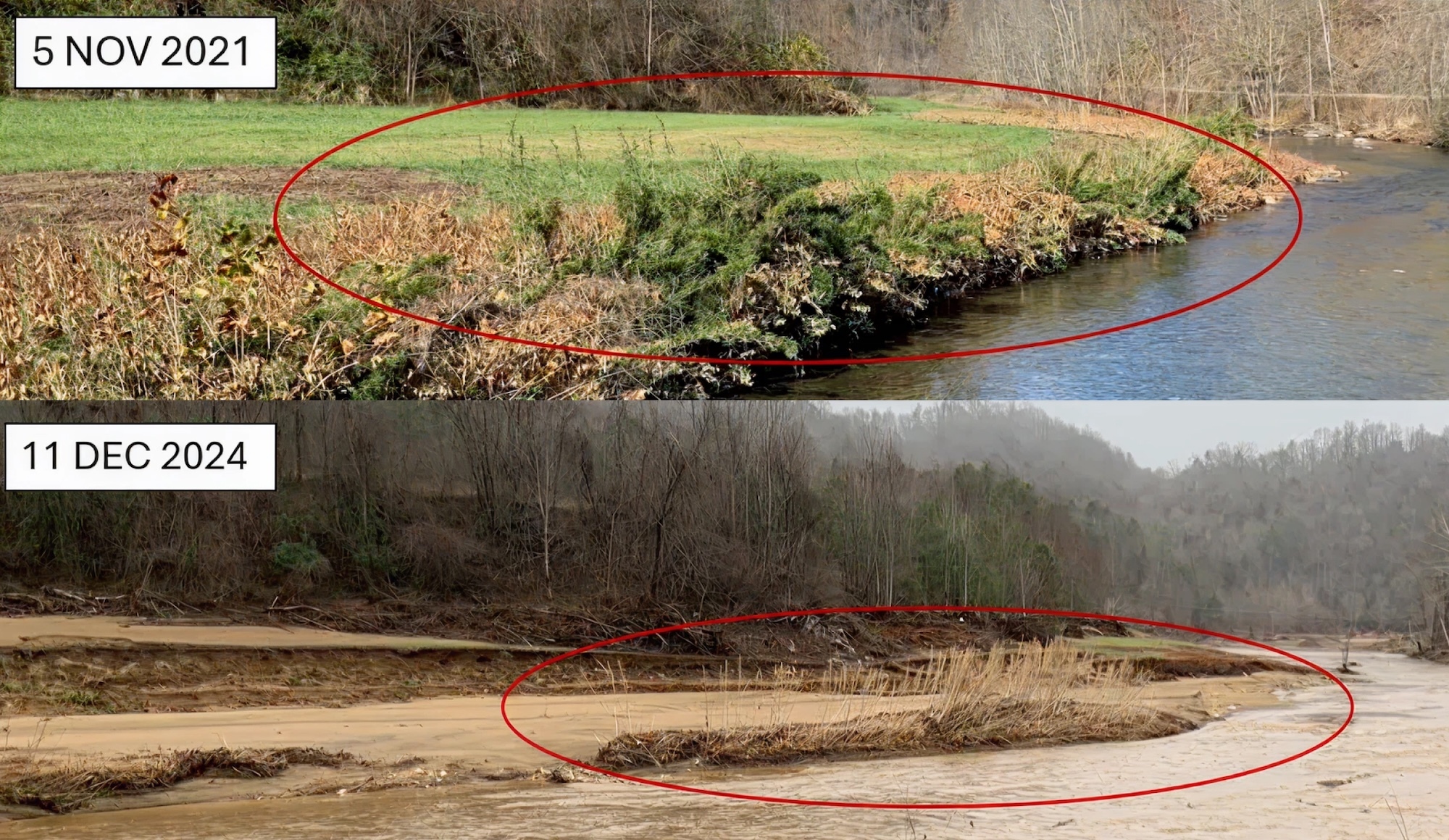
These enthusiasts are ushering in a “cane renaissance,” according to Fedoroff, who directs the University of Alabama program that hosts the Rivercane Restoration Alliance, or RRA, a network of pro-rivercane groups. The RRA and its allies are replanting rivercane where it once flourished, maintaining existing canebrakes and stands, and educating landowners and the general public on cane’s benefits. In addition to those rhizomes saving waterways from devastating erosion, rivercane also provides crucial habitat to native species, such as cane-feeding moths, and filters nitrate and other pollutants from water.
“When people grow to accept cane into their hearts, beautiful things happen,” said Fedoroff, whose team now has a $3.8 million grant from the National Fish and Wildlife Foundation to work on rivercane projects in 12 states throughout the Southeast.
Large restoration projects like this often involve collaboration with many major stakeholders: The Tuckabum Creek project, for example, looped in the RRA, the lumber and land management company Westervelt, the U.S. Army Corps of Engineers, and the Choctaw Nation of Oklahoma. Rivercane enthusiasts stressed that consulting with and including tribes is essential in returning this plant to the landscape. Not only does rivercane bring ecological benefits, it also holds a cultural role for tribes — one that’s been lost as the plant declined.
Historically, Native peoples in the Southeast used rivercane to make things like baskets, blow guns, and arrows, but nowadays, many artisans have turned to synthetic materials for these crafts, said Ryan Spring, a historian and a member of the Choctaw Nation of Oklahoma.
When Spring started his job at the tribe 14 years ago, no one knew much about rivercane ecology, he said. Now, Spring is actively involved in recentering rivercane in the cultural and ecological landscape. “We’re building up community, taking them out, teaching them ecology,” Spring said. “A lot are basket makers, and now they’re using rivercane to make baskets for the first time.”
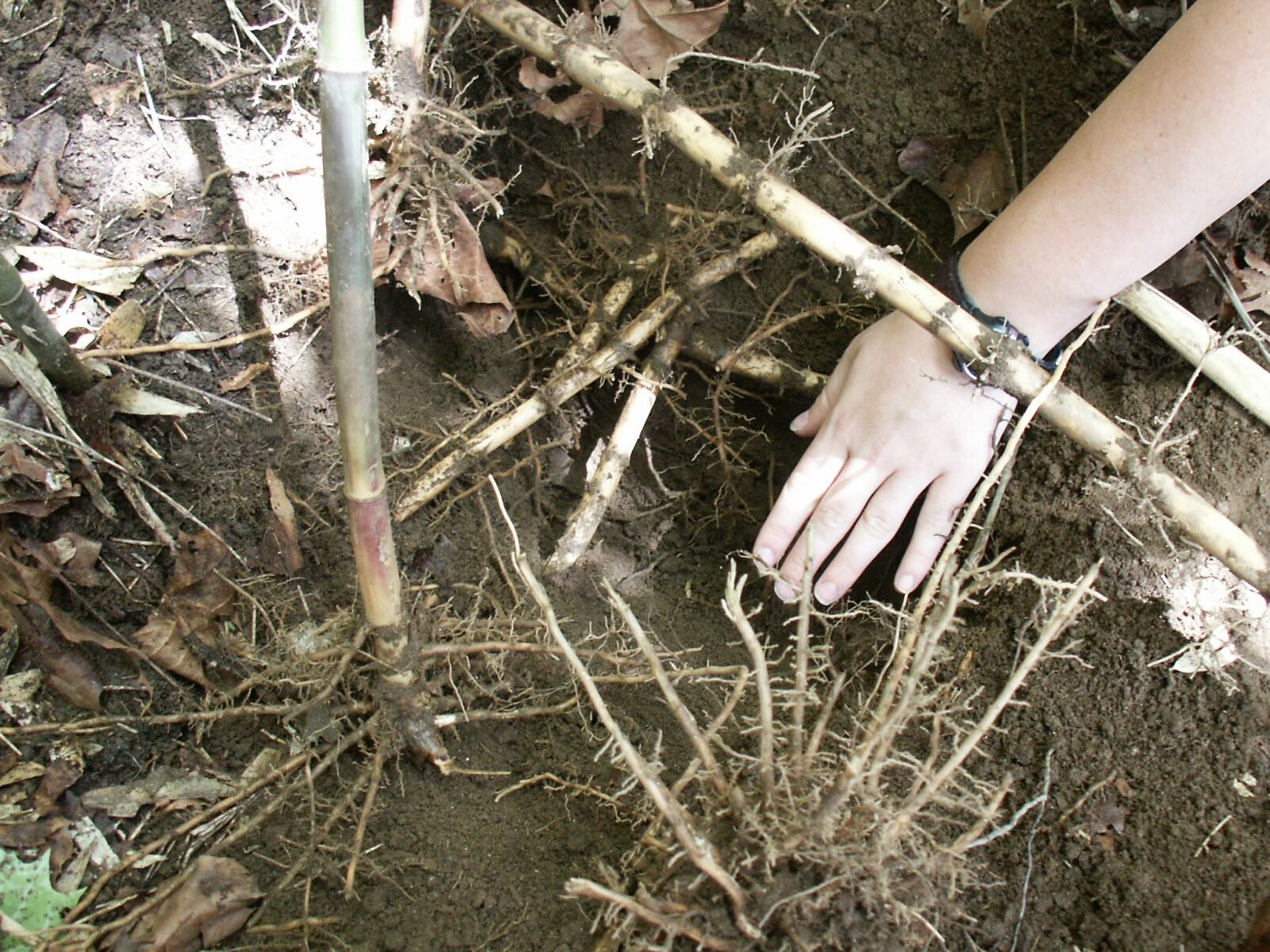
There are challenges to the dream of returning rivercane to its former prolific glory in the Southeast. One is education: For example, rivercane is often confused for invasive Chinese bamboo, which means that landowners and managers generally don’t think twice before removing it. Another barrier to restoration efforts is the cost and availability of rivercane plants. They’re not easy to find in nurseries, and can run between $50 and $60 per plant or more, according to Laura Young of the Virginia Department of Conservation and Recreation.
But Young has found a way around this problem. She does habitat and riverbank restoration in southeastern Virginia, and six years ago, she wanted to plant a canebrake along a river near the tiny town of Jonesville. The cost was prohibitive, and so Young pioneered a method now known colloquially as the “cane train.” She gathered pieces of cane rhizome, planted them in soil-filled sandwich bags, then started a canebrake with the propagated cuttings — all for $6.
Fedoroff pointed out that the cane train method has one major drawback: Different varieties of rivercane are better suited for, say, wet spots or sunny spots, so transplanting cuttings that thrived in one area could result in a bunch of dead plants in another. At his lab, researchers are working on sequencing rivercane genomes so they can compare different plants’ traits and choose the best varieties for different locations. But, Young added, while the propagation method is imperfect, it’s cheap, easy, and better than nothing. Out of the 200 plants in her initial project, 60 took off.
“Rivercane is kind of like investing,” she said. “It’s not get-rich-quick. You just need to invest time and money every year, and then it exponentially pays off.”
The cane train also offers a low-investment way for volunteers and private landowners to get involved in stabilizing stream banks. Yancey County, North Carolina, is home to numerous streams and creeks that suffered major erosion damage during Hurricane Helene. This spring, the county government, in partnership with several state and local groups, led a cadre of volunteers in a rivercane restoration project. They harvested thousands of rhizomes, contacted landowners along the county’s devastated waterways, and planted almost 700 shoots, a process they’ll repeat in 2026. “The county really showed up,” said Keira Albert, a restoration coordinator at The Beacon Network, a disaster recovery organization that helped lead the project.
That’s part of the power of a solution like planting rivercane: It’s an actionable, easy way for ordinary landowners and volunteers to heal the landscape around them. “There’s a lot of doom and gloom when we think about climate change,” Fedoroff said. “We become paralyzed. But we’re trying to take a different approach. We can’t get back to that pristine past state, but we can envision a future ecology that’s better.”
This story was originally published by Grist with the headline How a species of bamboo could help protect the South from future floods on Dec 11, 2025.