Cookies help us run our site more efficiently.

By clicking “Accept”, you agree to the storing of cookies on your device to enhance site navigation, analyze site usage, and assist in our marketing efforts. View our Privacy Policy for more information or to customize your cookie preferences.

Business With a Backbone

News Feed
Wednesday, November 12, 2025

Ulrich Eichelmann has seen many rivers over his lifetime as the head of RiverWatch, an organization dedicated to protecting the world’s waterways. He’s spent time on the Tigris floating through Turkey and Iraq, on the Tagliamento in Italy, and traveled along the Danube as it winds across Europe. Yet none, he said, have measured up to the Vjosa River. From the Greek Pindus Mountains, its rushing headwaters flow 169 miles to Albania’s Mediterranean coast, calming as it finally nears the sea.  “The river is a bit like an intact living being,” Eichelmann said. “It starts young and fast in the mountains of Greece, and it ends as an old river near the Adriatic Sea.” The Vjosa is dam-free, a rare feat in a world where the majority of rivers are confined by barriers. While hydropower dams may provide so-called “clean” energy, they also destroy ecosystems and emit methane. Fish can get trapped, unable to reach their spawning grounds, while nearby communities can be displaced. The Vjosa, however, remains one of Europe’s last free-flowing systems of water. The entire watershed is still untouched and is now likely to remain that way, thanks to a public-private coalition that created Europe’s first wild river national park in Albania — fighting dozens of planned dams along the way.  Outdoor apparel company Patagonia’s support was integral to the effort, providing both resources and advocacy that helped turn local activists’ bold vision into reality. In 2015, activists launched the Save the Blue Heart of Europe campaign to raise awareness about the environmental impacts of a Balkan hydropower boom. But the coalition needed international attention, and in 2018, Patagonia joined in, bringing much-needed funding and creativity that helped turn the campaign into a global cause. Once slated for the Kalivaç Dam, this stretch of Albania’s Vjosa River was spared when an administrative court in Tirana decided against the project in 2021. Andrew Burr Its quiet support is typical of Patagonia’s long history of environmental activism. But until now, the company has never attempted to measure its full impact — both successes and shortcomings. That’s about to change: Patagonia has just released its comprehensive “Work in Progress Report,” outlining the company’s improvements and challenges, and sharing a roadmap for others in the private sector. “Businesses created a lot of the environmental problems that we as humans are now navigating,” said Patagonia’s CEO, Ryan Gellert. “We’ve got an outsized responsibility to do something about it.” Gellert recognizes the paradox of a company fighting for a healthier planet while also selling consumers products they may not need. “I can sit here and make an argument that we should grow as fast as we can so we have more money to give away,” he said. Conversely, as a producer of apparel that requires fossil fuels, he sees the argument that “the best we could do for the planet is shut down.” The truth, he said, lies somewhere in between. Spelling out these nuances — and how to prove business can be a positive force for change — is what the company hopes to tease out in its 134-page report.  Patagonia’s environmental activism began close to home in Ventura, California, where it awarded its first grant in 1973 to Friends of Ventura River, even offering the group office space at its nearby headquarters. “We’ve got a really long history on river protection,” Gellert noted. When plans to divert the nearby Ventura River threatened both its health and the surf break at its mouth, Patagonia employees began showing up at council meetings. The experience taught them that they could shape local conservation decisions — and that rivers knit together the entire ecosystem of a community. That led to the company’s 1985 “Earth Tax,” which set aside one percent of all sales for grassroots environmental groups — a model that later helped inspire the “1% for the Planet” movement.  Patagonia’s work has grown to include causes around the globe — from defending the Tarkine rainforest in Tasmania in 2018 to helping add five new marine protected areas to Korea in 2023. The company also encourages its own employees to volunteer and attend non-violent direct action training, as well as covering their bail. Though this approach alienates some customers, it has become a central part of the company’s ethos.  The company has expanded its grants program with the Holdfast Collective, a collection of nonprofit trusts that now own 98 percent of Patagonia. It uses every dollar received to protect nature and advocate for causes and candidates that put the planet first. Its goal is to distribute company profits to causes like saving the Vjosa, which it has contributed nearly $5 million dollars to since 2023.  After its European team raised alarm over the Vjosa’s future, the company helped produce two films, as well as financially supported the Save the Blue Heart campaign. They launched a petition that drew international attention, including from celebrities such as Leonardo DiCaprio. Simultaneously, the company decided to also give money to the Albanian government, allowing them to back grassroots advocacy while also helping shape policy decisions. The result of this symbiosis was the government’s 2023 announcement of the Vjosa Wild River National Park.  Albanian Minister for culture and environment, Mirela Kumbaro, and Patagonia CEO Ryan Gellert sign a Memorandum of Understanding for the creation of the Vjosa National Park, on June 13, 2022 in Tirana, Albania. Nick St. Oegger This victory, Gellert said, shows the power of Patagonia’s lead-from-behind ethos. He remembers the team’s first visit to the river almost 10 years ago. They spent their first night camping along the riverbank, before taking the next few days to raft the rapids and participate in a local protest. At the time, Gellert wasn’t confident they could save the river: Finding a way to engage with political leaders took patience and years of dialogue, particularly as Albania faced contested elections. Gellert met with Albanian Prime Minister Edi Rama in person several times to discuss the Vjosa’s future, serving as a mediator between local advocates and the government.  Engaging with communities along the Vjosa was also key to keeping dams away, explained Olsi Nika, executive director of EcoAlbania, a coalition member organization. The river is home to some 100,00 people, who rely on it for fishing, agriculture and cultural traditions, as well as over a thousand species. With Patagonia’s help, EcoAlbania brought together residents, artists, scientists, and lawyers to build a successful front against dam construction, resulting in Albania’s first-ever environmental lawsuit.  The courts ultimately ruled in its favor, blocking a dam and setting an important legal precedent. Nika — who, along with his collaborator Besjana Guri, won a Goldman Prize award for their advocacy for the river this year — said that victory opens the door for future lawsuits. “We are following dozens of open cases in the court to oppose the construction of hydropower.” Patagonia’s role, which has since been formalized through a memorandum with the government, remains crucial. Two years after the Vjosa was designated a national park. pressures on the local water supply are mounting as developers race to build resorts and accommodations just outside its borders, said Besjana Guri, who recently left EcoAlbania to found a nonprofit focusing on empowering women and youth. “Now, we might have small threats,” Guri said, “but if they are not managed well and if the people are not totally aware, they can become big threats.” Besjana Guri along a stretch of the Vjosa River in Albania. Nick St. Oegger The country has approved a 10-year plan to manage the park’s more than 31,000 acres, said Daniel Pirushi, who handles environmental policy and development for the Albanian Ministry of Tourism and Environment. Visitors will be strictly zoned to specific areas. Sensitive river sections will have limits on how many out-of-towners can arrive. The government is also working to improve wastewater systems for rural communities along the Vjosa Basin to address pollution. In December, the government established a formal office to help with the park’s enforcement and environmental oversight. A visitor center is planned to feature local exhibitions and activities that would improve public awareness of how special the ecosystem is. “The establishment of a national park, especially one of this scale and complexity, cannot be achieved overnight,” Pirushi wrote in an email. “The protection of the Vjosa is not a symbolic act but a concrete, evolving process grounded in science, policy, and partnership.” Working together, Patagonia has learned, is what makes these kinds of lasting environmental protections possible. After achieving a turning point for the Vjosa campaign, the company is looking to inspire other businesses, especially outdoor companies, whose work is closely tied to the Earth’s health. As Alison Huyett, a senior strategist at Patagonia who led the report, said, the goal is to show business audiences “activism doesn’t have to be scary.” We’re in business to save our home planet. Founded by Yvon Chouinard in 1973, Patagonia is an outdoor apparel company based in Ventura, California. As a certified B Corporation and a founding member of 1% for the Planet, the company is recognized internationally for its product quality and environmental activism, as well as its contributions of more than $230 million to environmental organizations. Its unique ownership structure reflects that Earth is its only shareholder: Profits not reinvested back into the business are paid as dividends to protect the planet. LEARN MORE This story was originally published by Grist with the headline Business With a Backbone on Nov 12, 2025.

Patagonia’s new report highlights how the company acts as a connector, working with local communities and governments to build a global community to protect wild places.

Ulrich Eichelmann has seen many rivers over his lifetime as the head of RiverWatch, an organization dedicated to protecting the world’s waterways. He’s spent time on the Tigris floating through Turkey and Iraq, on the Tagliamento in Italy, and traveled along the Danube as it winds across Europe. Yet none, he said, have measured up to the Vjosa River. From the Greek Pindus Mountains, its rushing headwaters flow 169 miles to Albania’s Mediterranean coast, calming as it finally nears the sea. 

“The river is a bit like an intact living being,” Eichelmann said. “It starts young and fast in the mountains of Greece, and it ends as an old river near the Adriatic Sea.”

The Vjosa is dam-free, a rare feat in a world where the majority of rivers are confined by barriers. While hydropower dams may provide so-called “clean” energy, they also destroy ecosystems and emit methane. Fish can get trapped, unable to reach their spawning grounds, while nearby communities can be displaced. The Vjosa, however, remains one of Europe’s last free-flowing systems of water. The entire watershed is still untouched and is now likely to remain that way, thanks to a public-private coalition that created Europe’s first wild river national park in Albania — fighting dozens of planned dams along the way. 

Outdoor apparel company Patagonia’s support was integral to the effort, providing both resources and advocacy that helped turn local activists’ bold vision into reality. In 2015, activists launched the Save the Blue Heart of Europe campaign to raise awareness about the environmental impacts of a Balkan hydropower boom. But the coalition needed international attention, and in 2018, Patagonia joined in, bringing much-needed funding and creativity that helped turn the campaign into a global cause.
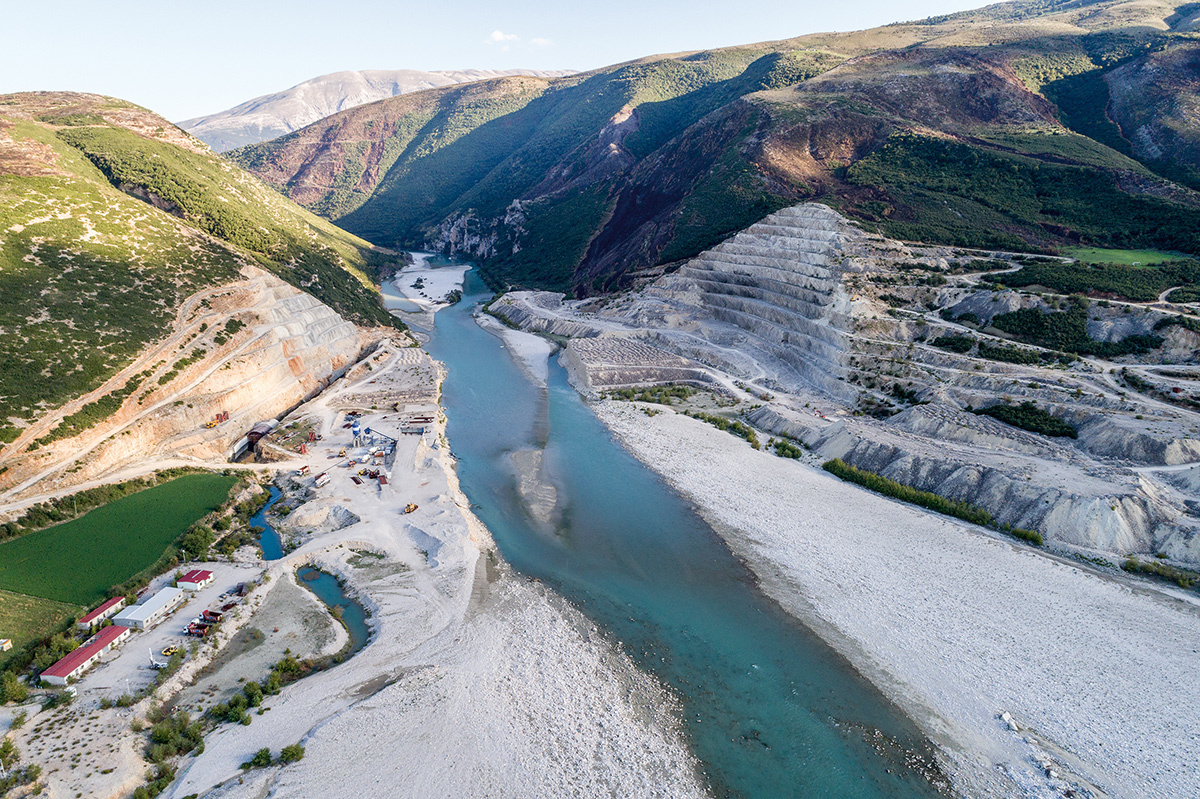
Once slated for the Kalivaç Dam, this stretch of Albania’s Vjosa River was spared when an administrative court in Tirana decided against the project in 2021.
Andrew Burr

Its quiet support is typical of Patagonia’s long history of environmental activism. But until now, the company has never attempted to measure its full impact — both successes and shortcomings. That’s about to change: Patagonia has just released its comprehensive “Work in Progress Report,” outlining the company’s improvements and challenges, and sharing a roadmap for others in the private sector. “Businesses created a lot of the environmental problems that we as humans are now navigating,” said Patagonia’s CEO, Ryan Gellert. “We’ve got an outsized responsibility to do something about it.”

Gellert recognizes the paradox of a company fighting for a healthier planet while also selling consumers products they may not need. “I can sit here and make an argument that we should grow as fast as we can so we have more money to give away,” he said. Conversely, as a producer of apparel that requires fossil fuels, he sees the argument that “the best we could do for the planet is shut down.” The truth, he said, lies somewhere in between. Spelling out these nuances — and how to prove business can be a positive force for change — is what the company hopes to tease out in its 134-page report

Patagonia’s environmental activism began close to home in Ventura, California, where it awarded its first grant in 1973 to Friends of Ventura River, even offering the group office space at its nearby headquarters. “We’ve got a really long history on river protection,” Gellert noted. When plans to divert the nearby Ventura River threatened both its health and the surf break at its mouth, Patagonia employees began showing up at council meetings. The experience taught them that they could shape local conservation decisions — and that rivers knit together the entire ecosystem of a community. That led to the company’s 1985 “Earth Tax,” which set aside one percent of all sales for grassroots environmental groups — a model that later helped inspire the “1% for the Planet” movement. 

Patagonia’s work has grown to include causes around the globe — from defending the Tarkine rainforest in Tasmania in 2018 to helping add five new marine protected areas to Korea in 2023. The company also encourages its own employees to volunteer and attend non-violent direct action training, as well as covering their bail. Though this approach alienates some customers, it has become a central part of the company’s ethos. 

The company has expanded its grants program with the Holdfast Collective, a collection of nonprofit trusts that now own 98 percent of Patagonia. It uses every dollar received to protect nature and advocate for causes and candidates that put the planet first. Its goal is to distribute company profits to causes like saving the Vjosa, which it has contributed nearly $5 million dollars to since 2023. 

After its European team raised alarm over the Vjosa’s future, the company helped produce two films, as well as financially supported the Save the Blue Heart campaign. They launched a petition that drew international attention, including from celebrities such as Leonardo DiCaprio. Simultaneously, the company decided to also give money to the Albanian government, allowing them to back grassroots advocacy while also helping shape policy decisions. The result of this symbiosis was the government’s 2023 announcement of the Vjosa Wild River National Park. 
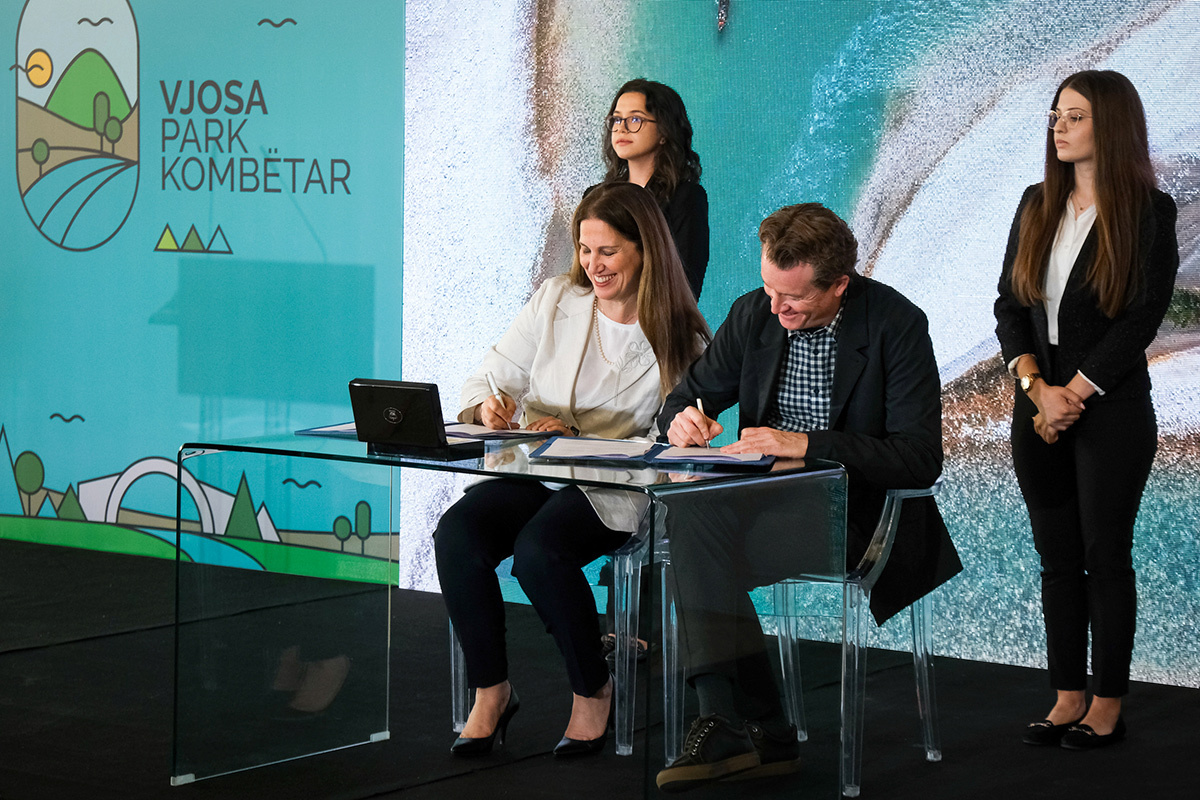
Albanian Minister for culture and environment, Mirela Kumbaro, and Patagonia CEO Ryan Gellert sign a Memorandum of Understanding for the creation of the Vjosa National Park, on June 13, 2022 in Tirana, Albania.
Nick St. Oegger

This victory, Gellert said, shows the power of Patagonia’s lead-from-behind ethos. He remembers the team’s first visit to the river almost 10 years ago. They spent their first night camping along the riverbank, before taking the next few days to raft the rapids and participate in a local protest. At the time, Gellert wasn’t confident they could save the river: Finding a way to engage with political leaders took patience and years of dialogue, particularly as Albania faced contested elections. Gellert met with Albanian Prime Minister Edi Rama in person several times to discuss the Vjosa’s future, serving as a mediator between local advocates and the government. 

Engaging with communities along the Vjosa was also key to keeping dams away, explained Olsi Nika, executive director of EcoAlbania, a coalition member organization. The river is home to some 100,00 people, who rely on it for fishing, agriculture and cultural traditions, as well as over a thousand species. With Patagonia’s help, EcoAlbania brought together residents, artists, scientists, and lawyers to build a successful front against dam construction, resulting in Albania’s first-ever environmental lawsuit

The courts ultimately ruled in its favor, blocking a dam and setting an important legal precedent. Nika — who, along with his collaborator Besjana Guri, won a Goldman Prize award for their advocacy for the river this year — said that victory opens the door for future lawsuits. “We are following dozens of open cases in the court to oppose the construction of hydropower.”

Patagonia’s role, which has since been formalized through a memorandum with the government, remains crucial. Two years after the Vjosa was designated a national park. pressures on the local water supply are mounting as developers race to build resorts and accommodations just outside its borders, said Besjana Guri, who recently left EcoAlbania to found a nonprofit focusing on empowering women and youth. “Now, we might have small threats,” Guri said, “but if they are not managed well and if the people are not totally aware, they can become big threats.”
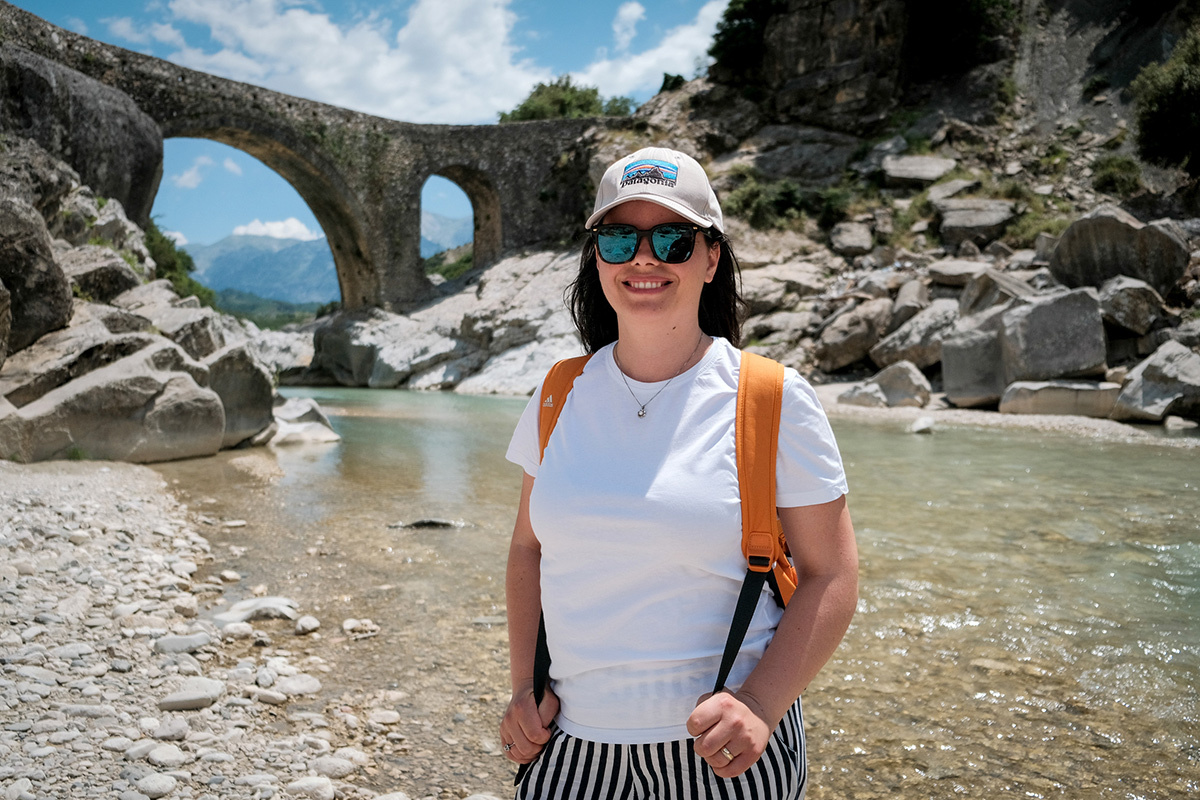
Vjosa river
Besjana Guri along a stretch of the Vjosa River in Albania.
Nick St. Oegger

The country has approved a 10-year plan to manage the park’s more than 31,000 acres, said Daniel Pirushi, who handles environmental policy and development for the Albanian Ministry of Tourism and Environment. Visitors will be strictly zoned to specific areas. Sensitive river sections will have limits on how many out-of-towners can arrive. The government is also working to improve wastewater systems for rural communities along the Vjosa Basin to address pollution.

In December, the government established a formal office to help with the park’s enforcement and environmental oversight. A visitor center is planned to feature local exhibitions and activities that would improve public awareness of how special the ecosystem is. “The establishment of a national park, especially one of this scale and complexity, cannot be achieved overnight,” Pirushi wrote in an email. “The protection of the Vjosa is not a symbolic act but a concrete, evolving process grounded in science, policy, and partnership.”

Working together, Patagonia has learned, is what makes these kinds of lasting environmental protections possible. After achieving a turning point for the Vjosa campaign, the company is looking to inspire other businesses, especially outdoor companies, whose work is closely tied to the Earth’s health. As Alison Huyett, a senior strategist at Patagonia who led the report, said, the goal is to show business audiences “activism doesn’t have to be scary.”


We’re in business to save our home planet. Founded by Yvon Chouinard in 1973, Patagonia is an outdoor apparel company based in Ventura, California. As a certified B Corporation and a founding member of 1% for the Planet, the company is recognized internationally for its product quality and environmental activism, as well as its contributions of more than $230 million to environmental organizations. Its unique ownership structure reflects that Earth is its only shareholder: Profits not reinvested back into the business are paid as dividends to protect the planet.

This story was originally published by Grist with the headline Business With a Backbone on Nov 12, 2025.

Read the full story here.
Photos courtesy of

OpenAI’s Secrets are Revealed in Empire of AI

On our 2025 Best Nonfiction of the Year list, Karen Hao’s investigation of artificial intelligence reveals how the AI future is still in our hands

Technology reporter Karen Hao started reporting on artificial intelligence in 2018, before ChatGPT was introduced, and is one of the few journalists to gain access to the inner world of the chatbot’s creator, OpenAI. In her book Empire of AI, Hao outlines the rise of the controversial company.In her research, Hao spoke to OpenAI leaders, scientists and entry-level workers around the globe who are shaping the development of AI. She explores its potential for scientific discovery and its impacts on the environment, as well as the divisive quest to create a machine that can rival human smarts through artificial general intelligence (AGI).Scientific American spoke with Hao about her deep reporting on AI, Sam Altman’s potential place in AI’s future and the ways the technology might continue to change the world.On supporting science journalismIf you're enjoying this article, consider supporting our award-winning journalism by subscribing. By purchasing a subscription you are helping to ensure the future of impactful stories about the discoveries and ideas shaping our world today.[An edited transcript of the interview follows.]How realistic is the goal of artificial general intelligence (AGI)?There is no scientific consensus around what intelligence is, so AI and AGI are inherently unmoored concepts. This is helpful for deflating the hype of Silicon Valley when they say AGI is around the corner, and it’s also helpful in recognizing that the lack of predetermination around what AI is and what it should do leaves plenty of room for everyone.You argue that we should be thinking about AI in terms of empires and colonialism. Can you explain why?I call companies like OpenAI empires both because of the sheer magnitude at which they are operating and the controlling influence they’ve developed—also the tactics for how they’ve accumulated an enormous amount of economic and political power. They amass that power through the dispossession of the majority of the rest of the world.There’s also this huge ideological component to the current AI industry. This quest for an artificial general intelligence is a faith-based idea. It's not a scientific idea. It is this quasi-religious notion that if we continue down a particular path of AI development, somehow a kind of AI god is going to emerge that will solve all of humanity's problems. Colonialism is the fusion of capitalism and ideology, so there’s just a multitude of parallels between the empires of old and the empires of AI.There’s also a parallel in how they both cause environmental destruction. Which environmental impacts of AI are most concerning?There are just so many intersecting crises that the AI industry’s path of development is exacerbating. One, of course, is the energy crisis. Sam Altman announced he wants to see 250 gigawatts of data-center capacity laid by 2033 just for his company. New York City [uses] on average 5.5 gigawatts [per day]. Altman has estimated that this would cost around $10 trillion —where is he going to get that money? Who knows.But if that were to come to pass, the primary energy sources would be fossil fuels. Business Insider had an investigation earlier this year that found that utilities are “torpedo[ing]” their renewable-energy goals in order to service the data-center demand. So we are seeing natural gas plants and coal plants having their lives extended. That’s not just pumping emissions into the atmosphere; it’s also pumping air pollution into communities.So the question is: How long are we going to deal with the actual harms and hold out for the speculative possibility that maybe, at the end of the road, it’s all going to be fine? There was a survey earlier this year that found that [roughly] 75 percent of long-standing AI researchers who are not in the pocket of industry do not think we are on the path to an artificial general intelligence. We should not be using a tiny possibility on the far-off horizon that is not even scientifically backed to justify an extraordinary and irreversible set of damages that are occurring right now.Do you think Sam Altman has lied about OpenAI’s abilities, or has he just fallen for his own marketing?It’s a great question. The thing that’s complex about OpenAI, that surprised me the most when I was reporting, is that there are quasi-religious movements that have developed around ideas like “AGI could solve all of humanity’s problems” or “AGI could kill everyone.” It is really hard to figure out whether Altman himself is a believer or whether he has just found it to be politically savvy to leverage these beliefs.You did a lot of reporting on the workers helping to make this AI revolution happen. What did you find?I traveled to Kenya to meet with workers that OpenAI had contracted, as well as workers being contracted by the rest of the AI industry. What OpenAI wanted them to do was to help build a content moderation filter for the company’s GPT models. At the time they were trying to expand their commercialization efforts, and they realized that if you put text-generation models that can generate anything into the hands of millions of people, you’re going to come up with a problem because it could end up spewing racist, toxic hate speech at users, and it would become a huge PR crisis.For the workers, that meant they had to wade through some of the worst content on the Internet, as well as content where OpenAI was prompting its own AI models to imagine the worst content on the Internet to provide a more diverse and comprehensive set of examples to these workers. These workers suffered the same kinds of psychological traumas that content moderators of the social media era suffered.I also spoke with the workers that were on a different part of the human labor supply chain in reinforcement learning from human feedback. This is a thing that many companies have adopted where tens of thousands of workers have to teach the model what is a good answer when a user chats with the chatbot.One woman I spoke to, Winnie, worked for this platform called Remotasks, which is the backend for Scale AI, one of the primary contractors of reinforcement learning from human feedback. The content that she was working with was not necessarily traumatic in and of itself, but the conditions under which she was working were deeply exploitative: she never knew who she was working for, and she also never knew when the tasks would arrive. When I spoke to her, she had already been waiting months for a task to arrive, and when those tasks arrived, she would work for 22 hours straight in a day to just try and earn as much money as possible to ultimately feed her kids.This is the lifeblood of the AI industry, and yet these workers see absolutely none of the economic value that they’re generating for these companies.Some people worry AI could surpass human intelligence and take over the world. Is this a risk you fear?I don’t believe that AI will ultimately develop some kind of agency of its own, and I don’t think that it’s worth engaging in a project that is attempting to develop agentic systems that take agency away from people.What I see as a much more hopeful vision of an AI future is returning back to developing AI models and AI systems that support, rather than supplant, humans. And one of the things that I’m really bullish about is specialized AI models for solving particular challenges that we need to overcome as a society.One of the examples that I often give is of DeepMind’s AlphaFold, which is also a specialized deep-learning tool that was trained on a relatively modest number of computer chips to accurately predict the protein-folding structures from a sequence of amino acids. [Its developers] won the Nobel Prize [in] Chemistry last year. These are the types of AI systems that I think we should be putting our energy, time and talent into building.Are there other books on this subject you read while writing this book or have enjoyed recently that you can recommend to me?I’d recommend Rebecca Solnit’s Hope in the Dark, which I read after my book published. It may not seem directly related, but it very much is. Solnit makes the case for human agency—she urges people to remember that we co-create the future through our individual and collective action. That is also the greatest message I want people to take away from my book. Empires of AI are not inevitable—and the alternative path forward is in our hands.

Costa Rica’s Nayara Resorts Plans Eco-Friendly Beach Hotel in Manuel Antonio

Nayara Resorts, known for its high-end hotels and focus on green practices, has revealed plans for a new property in Manuel Antonio. The beach resort aims to open in mid- to late 2027 and will create about 300 direct jobs. For those familiar with the area, the site sits where the Barba Roja restaurant once […] The post Costa Rica’s Nayara Resorts Plans Eco-Friendly Beach Hotel in Manuel Antonio appeared first on The Tico Times | Costa Rica News | Travel | Real Estate.

Nayara Resorts, known for its high-end hotels and focus on green practices, has revealed plans for a new property in Manuel Antonio. The beach resort aims to open in mid- to late 2027 and will create about 300 direct jobs. For those familiar with the area, the site sits where the Barba Roja restaurant once stood. Nayara bought the land and has woven environmental standards into every step of design and planning. Blake May, the project director, noted that the company holds all required permits and has worked with authorities to meet rules on protected zones and coastal setbacks. Construction will blend with the surroundings, keeping trees, palms, and bamboo in the layout. Rooms will use natural airflow to cut down on air conditioning. Bars will have plant-covered roofs to lower emissions and clean the air. The resort will also run its own system to turn wastewater into reusable water for gardens. Before any building starts, Nayara hired a soil expert to protect the ground during demolition. Trees on the property get special attention too. The team is studying species to decide which stay in place and which move elsewhere for safety. This fits Nayara’s track record, like at their Tented Camp in La Fortuna, where they turned old pasture into forest by planting over 40,000 native trees and plants. Beyond the environment, Nayara commits to local people. They plan to share updates on progress, hire from the area for building and running the hotel, and buy from nearby businesses. Demolition of the old restaurant is in progress, with full construction set to begin early next year. This move grows Nayara’s footprint in Costa Rica, where they already run three spots in La Fortuna: Gardens, Springs, and Tented Camp. The new hotel marks their first push into the Pacific coast, drawing on their model of luxury tied to nature. Locals in the area, see promise in the jobs and tourism boost, as Manuel Antonio draws visitors for its parks and beaches. Nayara’s approach could set an example for other developments in the area. The post Costa Rica’s Nayara Resorts Plans Eco-Friendly Beach Hotel in Manuel Antonio appeared first on The Tico Times | Costa Rica News | Travel | Real Estate.

In Colorado Town Built on Coal, Some Families Are Moving On, Even as Trump Tries to Boost Industry

The Cooper family has worked in the coal industry in Colorado for generations

CRAIG, Colo. (AP) — The Cooper family knows how to work heavy machinery. The kids could run a hay baler by their early teens, and two of the three ran monster-sized drills at the coal mines along with their dad.But learning to maneuver the shiny red drill they use to tap into underground heat feels different. It's a critical part of the new family business, High Altitude Geothermal, which installs geothermal heat pumps that use the Earth’s constant temperature to heat and cool buildings. At stake is not just their livelihood but a century-long family legacy of producing energy in Moffat County.Like many families here, the Coopers have worked in coal for generations — and in oil before that. That's ending for Matt Cooper and his son Matthew as one of three coal mines in the area closes in a statewide shift to cleaner energy. “People have to start looking beyond coal," said Matt Cooper. "And that can be a multitude of things. Our economy has been so focused on coal and coal-fired power plants. And we need the diversity.” Many countries and about half of U.S. states are moving away from coal, citing environmental impacts and high costs. Burning coal emits carbon dioxide that traps heat in the atmosphere, warming the planet.That's created uncertainty in places like Craig. As some families like the Coopers plan for the next stage of their careers, others hold out hope Trump will save their plants, mines and high-paying jobs. Matt and Matthew Cooper work at the Colowyo Mine near Meeker, though active mining has ended and site cleanup begins in January.The mine employs about 130 workers and supplies Craig Generating Station, a 1,400-megawatt coal-fired plant. Tri-State Generation and Transmission Association is planning to close Craig's Unit 1 by year's end for economic reasons and to meet legal requirements for reducing emissions. The other two units will close in 2028.Xcel Energy owns coal-fired Hayden Station, about 30 minutes away. It said it doesn't plan to change retirement dates for Hayden, though it's extending another coal unit in Pueblo in part due to increased demand for electricity.The Craig and Hayden plants together employ about 200 people.Craig residents have always been entrepreneurial and that spirit will get them through this transition, said Kirstie McPherson, board president for the Craig Chamber of Commerce. Still, she said, just about everybody here is connected to coal.“You have a whole community who has always been told you are an energy town, you’re a coal town," she said. “When that starts going away, beyond just the individuals that are having the identity crisis, you have an entire culture, an entire community that is also having that same crisis.”Coal has been central to Colorado’s economy since before statehood, but it's generally the most expensive energy on today's grid, said Democratic Gov. Jared Polis.“We are not going to let this administration drag us backwards into an overreliance on expensive fossil fuels,” Polis said in a statement. Nationwide, coal power was 28% more expensive in 2024 than it was in 2021, costing consumers $6.2 billion more, according to a June analysis from Energy Innovation. The nonpartisan think tank cited significant increases to run aging plants as well as inflation.Colorado’s six remaining coal-fired power plants are scheduled to close or convert to natural gas, which emits about half the carbon dioxide as coal, by 2031. The state is rapidly adding solar and wind that's cheaper and cleaner than legacy coal plants. Renewable energy provides more than 40% of Colorado’s power now and will pass 70% by the end of the decade, according to statewide utility plans.Nationwide, wind and solar growth has remained strong, producing more electricity than coal in 2025, as of the latest data in October, according to energy think tank Ember.But some states want to increase or at least maintain coal production. That includes top coal state Wyoming, where the Wyoming Energy Authority said Trump is breathing welcome new life into its coal and mining industry.The Coopers have gone all-in on geothermal. “Maybe we’ll never go back to coal," Matt Cooper said. "We haven’t (gone) back to oil and gas, so we might just be geothermal people for quite some time, maybe generations, and then eventually something else will come along.”While the Coopers were learning to use their drill in October, Wade Gerber was in downtown Craig distilling grain neutral spirits — used to make gin and vodka — on a day off from the Craig Station power plant. Gerber stepped over his corgis, Ali and Boss, and onto a stepladder to peer into a massive stainless steel pot where he was heating wheat and barley.Gerber's spent three decades in coal. When closure plans were announced four years ago, he, his wife Tenniel and their friend McPherson brainstormed business ideas.“With my background in plumbing and electrical from the plant it’s like, oh yeah, I can handle that part of it,” Gerber said about distilling. “This is the easy part.”He used Tri-State's education subsidies for classes in distilling, while other co-workers learned to fix vehicles or repair guns to find new careers. While some plan to leave town, Gerber is opening Bad Alibi Distillery. McPherson and Tenniel Gerber are opening a cocktail bar next door.Everyone in town hopes Trump will step in to extend the plant's life, Gerber said. Meanwhile, they're trying to define a new future for Craig in a nerve-wracking time.“For me, my products can go elsewhere. I don’t necessarily have to sell it in Craig, there’s that avenue. For someone relying on Craig, it's even scarier,” he said. Questioning the coal rollback Tammy Villard owns a gift shop, Moffat Mercantile, with her husband. After the coal closures were announced, they opened a commercial print shop too, seeing it as a practical choice for when so many high-paying jobs go away. Villard, who spent a decade at Colowyo as administrative staff, said she doesn't understand how the state can throw the switch to turn off coal and still have reliable electricity. She wants the state to slow down. Villard describes herself as a moderate Republican. She said political swings at the federal level — from the green energy push in the last administration to doubling down on fossil fuels in this one — aren't helpful.“The pendulum has to come back to the middle," she said, “and we are so far out to either side that I don’t know how we get back to that middle.”The Associated Press’ climate and environmental coverage receives financial support from multiple private foundations. AP is solely responsible for all content. Find AP’s standards for working with philanthropies, a list of supporters and funded coverage areas at AP.org.Copyright 2025 The Associated Press. All rights reserved. This material may not be published, broadcast, rewritten or redistributed.Photos You Should See – Nov. 2025

1803 Fund unveils renderings of $70 million investment for Portland’s Black community

Initial site work, including permitting, is expected to take roughly two years, with construction scheduled to take another two years after that.

The 1803 Fund, an organization working to advance Portland’s Black community, unveiled new renderings Tuesday for a combined ten acres it purchased on the banks of the Willamette River near the Moda Center and in the lower Albina neighborhood.The organization, formed in 2023 with a $400 million pledge from Nike co-founder Phil Knight and wife Penny Knight, said last month it was spending $70 million on several Eastside properties. It said the redevelopment of those sites would have a tenfold economic impact via the hundreds of local jobs it expects to generate. The total projected outlay for the redevelopment remains unclear.Project leaders say they expect initial site work for what they’re calling Rebuild Albina, including permitting, to take roughly two years, with construction scheduled to take another two years after that.At a Tuesday press conference, organization leaders detailed plans for two sites: a set of grain silos on three acres formerly owned by the Louis Dreyfus Co. and now called Albina Riverside; and a seven-acre property in the lower Albina neighborhood south of the Fremont Bridge and west of Interstate 5, in a district once known as The Low End.“We intend to give that name back to the community,” Rukaiyah Adams, chief executive of the 1803 Fund, said Tuesday of The Low End district, as a carousel of renderings flashed on a wide screen behind her.The group has said it wants to see those seven acres become a neighborhood gateway that connects the Black community to downtown. The Low End is slated to become a mixed-use neighborhood with housing and public spaces with art, businesses, culture and community initiatives, according to a factsheet provided by the 1803 Fund, while plans for Albina Riverside are still in the works. Still, the Albina Riverside renderings show a reuse of the grain silos, a basketball court and what appear to be community-access steps down to the waterfront.Properties in The Low End require environmental cleanup, which project officials say they are coordinating with the Oregon Department of Environmental Quality. It’s not clear at this point what environmental remediation the Albina Riverside site may need, officials said.On Tuesday, project leaders said $30 million went toward properties in The Low End, while they spent $5 million on Albina Riverside. Another $35 million in Albina-area property investments are forthcoming, according to the factsheet.Mayor Keith Wilson and City Council member Loretta Smith took turns at the lectern heaping praise on Adams for her leadership of the fund.Wilson said he was committed to supporting the 1803 Fund’s “transformational projects” as the redevelopment of Albina bolsters Portland’s broader renaissance. “I keep wanting to cry every time I look at you, Rukaiyah,” the mayor said. “It’s personal for me, and I know it is for you, as well.”Smith told attendees that whenever she travels to another city, there’s a district called The Low End where members of the Black community live and gather.“It had a stigma to it, and it does have a stigma to it,” Smith said. “Now you’re taking that stigma away and saying, come on down to Albina to The Low End. It’s a cool thing to do. So thank you very much for giving us back that history and that culture.”Retaking the stage, Adams said part of what prompted the purchase of the grain silo was stories she heard years ago from former state Sen. Avel Gordly – the first Black woman sworn into the Oregon Senate – of Black men who used to work and died in the silos.Gordly implored Adams to take more of a leadership role in helping to clean up the Willamette, Adams said. “The connection of Black folks who migrated here from watersheds in the Jim Crow South to that Willamette River watershed is deep and spiritual,” Adams said. “My family left the Red River watershed in Louisiana to come to the Willamette River watershed here. “Our stories are often told as the movement between cities, but we are a people deeply connected to the water,” she said. “We wade in the water.”--Matthew Kish contributed to this article.

Colorado mandates ambitious emissions cuts for its gas utilities

Colorado just set a major new climate goal for the companies that supply homes and businesses with fossil gas. By 2035, investor-owned gas utilities must cut carbon pollution by 41% from 2015 levels, the Colorado Public Utilities Commission decided in a 2–1 vote in mid-November. The target — which builds on goals…

Colorado just set a major new climate goal for the companies that supply homes and businesses with fossil gas. By 2035, investor-owned gas utilities must cut carbon pollution by 41% from 2015 levels, the Colorado Public Utilities Commission decided in a 2–1 vote in mid-November. The target — which builds on goals already set for 2025 and 2030 — is far more consistent with the state’s aim to decarbonize by 2050 than the other proposals considered. Commissioners rejected the tepid 22% to 30% cut that utilities asked for and the 31% target that state agencies recommended. Climate advocates hailed the decision as a victory for managing a transition away from burning fossil gas in Colorado buildings. “It’s a really huge deal,” said Jim Dennison, staff attorney at the Sierra Club, one of more than 20 environmental groups that advocated for an ambitious target. ​“It’s one of the strongest commitments to tangible progress that’s been made anywhere in the country.” In 2021, Colorado passed a first-in-the-nation law requiring gas utilities to find ways to deliver heat sans the emissions. That could entail swapping gas for alternative fuels, like methane from manure or hydrogen made with renewable power. But last year the utilities commission found that the most cost-effective approaches are weatherizing buildings and outfitting them with all-electric, ultraefficient appliances such as heat pumps. These double-duty devices keep homes toasty in winter and cool in summer. The clean-heat law pushes utilities to cut emissions by 4% from 2015 levels by 2025 and then 22% by 2030. But Colorado leaves exact targets for future years up to the Public Utilities Commission. Last month’s decision on the 2035 standard marks the first time that regulators have taken up that task. Gas is still a fixture in the Centennial State. About seven out of 10 Colorado households burn the fossil fuel as their primary source for heating, which accounts for about 31% of the state’s gas use. If gas utilities hit the new 2035 mandate, they’ll avoid an estimated 45.5 million metric tons of greenhouse gases over the next decade, according to an analysis by the Colorado Energy Office and the Colorado Department of Public Health and Environment. They’d also prevent the release of hundreds more tons of nitrogen oxides and ultrafine particulates that cause respiratory and cardiovascular problems, from asthma to heart attacks. State officials predicted this would mean 58 averted premature deaths between now and 2035, nearly $1 billion in economic benefits, and $5.1 billion in avoided costs of climate change. “I think in the next five to 10 years, people will be thinking about burning fossil fuels in their home the way they now think about lead paint,” said former state Rep. Tracey Bernett, a Democrat who was the prime sponsor of the clean-heat law. Competing clean-heat targets Back in August, during proceedings to decide the 2035 target, gas utilities encouraged regulators to aim low. Citing concerns about market uptake of heat pumps and potential costs to customers, they asked for a goal as modest as 22% by 2035 — a target that wouldn’t require any progress at all in the five years after 2030. Climate advocates argued that such a weak goal would cause the state to fall short on its climate commitments. Nonprofits the Sierra Club, the Southwest Energy Efficiency Project, and the Western Resource Advocates submitted a technical analysis that determined the emissions reductions the gas utilities would need to hit to align with the state’s 2050 net-zero goal: 55% by 2035, 74% by 2040, 93% by 2045, and, finally, 100% by 2050. History suggests these reductions are feasible, advocates asserted.

Suggested Viewing

Join us to forge
a sustainable future

Our team is always growing.
Become a partner, volunteer, sponsor, or intern today.
Let us know how you would like to get involved!

CONTACT US

sign up for our mailing list to stay informed on the latest films and environmental headlines.

Subscribers receive a free day pass for streaming Cinema Verde.
Thank you! Your submission has been received!
Oops! Something went wrong while submitting the form.