Cookies help us run our site more efficiently.

By clicking “Accept”, you agree to the storing of cookies on your device to enhance site navigation, analyze site usage, and assist in our marketing efforts. View our Privacy Policy for more information or to customize your cookie preferences.

40% Surge: Growing Nitrous Oxide Emissions Trigger Scientific Alarm

News Feed
Tuesday, June 11, 2024

Nitrous oxide emissions, largely from agriculture, have increased significantly from 1980 to 2020. Efforts to reduce these emissions are critical as there are no means to remove the gas from the atmosphere, posing risks to climate and environmental health.Over four decades, nitrous oxide emissions have risen sharply, driven mainly by agriculture. Without technologies to remove it, the focus must shift to reducing emissions to meet the Paris Agreement targets.Recent increases in emissions heighten concerns over their impact on global warming and environmental health.Nitrous Oxide EmissionsBetween 1980 and 2020, emissions of nitrous oxide—a greenhouse gas more potent than carbon dioxide or methane—continued unabated, with over 10 million metric tons released into the atmosphere in 2020 alone, predominantly due to farming practices. This finding comes from a new report by the Global Carbon Project. The report, “Global Nitrous Oxide Budget 2024,” led by researchers from Boston College and published today (June 11) in the journal Earth System Science Data, states that agricultural production was responsible for 74 percent of human-driven nitrous oxide emissions in the 2010s. These emissions were mainly due to the use of chemical fertilizers and animal waste on croplands.Like carbon dioxide and methane, the greenhouse gas nitrous oxide plays a significant role in global warming. While naturally occurring, it is also produced primarily by farming activity. Human-driven nitrous oxide emissions flowed unabated between 1980 and 2020, with more than 10-million metric tons released into the atmosphere in 2020, according to a new report led by Boston College researchers for the Global Carbon Project. Credit: Global Carbon ProjectUrgency in Reducing EmissionsIn an era when greenhouse gas emissions must decline to reduce global warming, in 2020 and 2021 nitrous oxide flowed into the atmosphere at a faster rate than at any other time in history, the international team of researchers reported. On Earth, excess nitrogen contributes to soil, water, and air pollution. In the atmosphere, it depletes the ozone layer, and exacerbates climate change.Agricultural emissions reached 8 million metric tons in 2020, a 67 percent increase from the 4.8 million metric tons released in 1980, according to the study, the most comprehensive study of global nitrous oxide emissions and sinks produced by a team of 58 researchers from 55 organizations in 15 countries.Call for Emission Reductions“Nitrous oxide emissions from human activities must decline in order to limit global temperature rise to 2°C as established by the Paris Agreement,” said the report’s lead author, Hanqin Tian, the Schiller Institute Professor of Global Sustainability at Boston College. “Reducing nitrous oxide emissions is the only solution since at this point no technologies exist that can remove nitrous oxide from the atmosphere.”The concentration of atmospheric nitrous oxide reached 336 parts per billion in 2022, a 25 percent increase over pre-industrial levels that far outpaces predictions previously developed by the Intergovernmental Panel on Climate Change, said Tian, director of the Center for Earth System Science and Global Sustainability at BC’s Schiller Institute for Integrated Science and Society.Accelerating Emissions Amid Climate Goals“This emission increase is taking place when the global greenhouse gasses should be rapidly declining towards net zero emissions if we have any chances to avoid the worst effects of climate change,” said Tian, who coordinated the research on behalf of the Global Carbon Project.The world’s farmers used 60 million metric tons of commercial nitrogen fertilizers in 1980. By 2020, the sector used 107 million metric tons. That same year, animal manure contributed 101 million metric tons for a combined 2020 usage of 208 million metric tons.The unfettered increase in a greenhouse gas with a global warming potential approximately 300 times larger than carbon dioxide, presents dire consequences for the planet.Drawing on millions of nitrous oxide measurements taken during the past four decades on land and in the atmosphere, freshwater systems, and the ocean, Tian said the researchers have generated the most comprehensive assessment of global nitrous oxide to date.Global Emission InsightsThe researchers examined data collected around the world for all major economic activities that lead to nitrous oxide emissions and reported on 18 anthropogenic and natural sources and three absorbent “sinks” of global nitrous oxide.The top 10 nitrous oxide emission-producing countries are: China, India, the United States, Brazil, Russia, Pakistan, Australia, Indonesia, Turkey, and Canada, the researchers found.Some countries have seen success implementing policies and practices to reduce nitrous oxide emissions, according to the report. Emissions in China have slowed since the mid 2010s; as have emissions in Europe during the past few decades.In the U.S., agricultural emissions continue to creep up while industrial emissions have declined slightly, leaving overall emissions rather flat. Natural sources of nitrous oxide emissions from soil, fresh- and saltwater have remained stableEstablished in 2001, The Global Carbon Project analyzes the impact of human activity on greenhouse gas emissions and Earth systems, producing global budgets for the three dominant greenhouse gasses – carbon dioxide, methane, and nitrous oxide – that assess emissions and sinks to inform further research, policy, and international action.Agricultural Practices and Emission ReductionImproved agricultural practices that limit the use of nitrogen fertilizers and animal waste can help reduce greenhouse gas emissions and water pollution. Tian said there is a need for more frequent assessments so mitigation efforts can target high-emission regions and activities. An improved inventory of sources and sinks will be required if progress is going to be made toward the objectives of the Paris Agreement.“While there have been some successful nitrogen reduction initiatives in different regions, we found an acceleration in the rate of nitrous oxide accumulation in the atmosphere in this decade,” said Global Carbon Project Executive Director Josep Canadell, a research scientist at CSIRO, Australia’s national science agency. “The growth rates of atmospheric nitrous oxide in 2020 and 2021 were higher than any previous observed year and more than 30 percent higher than the average rate of increase in the previous decade.”Reference: “Global Nitrous Oxide Budget (1980-2020)” 11 June 2024, Earth System Science Data. DOI: 10.5194/essd-2023-401

Over four decades, nitrous oxide emissions have risen sharply, driven mainly by agriculture. Without technologies to remove it, the focus must shift to reducing emissions...
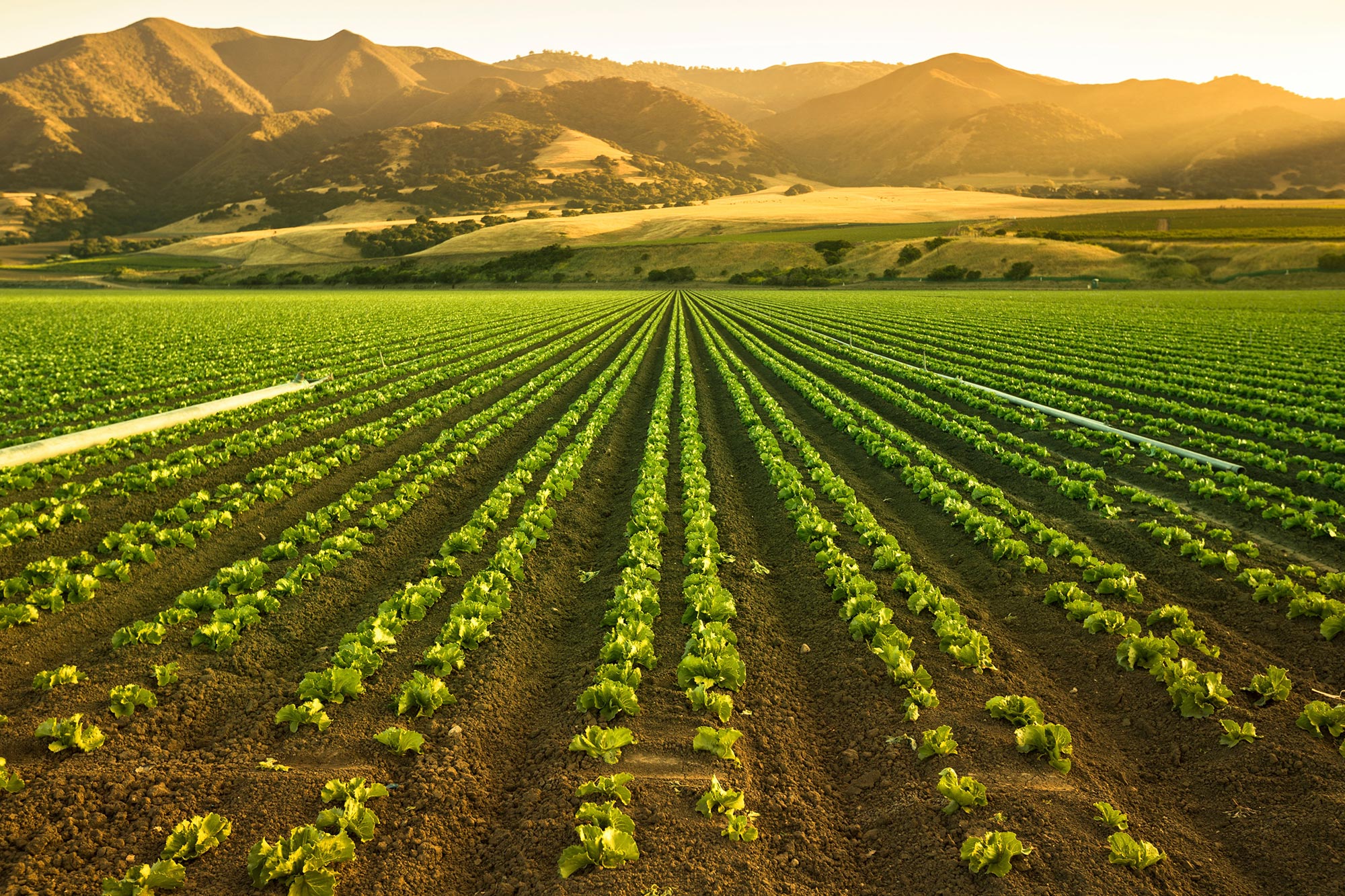
Agriculture Crops Fertile Farm Land

Nitrous oxide emissions, largely from agriculture, have increased significantly from 1980 to 2020. Efforts to reduce these emissions are critical as there are no means to remove the gas from the atmosphere, posing risks to climate and environmental health.

Over four decades, nitrous oxide emissions have risen sharply, driven mainly by agriculture. Without technologies to remove it, the focus must shift to reducing emissions to meet the Paris Agreement targets.

Recent increases in emissions heighten concerns over their impact on global warming and environmental health.

Nitrous Oxide Emissions

Between 1980 and 2020, emissions of nitrous oxide—a greenhouse gas more potent than carbon dioxide or methane—continued unabated, with over 10 million metric tons released into the atmosphere in 2020 alone, predominantly due to farming practices. This finding comes from a new report by the Global Carbon Project.

The report, “Global Nitrous Oxide Budget 2024,” led by researchers from Boston College and published today (June 11) in the journal Earth System Science Data, states that agricultural production was responsible for 74 percent of human-driven nitrous oxide emissions in the 2010s. These emissions were mainly due to the use of chemical fertilizers and animal waste on croplands.
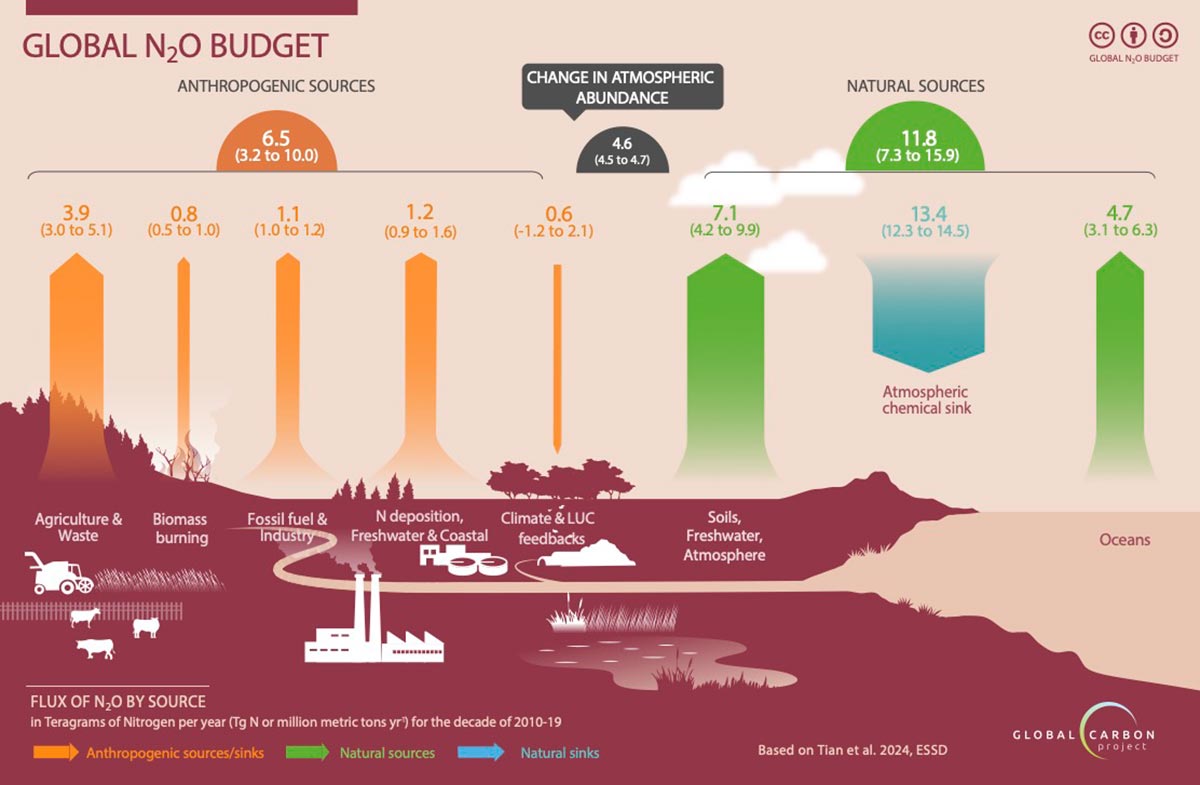
Global Nitrous Oxide Budget

Like carbon dioxide and methane, the greenhouse gas nitrous oxide plays a significant role in global warming. While naturally occurring, it is also produced primarily by farming activity. Human-driven nitrous oxide emissions flowed unabated between 1980 and 2020, with more than 10-million metric tons released into the atmosphere in 2020, according to a new report led by Boston College researchers for the Global Carbon Project. Credit: Global Carbon Project

Urgency in Reducing Emissions

In an era when greenhouse gas emissions must decline to reduce global warming, in 2020 and 2021 nitrous oxide flowed into the atmosphere at a faster rate than at any other time in history, the international team of researchers reported. On Earth, excess nitrogen contributes to soil, water, and air pollution. In the atmosphere, it depletes the ozone layer, and exacerbates climate change.

Agricultural emissions reached 8 million metric tons in 2020, a 67 percent increase from the 4.8 million metric tons released in 1980, according to the study, the most comprehensive study of global nitrous oxide emissions and sinks produced by a team of 58 researchers from 55 organizations in 15 countries.

Call for Emission Reductions

“Nitrous oxide emissions from human activities must decline in order to limit global temperature rise to 2°C as established by the Paris Agreement,” said the report’s lead author, Hanqin Tian, the Schiller Institute Professor of Global Sustainability at Boston College. “Reducing nitrous oxide emissions is the only solution since at this point no technologies exist that can remove nitrous oxide from the atmosphere.”

The concentration of atmospheric nitrous oxide reached 336 parts per billion in 2022, a 25 percent increase over pre-industrial levels that far outpaces predictions previously developed by the Intergovernmental Panel on Climate Change, said Tian, director of the Center for Earth System Science and Global Sustainability at BC’s Schiller Institute for Integrated Science and Society.

Accelerating Emissions Amid Climate Goals

“This emission increase is taking place when the global greenhouse gasses should be rapidly declining towards net zero emissions if we have any chances to avoid the worst effects of climate change,” said Tian, who coordinated the research on behalf of the Global Carbon Project.

The world’s farmers used 60 million metric tons of commercial nitrogen fertilizers in 1980. By 2020, the sector used 107 million metric tons. That same year, animal manure contributed 101 million metric tons for a combined 2020 usage of 208 million metric tons.

The unfettered increase in a greenhouse gas with a global warming potential approximately 300 times larger than carbon dioxide, presents dire consequences for the planet.

Drawing on millions of nitrous oxide measurements taken during the past four decades on land and in the atmosphere, freshwater systems, and the ocean, Tian said the researchers have generated the most comprehensive assessment of global nitrous oxide to date.

Global Emission Insights

The researchers examined data collected around the world for all major economic activities that lead to nitrous oxide emissions and reported on 18 anthropogenic and natural sources and three absorbent “sinks” of global nitrous oxide.

The top 10 nitrous oxide emission-producing countries are: China, India, the United States, Brazil, Russia, Pakistan, Australia, Indonesia, Turkey, and Canada, the researchers found.

Some countries have seen success implementing policies and practices to reduce nitrous oxide emissions, according to the report. Emissions in China have slowed since the mid 2010s; as have emissions in Europe during the past few decades.

In the U.S., agricultural emissions continue to creep up while industrial emissions have declined slightly, leaving overall emissions rather flat. Natural sources of nitrous oxide emissions from soil, fresh- and saltwater have remained stable

Established in 2001, The Global Carbon Project analyzes the impact of human activity on greenhouse gas emissions and Earth systems, producing global budgets for the three dominant greenhouse gasses – carbon dioxide, methane, and nitrous oxide – that assess emissions and sinks to inform further research, policy, and international action.

Agricultural Practices and Emission Reduction

Improved agricultural practices that limit the use of nitrogen fertilizers and animal waste can help reduce greenhouse gas emissions and water pollution. Tian said there is a need for more frequent assessments so mitigation efforts can target high-emission regions and activities. An improved inventory of sources and sinks will be required if progress is going to be made toward the objectives of the Paris Agreement.

“While there have been some successful nitrogen reduction initiatives in different regions, we found an acceleration in the rate of nitrous oxide accumulation in the atmosphere in this decade,” said Global Carbon Project Executive Director Josep Canadell, a research scientist at CSIRO, Australia’s national science agency. “The growth rates of atmospheric nitrous oxide in 2020 and 2021 were higher than any previous observed year and more than 30 percent higher than the average rate of increase in the previous decade.”

Reference: “Global Nitrous Oxide Budget (1980-2020)” 11 June 2024, Earth System Science Data.
DOI: 10.5194/essd-2023-401

Read the full story here.
Photos courtesy of

The environmental costs of corn: should the US change how it grows its dominant crop?

Amid concerns over greenhouse gas emissions, the Trump administration has abolished climate-friendly farming incentivesThis article was produced in partnership with FloodlightFor decades, corn has reigned over American agriculture. It sprawls across 90m acres – about the size of Montana – and goes into everything from livestock feed and processed foods to the ethanol blended into most of the nation’s gasoline. Continue reading...

This article was produced in partnership with FloodlightFor decades, corn has reigned over American agriculture. It sprawls across 90m acres – about the size of Montana – and goes into everything from livestock feed and processed foods to the ethanol blended into most of the nation’s gasoline.But a growing body of research reveals that the US’s obsession with corn has a steep price: the fertilizer used to grow it is warming the planet and contaminating water.Corn is essential to the rural economy and to the world’s food supply, and researchers say the problem isn’t the corn itself. It’s how we grow it.Corn farmers rely on heavy fertilizer use to sustain today’s high yields. And when the nitrogen in the fertilizer breaks down in the soil, it releases nitrous oxide, a greenhouse gas nearly 300 times more potent than carbon dioxide. Producing nitrogen fertilizer also emits large amounts of carbon dioxide, adding to its climate footprint.The corn and ethanol industries insist that rapid growth in ethanol – which now consumes 40% of the US corn crop – is a net environmental benefit, and they strongly dispute research suggesting otherwise.Industry is also pushing for ethanol-based jet fuel and higher-ethanol gasoline blends as growth in electric vehicles threatens long-term gasoline sales.Agriculture accounts for more than 10% of US greenhouse gas emissions, and corn uses more than two-thirds of all nitrogen fertilizer nationwide – making it the leading driver of agricultural nitrous oxide emissions, studies show.Since 2000, US corn production has surged almost 50%, further adding to the crop’s climate impact.The environmental costs of corn rarely make headlines or factor into political debates. Much of the dynamic traces back to federal policy – and to the powerful corn and ethanol lobby that helped shape it.The Renewable Fuel Standard (RFS), passed in the mid-2000s, required that gasoline be blended with ethanol, a biofuel that in the United States comes almost entirely from corn. That mandate drove up demand and prices for corn, spurring farmers to plant more of it.Many plant corn year after year on the same land. The practice, called “continuous corn”, demands massive amounts of nitrogen fertilizer and drives especially high nitrous oxide emissions.Corn growing in front of an ethanol refinery in South Dakota. Photograph: Stephen Groves/APAt the same time, federal subsidies make it more lucrative to grow corn than to diversify. Taxpayers have covered more than $50bn in corn insurance premiums over the past 30 years, according to federal data compiled by the Environmental Working Group.Researchers say proven conservation steps – such as planting rows of trees, shrubs and grasses in cornfields – could sharply reduce these emissions. But the Trump administration has eliminated many of the incentives that helped farmers try such practices.Experts say it all raises a larger question: if the US’s most widely planted crop is worsening climate change, shouldn’t we begin growing it in a different way?How corn took over the USIn the late 1990s, the US’s corn farmers were in trouble. Prices had cratered amid a global grain glut and the Asian financial crisis. A 1999 report by the Federal Reserve Bank of Minneapolis said crop prices had hit “rock bottom”.Corn production really took off in the 2000s after federal mandates and incentives helped turn much of the US’s corn crop into ethanol.In 2001, the US Department of Agriculture launched the bioenergy program, which paid ethanol producers to increase their use of farm commodities for fuel. Then the 2002 farm bill created programs supporting ethanol and other renewable energy.Corn growers soon mounted an all-out campaign to persuade Congress to require that gasoline be blended with ethanol, arguing it cut greenhouse gasses, reduced oil dependence and revived rural economies.“I started receiving calls from Capitol Hill saying: ‘Would you have your growers stop calling us? We are with you,’” Jon Doggett, then the industry’s chief lobbyist, said in an article published by the National Corn Growers Association. “I had not seen anything like it before and haven’t seen anything like it since.”In 2005, Congress created the RFS, which requires adding ethanol to gasoline, and expanded it two years later. The amount of corn used for ethanol domestically has more than tripled in the past 20 years.When demand for corn spiked as a result of the RFS, it pushed up prices worldwide, said Tim Searchinger, a researcher at Princeton University’s School of Public and International Affairs. The result, Searchinger said, was more land cleared to grow corn. The Global Carbon Project found that nitrous oxide emissions from human activity rose 40% from 1980 to 2020.In the United States, “king corn” became a political force. Since 2010, national corn and ethanol trade groups have spent more than $55m on lobbying and millions more on political donations to Democrats and Republicans alike, according to campaign finance records analyzed by Floodlight.In 2024 alone, those trade groups spent twice as much on lobbying as the National Rifle Association. Now the sectors are pushing for the next big prize: expanding higher-ethanol gasoline blends and positioning ethanol-based jet fuel as aviation’s “low-carbon” future.Research undercuts ethanol’s clean-fuel claimsCorn and ethanol trade groups did not respond to requests for interviews. But they have long promoted corn ethanol as a climate-friendly fuel.The Renewable Fuels Association cites government and university research that finds burning ethanol reduces greenhouse gas emissions by roughly 40%-50% compared with gasoline. The ethanol industry says the climate critics have it wrong – and that most of the corn used for fuel comes from better yields and smarter farming, not from plowing up new land. The amount of fertilizer required to produce a bushel of corn has dropped sharply in recent decades, they say.“Ethanol reduces carbon emissions, removing the carbon equivalent of 12 million cars from the road each year,” according to the Renewable Fuels Association.Growth Energy, a major ethanol trade group, said in a written statement to Floodlight that US farmers and biofuel producers are “constantly finding new ways to make their operations more efficient and more environmentally beneficial”, using things like cover crops to reduce their carbon footprint. “Biofuel producers are making investments today that will make their products net-zero or even net negative in the next two decades,” the statement said.Some research tells a different story.A recent Environmental Working Group report finds that the way corn is grown in much of the midwest – with the same fields planted in corn year after year – carries a heavy climate cost.And research in 2022 by agricultural land use expert Tyler Lark and colleagues links the Renewable Fuel Standard to worsening water pollution and increased emissions, concluding the climate impact is “no less than gasoline and likely at least 24% higher”.Lark’s research has been disputed by scientists at the Argonne National Laboratory, Purdue University and the University of Illinois, who published a formal rebuttal arguing the study relied on “questionable assumptions” and faulty modeling – a charge Lark’s team has rejected.One recent study found that solar panels can generate as much energy as corn ethanol on roughly 3% of the land.“It’s just a terrible use of land,” Searchinger, the Princeton researcher, said of ethanol. “And you can’t solve climate change if you’re going to make such terrible use of land.”Nitrogen polluting rural drinking waterThe nitrogen used to grow corn and other crops is also a key source of drinking water pollution, experts say.According to a new report by Clean Wisconsin and the Alliance for the Great Lakes, more than 90% of nitrate contamination in Wisconsin’s groundwater is linked to agricultural sources – mostly synthetic fertilizer and manure.A farm in Pemberton, New Jersey, on 14 October 2025. Photograph: Bloomberg/Getty ImagesIn 2022, Tyler Frye and his wife moved into a new home in the rural village of Casco, Wisconsin, about 20 miles (32km) east of Green Bay. Testing found their well water had nitrate levels more than twice the EPA’s safe limit. “We were pretty shocked,” Frye said.He installed a reverse-osmosis system in the basement and still buys bottled water for his wife, who is breastfeeding their daughter, born in July.When he watches manure or fertilizer being spread on nearby fields, he said, one question nags him: “Where does that go?”What cleaner corn could look likeReducing corn’s climate footprint is possible – but the farmers trying to do it are swimming against the policy tide.Recent moves by the Trump administration have stripped out Biden-era incentives for climate-friendly farming practices, which the agriculture secretary Brooke Rollins dismissed as part of the “green new scam”.Research, however, shows that proven conservation practices – including planting trees, shrubs and hedgerows in corn fields – could make a measurable difference.In northern Iowa, Wendy Johnson is planting fruit and nut trees, organic grains, shrubs and other plants that need little or no nitrogen fertilizer on 130 of the 1,200 acres (485 hectares) of corn and soybeans she farms with her father. Across the rest of the farm, they enrich the soil by rotating crops and planting cover crops. They’ve also converted less productive parts of the fields into “prairie strips” – bands of prairie grass that store carbon and require no fertilizer.They were counting on $20,000 a year from the now-cancelled Climate-Smart grant program, but it never came.“It’s hard to take risks on your own,” Johnson said. “That’s where federal support really helps.”In south-east Iowa, sixth-generation farmer Levi Lyle mixes organic and conventional methods across 290 acres. He uses a three-year rotation, extensive cover crops and a technique called roller crimping: flattening rye each spring to create a mulch that suppresses weeds, feeds the soil and reduces fertilizer needs.“The roller crimping of cover crops is a huge, huge opportunity to sequester more carbon, improve soil health, save money on chemicals and still get a similar yield,” Lyle said.Despite mounting research about corn’s climate costs, industry groups are pushing for legislation to pave the way for ethanol-based jet fuel.Researchers warn that producing enough ethanol-based aviation fuel could prompt another 114m acres to be converted to corn, or 20% more corn acres than the US plants for all purposes.“The result,” said University of Iowa professor and natural resources economist Silvia Secchi, “would be essentially to enshrine this dysfunctional system that we created.”Floodlight is a non-profit newsroom that investigates the powers stalling climate action

A drying Great Salt Lake is spewing toxic dust. It could cost Utah billions

A new report lays out the case for action -- instead of waiting for more data.

Note to readers • This story is made possible through a partnership between The Salt Lake Tribune and Grist, a nonprofit environmental media organization. The dust blowing from the dry bed of the Great Salt Lake is creating a serious public health threat that policymakers and the scientific community are not taking seriously enough, two environmental nonprofits warn in a recent report. The Great Salt Lake hit a record-low elevation in 2022 and teetered on the brink of ecological collapse. It put millions of migrating birds at risk, along with multi-million-dollar lake-based industries such as brine shrimp harvesting, mineral extraction and tourism. The lake only recovered after a few winters with above-average snowfall, but it sits dangerously close to sinking to another record-breaking low. Around 800 square miles of lakebed sit exposed, baking and eroding into a massive threat to public health. Dust storms large and small have become a regular occurrence on the Wasatch Front, the urban region where most Utahns live. The report from the Utah Physicians for a Healthy Environment and the Utah Rivers Council argues that Utah’s “baby steps” approach to address the dust fall short of what’s needed to avert a long-term public health crisis. Failing to address those concerns, they say, could saddle the state with billions of dollars in cleanup costs. “We should not wait until we have all the data before we act,” said Brian Moench, president of Utah Physicians for a Healthy Environment, in an interview. “The overall message of this report is that the health hazard so far has been under-analyzed by the scientific community.” After reviewing the report, however, two scientists who regularly study the Great Salt Lake argued the nonprofits’ findings rely on assumptions and not documented evidence. The report warns that while much of the dust discussion and new state-funded dust monitoring network focus on coarse particulates, called PM 10, Utahns should also be concerned about tiny particulates 0.1 microns or smaller called “ultrafines.” The near-invisible pollutants can penetrate a person’s lungs, bloodstream, placenta and brain. The lake’s dust could also carry toxins like heavy metals, pesticides and PFAS, or “forever chemicals,” Moench cautioned, because of the region’s history of mining, agriculture and manufacturing. “Great Salt Lake dust is more toxic than other sources of Great Basin dust,” Moench said. “It’s almost certain that virtually everyone living on the Wasatch Front has contamination of all their critical organs with microscopic pollution particles.” If the lake persists at its record-low elevation of 4,188 feet above sea level, the report found, dust mitigation could cost between $3.4 billion and $11 billion over 20 years depending on the methods used. The nonprofits looked to Owens Lake in California to develop their estimates. Officials there used a variety of methods to control dust blowing from the dried-up lake, like planting vegetation, piping water for shallow flooding and dumping loads of gravel. Dust blows over the Great Salt Lake on Monday, May 12, 2025. Trent Nelson / The Salt Lake Tribune The Great Salt Lake needs to rise to 4,198 feet to reach a minimum healthy elevation, according to state resource managers. It currently sits at 4,191.3 feet in the south arm and 4,190.8 feet in the north arm. The lake’s decline is almost entirely human caused, as cities, farmers and industries siphon away water from its tributary rivers. Climate change is also fueling the problem by taking a toll on Utah’s snowpack and streams. Warmer summers also accelerate the lake’s rate of evaporation. The two nonprofits behind the report, Utah Physicians and the Utah Rivers Council, pushed back at recent solutions for cleaning up the toxic dust offered up by policymakers and researchers. Their report panned a proposal by the state’s Speaker of the House, Mike Schultz, a Republican, to build berms around dust hotspots so salty water can rebuild a protective crust. It also knocked a proposal to tap groundwater deep beneath the lakebed and use it to help keep the playa wet. “Costly engineered stopgaps like these appear to be the foundation of the state’s short-sighted leadership on the Great Salt Lake,” the groups wrote in their report, “which could trigger a serious exodus out of Utah among wealthier households and younger populations.” Bill Johnson, a professor of geology and geophysics at the University of Utah who led research on the aquifer below the lake, said he agreed with the report’s primary message that refilling the Great Salt Lake should be the state’s priority, rather than managing it as a long-term and expensive source of pollution. Bill Johnson’s University of Utah graduate students haul their equipment out onto the playa of the Great Salt Lake on Tuesday, June 17, 2025. Rick Egan / The Salt Lake Tribune “We don’t want this to become just about dust management, and we forget about the lake,” Johnson said. “I don’t think anybody’s proposing that at this point.” It took decades of unsustainable water consumption for the Great Salt Lake to shrink to its current state, Johnson noted, and it will likely take decades for it to refill. Kevin Perry, an atmospheric scientist at the University of Utah and one of the top researchers studying the Great Salt Lake’s dust, said Utah Physicians and Utah Rivers Council asked him to provide feedback on their report in the spring. “It’s a much more balanced version of the document than what I saw last March,” he said of the report. “It’s still alarmist.” Perry agreed with the report’s findings that many unknowns linger about what the lakebed dust contains, and what Utahns are potentially inhaling when it becomes airborne. He said he remains skeptical that ultrafine particulates are a concern with lakebed dust. Those pollutants are typically formed through high-heat combustion sources, like diesel engines. “In the report, they just threw it all at the wall and said it has to be there,” Perry said. “I kept trying to encourage them to limit their discussion to the things we have actually documented. ” The report’s chapter outlining cost estimates for dust mitigation, however, largely aligned with Perry’s own research. Fighting back dust over the long term comes with an astronomical price tag, he said, along with the risk of leaving permanent scars from gravel beds or irrigation lines on the landscape. “Yes, we can mitigate the dust using engineered solutions,” Perry said, “but we really don’t want to go down that path if we don’t have to.” This story was originally published by Grist with the headline A drying Great Salt Lake is spewing toxic dust. It could cost Utah billions on Dec 1, 2025.

Illinois has few remaining wetlands. A Trump administration proposal could decimate what’s left.

If the rule takes effect, more than two-thirds of Illinois’ wetlands could lose federal protections.

The Environmental Protection Agency calls wetlands “biological supermarkets” for the sheer abundance of food they supply to a broad range of species. Roughly 40 percent of all plants and animals rely on wetlands for some part of their lifecycle. These ecosystems also filter drinking water, blunt the force of flooding, and store vast amounts of carbon dioxide — functions that make them critical in efforts to combat climate change. But the EPA and Army Corps of Engineers are now moving to slash federal protections for the nation’s wetlands and streams, potentially leaving millions of acres of habitat in Illinois and the Midwest vulnerable to being dug up, filled in, or paved over. At the heart of the proposal announced last week is a new, stricter definition to the long-debated legal term, “Waters of the United States,” the federal guidance that determines which bodies of water are protected under the 1972 Clean Water Act. The proposal codifies a 2023 Supreme Court decision that limits federal protection to wetlands that are so inseparable from larger, relatively permanent bodies of water like streams, rivers, and lakes that you can’t tell where one ends and the other begins. Under the proposed rule, wetlands must contain water during the “wet season” and must be connected to a major waterbody during that season. Effectively, the new definition excludes seasonal streams and wetlands, which remain dry for much of the year. “We’re looking at up to 85 percent of the country’s wetlands losing their protected status under the Clean Water Act,” said Andrew Wetzler, the Natural Resources Defense Council’s senior vice president for nature.  A 2025 analysis from the nonprofit environmental group found that approximately 70 million of the 84 million acres of wetlands across the country are at risk. Under the current regulations, developers must obtain a permit from the Army Corps of Engineers before destroying a wetland to ensure environmentally responsible practices. The new regulations will eliminate the need for a federal permit to build over wetlands, allowing developers to act with minimal environmental oversight, according to Weltzer.  EPA Administrator Lee Zeldin defended the move in a statement, arguing it “protects the nation’s navigable waters from pollution, advances cooperative federalism by empowering states, and will result in economic growth across the country.” Agricultural, chemical, and mining industry groups also celebrated the EPA’s push to curb federal water protections. “The Supreme Court clearly ruled several years ago that the government overreached in its interpretation of what fell under federal guidelines,” read a statement from Zippy Duval, the American Farm Bureau Federation’s president. “We are still reviewing the entire rule, but we are pleased that it finally addresses those concerns and takes steps to provide much-needed clarity.” When Europeans settled the area in the 1700s, Illinois was home to more than 8 million acres of wetlands. The state has since lost about 90 percent of that terrain to agriculture, development, and urbanization. Illinois’ wetlands alone provide $419 million worth of residential flood protection annually, according to the University of Illinois Urbana-Champaign.  Since the Supreme Court decision gutted federal protections for wetlands, states like Colorado have passed their own laws to safeguard their endangered ecosystems. Illinois lawmakers have attempted to introduce similar legislation, but have yet to succeed.  “The vast majority of Illinois wetlands do not have federal protection,” said Robert Hirschfeld, director of water policy at the Prairie Rivers Network. “The loss of the federal Clean Water Act means it is open season on wetlands.” A recent study from the University of Illinois Urbana-Champaign found that slashing the wetland protection could endanger the vast majority of the state’s dwindling wetlands. “We determined that about 72 percent of Illinois wetlands, which is about 700,000 acres, no longer meet that criteria for continuous surface connection to relatively permanent waters in Illinois,” said Chelsea Peters, a PhD candidate in wetland ecology at the University of Illinois and a lead author of the study. “So they are not protected by the Clean Water Act.” That figure could get higher depending on how regulators hash out wetness requirements. “The next best estimate is 90 percent,” she said.  The proposal still has a long road ahead before being finalized. The EPA has opened a 45-day comment period for the public to weigh in on the proposed change. The EPA will consider these public comments before finalizing rule changes as early as the first quarter of next year. This story was originally published by Grist with the headline Illinois has few remaining wetlands. A Trump administration proposal could decimate what’s left. on Nov 24, 2025.

How Much Protein Do You Need? Experts Explain

Fitness influencers promote superhigh-protein diets, but studies show there’s only so much the body can use

Snack bars, yogurts, ice cream, even bottled water: it seems like food makers have worked out ways to slip extra protein into just about anything as they seek to capitalize on a growing consumer trend.Today, protein-fortified foods and protein supplements form a market worth tens of billions of US dollars, with fitness influencers, as well as some researchers and physicians, promoting high-protein diets as the secret to strength and longevity. Protein is undeniably essential, but how much people really need is still a topic of debate.On the one hand, most official guidelines recommend a minimum of close to one gram of protein per kilogram of body weight per day, or the equivalent of about 250 grams of cooked chicken (which contains around 68 g of protein) for an adult weighing 70 kilograms. On the other hand, a growing narrative in wellness circles encourages people to eat more than double that amount. Many scientists fall somewhere in the middle and take issue with some of the advice circulating online.On supporting science journalismIf you're enjoying this article, consider supporting our award-winning journalism by subscribing. By purchasing a subscription you are helping to ensure the future of impactful stories about the discoveries and ideas shaping our world today.“It’s really frustrating because there isn’t evidence to support the claims that they’re making,” says Katherine Black, an exercise nutritionist at the University of Otago in Dunedin, New Zealand, referring to the super-high protein recommendations often shared on social media. What research does show is that protein needs can vary from person to person and can change throughout a lifetime. And people should think carefully about what they eat to meet those needs. “On social media, it’s like everyone’s worried about protein, putting protein powder into everything,” she says.Health authorities can help to guide people’s dietary choices on the basis of the latest research. The next Dietary Guidelines for Americans, a document that advises on what to eat for maintaining a healthy lifestyle, is due to come out by the end of this year. But its recommendations, which have tended to be broadly influential, might be changing.Calculating protein needsResearchers have been trying to estimate how much protein people need for more than a century. In 1840, chemist Justus von Liebig estimated that the average adult required 120 grams of protein a day, on the basis of a group of German workers’ diets. Later, scientists started to use nitrogen to calculate protein requirements. Protein is the only major dietary component that contains nitrogen. So, by measuring how much of it people consume and the amount they excrete, researchers could estimate how much the body uses.Since the 1940s, this nitrogen-balance method has been used to determine the Recommended Dietary Allowances (RDA), a set of nutrient recommendations developed by the US National Academies of Sciences, Engineering, and Medicine.The latest such recommendation for protein, from 2005, establishes the RDA for both men and women at 0.8 grams per kilogram of body weight per day, which it states should be enough to meet the needs of 97–98% of healthy people. European and global-health authorities recommend similar or slightly higher levels.Although scientists recognize that RDAs are a useful reference point, many say that people could benefit from a higher amount. “The RDA is not a target; it’s simply the minimum that appears to prevent any detectable deficiency,” says Donald Layman, a researcher focusing on protein requirements at the University of Illinois Urbana–Champaign. Evidence suggests that the optimal range is between 1.2 and 1.6 grams of protein per kilogram of body weight per day, he says.That is especially true for older adults, who often experience muscle loss as they age, as well as for certain athletes and people trying to gain muscle.For example, in an observational study of 2,066 adults aged 70–79, those who reported eating the most protein — about 1.1 gram per kilogram of bodyweight — lost 40% less lean mass during the three years of follow-up than did those who ate the least — around 0.7 grams per kilogram.“For older adults, 1.2 grams per kilogram is just giving them a little extra protection,” says Nicholas Burd, a nutrition and exercise researcher also at the University of Illinois Urbana–Champaign. Furthermore, older people might experience a decline in appetite, which makes it particularly important for them to pay attention to their protein intake. It doesn’t mean that they need to take protein supplements, he says. “It’s all things we can do with just normal incorporation of high-protein foods in our lives.”For healthy adults, increasing protein can boost the effects of resistance exercise, such as weightlifting. A 2017 systematic review found that, among people engaged in this type of training, taking protein supplements enhanced muscle gain and strength. But increasing protein beyond 1.6 grams per kilogram per day provided no further benefit.Meanwhile, some fitness influencers swear by eating 2.2 grams per kilogram of body weight. For most people, that’s simply overkill, says Burd. There’s little harm, other than for people with kidney disease, but Burd adds: “You just create an inefficient system where your body gets very good at wasting food protein.”Some practitioners might recommend higher protein targets to ensure that people get enough, Burd says. But the protein craze has been driven mostly by aggressive marketing of high-protein foods and supplements, he says.“The myth of increased protein needs has seeped into popular imagination, including among health professionals, and has been conveniently reinforced by the food industry,” says Fernanda Marrocos, a researcher specializing in nutrition and food policy at the University of São Paulo in Brazil.Amino-acid goalsNot all proteins are the same, and some researchers argue for a more nuanced recommendation that takes into account the amino acids — the building blocks of proteins — that foods contain. The human body requires 20 amino acids to function properly, including 9 that are considered ‘essential’ because they can be obtained only through food.The balance of those nine in animal-based foods is exactly what other animals need, says Layman. “In plants, the essential amino acids are generally there, but they’re in proportions for the plants.” That means that some plants might be rich in certain amino acids but not in others, so meeting the amino-acid requirements with plant-based products might require a greater variety of foods.He is critical of the way that official dietary guidelines calculate the recommendations for proteins from different sources. For example, according to the US Department of Agriculture, 14 grams of almonds can substitute 28 grams of chicken breast. Research by Layman and his colleagues, which considers the amino-acid balance, suggests that it would actually take more than 115 grams of almonds to substitute 28 grams of chicken.Robert Wolfe, a researcher focusing on muscle metabolism at the University of Arkansas for Medical Sciences in Little Rock, says that dietary guidelines should incorporate the analysis of the quality of the protein, including the amino-acid balance and the degree to which the human body can digest them.One area for future research, Wolfe says, is understanding exactly how food processing affects protein content. Factors such as cooking temperature, for example, can influence how well the body digests protein. This can have implications for certain protein supplements and high-protein bars, which are generally highly processed.Obtaining that information requires going beyond nitrogen-balance studies. Wolfe’s team has used isotope tracers to determine the rate at which food protein is incorporated into new proteins in the body. One study of 56 young adults, for example, concluded that eating animal-based proteins resulted in a greater gain in body protein than did eating the equivalent amount of plant-based protein. But studies in this area are still small and shouldn’t be taken to mean that people must get all their protein from animal sources.The American Heart Association recommends prioritizing plant proteins, given that the saturated fat found in red meats can increase the risk of cardiovascular disease. There’s also a high environmental cost associated with meat production, which is a major source of greenhouse-gas emissions.Burd says that if a diet includes at least a portion of animal-based protein, it will probably provide all the essential amino acids for maintaining good health. And it is possible to achieve the same benefits solely from plant-based proteins. “This is where supplements could be beneficial because it’s more challenging to reach that balance from plants only,” Burd says.Specialists advising the formulation of the upcoming Dietary Guidelines for Americans say that most Americans already eat more than enough proteins. They suggest reducing protein consumption from red meat, chicken and eggs and increasing the consumption of certain vegetables. But it’s unclear what exactly will be in the guidelines: US health secretary Robert F. Kennedy Jr has stated in recent months that they will emphasize the need to eat saturated fats from sources including meat and dairy, which goes against recommendations from many medical associations.Protein consumption is adequate in most parts of the world, says Marrocos. A study her team led in Brazil found that, in general, people consume well above the World Health Organization’s protein recommendation, even those with the lowest income. So there’s no need to obsess about hitting an exact protein number.“For most people, as long as they’re eating enough calories and a reasonably varied diet, they’ll get all the protein they need,” says Marrocos.This article is reproduced with permission and was first published on November 12, 2025.

This pig’s bacon was delicious. But she’s alive and well

A company called Mission Barns is cultivating pork fat in bioreactors and turning it into meatballs and other products. Honestly, they're pretty darn good.

I’m eating Dawn the Yorkshire pig and she’s quite tasty. But don’t worry. She’s doing perfectly fine, traipsing around a sanctuary in upstate New York. (Word is that she appreciates belly rubs and sunshine.) I’m in San Francisco, at an Italian joint just south of Golden Gate Park, enjoying meatballs and bacon not made of meat in the traditional sense, but of plants mixed with “cultivated” pork fat. Dawn, you see, donated a small sample of fat, which a company called Mission Barns got to proliferate in devices called bioreactors by providing nutrients like carbohydrates, amino acids, and vitamins — essentially replicating the conditions in her body. Because so much of the flavor of pork and other meats comes from the animal’s fat, Mission Barns can create products like sausages and salami with plants, but make them taste darn near like sausages and salami. I’ve been struggling to describe the experience, because cultivated meat short-circuits my brain — my mouth thinks I’m eating a real pork meatball, but my brain knows that it’s fundamentally different, and that Dawn (that’s her above) didn’t have to die for it. This is the best I’ve come up with: It’s Diet Meat. Just as Diet Coke is an approximation of the real thing, so too are cultivated meatballs. They simply taste a bit less meaty, at least to my tongue. Which is understandable, as the only animal product in this food is the bioreactor-grown fat.Cultivated pork is the newest entrant in the effort to rethink meat. For years, plant-based offerings have been mimicking burgers, chicken, and fish with ever-more convincing blends of proteins and fats. Mission Barns is one of a handful of startups taking the next step: growing real animal fat outside the animal, then marrying it with plants to create hybrids that look, cook, and taste more like what consumers have always eaten, easing the environmental and ethical costs of industrial livestock. The company says it’s starting with pork because it’s a large market and products like bacon are fat-rich, but its technology is “cell-agnostic,” meaning it could create beef and chicken, too. Matt Simon Honestly, Mission Barns’ creations taste great, in part because they’re “unstructured,” in the parlance of the industry. A pork loin is a complicated tangle of fat, muscle cells, and connective tissues that is very difficult — and expensive — to replicate, but a meatball, salami, or sausage incorporates other ingredients. That allows Mission Barns to experiment with what plant to use as a base, to which they add spices to accentuate the flavors. It’s a technology that they can iterate, basically, crafting ever-better meats by toying with ingredients in different ratios. So the bacon I ate, for instance, had a nice applewood smoke to it. The meatballs had the springiness you’d expect. During a later visit to Mission Barns’ headquarters across town, I got to try two prototypes of its salami as well — both were spiced like you’d expect, but less elastic, so they chewed a bit more easily than what you’d find on a charcuterie board. (The sensation of food in the mouth is known in the industry as “mouthfeel,” and nailing it is essential to the success of alt-meats.) The salami slices even left grease stains on the paper they were served on — Dawn’s own little mark on the world. Matt Simon I was one of the first people to purchase a cultivated pork product. While Mission Barns has so far only sold its products at that Italian restaurant and, for a limited time, at a grocery store in Berkeley — $13.99 for a pack of eight meatballs, similar to higher-end products from organic and regenerative farms — it is fixing to scale up production and sell the technology to other companies to produce more cultivated foods. (It is assessing how big the bioreactors will have to be to reach price parity with traditional meat products.) The idea is to provide an alternative to animal agriculture, which uses a whole lot of land, water, and energy to raise creatures and ship their flesh around the world. Livestock are responsible for between 10 and 20 percent of humanity’s greenhouse gas emissions — depending on who’s estimating it — and that’s to say nothing of the cruelty involved in keeping pigs and chickens and cows in unsavory, occasionally inhumane, conditions.Getting animal cells to grow outside of an animal, though, ain’t easy. For one, if cells don’t have anything to attach to, they die. So Mission Barns’ cultivator uses a sponge-like structure, full of nooks and crannies that provides lots of surface area for the cells to grow. “We have our media, which is just the nutrient solution that we give to these cells,” said Saam Shahrokhi, chief technology officer at Mission Barns. “We’re essentially recapitulating all of the environmental cues that make cells inside the body grow fat, [but] outside the body.” While Dawn’s fat is that of a Yorkshire pig, Shahrokhi said they could easily produce fat from other breeds like the Mangalitsa, known as the Kobe beef of pork. (In June, the company won approval from the U.S. Department of Agriculture to bring its cultivated fat to market.)Fat in hand, Mission Barns can mix it with plant proteins. If you’re familiar with Impossible Foods, it uses soy to replicate the feel and look of ground beef and adds soy leghemoglobin, which is similar to the heme that gives meat its meaty flavor. Depending on the flavor and texture it’s trying to copy, Mission Bay uses pea protein for the meatballs and sausages, wheat for the bacon, and fava beans for the salami. “The plant-based meat industry has done pretty well with texture,” said Bianca Le, head of special projects at Mission Barns. “I think what they’re really missing is flavor and juiciness, which obviously is where the fat comes in.” Matt Simon But the fat is just the beginning. Mission Barn’s offerings not only have to taste good, but also can’t have an offputting smell when they’re coming out of the package and when they’re cooking. The designers have to dial in the pH, which could degrade the proteins if not balanced. How the products behave on the stove or in the oven has to be familiar, too. “If someone has to relearn how to cook a piece of bacon or a meatball, then it’s never going to work,” said Zach Tyndall, the product development and culinary manager at Mission Barns.When I pick up that piece of salami, it has to feel like the real thing, in more ways than one. Indeed, it’s greasy in the hand and has that tang of cured meat. It’s even been through a dry-aging process to reduce its moisture. “We treat this like we would a conventional piece of salami,” Tyndall said. Cultivated meat companies may also go more unconventional. “I also love the idea of taking their pork fat and putting it in a beef burger — what would happen if you did that?” said Barb Stuckey, chief new product strategy officer at Mattson, a food developer that has worked with many cultivated meat companies. “Mixing species, it’s not something we typically do. But with this technology, we can.” Of course, in this new frontier of food, the big question is: Who exactly is this for? Would a vegetarian or vegan eat cultured pork fat if it’s divorced from the cruelty of factory farming? Would meat-eaters be willing to give up the real thing for a facsimile? Mission Barns’ market research, Le said, found that its early adopters are actually flexitarians — people who eat mostly plant-based but partake in the occasional animal product. But Le adds that their first limited sale to the public in Berkeley included some people who called themselves vegetarians and vegans.  Mission Barns There’s also the matter of quantifying how much of an environmental improvement cultivated fat might offer over industrial pork production. If scaled up, one benefit of cultivated food might be that companies can produce the stuff in more places — that is, instead of sprawling pig farms and slaughterhouses being relegated to rural areas, bioreactors could be run in cities, cutting down on the costs and emissions associated with shipping. Still, those factories would need energy to grow fat cells, though they could be run on renewable electricity. “We modeled our process at the large commercial scale, and then compared it to U.S. bacon production,” Le said. (The company would not offer specific details, saying it is in the process of patenting its technique.) “And we found that with renewable energy, we do significantly better in terms of greenhouse gas emissions.”Whether or not consumers bite, though, remains to be seen. The market for meat alternatives in the U.S. has majorly softened of late: Beyond Meat, which makes plant-based products like burgers and sausages, has seen revenues drop significantly, in part because of consumers’ turn away from processed foods. But by licensing its technology elsewhere, Mission Barns’ strategy is to break into new markets beyond the U.S.The challenges of cultivated meat go beyond the engineering once you get to the messaging and branding — telegraphing to consumers that they’re buying something that may in fact be partially meat. “When you buy chicken, you get 100 percent chicken,” Stuckey said. “I think a lot of people go into cultivated meat thinking what’s going to come onto the market is 100 percent cultivated chicken, and it’s not going to be that. It’s going to be something else.” Regardless of the trajectory of cultivated fat products, Dawn will continue mingling with llamas, soaking up the sunshine, and getting belly rubs in upstate New York — even as she makes plants taste more like pork.  This story was originally published by Grist with the headline This pig’s bacon was delicious. But she’s alive and well on Nov 20, 2025.

Suggested Viewing

Join us to forge
a sustainable future

Our team is always growing.
Become a partner, volunteer, sponsor, or intern today.
Let us know how you would like to get involved!

CONTACT US

sign up for our mailing list to stay informed on the latest films and environmental headlines.

Subscribers receive a free day pass for streaming Cinema Verde.
Thank you! Your submission has been received!
Oops! Something went wrong while submitting the form.