

Workers were exposed to toxic chemicals in firefighting foam
Workers were exposed to toxic chemicals in firefighting foamAnna MeiselandEsme Stallard,BBC File on 4 InvestigatesGeograph/ Nigel DaviesThe 3M factory in Swansea was once its biggest outside the US, but it made the decision to close it two years ago Dozens of factory workers were exposed to toxic chemicals within firefighting foam over decades, BBC File on 4 Investigates can reveal.Multi-billion-pound US manufacturer, 3M, failed to tell employees at its Swansea site they were using foam containing two forever chemicals, now classed as carcinogenic, despite knowing for decades of the health risks.The company said it would stop manufacturing the forever chemicals – so called because they persist in the environment – in 2002, but failed to remove them from the factory resulting in an environmental accident four years later.3M said that the health and safety of its workers and their families were "critical priorities" for the company.The factory in Gorseinon, Swansea, opened in 1952 and for decades was 3M's largest outside of the US. It employed more than 1,000 people from across south Wales to manufacture nappy fastenings and video tape.In 2023, 3M made the decision to close the factory and applied for planning permission to redevelop the site.BBC File on 4 Investigates discovered a land contamination report amongst hundreds of documents 3M submitted to the local council - it said the site is polluted with two toxic forever chemicals, PFOS and PFOA.The company never manufactured the chemicals, part of the PFAS family of substances, at the site. Its report said the chemicals came from "historic firefighting activities" using aqueous film-forming foam (AFFF) - a type of firefighting foam.The BBC has tracked down those involved in firefighting on the site, who are speaking publicly for the first time.Every year, a dozen workers at the factory were selected to take on an additional responsibility as members of the "fire party" at the factory."We were on the emergency squad, like part-time firemen," said Ian (not his real name). He worked at the 3M factory for 40 years and was part of the fire party team."Once a month we did the training and we used to train putting out chemical fires," Ian added."They'd have a big tray full of chemicals, put a torch to it, set it up and then we used to use the light water then to put it out, it would come out like foam."Light water is the 3M product name for AFFF, with Ian saying workers were not told anything about chemicals it may contain. Levels of PFOS discovered in soil at the site in 2023 were listed in the report ranging from 50 to more than 1,500 micrograms per kilogram.These upper levels are 500 times greater than the average in British soils.Dr David Megson, an environmental scientist at Manchester Metropolitan University, told the BBC that these levels were a "cause for concern".In a commercial setting he said levels above 600 micrograms may pose a risk to human health because of inhalation of dust and contact with the skin.Members of the PFAS family of chemicals, specifically PFOA and PFOS, have been linked with a range of different adverse health conditions, Dr Megson said. He added: "[They] can cause damage to the liver, cardiovascular system, immune system and in the developing foetus."Both chemicals are now banned in the UK because they are toxic and do not break down easily in the environment. In 2024, the World Health Organization (WHO) determined PFOA was carcinogenic and PFOS "possibly" carcinogenic to humans.But 3M knew as early as the 1970s of the health risks of these chemicals to workers.Bastiaan Slabbers/Getty ImagesSome firefighting foam used in Swansea contained toxic forever chemicals - this is a similar type of foam at a site in the US In 1999, a major civil claim was made against 3M after people started becoming unwell from water contaminated with PFOS and PFOA in the United States.During the case, internal 3M documents were released which showed the company recording elevated levels of PFAS in the blood of its workers and possible increases in cancer."[It] understood, going back many decades, the dangers of these chemicals," said Rob Bilott, partner at US firm Taft Law, who led that litigation."Animal studies started being done by [3M] in the 1960s that was showing incredible toxicity in multiple different animal species. "Rats, mice, rabbits, guinea pigs, dogs, even monkeys were dropping dead by the late 1970s."Cheryl's father worked for decades at the factory in Swansea, starting back in the 70s, and was also on the fire party."He was the provider. He always worked hard. He was at his happiest when he was with his family and his friends," said Cheryl (not her real name).In his early 40s, he was diagnosed with kidney cancer and after treatment briefly returned to work before retiring at 50. A few years later the cancer returned and Cheryl's dad died at the age of 54.She said: "It was a shock because my father was always a big, strong man, so he was never ill. He never used to take time off sick from work."Many things can cause kidney cancer, but research compiled by the World Health Organization has concluded the risk of kidney cancer is probably increased by significant exposure to PFOS and PFOA.Dr Steve Hajioff is an epidemiologist and chairs an independent panel in Jersey looking into contamination of water supply by firefighting foam that also contains the chemicals manufactured by 3M.It was set up by the government after residents fell ill."I do not think you can ever say that [it] is impossible it might be caused or made more likely by PFAS exposure," he said. "But there are things where we can be pretty convinced, and those are things like kidney cancer, testicular cancer, less effective immunisations for children."Cheryl said she cannot understand why the company knew of the risks and failed to test the blood of workers, adding: "Maybe some people who have passed away could have been diagnosed earlier and had treatment earlier."This sentiment is echoed by Ian who said as the workers were never told of any risks, they did not wear breathing equipment and handled the foam in their factory overalls and wellies only."I'm not very happy about it," he said. "I've always said they were a bit blasé about all the chemicals they were really using."Ian also left the factory after being diagnosed with colon cancer after nearly four decades of service.We do not know if Ian's exposure to the foams caused this. The WHO said this year the evidence to link PFOS and PFOA to colon cancer remains unclear as there have not be enough cases identified.When litigation began in the US, 3M announced publicly that it would stop manufacturing PFOS and PFOA in the US, and globally by 2002.But BBC File on 4 Investigates found that even then workers in Swansea were not told of the health risks, and legacy foams were left on site.In October 2006, a major storm caused the system containing the foams to malfunction and release it on the site. At this point, it was just a liquid, and workers thinking it was rain water, pumped it into the aeration pond – used to store wastewater.John Bowers, the health and safety manager for the site at the time, said this suddenly created a serious problem."The aeration then created a huge amount of foam, which basically went from the pond basically up into the air," he said. Mr Bowers told the BBC the storm was so strong it blew the foam on to Gorseinon high street.He added: "It was described to me as if it was, excuse the phrase, like a foam party."Mr Bowers said the workers managed to contain the foam and the next day called 3M headquarters in Minnesota - it was only at this point the company told him the foam contained the toxic chemical PFOS."I found it surprising that 3M didn't contact existing customers to make them aware of the potential hazards and also even more surprising that they didn't contact the 3M facilities," he said. "I was disappointed."Rob Bilott has led legal action against 3M for decades over PFOS contamination in the USThe BBC submitted a freedom of information request to Swansea council and Natural Resources Wales, the environmental regulator, which revealed that this spill was not contained to the site but also contaminated a local waterway – Afon Lliw.Test results also released to the BBC show that PFOS levels in the pond were at 1800 ug/L and in the local river were at 20ug/L. Average levels above 0.00065ug/L in rivers and lakes are considered to be harmful to aquatic organisms – the levels in the river were 31,000 times higher than that.A local farmer was recorded as complaining to the council at the time after seeing foam in the river and raising concerns for her cattle.The company was warned by the regulator that it committed an offence under water regulations in force at the time, but was told it would not be prosecuted or fined.Mr Bowers told the BBC after this 2006 incident that the pond filled with contaminated foam on the site was cleaned and drained.But the planning application documents from 2023 say that the pond had filled back up and had very high levels of PFOS.The contamination report said the pond might "have the potential to act as an ongoing source to the water environment".In 2023, the pond's levels of PFOS were still at 21,000 times the recommended safe level for aquatic life.3M has now remediated the pond and surrounding soil again, which was completed in recent months.A 3M spokesperson told the BBC: "The health and safety of our employees, their families, and our communities, are critical priorities for 3M."It said it had long since phased PFOS and PFOA out of its operations and has permanently discontinued production of this firefighting foam.It told the BBC it would continue to deliver on its commitments – including remediating PFAS and collaborating with communities including by committing "to invest $1bn (£750m) globally in state-of-the-art water treatment technologies at sites where we have historically manufactured PFAS"."Over decades, 3M has shared significant information about PFAS, including by publishing many of its findings regarding PFAS in publicly available scientific journals," it added.Ian and Cheryl are not their real names. Because of their concerns about speaking publicly their names have been changed.
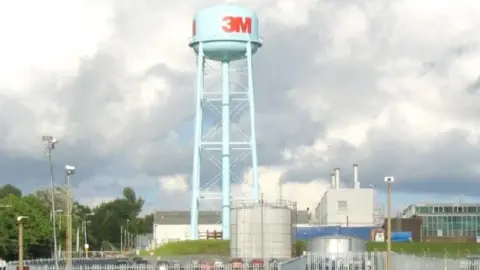
For decades it was 3M's biggest outside the US, and the factory made nappy fastenings and video tape.
Workers were exposed to toxic chemicals in firefighting foam
Anna Meiseland
Esme Stallard,BBC File on 4 Investigates
 Geograph/ Nigel Davies
Dozens of factory workers were exposed to toxic chemicals within firefighting foam over decades, BBC File on 4 Investigates can reveal.
Multi-billion-pound US manufacturer, 3M, failed to tell employees at its Swansea site they were using foam containing two forever chemicals, now classed as carcinogenic, despite knowing for decades of the health risks.
The company said it would stop manufacturing the forever chemicals – so called because they persist in the environment – in 2002, but failed to remove them from the factory resulting in an environmental accident four years later.
3M said that the health and safety of its workers and their families were "critical priorities" for the company.
The factory in Gorseinon, Swansea, opened in 1952 and for decades was 3M's largest outside of the US.
It employed more than 1,000 people from across south Wales to manufacture nappy fastenings and video tape.
In 2023, 3M made the decision to close the factory and applied for planning permission to redevelop the site.
BBC File on 4 Investigates discovered a land contamination report amongst hundreds of documents 3M submitted to the local council - it said the site is polluted with two toxic forever chemicals, PFOS and PFOA.
The company never manufactured the chemicals, part of the PFAS family of substances, at the site.
Its report said the chemicals came from "historic firefighting activities" using aqueous film-forming foam (AFFF) - a type of firefighting foam.
The BBC has tracked down those involved in firefighting on the site, who are speaking publicly for the first time.
Every year, a dozen workers at the factory were selected to take on an additional responsibility as members of the "fire party" at the factory.
"We were on the emergency squad, like part-time firemen," said Ian (not his real name).
He worked at the 3M factory for 40 years and was part of the fire party team.
"Once a month we did the training and we used to train putting out chemical fires," Ian added.
"They'd have a big tray full of chemicals, put a torch to it, set it up and then we used to use the light water then to put it out, it would come out like foam."
Light water is the 3M product name for AFFF, with Ian saying workers were not told anything about chemicals it may contain.
Levels of PFOS discovered in soil at the site in 2023 were listed in the report ranging from 50 to more than 1,500 micrograms per kilogram.
These upper levels are 500 times greater than the average in British soils.
Dr David Megson, an environmental scientist at Manchester Metropolitan University, told the BBC that these levels were a "cause for concern".
In a commercial setting he said levels above 600 micrograms may pose a risk to human health because of inhalation of dust and contact with the skin.
Members of the PFAS family of chemicals, specifically PFOA and PFOS, have been linked with a range of different adverse health conditions, Dr Megson said.
He added: "[They] can cause damage to the liver, cardiovascular system, immune system and in the developing foetus."
Both chemicals are now banned in the UK because they are toxic and do not break down easily in the environment.
In 2024, the World Health Organization (WHO) determined PFOA was carcinogenic and PFOS "possibly" carcinogenic to humans.
But 3M knew as early as the 1970s of the health risks of these chemicals to workers.

 Bastiaan Slabbers/Getty Images
In 1999, a major civil claim was made against 3M after people started becoming unwell from water contaminated with PFOS and PFOA in the United States.
During the case, internal 3M documents were released which showed the company recording elevated levels of PFAS in the blood of its workers and possible increases in cancer.
"[It] understood, going back many decades, the dangers of these chemicals," said Rob Bilott, partner at US firm Taft Law, who led that litigation.
"Animal studies started being done by [3M] in the 1960s that was showing incredible toxicity in multiple different animal species.
"Rats, mice, rabbits, guinea pigs, dogs, even monkeys were dropping dead by the late 1970s."
Cheryl's father worked for decades at the factory in Swansea, starting back in the 70s, and was also on the fire party.
"He was the provider. He always worked hard. He was at his happiest when he was with his family and his friends," said Cheryl (not her real name).
In his early 40s, he was diagnosed with kidney cancer and after treatment briefly returned to work before retiring at 50.
A few years later the cancer returned and Cheryl's dad died at the age of 54.
She said: "It was a shock because my father was always a big, strong man, so he was never ill. He never used to take time off sick from work."
Many things can cause kidney cancer, but research compiled by the World Health Organization has concluded the risk of kidney cancer is probably increased by significant exposure to PFOS and PFOA.
Dr Steve Hajioff is an epidemiologist and chairs an independent panel in Jersey looking into contamination of water supply by firefighting foam that also contains the chemicals manufactured by 3M.
It was set up by the government after residents fell ill.
"I do not think you can ever say that [it] is impossible it might be caused or made more likely by PFAS exposure," he said.
"But there are things where we can be pretty convinced, and those are things like kidney cancer, testicular cancer, less effective immunisations for children."
Cheryl said she cannot understand why the company knew of the risks and failed to test the blood of workers, adding: "Maybe some people who have passed away could have been diagnosed earlier and had treatment earlier."
This sentiment is echoed by Ian who said as the workers were never told of any risks, they did not wear breathing equipment and handled the foam in their factory overalls and wellies only.
"I'm not very happy about it," he said.
"I've always said they were a bit blasé about all the chemicals they were really using."
Ian also left the factory after being diagnosed with colon cancer after nearly four decades of service.
We do not know if Ian's exposure to the foams caused this.
The WHO said this year the evidence to link PFOS and PFOA to colon cancer remains unclear as there have not be enough cases identified.
When litigation began in the US, 3M announced publicly that it would stop manufacturing PFOS and PFOA in the US, and globally by 2002.
But BBC File on 4 Investigates found that even then workers in Swansea were not told of the health risks, and legacy foams were left on site.
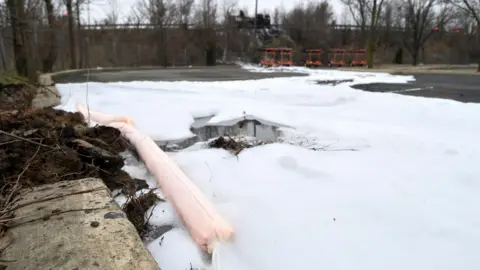
In October 2006, a major storm caused the system containing the foams to malfunction and release it on the site.
At this point, it was just a liquid, and workers thinking it was rain water, pumped it into the aeration pond – used to store wastewater.
John Bowers, the health and safety manager for the site at the time, said this suddenly created a serious problem.
"The aeration then created a huge amount of foam, which basically went from the pond basically up into the air," he said.
Mr Bowers told the BBC the storm was so strong it blew the foam on to Gorseinon high street.
He added: "It was described to me as if it was, excuse the phrase, like a foam party."
Mr Bowers said the workers managed to contain the foam and the next day called 3M headquarters in Minnesota - it was only at this point the company told him the foam contained the toxic chemical PFOS.
"I found it surprising that 3M didn't contact existing customers to make them aware of the potential hazards and also even more surprising that they didn't contact the 3M facilities," he said.
"I was disappointed."
The BBC submitted a freedom of information request to Swansea council and Natural Resources Wales, the environmental regulator, which revealed that this spill was not contained to the site but also contaminated a local waterway – Afon Lliw.
Test results also released to the BBC show that PFOS levels in the pond were at 1800 ug/L and in the local river were at 20ug/L.
Average levels above 0.00065ug/L in rivers and lakes are considered to be harmful to aquatic organisms – the levels in the river were 31,000 times higher than that.
A local farmer was recorded as complaining to the council at the time after seeing foam in the river and raising concerns for her cattle.
The company was warned by the regulator that it committed an offence under water regulations in force at the time, but was told it would not be prosecuted or fined.
Mr Bowers told the BBC after this 2006 incident that the pond filled with contaminated foam on the site was cleaned and drained.
But the planning application documents from 2023 say that the pond had filled back up and had very high levels of PFOS.
The contamination report said the pond might "have the potential to act as an ongoing source to the water environment".
In 2023, the pond's levels of PFOS were still at 21,000 times the recommended safe level for aquatic life.
3M has now remediated the pond and surrounding soil again, which was completed in recent months.
A 3M spokesperson told the BBC: "The health and safety of our employees, their families, and our communities, are critical priorities for 3M."
It said it had long since phased PFOS and PFOA out of its operations and has permanently discontinued production of this firefighting foam.
It told the BBC it would continue to deliver on its commitments – including remediating PFAS and collaborating with communities including by committing "to invest $1bn (£750m) globally in state-of-the-art water treatment technologies at sites where we have historically manufactured PFAS".
"Over decades, 3M has shared significant information about PFAS, including by publishing many of its findings regarding PFAS in publicly available scientific journals," it added.
- Ian and Cheryl are not their real names. Because of their concerns about speaking publicly their names have been changed.