Cookies help us run our site more efficiently.

By clicking “Accept”, you agree to the storing of cookies on your device to enhance site navigation, analyze site usage, and assist in our marketing efforts. View our Privacy Policy for more information or to customize your cookie preferences.

Where the sky keeps bursting

News Feed
Wednesday, November 12, 2025

McDOWELL COUNTY, W.Va. — Carol Lester remembers every flood.The epic one in 1977, when she fled over a mountain with her young children to avoid rising water. The deluges of 2001 and 2002, which left a trail of destruction in this area but somehow spared the modest house she and her husband have shared for more than a half century.But like many others who have spent their lives in the coalfields of southern West Virginia, she had never seen the likes of what arrived on a frigid day this past February. Days of rain sent the Tug Fork River surging from a relatively calm 6.8 feet to a raging 22.7 feet in just 10 hours, filling the river and its tributaries far beyond their banks.“It was like you could hear the devil and his demons in that water,” recalled Lester, 73, who endured a harrowing escape thanks to friends who came to the couple’s rescue. “I’ve never been so scared in my life.”“The next flood that comes, there might not be any house.”— Carol LesterAcross McDowell County, the rising water wrecked roads and bridges and left residents stranded. It swallowed cars and trucks, sent debris downstream, flooded homes and claimed three lives, including that of a 2-year-old boy. In the town of Welch, the flood swamped city hall, the library and the sheriff’s station. It also blocked the main road to the hospital.This time, the devastation carried the fingerprints of a mostly invisible but profound atmospheric shift: As the air gets warmer and wetter over time, states within central Appalachia lie within a region particularly vulnerable to the extreme rainfall and the flooding that often follows.To understand how that increasing moisture in the skies has driven these downpours, The Washington Post examined a metric called integrated vapor transport (IVT) — which characterizes where plumes are flowing from and their intensity. Across much of the planet in recent decades, the analysis has found rising temperatures and shifting wind patterns have waterlogged the atmosphere, raising the odds for more destructive, torrential rainstorms that can cause floods.That is true in swaths of the eastern United States, as well as parts of California and other states in the Intermountain West, where atmospheric rivers rising from the Pacific Ocean are slamming into the region with increasing force.But some hot spots in the American West and Northeast are wealthier and have homes and businesses distributed over a wider area, which help make them less vulnerable to punishing storms.In central Appalachia, the changes high above are exacerbating devastation below in an area where mountainous terrain, widespread poverty and infrastructure built along snaking waterways makes preparing for floods difficult — and recovering from them that much tougher.The broader hot spot in the East is one of the longest ones in the world — stretching about 2,000 miles from Florida to Newfoundland, an expanse that is home to roughly 131 million people.Trends dating to 1992 show that central Appalachia sits in an area where this conveyor belt of moisture has increased at some of the highest rates anywhere in the nation. A Post analysis of 75 years of rain gauge data for central Appalachia shows that the area now experiences about two more days of heavy rainfall each year, a 35 percent increase compared to 1950.And in central Appalachia — in a swath where around 8 million people live in cities like Knoxville, Tennessee; Asheville, North Carolina; and Charleston, West Virginia — warming waters in the Gulf create plumes that repeatedly flow across the mountainous region. In West Virginia and Kentucky, for example, around 79 and 93 percent of land area respectively has seen moisture flows increase significantly, repeatedly driving heavy rain.Sometimes, heavy rains that hit these hot spots come as a relief, helping to break droughts. But more often, they arrive as the kind of deluges that can trigger damaging floods.Josh Gibson rides his bike in Welch. (Tom Brenner/For The Washington Post)Again and again in recent years, some of central Appalachia’s most devastating disasters have unfolded during periods when plumes of intensely moist air fueled catastrophic rainfall.Such moisture drove the storms in southern West Virginia earlier this year and those the year before. It helped to fuel 2022 floods in eastern Kentucky and April’s floods in northern and western Kentucky. A historic storm battered much of West Virginia in 2016, when as much as 7 inches of rain fell over a period of 24 hours, with flash floods killing at least 23 across the state.The region’s floods have claimed nearly 300 lives since 2000, on average about a dozen per year, a Post analysis of National Weather Service storm events data found.The trend shows no signs of slowing. As long as the planet keeps warming, the atmosphere’s capacity to hold water will increase — at about 4 percent per degree Fahrenheit.Chart showing heavy rain days in Central Appalachia“It’s going to continue to intensify and get worse, and it’s going to happen more frequently,” said Nicolas Zegre, director of the Mountain Hydrology Lab at West Virginia University, whose work is focused on trying to help communities in the region become more resilient to extreme weather events.“We are underprepared in so many ways.”But preparation is complicated, and not just because it’s hard to predict where the next flood will hit.So much of what humans have built in Appalachia is susceptible. That includes homes, businesses, railroad tracks and fire stations.According to the West Virginia Flood Resiliency Framework created by researchers at WVU, the state has more than 80,000 structures that lie in a zone deemed high-risk by the Federal Emergency Management Agency. Nearly 200,000 residents also live in these areas.And other factors, including waterways that have long been choked with debris, only exacerbate the rain’s impact.Flooding, Zegre and others are quick to note, is just one of the many challenges of life here and elsewhere in Appalachia. The area is among the poorest in the nation. It has endured the opioid epidemic, population loss and the decline of the coal industry.“Before the disaster even strikes, communities are already stressed,” Zegre said. “There’s food insecurity, there’s drinking water insecurity, there’s employment insecurity, there’s poor public health.”All that combined, he said, leaves many Appalachian communities “in a precarious place.”Children play in a pool on Summers Street in Welch. (Tom Brenner/The Washington Post)Many of the buildings in Welch lie in areas considered at high risk of flooding by the Federal Emergency Management Agency. (Tom Brenner/For The Washington Post)Linda Lou Woods stands outside her back door where a watermark is still visible from the February flooding. (Tom Brenner/For The Washington Post)Carol Lester is among the stressed, wondering what lies ahead.“This one, it wasn’t normal,” she said of the February storm one afternoon in the living room with donated furniture and the new floor her brother had installed to replace what got ruined. “The water came down so fast, and then it rose so fast. … There was water coming from places I’ve never seen water come from.”She and her husband, John, are back in their home. But even as she says how grateful she is for that, she gestures at the water line still visible on her front door, and the babbling brook out front.“The next flood that comes, there might not be any house.”‘Ground zero for flooding’So many floods have hit the region in recent years, they have become impossible to ignore.“It rains harder and more often than any time I can remember,” said Rodney Fouch, the city manager in Morehead, Kentucky, 60 miles east of Lexington. “We get closer [to flooding] a lot more often.”That was evident last year, when Hurricane Helene dumped biblical rains across five southern Appalachian states. Most deadly in western North Carolina, the floods that followed also killed residents, destroyed homes and wrecked roads in South Carolina, Tennessee, Virginia, Georgia and Florida.“If we can’t use the rainy day fund for a literal rainy day, why does it even exist? If we can’t use it for an actual emergency, then why do we have it?”— Rev. Brad DavisWhen the flooding hit southern West Virginia in February, the rains also sent rivers rising through Tennessee, Virginia and eastern Kentucky, where nearly two dozen people died. The storm brought reminders of Kentucky’s 2022 flood.“It happens so often now, you kind of forget the year and the time,” Fouch said.If there’s a bull’s eye to the Appalachian flooding hot spot, it’s the hollers where Kentucky meets West Virginia.Map key explaining the colors on the following map representing the share of properties in U.S. counties facing risk of extreme damage from floodingMap showing the share of homes at risk of extreme damage from flooding in U.S. counties. 29% of homes in McDowell County, West Virginia are at risk. Data on the map is from Cotality.Of the 16 U.S. counties that have experienced the most frequent federally declared flooding disasters since 2004, 11 of them are in Kentucky, according to a Post analysis of FEMA disaster declarations. In three of those Kentucky counties, there has been an average of one federally declared flooding disaster every year for the past two decades.Especially in eastern Kentucky, floodplains tend to be among the only places flat enough for towns to grow, said Brian Storz, the Licking River basin coordinator for the Kentucky Division of Water.“We’re kind of ground zero for flooding,” Storz said.There, and in other parts of Appalachia, that recognition is starting to spur more action.In the hardest-hit Kentucky counties, the U.S. Army Corps of Engineers launched a study this year of how to lower flood risks in the future, whether through infrastructure like dams or levees, or measures such as buyouts of at-risk buildings. The study process typically takes three years, but could take longer given that it covers such a large area, said Laura Mattingly, chief of the planning formulation division of the Army Corps’ Louisville district office.West Virginia will soon embark on two similar studies, its governor announced this summer, nearly a decade after the crippling 2016 floods that spurred calls for ways to protect vulnerable valley towns.A resident of Welch shovels out mud from a damaged downtown apartment building basement. (Tom Brenner/For The Washington Post)Officials have been working for years on a project that would guard the West Virginia town of Milton from floodwaters flowing out of the Mud River. And they have acknowledged the project’s rising importance, estimating that if it experienced what is considered a 100-year flood event, waters would inundate some 650 buildings.In east Tennessee, there are efforts to plant hundreds of trees across the barren stretches of packed soil where mines once stood, so that more rain is absorbed into the soil instead of flowing into the Cumberland River. It flows to Nashville, where there are also efforts to increase tree cover and remove pavement to reduce runoff, said Mekayle Houghton, executive director of the Cumberland River Compact.The hope is that, even if the efforts cannot stop the most disastrous flooding, they can limit the damage, Houghton said.In Kentucky, there are ongoing efforts to build entire new communities at higher ground — in some cases, atop former mines. Researchers also are working to develop improved warning systems to detect signs of floods earlier.Scientists have estimated that for every mile of any steadily flowing stream, there are about 10 miles of ephemeral streams that feed it, said Christopher Barton, a professor of forest hydrology and watershed management at the University of Kentucky.Such streams are shallow, narrow and usually dry gullies, and they quickly fill up in a downpour. When many of these small tributaries begin gushing into rivers at once, even the larger waterways can rise quickly and overflow their banks.When a torrent comes, Barton said, “It doesn’t take long to overwhelm those systems.”An abandoned house along the hillside overlooking downtown Welch and the Tug River. (Tom Brenner/For The Washington Post)In eastern Kentucky, some communities are mulling projects that could lower floodwaters by even a few inches. Storz is working with nearly two dozen towns and county governments on plans to widen and deepen floodplains to allow for water that perennially overflows from tributaries of the Licking River.Engineering estimates suggest that in Morehead, that effort could lower floodwaters by at least a few inches, Fouch said.“Two inches doesn’t sound like a lot, unless you’ve had 2 inches in your house before,” he said.You won’t find better people,” Howard Short, who has lived on Summers Street since the 1970s, said of his neighbors in Welch. (Tom Brenner/For The Washington Post)Clothing on a tree branch on Elkhorn Creek. (Tom Brenner/For The Washington Post)Work to explore the idea, which organizers have dubbed “green sinks,” is funded through FEMA grants that have been frozen by the Trump administration.For now, state and local officials are left hoping the agency will still be able to help the project move to the engineering and construction phase, or that some other source of funding will materialize.Trying to prevent ‘so many heartaches’On a Friday in early April, lawmakers in West Virginia’s capital paused for a moment of prayer for flood victims in the state.House Minority Leader Sean Hornbuckle (D-Cabell) soon rose. Prayers alone were not enough, he said. “We have the ability to do something earthly.”He had proposed to set aside $250 million — with half of it coming from the state’s $1.4 billion rainy day fund — to help communities in the state better prepare for floods. When that failed, he led an effort to earmark $50 million in the state budget to go toward flood mitigation projects. That proposal failed, too.“It’s just the worry of, is it going to happen again?”— Linda PearsonFor Hornbuckle, there is an economic argument to be made that the state could avoid costly flood damages on the back end with some up-front investment, as well as lessen unemployment and job loss. But also, he said, “It’s a moral issue. We have the obligation as a state to help our residents when they are in need.”But his efforts, like those before, so far have foundered. In 2023, with the backing of then-Gov. Jim Justice (R), lawmakers had created a Flood Resiliency Trust Fund intended to help struggling communities adapt and prepare for the flood risks.Years later, the trust has yet to be funded.Gov. Patrick Morrisey (R), whose office did not respond to requests for comment, has acknowledged more extreme rainfall will come. He said he wants to ensure the state is learning from each flood, using damage assessments and post-disaster reviews to guide preparations for the next catastrophe.But he also has stressed how difficult those preparations can be.“It’s pretty unbelievable,” he said during a June news conference after yet another deadly bout of flooding struck northern parts of the state, adding, “You could have large areas where there’s some rain but then in one concentrated area it’s a torrential downpour, and you’re seeing massive quantities of water dumped. It’s just Mother Nature at its worst. And so, it’s not something that’s easy to foresee.”Welch’s downtown, which sits at the confluence of the Tug Fork River and a creek, is particularly flood-prone. (Tom Brenner/For The Washington Post)Dried mud from the February flood seen through a downtown storefront window. (Tom Brenner/For The Washington Post)Shawn Rutherford talks about the floodwaters that tore through his home in February in Berwind. 'If it does it again, I'm done,' he said. 'I'm out of here.' (Tom Brenner/For The Washington Post)As lawmakers debated in the state capital and flooding plagued other parts of the state and region, recovery remained a struggle in McDowell County.Long after the February floods, piles of debris and ruined appliances sat stacked in yards and driveways. Many houses remained unlivable or in various states of disrepair. Some residents decided to forego planting gardens over the summer, fearful of what contaminated floodwaters had left behind.The looming threat of future floods only compounds the unease. In the small community of Berwind, Linda Pearson keeps jugs of bleach on her basement stairs as she tries to keep the mold at bay and continues to eye a nearby creek.A downed utility pole near Lester's residence on June 3, months after the floods. (Tom Brenner/For The Washington Post)She finds it hard to rest when it rains and stays awake watching the creek that not long ago swallowed part of her home. “I have a bag packed, and I keep it by our bed,” she said.The Rev. Brad Davis, who pastors five local United Methodist congregations, has been displaced ever since he fled the rising waters inside his Welch home on Lake Drive. It was built in 1950, but until this year had never flooded on the main living area. For now, he still lives in a spare apartment owned by one of his parishioners.“I’m not a scientist, but it seems to me as though the amount of rain being dumped is increasing in a much shorter time window,” said Davis, who grew up in nearby Mingo County.He has been an outspoken critic of the state’s lack of action, and has pushed lawmakers in Charleston to fund the state’s flood resiliency efforts.“We have got to do some things to help ourselves, because it’s going to happen again.”— Mayor Harold McBride“If we can’t use the rainy day fund for a literal rainy day, why does it even exist?” he said. “If we can’t use it for an actual emergency, then why do we have it?”Welch Mayor Harold McBride said he has written to state officials too, asking for more money to build flood walls and an overpass along an especially problematic road in town.At the same time, McBride said, people here take pride in their ability to carry on and persist without outside help. Even the mayor has spent the months since the February flood helping to rebuild parts of town himself — on a June day, he was part of a crew racing to restore the Coaltown Creamery, a city-run ice cream shop, ahead of a weekend festival in town.A young neighborhood resident points to an elevated, occupied home along the Riverside Drive hill in Welch. (Tom Brenner/For The Washington Post)Still, he is hopeful help will come — from the governor, from FEMA, from anywhere. But he also knows residents can’t wait around for support that might never arrive, that they must figure out how to better protect this place from the water that can change so much in a flash.“In the past, the only thing we do is shovel the mud and forget about it,” he said. “But we have got to do some things to help ourselves prepare, because it’s going to happen again.”About this storyStory editing by Paulina Firozi, Simon Ducroquet, Anu Narayanswamy and Katie Zezima. Additional editing by Juliet Eilperin. Photo editing by Dominique Hildebrand. Video editing by John Farrell. Copy editing by Gaby Morera Di Núbila.Design and development by Talia Trackim and Hailey Haymond. Design editing by Betty Chavarria.MethodologyTo examine trends in heavy rainfall The Post analyzed 75 years of rain gauge data from 28 stations in three central subregions of Appalachia produced by NOAA’s National Centers for Environmental Information. The area encompasses all of West Virginia and portions of Ohio, Kentucky, Virginia, North Carolina and Tennessee.To define what counts as a heavy rainfall day, The Post used the period from 1950 to 1989 as the base for determining the 95th percentile precipitation event at each station. Days with at least 0.5 millimeters of precipitation were included. Using a simple linear regression, The Post measured the change in frequency of the 95th percentile rain events at each station from 1950 to 2024.The analysis showed a significant positive trend in 95th percentile rain events in the central regions of Appalachia, where the number of days each year with heavy rainfall has increased by two, a 35 percent increase.To investigate global changes in extreme precipitation, The Post measured the amount of water vapor flowing through Earth’s atmosphere, a metric called integrated vapor transport (IVT). The analysis also identified days and locations where heavy rainfall coincided with high IVT. See more about The Post’s methodology for the IVT analysis here.

Read more

McDOWELL COUNTY, W.Va. — Carol Lester remembers every flood.

The epic one in 1977, when she fled over a mountain with her young children to avoid rising water. The deluges of 2001 and 2002, which left a trail of destruction in this area but somehow spared the modest house she and her husband have shared for more than a half century.

But like many others who have spent their lives in the coalfields of southern West Virginia, she had never seen the likes of what arrived on a frigid day this past February. Days of rain sent the Tug Fork River surging from a relatively calm 6.8 feet to a raging 22.7 feet in just 10 hours, filling the river and its tributaries far beyond their banks.

“It was like you could hear the devil and his demons in that water,” recalled Lester, 73, who endured a harrowing escape thanks to friends who came to the couple’s rescue. “I’ve never been so scared in my life.”

“The next flood that comes, there might not be any house.”

— Carol Lester

Across McDowell County, the rising water wrecked roads and bridges and left residents stranded. It swallowed cars and trucks, sent debris downstream, flooded homes and claimed three lives, including that of a 2-year-old boy. In the town of Welch, the flood swamped city hall, the library and the sheriff’s station. It also blocked the main road to the hospital.

This time, the devastation carried the fingerprints of a mostly invisible but profound atmospheric shift: As the air gets warmer and wetter over time, states within central Appalachia lie within a region particularly vulnerable to the extreme rainfall and the flooding that often follows.

To understand how that increasing moisture in the skies has driven these downpours, The Washington Post examined a metric called integrated vapor transport (IVT) — which characterizes where plumes are flowing from and their intensity. Across much of the planet in recent decades, the analysis has found rising temperatures and shifting wind patterns have waterlogged the atmosphere, raising the odds for more destructive, torrential rainstorms that can cause floods.

That is true in swaths of the eastern United States, as well as parts of California and other states in the Intermountain West, where atmospheric rivers rising from the Pacific Ocean are slamming into the region with increasing force.

But some hot spots in the American West and Northeast are wealthier and have homes and businesses distributed over a wider area, which help make them less vulnerable to punishing storms.

In central Appalachia, the changes high above are exacerbating devastation below in an area where mountainous terrain, widespread poverty and infrastructure built along snaking waterways makes preparing for floods difficult — and recovering from them that much tougher.

The broader hot spot in the East is one of the longest ones in the world — stretching about 2,000 miles from Florida to Newfoundland, an expanse that is home to roughly 131 million people.

Trends dating to 1992 show that central Appalachia sits in an area where this conveyor belt of moisture has increased at some of the highest rates anywhere in the nation. A Post analysis of 75 years of rain gauge data for central Appalachia shows that the area now experiences about two more days of heavy rainfall each year, a 35 percent increase compared to 1950.

And in central Appalachia — in a swath where around 8 million people live in cities like Knoxville, Tennessee; Asheville, North Carolina; and Charleston, West Virginia — warming waters in the Gulf create plumes that repeatedly flow across the mountainous region. In West Virginia and Kentucky, for example, around 79 and 93 percent of land area respectively has seen moisture flows increase significantly, repeatedly driving heavy rain.

Sometimes, heavy rains that hit these hot spots come as a relief, helping to break droughts. But more often, they arrive as the kind of deluges that can trigger damaging floods.
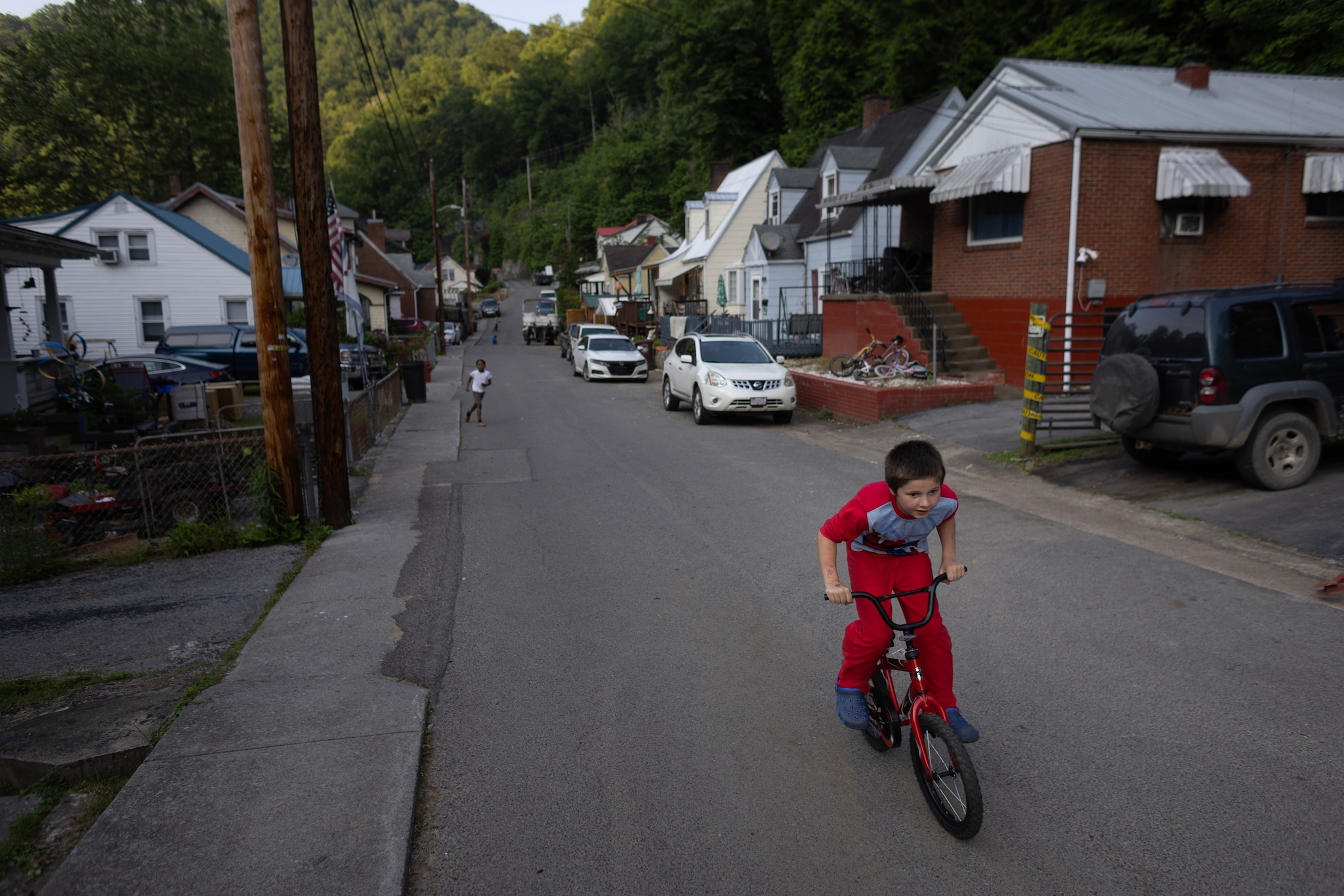
Josh Gibson rides his bike in Welch. (Tom Brenner/For The Washington Post)

Again and again in recent years, some of central Appalachia’s most devastating disasters have unfolded during periods when plumes of intensely moist air fueled catastrophic rainfall.

Such moisture drove the storms in southern West Virginia earlier this year and those the year before. It helped to fuel 2022 floods in eastern Kentucky and April’s floods in northern and western Kentucky. A historic storm battered much of West Virginia in 2016, when as much as 7 inches of rain fell over a period of 24 hours, with flash floods killing at least 23 across the state.

The region’s floods have claimed nearly 300 lives since 2000, on average about a dozen per year, a Post analysis of National Weather Service storm events data found.

The trend shows no signs of slowing. As long as the planet keeps warming, the atmosphere’s capacity to hold water will increase — at about 4 percent per degree Fahrenheit.

Chart showing heavy rain days in Central Appalachia

“It’s going to continue to intensify and get worse, and it’s going to happen more frequently,” said Nicolas Zegre, director of the Mountain Hydrology Lab at West Virginia University, whose work is focused on trying to help communities in the region become more resilient to extreme weather events.

“We are underprepared in so many ways.”

But preparation is complicated, and not just because it’s hard to predict where the next flood will hit.

So much of what humans have built in Appalachia is susceptible. That includes homes, businesses, railroad tracks and fire stations.

According to the West Virginia Flood Resiliency Framework created by researchers at WVU, the state has more than 80,000 structures that lie in a zone deemed high-risk by the Federal Emergency Management Agency. Nearly 200,000 residents also live in these areas.

And other factors, including waterways that have long been choked with debris, only exacerbate the rain’s impact.

Flooding, Zegre and others are quick to note, is just one of the many challenges of life here and elsewhere in Appalachia. The area is among the poorest in the nation. It has endured the opioid epidemic, population loss and the decline of the coal industry.

“Before the disaster even strikes, communities are already stressed,” Zegre said. “There’s food insecurity, there’s drinking water insecurity, there’s employment insecurity, there’s poor public health.”

All that combined, he said, leaves many Appalachian communities “in a precarious place.”

Children play in a pool on Summers Street in Welch. (Tom Brenner/The Washington Post)
Many of the buildings in Welch lie in areas considered at high risk of flooding by the Federal Emergency Management Agency. (Tom Brenner/For The Washington Post)
Linda Lou Woods stands outside her back door where a watermark is still visible from the February flooding. (Tom Brenner/For The Washington Post)

Carol Lester is among the stressed, wondering what lies ahead.

“This one, it wasn’t normal,” she said of the February storm one afternoon in the living room with donated furniture and the new floor her brother had installed to replace what got ruined. “The water came down so fast, and then it rose so fast. … There was water coming from places I’ve never seen water come from.”

She and her husband, John, are back in their home. But even as she says how grateful she is for that, she gestures at the water line still visible on her front door, and the babbling brook out front.

“The next flood that comes, there might not be any house.”

‘Ground zero for flooding’

So many floods have hit the region in recent years, they have become impossible to ignore.

“It rains harder and more often than any time I can remember,” said Rodney Fouch, the city manager in Morehead, Kentucky, 60 miles east of Lexington. “We get closer [to flooding] a lot more often.”

That was evident last year, when Hurricane Helene dumped biblical rains across five southern Appalachian states. Most deadly in western North Carolina, the floods that followed also killed residents, destroyed homes and wrecked roads in South Carolina, Tennessee, Virginia, Georgia and Florida.

“If we can’t use the rainy day fund for a literal rainy day, why does it even exist? If we can’t use it for an actual emergency, then why do we have it?”

— Rev. Brad Davis

When the flooding hit southern West Virginia in February, the rains also sent rivers rising through Tennessee, Virginia and eastern Kentucky, where nearly two dozen people died. The storm brought reminders of Kentucky’s 2022 flood.

“It happens so often now, you kind of forget the year and the time,” Fouch said.

If there’s a bull’s eye to the Appalachian flooding hot spot, it’s the hollers where Kentucky meets West Virginia.

Map key explaining the colors on the following map representing the share of properties in U.S. counties facing risk of extreme damage from flooding

Map showing the share of homes at risk of extreme damage from flooding in U.S. counties. 29% of homes in McDowell County, West Virginia are at risk. Data on the map is from Cotality.

Of the 16 U.S. counties that have experienced the most frequent federally declared flooding disasters since 2004, 11 of them are in Kentucky, according to a Post analysis of FEMA disaster declarations. In three of those Kentucky counties, there has been an average of one federally declared flooding disaster every year for the past two decades.

Especially in eastern Kentucky, floodplains tend to be among the only places flat enough for towns to grow, said Brian Storz, the Licking River basin coordinator for the Kentucky Division of Water.

“We’re kind of ground zero for flooding,” Storz said.

There, and in other parts of Appalachia, that recognition is starting to spur more action.

In the hardest-hit Kentucky counties, the U.S. Army Corps of Engineers launched a study this year of how to lower flood risks in the future, whether through infrastructure like dams or levees, or measures such as buyouts of at-risk buildings. The study process typically takes three years, but could take longer given that it covers such a large area, said Laura Mattingly, chief of the planning formulation division of the Army Corps’ Louisville district office.

West Virginia will soon embark on two similar studies, its governor announced this summer, nearly a decade after the crippling 2016 floods that spurred calls for ways to protect vulnerable valley towns.

A resident of Welch shovels out mud from a damaged downtown apartment building basement. (Tom Brenner/For The Washington Post)

Officials have been working for years on a project that would guard the West Virginia town of Milton from floodwaters flowing out of the Mud River. And they have acknowledged the project’s rising importance, estimating that if it experienced what is considered a 100-year flood event, waters would inundate some 650 buildings.

In east Tennessee, there are efforts to plant hundreds of trees across the barren stretches of packed soil where mines once stood, so that more rain is absorbed into the soil instead of flowing into the Cumberland River. It flows to Nashville, where there are also efforts to increase tree cover and remove pavement to reduce runoff, said Mekayle Houghton, executive director of the Cumberland River Compact.

The hope is that, even if the efforts cannot stop the most disastrous flooding, they can limit the damage, Houghton said.

In Kentucky, there are ongoing efforts to build entire new communities at higher ground — in some cases, atop former mines. Researchers also are working to develop improved warning systems to detect signs of floods earlier.

Scientists have estimated that for every mile of any steadily flowing stream, there are about 10 miles of ephemeral streams that feed it, said Christopher Barton, a professor of forest hydrology and watershed management at the University of Kentucky.

Such streams are shallow, narrow and usually dry gullies, and they quickly fill up in a downpour. When many of these small tributaries begin gushing into rivers at once, even the larger waterways can rise quickly and overflow their banks.

When a torrent comes, Barton said, “It doesn’t take long to overwhelm those systems.”
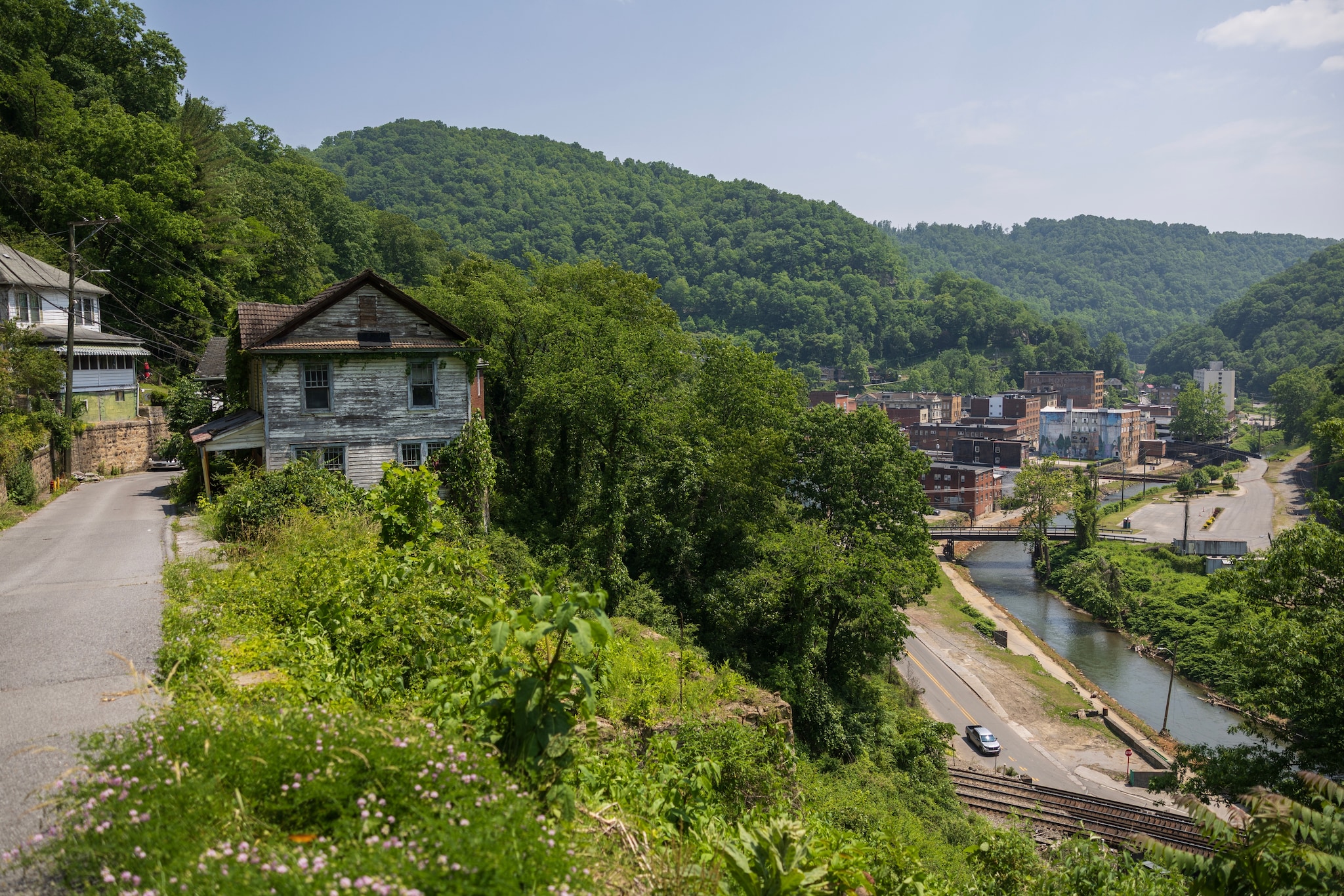
An abandoned house along the hillside overlooking downtown Welch and the Tug River. (Tom Brenner/For The Washington Post)

In eastern Kentucky, some communities are mulling projects that could lower floodwaters by even a few inches. Storz is working with nearly two dozen towns and county governments on plans to widen and deepen floodplains to allow for water that perennially overflows from tributaries of the Licking River.

Engineering estimates suggest that in Morehead, that effort could lower floodwaters by at least a few inches, Fouch said.

“Two inches doesn’t sound like a lot, unless you’ve had 2 inches in your house before,” he said.
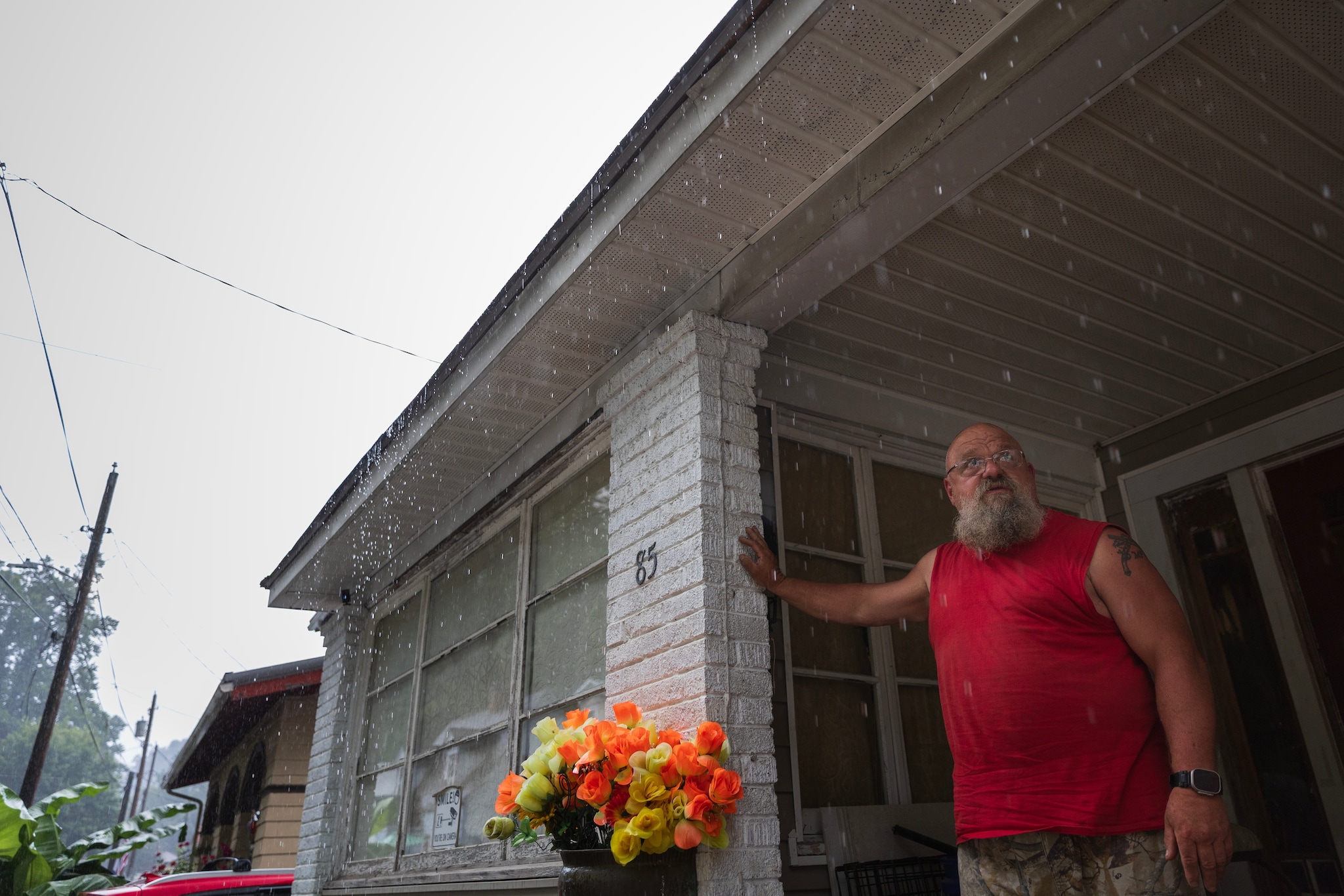
You won’t find better people,” Howard Short, who has lived on Summers Street since the 1970s, said of his neighbors in Welch. (Tom Brenner/For The Washington Post)
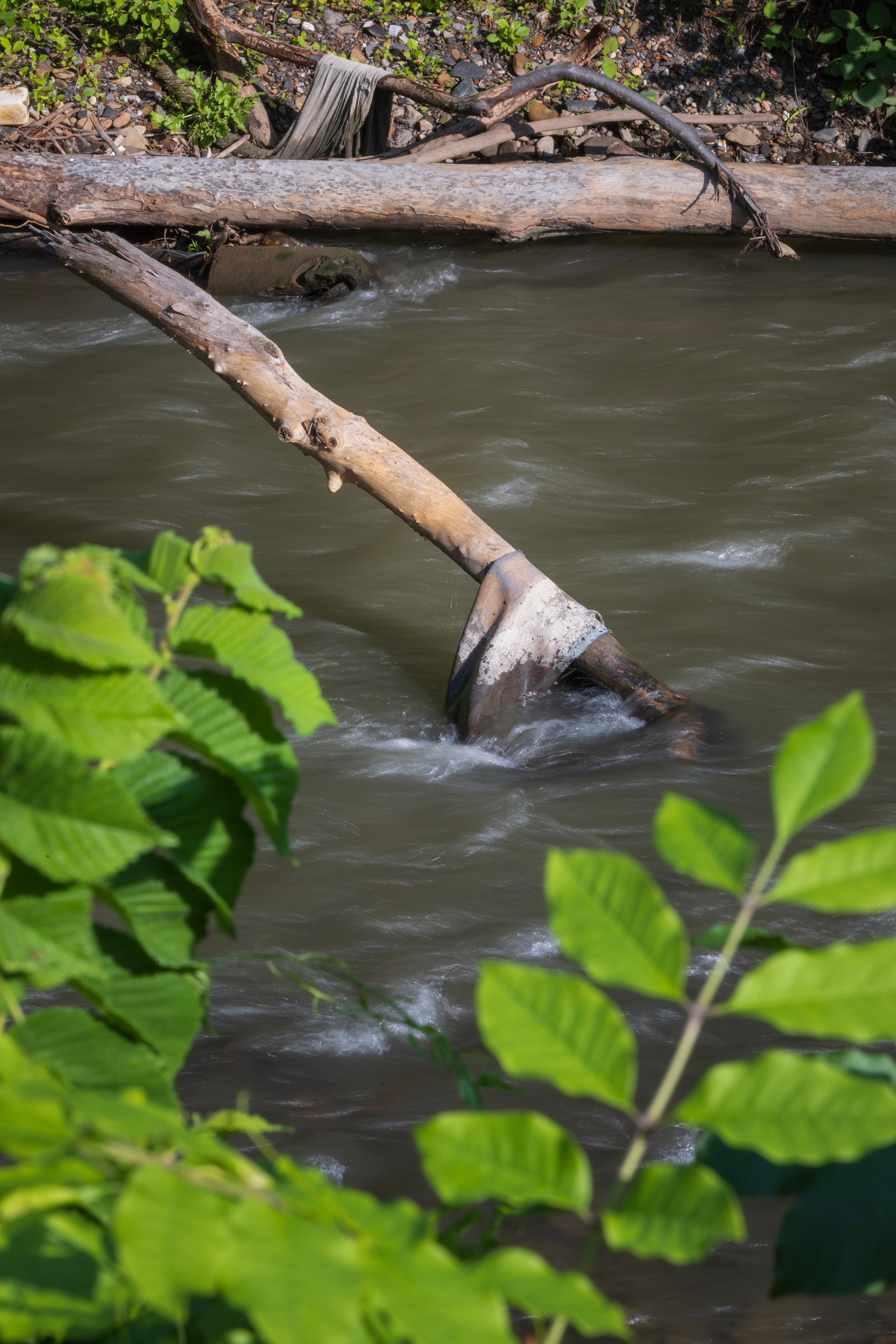
Clothing on a tree branch on Elkhorn Creek. (Tom Brenner/For The Washington Post)

Work to explore the idea, which organizers have dubbed “green sinks,” is funded through FEMA grants that have been frozen by the Trump administration.

For now, state and local officials are left hoping the agency will still be able to help the project move to the engineering and construction phase, or that some other source of funding will materialize.

Trying to prevent ‘so many heartaches’

On a Friday in early April, lawmakers in West Virginia’s capital paused for a moment of prayer for flood victims in the state.

House Minority Leader Sean Hornbuckle (D-Cabell) soon rose. Prayers alone were not enough, he said. “We have the ability to do something earthly.”

He had proposed to set aside $250 million — with half of it coming from the state’s $1.4 billion rainy day fund — to help communities in the state better prepare for floods. When that failed, he led an effort to earmark $50 million in the state budget to go toward flood mitigation projects. That proposal failed, too.

“It’s just the worry of, is it going to happen again?”

— Linda Pearson

For Hornbuckle, there is an economic argument to be made that the state could avoid costly flood damages on the back end with some up-front investment, as well as lessen unemployment and job loss. But also, he said, “It’s a moral issue. We have the obligation as a state to help our residents when they are in need.”

But his efforts, like those before, so far have foundered. In 2023, with the backing of then-Gov. Jim Justice (R), lawmakers had created a Flood Resiliency Trust Fund intended to help struggling communities adapt and prepare for the flood risks.

Years later, the trust has yet to be funded.

Gov. Patrick Morrisey (R), whose office did not respond to requests for comment, has acknowledged more extreme rainfall will come. He said he wants to ensure the state is learning from each flood, using damage assessments and post-disaster reviews to guide preparations for the next catastrophe.

But he also has stressed how difficult those preparations can be.

“It’s pretty unbelievable,” he said during a June news conference after yet another deadly bout of flooding struck northern parts of the state, adding, “You could have large areas where there’s some rain but then in one concentrated area it’s a torrential downpour, and you’re seeing massive quantities of water dumped. It’s just Mother Nature at its worst. And so, it’s not something that’s easy to foresee.”
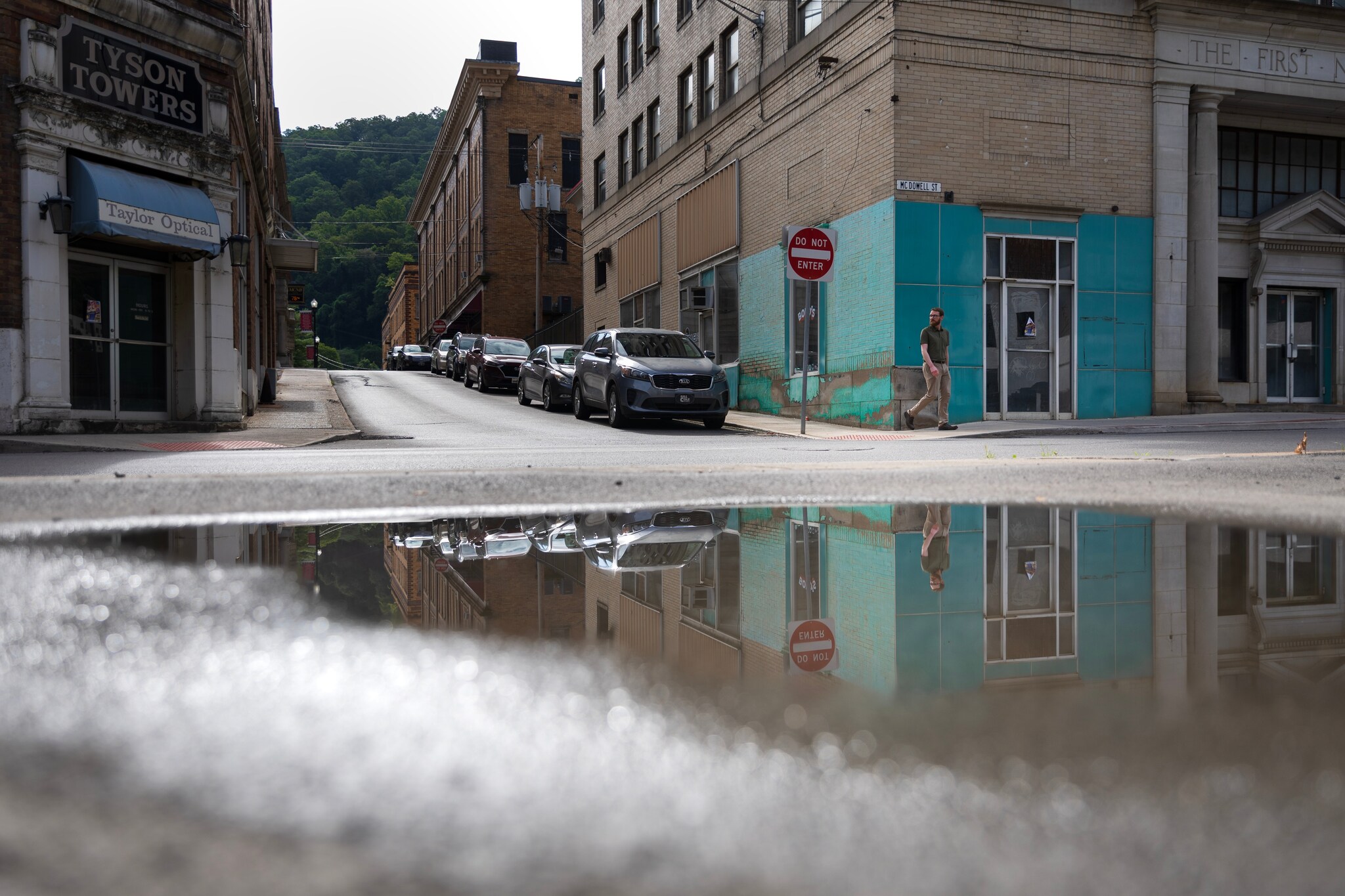

Welch’s downtown, which sits at the confluence of the Tug Fork River and a creek, is particularly flood-prone. (Tom Brenner/For The Washington Post)
Dried mud from the February flood seen through a downtown storefront window. (Tom Brenner/For The Washington Post)
Shawn Rutherford talks about the floodwaters that tore through his home in February in Berwind. 'If it does it again, I'm done,' he said. 'I'm out of here.' (Tom Brenner/For The Washington Post)

As lawmakers debated in the state capital and flooding plagued other parts of the state and region, recovery remained a struggle in McDowell County.

Long after the February floods, piles of debris and ruined appliances sat stacked in yards and driveways. Many houses remained unlivable or in various states of disrepair. Some residents decided to forego planting gardens over the summer, fearful of what contaminated floodwaters had left behind.

The looming threat of future floods only compounds the unease. In the small community of Berwind, Linda Pearson keeps jugs of bleach on her basement stairs as she tries to keep the mold at bay and continues to eye a nearby creek.
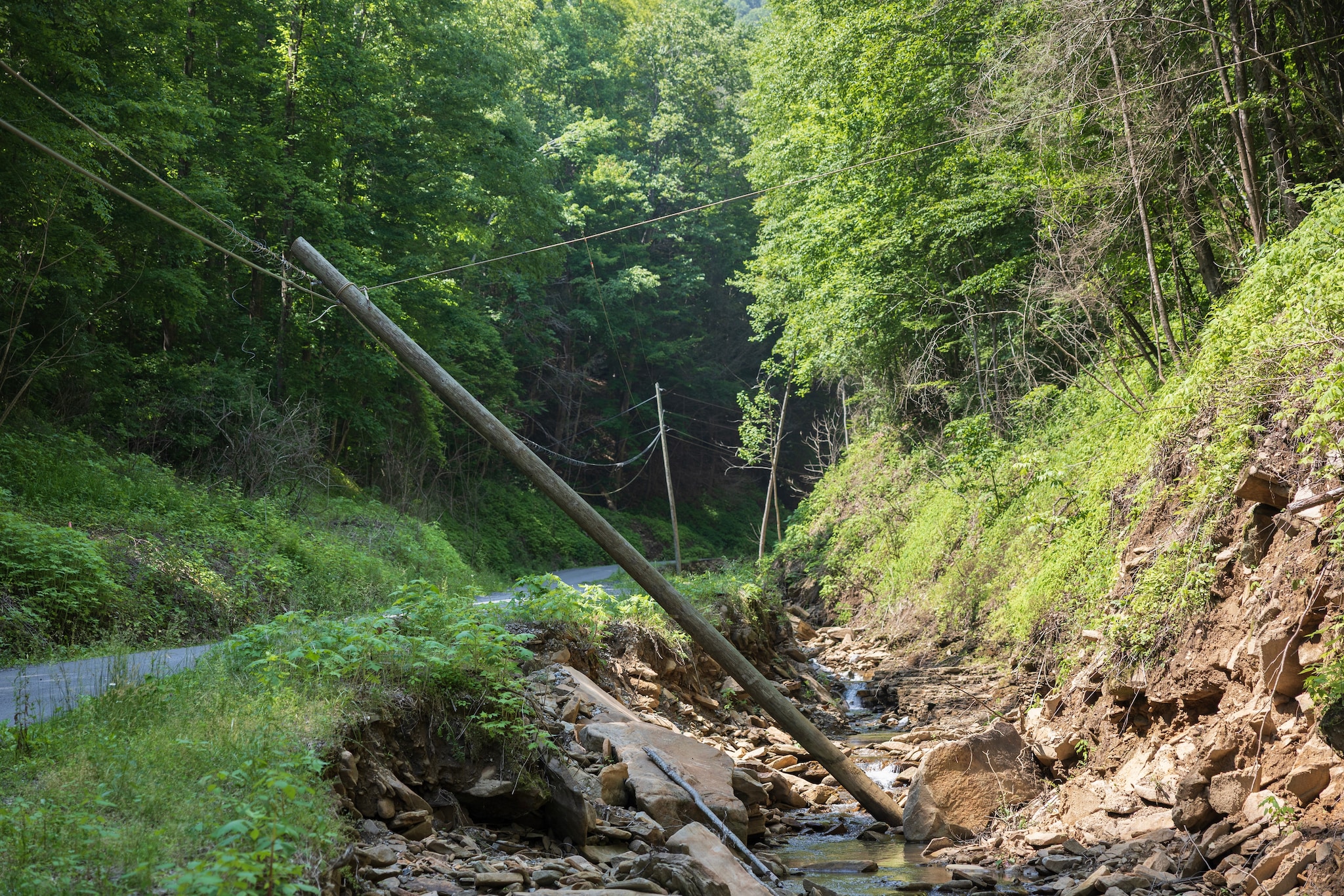
A downed utility pole near Lester's residence on June 3, months after the floods. (Tom Brenner/For The Washington Post)

She finds it hard to rest when it rains and stays awake watching the creek that not long ago swallowed part of her home. “I have a bag packed, and I keep it by our bed,” she said.

The Rev. Brad Davis, who pastors five local United Methodist congregations, has been displaced ever since he fled the rising waters inside his Welch home on Lake Drive. It was built in 1950, but until this year had never flooded on the main living area. For now, he still lives in a spare apartment owned by one of his parishioners.

“I’m not a scientist, but it seems to me as though the amount of rain being dumped is increasing in a much shorter time window,” said Davis, who grew up in nearby Mingo County.

He has been an outspoken critic of the state’s lack of action, and has pushed lawmakers in Charleston to fund the state’s flood resiliency efforts.

“We have got to do some things to help ourselves, because it’s going to happen again.”

— Mayor Harold McBride

“If we can’t use the rainy day fund for a literal rainy day, why does it even exist?” he said. “If we can’t use it for an actual emergency, then why do we have it?”

Welch Mayor Harold McBride said he has written to state officials too, asking for more money to build flood walls and an overpass along an especially problematic road in town.

At the same time, McBride said, people here take pride in their ability to carry on and persist without outside help. Even the mayor has spent the months since the February flood helping to rebuild parts of town himself — on a June day, he was part of a crew racing to restore the Coaltown Creamery, a city-run ice cream shop, ahead of a weekend festival in town.
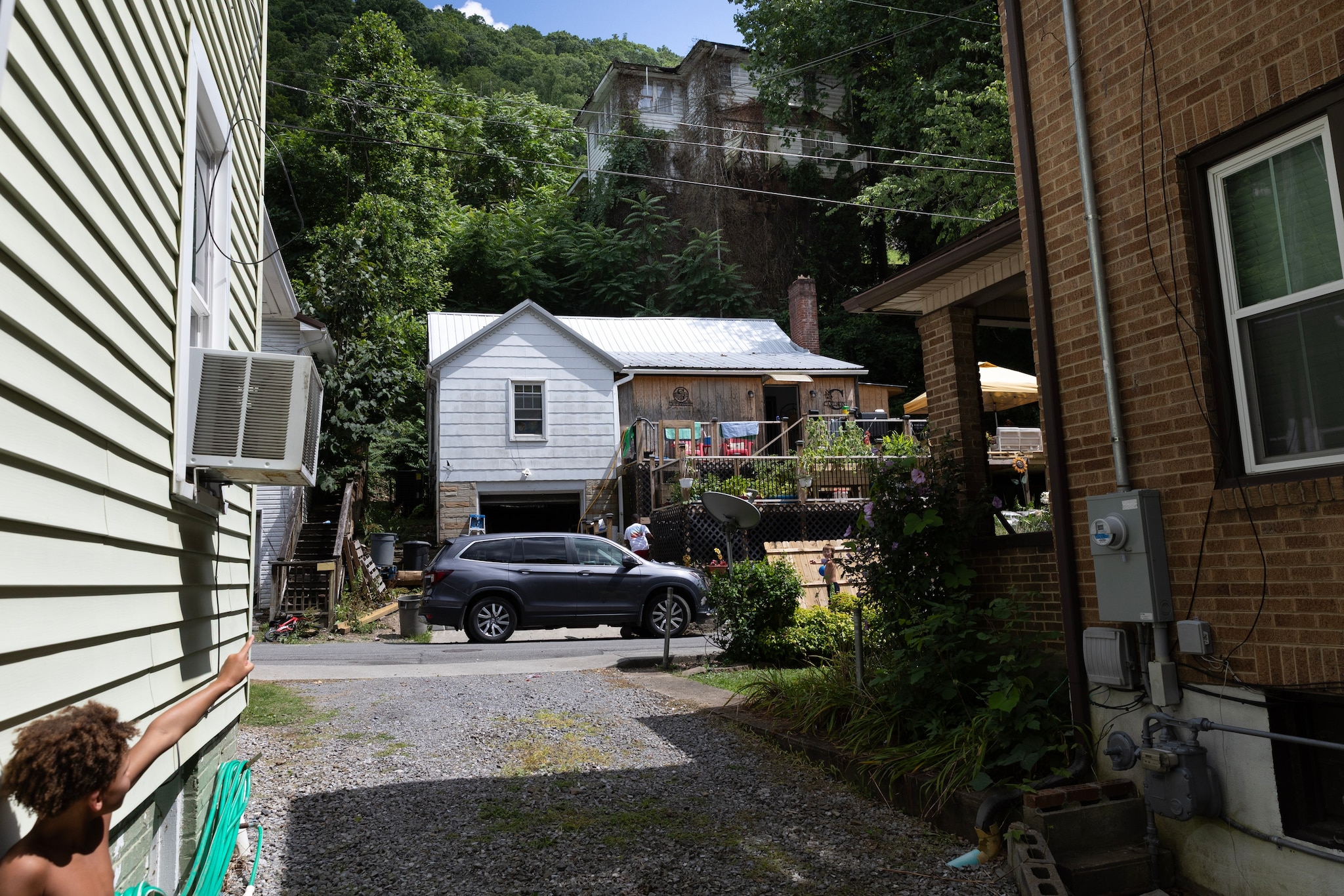
A young neighborhood resident points to an elevated, occupied home along the Riverside Drive hill in Welch. (Tom Brenner/For The Washington Post)

Still, he is hopeful help will come — from the governor, from FEMA, from anywhere. But he also knows residents can’t wait around for support that might never arrive, that they must figure out how to better protect this place from the water that can change so much in a flash.

“In the past, the only thing we do is shovel the mud and forget about it,” he said. “But we have got to do some things to help ourselves prepare, because it’s going to happen again.”

About this story

Story editing by Paulina Firozi, Simon Ducroquet, Anu Narayanswamy and Katie Zezima. Additional editing by Juliet Eilperin. Photo editing by Dominique Hildebrand. Video editing by John Farrell. Copy editing by Gaby Morera Di Núbila.

Design and development by Talia Trackim and Hailey Haymond. Design editing by Betty Chavarria.

Methodology

To examine trends in heavy rainfall The Post analyzed 75 years of rain gauge data from 28 stations in three central subregions of Appalachia produced by NOAA’s National Centers for Environmental Information. The area encompasses all of West Virginia and portions of Ohio, Kentucky, Virginia, North Carolina and Tennessee.

To define what counts as a heavy rainfall day, The Post used the period from 1950 to 1989 as the base for determining the 95th percentile precipitation event at each station. Days with at least 0.5 millimeters of precipitation were included. Using a simple linear regression, The Post measured the change in frequency of the 95th percentile rain events at each station from 1950 to 2024.

The analysis showed a significant positive trend in 95th percentile rain events in the central regions of Appalachia, where the number of days each year with heavy rainfall has increased by two, a 35 percent increase.

To investigate global changes in extreme precipitation, The Post measured the amount of water vapor flowing through Earth’s atmosphere, a metric called integrated vapor transport (IVT). The analysis also identified days and locations where heavy rainfall coincided with high IVT. See more about The Post’s methodology for the IVT analysis here.

Read the full story here.
Photos courtesy of

A Familiar Refrain as China and Japan, Uneasy Neighbors in East Asia, Begin 2026 at Odds Again

They’re at it again

BEIJING (AP) — They’re at it again. China and Japan — frenemies, trading partners and uneasy neighbors with a tortured, bloody history they still struggle to navigate — are freshly at each other’s rhetorical throats as 2026 begins. And it’s over the same sticking points that have kept them resentful and suspicious for many decades: Japan’s occupation of parts of China in the 20th century, the use of military power in East Asia, economics and politics — and, of course, pride.From insinuations that Chinese citizens face dangers in Japan to outright accusations of resurgent Japanese imperialism, this first week of the year in China has been marked by the communist government scorning Tokyo on multiple fronts and noticeably embracing the visiting leader of another crucial strategic neighbor: South Korea.The latest chapter in Japan-China enmity surged In November when Japan's new leader waded into choppy bilateral waters. She said, in effect, that if China moved militarily against Taiwan, she wouldn't rule out involving Japan's constitutionally defense-only military. That didn't go over well in Beijing, which has teed off on Tokyo over the years for far less.“Prime Minister Sanae Takaichi’s erroneous remarks concerning Taiwan infringe upon China’s sovereignty and territorial integrity, blatantly interfere in China’s internal affairs, and send a military threat against China,” Foreign Ministry spokesperson Mao Ning said Wednesday, a week after military exercises around the island ended. “We urge Japan to face up to the root causes of the issue, reflect and correct its mistakes.”That’s hardly uncommon language. China frequently demands Japan ponder the path it has taken and correct its “erroneous” course. It's rhetoric, sure, but it goes far deeper. And sometimes it's hard to tell what's real umbrage and what's ginned up for domestic political consumption.Because when it comes to the China-Japan relationship, anger remains a powerful and enduring tool on both sides. And there's no indication that's going away anytime soon. A long history of antagonism From the time Japan colonized Taiwan in 1895 after a war with Qing Dynasty China, a deep suspicion and at times outright enmity has existed between the two countries.It worsened in the 1920s and 1930s after Japan’s brutal occupation of parts of China resulted in torture and deaths that Chinese resent to this day. At the same time, Japanese leaders have sometimes thrown incendiary political footballs like visits to the Yasukuni Shrine, a memorial to Japanese who gave their lives in the nation’s wars — including some war criminals from the Sino-Japanese wars. China, like clockwork, responds with indignation.Japan lost World War II to the Allied powers and relinquished offensive military powers under a U.S.-drafted constitution, even as the current communist Chinese government was establishing the People’s Republic in 1949. Since then, any hint of Japanese military assertiveness has drawn great umbrage here. Disputes over territory, such as an island chain called Diaoyu by China and Senkaku by Japan, spike occasionallyThe enmity, pulled out when something is perceived as aggressive or anger is required for a domestic audience, lurks barely beneath the surface, ready to pop. Even today, cartoons circulate online in China depicting Japanese as demonic, aggressive and anti-China. This week has been an illuminating case study.On Tuesday, China slapped restrictions on “dual-use exports” to Japan — anything, it said, that Japan could adapt for military use. Though it didn't specify what the ban includes, anything from drones to rare earths could be considered dual-use. The lack of specificity allows China to adjust its approach as it goes — making it more or less strict depending on where the political winds are blowing. Japan demanded the move be rescinded. “These measures, which only target Japan, deviate significantly from international practice,” its Foreign Ministry said, calling China's actions “absolutely unacceptable and deeply regrettable.” This came days after it protested Chinese mobile drilling rigs in the East China Sea.While the Chinese Commerce Ministry did not mention rare earths curbs, the official newspaper China Daily, seen as a government mouthpiece, quoted anonymous sources saying Beijing was considering tightening exports of certain rare earths to Japan. On Wednesday, the focus turned to a gas called dichlorosilane, used in computer chip manufacturing. The Commerce Ministry said it had launched an investigation into why the price of dichlorosilane imported from Japan had decreased 31% between 2022 and 2024. “The dumping of imported products from Japan has damaged the production and operation of our domestic industry,” it said.Finally, on Thursday, China's Arms Control and Disarmament Association, a nongovernment agency (inasmuch as any agency in China is nongovernmental) released with some fanfare a report provocatively titled “Nuclear Ambitions of Japan's Right-Wing Forces: A Serious Threat to World Peace.” It spent 29 pages outlining worries and accusations that Tokyo harbors dangerous nuclear ambitions. But it also went broader, invoking once again its stance that the nation's right-wing leaders — and, by extension, the whole country itself — have “failed to reflect on Japan's history of aggression.”“Japan has never been able to fully eliminate the scourge of militarism in the country,” the report said. “If Japan's right-wing forces are left free to develop powerful offensive weapons, or even possess nuclear weapons, it will again bring disaster to the world.”Also part of the equation this week: China's visible pivot to another regional neighbor, South Korea, whose president spent four days in Beijing. Seoul has a bumpy history of its own with Japanese aggression and also sporadic — though generally less intense — friction with Beijing, a longtime supporter and ally of its rival North Korea.Chinese media gave splashy coverage to Lee Jae Myung's visit, touting new Beijing-Seoul agreements on trade, environmental protection and transportation — and notably technology, given the dual-export ban. Also visible: Lee at two business events watching major companies pledge increased collaboration. The sides signed 24 export contracts worth a combined $44 million, according to South Korea’s Ministry of Trade, Industry and Resources.The burst of official affection toward South Korea didn't stop with Lee. While he was here, Chinese media reported that South Korea overtook Japan as the leading destination for outbound flights from the mainland over New Year’s. That's on top of Beijing's recent efforts to discourage Chinese from traveling to Japan, citing “significant risks to the personal safety and lives of Chinese citizens” there.For now, Japan-China tension remains a matter of rhetoric and policy. But no one is predicting a quick resolution. With Japan's staunch ally, the United States, planning to furnish more arms to Taiwan in a single sale than ever before, there's too much at stake for both East Asian nations at this moment — and too much contentious history — for an easy and quick solution."This time ... de-escalation and a return to the status quo may not be as easily achieved," Sebastian Maslow, an East Asia specialist and associate professor of international relations at the University of Tokyo, wrote in The Conversation last month. “With diplomatic channels in short supply and domestic political agendas paramount, an off-ramp for the current dispute is not in sight.”Ted Anthony has written about China for The Associated Press since 1994. Copyright 2026 The Associated Press. All rights reserved. This material may not be published, broadcast, rewritten or redistributed.Photos You Should See – December 2025

This startup helps enterprising resellers prevent nearly a million pounds of returns from ending up in landfills

Americans are likely to have spent a record $1 trillion-plus this holiday shopping season alone, and about $5.5 trillion in retail sales in all of 2025, according to estimates by the National Retail Federation. That includes many unhappy returns for retailers: And when it comes back to them, a lot of the $850 billion in returned merchandise is often cheaper to discard than to inspect, sort, and resell—adding millions of tons to landfills every year. “This is a massive ecological problem, as well as a financial problem for these companies,” says Ryan Ryker, CEO of rScan. Based in South Bend, Indiana, the startup has developed software and logistics services to help transfer these products from the beleaguered original sellers to resellers more eager to do the work of making money on a returned product. “There’s a lot of people who are looking to make side cash,” says cofounder and chief logistics officer Julian Marquez about their small-business clients. But it’s not easy. Instead of getting, say, a shipping pallet of all the same product, such as a power tool, resellers have to sort through a mishmash that can contain dozens of different items—including many one-offs. rScan’s offering for them sounds simple: a barcode-scanning app. But behind that is an entire data infrastructure to help resellers understand what they’ve got and how to sell it. Scanning the UPC barcode on a box pulls up the item’s product name and brand, images, detailed descriptions, and manuals. Resellers can first ascertain the product’s condition and whether everything that should be in the box is. If they decide it’s worth selling, rScan can pull from its database the dozens of product attributes required by online marketplaces and format complete product listings tailored to venues such as Amazon, eBay, or Shopify. The company regularly scrapes these sites to survey what products are selling for and estimate a price for the reseller’s listing. rScan charges 30 cents per month per unique item that is scanned and in their catalogue for as long as it’s listed for sale online. (So selling 10 of the same product would cost 30 cents per month, total.) The company also takes a percentage of monthly sales, from 1% to 3.9% on a sliding scale that ramps up as vendors sell more. Clients range from newbies working out of a garage to what Ryker calls, “sellers that are doing multiple hundreds of thousands of dollars per year.” Retailers from High School For Ryker, rScan was tailored to the challenges he’d personally encountered. “Resale is something I previously dabbled in prior to the pandemic. From there, there was a lot of returns going on with COVID, the rise in e-commerce sales, things of that nature,” he says.  But his retail experience goes back to high school in the 2010s when he and Marquez established their own apparel brand, called Culture Clothing, which ran for a couple years and grossed about $45,000 in its best year. They mostly sold at concerts and show venues, but also called on another classmate, Rod Baradaran, to set up an ecommerce site. In 2021, the three reunited to cofound rScan. Baradaran reprised his tech role, coding the app and the online services, developing the price-setting algorithm, and serving as COO. (A fourth cofounder, Michael Altenburger, joined a few months later.) The company—which was bootstrapped by the founders—now has 36 employees. Taking on a Clunky System It’s not that returned goods would all go into the trash without rScan. “The real advantage of being able to get this online faster and on ecommerce [platforms] is that you have a much wider market where these products can be distributed and actually used,” says Baradaran. The three seem especially proud of helping side-hustlers make ends meet. Marquez also works in the RV manufacturing industry around South Bend—which has taken a hit in recent years, with hundreds of layoffs in 2025 alone. He helped one of his coworkers get into online resale as a safety net when his earnings dropped.  “If he didn’t have rScan at the time, he would have had to either sell something or lose a part of the lifestyle that he was already used to living with,” says Marquez. He was able to take advantage of rScan’s physical as well as virtual services. The company runs a warehouse to receive returned goods from retailers, hold them for small clients who don’t have their own storage space, and help arrange shipping to buyers. It was also a chance to test and refine the software by running their own resale business. “We kind of dogfooded our own product when we first started,” says Baradaran. In May 2025, rScan upgraded to a 53,000-square-foot warehouse in South Bend. Living Up to Values While they have eschewed outside investors so far, rScan recognizes it may need to go that route to scale up. “We want to make sure that they share the same vision as us, and as long as that’s aligned—absolutely,” says Baradaran. Helping not just sellers but the planet is a key part of that vision. By its own accounting, rScan says it has saved over 840,000 pounds of products from going into the trash. After rScan scales more, the founders plan to seek independent verification of their ecological impact in the process of becoming a Benefit Corporation. To be certified as a B Corp, a company has to pass an initial and ongoing evaluation by the nonprofit B Lab of its environmental impact, social responsibility, transparency, and accountability to all stakeholders—not just investors. “Ultimately, our goal is to democratize entrepreneurship,” Baradaran says in an email. “In doing so, we drive sustainability by extending the lifecycle of consumer goods that would otherwise end up in landfills.”

Americans are likely to have spent a record $1 trillion-plus this holiday shopping season alone, and about $5.5 trillion in retail sales in all of 2025, according to estimates by the National Retail Federation. That includes many unhappy returns for retailers: And when it comes back to them, a lot of the $850 billion in returned merchandise is often cheaper to discard than to inspect, sort, and resell—adding millions of tons to landfills every year. “This is a massive ecological problem, as well as a financial problem for these companies,” says Ryan Ryker, CEO of rScan. Based in South Bend, Indiana, the startup has developed software and logistics services to help transfer these products from the beleaguered original sellers to resellers more eager to do the work of making money on a returned product. “There’s a lot of people who are looking to make side cash,” says cofounder and chief logistics officer Julian Marquez about their small-business clients. But it’s not easy. Instead of getting, say, a shipping pallet of all the same product, such as a power tool, resellers have to sort through a mishmash that can contain dozens of different items—including many one-offs. rScan’s offering for them sounds simple: a barcode-scanning app. But behind that is an entire data infrastructure to help resellers understand what they’ve got and how to sell it. Scanning the UPC barcode on a box pulls up the item’s product name and brand, images, detailed descriptions, and manuals. Resellers can first ascertain the product’s condition and whether everything that should be in the box is. If they decide it’s worth selling, rScan can pull from its database the dozens of product attributes required by online marketplaces and format complete product listings tailored to venues such as Amazon, eBay, or Shopify. The company regularly scrapes these sites to survey what products are selling for and estimate a price for the reseller’s listing. rScan charges 30 cents per month per unique item that is scanned and in their catalogue for as long as it’s listed for sale online. (So selling 10 of the same product would cost 30 cents per month, total.) The company also takes a percentage of monthly sales, from 1% to 3.9% on a sliding scale that ramps up as vendors sell more. Clients range from newbies working out of a garage to what Ryker calls, “sellers that are doing multiple hundreds of thousands of dollars per year.” Retailers from High School For Ryker, rScan was tailored to the challenges he’d personally encountered. “Resale is something I previously dabbled in prior to the pandemic. From there, there was a lot of returns going on with COVID, the rise in e-commerce sales, things of that nature,” he says.  But his retail experience goes back to high school in the 2010s when he and Marquez established their own apparel brand, called Culture Clothing, which ran for a couple years and grossed about $45,000 in its best year. They mostly sold at concerts and show venues, but also called on another classmate, Rod Baradaran, to set up an ecommerce site. In 2021, the three reunited to cofound rScan. Baradaran reprised his tech role, coding the app and the online services, developing the price-setting algorithm, and serving as COO. (A fourth cofounder, Michael Altenburger, joined a few months later.) The company—which was bootstrapped by the founders—now has 36 employees. Taking on a Clunky System It’s not that returned goods would all go into the trash without rScan. “The real advantage of being able to get this online faster and on ecommerce [platforms] is that you have a much wider market where these products can be distributed and actually used,” says Baradaran. The three seem especially proud of helping side-hustlers make ends meet. Marquez also works in the RV manufacturing industry around South Bend—which has taken a hit in recent years, with hundreds of layoffs in 2025 alone. He helped one of his coworkers get into online resale as a safety net when his earnings dropped.  “If he didn’t have rScan at the time, he would have had to either sell something or lose a part of the lifestyle that he was already used to living with,” says Marquez. He was able to take advantage of rScan’s physical as well as virtual services. The company runs a warehouse to receive returned goods from retailers, hold them for small clients who don’t have their own storage space, and help arrange shipping to buyers. It was also a chance to test and refine the software by running their own resale business. “We kind of dogfooded our own product when we first started,” says Baradaran. In May 2025, rScan upgraded to a 53,000-square-foot warehouse in South Bend. Living Up to Values While they have eschewed outside investors so far, rScan recognizes it may need to go that route to scale up. “We want to make sure that they share the same vision as us, and as long as that’s aligned—absolutely,” says Baradaran. Helping not just sellers but the planet is a key part of that vision. By its own accounting, rScan says it has saved over 840,000 pounds of products from going into the trash. After rScan scales more, the founders plan to seek independent verification of their ecological impact in the process of becoming a Benefit Corporation. To be certified as a B Corp, a company has to pass an initial and ongoing evaluation by the nonprofit B Lab of its environmental impact, social responsibility, transparency, and accountability to all stakeholders—not just investors. “Ultimately, our goal is to democratize entrepreneurship,” Baradaran says in an email. “In doing so, we drive sustainability by extending the lifecycle of consumer goods that would otherwise end up in landfills.”

Monarch butterflies could disappear. Butterfly Town USA is scrambling to save them

Pacific Grove is known as ‘Butterfly Town USA’ for its role as an overwintering spot. As the insect’s population plummets, residents are coming to its rescueIn the tiny seaside village of Pacific Grove, California, there’s no escaping the monarch butterfly.Here, butterfly murals abound: one splashes across the side of a hotel, another adorns a school. As for local businesses, there’s the Monarch Pub, the Butterfly Grove Inn, even Monarch Knitting (a local yarn shop). And every fall, the small city hosts a butterfly parade, where local elementary school children dress up in butterfly costumes. The city’s municipal code even declares it an unlawful act to “molest or interfere” with monarchs in any way, with a possible fine of $1,000. Continue reading...

In the tiny seaside village of Pacific Grove, California, there’s no escaping the monarch butterfly.Here, butterfly murals abound: one splashes across the side of a hotel, another adorns a school. As for local businesses, there’s the Monarch Pub, the Butterfly Grove Inn, even Monarch Knitting (a local yarn shop). And every fall, the small city hosts a butterfly parade, where local elementary school children dress up in butterfly costumes. The city’s municipal code even declares it an unlawful act to “molest or interfere” with monarchs in any way, with a possible fine of $1,000.After all, Pacific Grove is better known by its other, self-given nickname: “Butterfly Town, U.S.A.”But Butterfly Town, and the rest of California, has a problem. The species behind the fanfare is disappearing at an alarming rate, amid rampant pesticide use, habitat loss, extreme weather and the climate crisis. The stakes are dire; monarch populations in the western US have plummeted by more than 99% since the 1980s.If nothing changes, experts fear the western monarchs have a nearly 100% chance of extinction by 2080.“It’s important to recognize that Butterfly Town is about living creatures that need our help, not just orange-and-black merchandise,” stressed Natalie Johnston, the education manager at the Pacific Grove Museum of Natural History, who also runs the museum’s monarch programs.Pacific Grove has long been an official “overwintering” resting site for monarch butterflies, which flock from the Pacific north-west down to the California coast every late fall and winter on their annual migration route. In years past, tens of thousands of monarchs have taken shelter in the town’s designated monarch sanctuary, amassing around the branches of trees in huge clumps and bursting through the air in giant orange clouds.One week in December 2022, volunteers counted nearly 16,000 butterflies sheltering within Pacific Grove’s sanctuary. But this year, on a similar December week, the butterfly count there was 107.In Pacific Grove, it’s unlawful to ‘molest or interfere’ with monarchs in any way. The fine for breaking that law was upped from $500 to $1,000. Photograph: Amanda UlrichFor many biologists, monarchs serve as a canary in the coal mine for environmental impacts to come, especially for other pollinators.“They are one of the best-studied butterflies,” said Emma Pelton, senior conservation biologist for the nonprofit Xerces Society for Invertebrate Conservation. “So the more we know about them, and the more we understand all the threats they face, that’s a direct correlation to the threats that these other butterflies and other insects face.”Although the US Fish and Wildlife Service proposed that the entire monarch species, including populations in the east and west, be formally listed as threatened under the Endangered Species Act, the Department of the Interior has delayed making a decision on that listing.Still, all hope is not yet lost for Butterfly Town. Johnston, from the natural history museum, and a band of other staff and volunteers are fighting for the namesake invertebrates by diligently tracking their numbers and calling for their protection.We continue to lose sites, and we continue to have a lack of meaningful legal protection for the vast majority of themOn a recent brisk December morning, Johnston and four volunteer “citizen scientists” gathered outside the city’s small monarch sanctuary, bundled up in hats and gloves, for their weekly butterfly count. Up and down the state, researchers rely on citizen scientists to collect real-time data, helping them to get a true sense of where the monarch population stands.One butterfly counter and docent for the history museum, Kat Morgan, described herself as “a data geek”. Part of the appeal of the butterfly count, she said, is to be able to contextualize current numbers within broader patterns and trends.“My job is to help people fall in love with the butterflies, or fall deeper in love, so that they’ll take action,” she said.Equipped with binoculars, clipboards and small green laser pointers (to aid in counting), the volunteer group set out into the wooded, roughly three-acre preserve.Inside the sanctuary, butterflies hung from the branches of eucalyptus trees in shadow, like a darkened chandelier, occasionally flitting into the sunlight in sudden brilliant color. The volunteers were largely quiet as they peered upwards, squinting into their binoculars. The Pacific Ocean thudded dully in the distance.When monarchs cluster in big groups, volunteers are able to count them by estimating the general density of the butterflies and how many are typically in one area. But when they’re more scattered, like this December morning, the volunteers count each flattened set of wings they see.Signs celebrating the monarch butterfly are everywhere in Pacific Grove. Photograph: Amanda UlrichThe monarchs’ presence here at all, year after year, has a somewhat mysterious quality to it; because migrating monarchs have a lifespan of just nine months or less, each wave of butterflies that arrives to Pacific Grove has never been there before. Scientists still don’t understand how, exactly, they know which tiny plot of land and specific tree to fly to, hundreds of miles south from where they started their journey.Near the top of one eucalyptus, the volunteer group spied a solid bunch of nestling monarchs. One person counted 27 butterflies, another 28. Johnston checked the butterfly tally on her clipboard.“If we do in fact have 28, that makes this our highest count of the year,” she reported.After another beat of counting, another volunteer agreed with the higher number: “28!”“Yay!” Johnston cheered, encouraging them along.The volunteers’ final tally of the morning was 226 butterflies: A very far cry from the huge counts of years past, but better than every other week of the 2025 season in Pacific Grove. It’s anyone’s guess, the volunteers said, why this particular weekly count may have been different. The numbers fluctuate, and there could always be butterflies the volunteers don’t spot.On a broader scale, the reasons why monarch counts have plunged in the last 50 years are more obvious.Starting in the 80s, frenzied coastal development across the state likely sparked some of the major drop-offs, Pelton said. Even the Pacific Grove sanctuary today, she pointed out, is a “green space in a sea of houses”.“That’s the same for so many of these core overwintering sites,” she said. “We lose sites every year. We continue to lose sites, and we continue to have a lack of meaningful legal protection for the vast majority of them.”The climate crisis is also driving some of the decline. This winter may prove to be the second or third-lowest count of western monarchs on record, the Xerces Society reported in early December, partially due to a warmer summer and drought conditions across the west.“Now climate change might be like the straw that breaks the camel’s back,” Pelton said. “But there are these other root causes that, thankfully, we can probably address more easily than climate change in the very near term, such as reducing our pesticide use.”There’s something about monarch butterflies that seems to resonate ... Pesticides have been a particularly glaring issue in Pacific Grove. In early 2024, Butterfly Town was the center of a monarch “mass mortality event” after hundreds of butterflies were exposed to pesticides and died.Johnston and the other volunteers still remember stumbling upon the dying butterflies on a private property just off the sanctuary grounds: seeing them convulse in clumps on the ground for days. Several volunteers still can’t bear to look at the photos and videos from those days, or read about any of the scientific findings. Witnessing the impacts of pesticides in real-time – “the convulsions, the seizures” – was horrific, Johnston said.A total of 15 different pesticides were found in the butterflies’ systems, a new study reported this year. County officials and the study’s authors, including Pelton, weren’t able to pinpoint the specific source, but determined that the toxins could have come from an unreported or untraceable residential or commercial use in Pacific Grove. Aside from pesticides used in large-scale farming operations, simple residential use of the household products can be a huge threat to monarchs – and homeowners don’t have to report using them.To many, the whole 2024 saga ended up feeling like an unsolved murder investigation.“There were dead bodies,” Pelton said, “but no weapon, no perpetrator.”Butterflies hang from a eucalyptus tree in the Pacific Grove Monarch Sanctuary. Photograph: Amanda UlrichThe mass die-off did, however, spark a wider conversation in Pacific Grove about pesticides, including seemingly benign ones labeled as “organic”, which homeowners may not realize are harmful to monarchs as they fly across the city before landing in the sanctuary. Johnston started knocking on neighbors’ doors and handing out brochures about how to maintain their properties with butterflies in mind, like planting flowering, native plants and avoiding pesticides.“Monarch butterflies depend on you!” the brochures implored.Luckily, for now, Butterfly Town is still flush with monarch enthusiasts. People eagerly impart their own personal meanings onto butterflies, Johnston said. Visitors to the sanctuary will often tell her they love the species because of its strength – they weigh less than a paper clip, but can fly more than 100 miles in a day – or because of its transformation from lowly caterpillar to winged beauty.Whatever the reason, in Pacific Grove the butterflies carry weight.“They’re harmless and they’re beautiful,” Johnston said. “There’s something about monarch butterflies that seems to resonate with everybody.”

Feed a goat and other ways to recycle real Oregon Christmas trees

Here are ways experts suggest a post-Christmas trees can be put to good use.

Ready to remove a real Christmas tree from the living room? Consider donating it to feed a goat. The 130-acre Topaz Farm on Sauvie Island will accept trees, stripped of their holiday decorations, 10 a.m.-noon Jan. 3-4, at 17100 N.W. Sauvie Island Road in Portland.Most of the trees dropped off for free at Topaz Farm, however, will be used to make biochar to improve soil health, according to owners Kat Topaz and Jim Abeles.“Bringing the tree to the farm can be a family tradition that gets people outside and keeps trees out of landfills,” said Topaz, who serves as an elected representative for the West Multnomah Soil & Water Conservation District. While at the farm, visitors can also see and hear sandhill cranes and bald eagles, said Topaz, who also sits on the board of the nonprofit Bird Alliance of Oregon.The trees to be converted into biochar are burned in a kiln at high temperatures to minimize smoke. While still in a charcoal state, they’re extinguished with compost tea. The biochar is then put into fields where it acts like a sponge in the soil, holding water and nutrients in place and storing carbon underground instead of releasing it into the atmosphere, Topaz added. “Combined with compost and cover crops, it helps us grow healthier, more nutrient-dense food,” Topaz said. “It’s a practical example of regenerative farming — taking a material many people consider waste and using it to rebuild the soil."The Oregon Department of Forestry encourages repurposing only Christmas trees grown in the state. Non-native Christmas trees sold at some stores can carry invasive pests.If you suspect there is a bug on an out-of-state Christmas tree, contact the forest department, cut up the tree, place the pieces in plastic bags, and seal them in your garbage can. Do not leave it in the backyard for an extended period or donate it to a group that will use it in a forest or waterway.Environmental groups are authorized to collect cut trees to strategically submerge into creeks to protect young salmon and steelhead from predators, and for wetland restoration work.Biodegradable trees cleared of ornaments, lights, tinsel, wire, nails, spikes, stands, plastic and other non-plant products can also be chipped and used as ground cover at parks.Collecting trees and wreaths after Christmas are fundraising projects for Scout troops and other nonprofits. For a small fee and on specified days, volunteers will pick up greenery set on curbs and driveways outside a home or brought to designated sites.Find Oregon Scout troops at beascout.scouting.org.Garbage collection services accept trees as recyclable yard debris if the tree fits inside the bin and is collected on the regularly scheduled pick-up day. A large tree can be cut up and the debris placed in the bin and picked up over several weeks. Some haulers charge an additional fee for the extra garbage, and some do not accept flocked trees, those sprayed to look snow-covered.Visit Metro’s Find-A-Recycler to determine the closest yard debris recycling facility or seasonal tree recycling event. Send a question, call 503-234-3000 or contact your garbage hauler.Repurpose a treeWishing Well is a family-owned business in Medford sells cut Oregon-grown fresh Christmas Trees.Janet Eastman/The Oregonian/OregonLiveOnce stripped of decorations and non-plant materials, a real Christmas tree can be used in the yard as mulch or a wildlife habitat. Here are ways experts suggest a post-Christmas trees can be put to good use:Make mulch: Cut off the boughs and place them around plants to insulate roots from the cold. Decomposing wood releases nutrients such as carbon, nitrogen, potassium and phosphorus, improving soil quality and plant growth. Wood chips can also be used to fill in garden paths and reduce weeds.Enhance a compost pile: Bend blogger Linda Ly of Garden Betty suggests cutting the tree into smaller pieces and letting the pile sit until the pine needles have fallen off and the branches are dry and brittle. Then, use these brown materials as a carbon source for a compost bin, as needed.Benefit wildlife: Move the tree in its stand outdoors for the winter, where it can provide food and shelter for wild birds. Hang a bird feeder or suet cage from the branches. Ly wrote that her goats like eating the trees and that putting branches in a chicken run “is a good way to help chickens beat winter boredom.”A fish home: With the pond owner’s permission, sink a tree in a deep pond to become habitats for fish and aquatic insects. In shallow wetlands, trees can act as barriers to sand and soil erosion.Make a trellis: Move the tree to a corner of the yard and in the spring set it up in the garden as a trellis for peas or beans.

20 stories of Oregonians who inspired us in 2025

From a 16-year-old chess grandmaster to a bus driver who thwarted a hijacking, these Oregonians made remarkable impacts in their communities this year.

Among the accomplishments of elementary and high school students, business owners, professional athletes and artists, The Oregonian/OregonLive journalists had no shortage of inspirational stories to tell in 2025. This year, we celebrated remarkable Oregonians such as Rosie Lanenga, Oregon’s Kid Governor, who championed climate change awareness, and Manny Chavez, who courageously addressed the impact of immigration enforcement on his community. We also highlighted the philanthropic efforts of athletes such as Blake Wesley, who exemplified compassion through his outreach, and artists like Aaron Nigel Smith, who brought history to life with his folk opera. These stories reflect the resilience and creativity that define Oregon, reminding us all of the potential for positive change in our communities. Here are some of the Oregonians who inspired us to be kinder, braver, determined and selfless in 2025. Woman Grandmaster Zoey Tang at the Portland Chess Club.Samantha Swindler/ The OregonianZoey TangAt just 16 years old, Zoey Tang made history as Oregon’s first woman grandmaster in chess, a prestigious title awarded by the Fédération Internationale des Échecs (FIDE). During her junior year at Westview High School in Beaverton, Tang’s achievement was remarkable in a field where only about 500 players worldwide hold the woman grandmaster title, out of approximately 350,000 active FIDE-rated players, Samantha Swindler reported in January. Tang, who held a rating of 2306 and was a FIDE Master in January, aims to achieve the open grandmaster title within the next four years. She is also the Oregon state champion, competing successfully against players of all genders and ages. Beyond her competitive success, Tang founded Puddletown Chess, a nonprofit aimed at increasing participation among young players, particularly women and those from underrepresented backgrounds. Her journey reflects a commitment to not only excel in chess but also to foster a more inclusive community in the game.2025 Kid Governor Rosie Lanenga poses for a photo at the Oregon Capitol on Thursday, January 16, 2025, in Salem.Vickie Connor/The OregonianRosie LanengaOregon’s 2025 Kid Governor, Rosie Lanenga, made climate change her top priority this year when she stepped into her role. Elected by her peers from across the state as a fifth-grader last school year, the student from Portland’s Riverdale Grade School was sworn in at the Oregon State Capitol alongside her cabinet members in January, Samantha Swindler reported. Lanenga emphasized the importance of addressing climate change, stating, “I want Oregon to stay as beautiful as it is right now, and climate change is affecting that.”As part of her campaign, Lanenga introduced her A.C.T. plan, which encourages individuals to take action at home, hold discussions about reducing carbon footprints and share knowledge with others. With aspirations of becoming a lawyer and a passion for politics, Lanenga engaged with state leaders throughout her yearlong term. Her commitment to environmental advocacy highlights the potential of young leaders to influence positive change in their communities.Mike Perrault, a TriMet bus driver, faced an armed man on his bus in January of this year.SubmittedMike PerraultTriMet bus driver Mike Perrault displayed extraordinary bravery during a harrowing 12-minute hijacking of his Line 4 bus in Portland on Jan. 29. With nearly a decade of experience, Perrault faced an armed man who forced him to drive through the streets of Old Town. Despite the life-threatening situation, he remained calm and focused on de-escalating the tension, assuring the hijacker that he would be safe on the bus.“I told him that while he was on my bus, he’d be safe. He could give me the gun or he could put it down, but while he was on the bus, I wouldn’t let anything happen to him,” Perrault told reporter Zane Sparling.Perrault successfully persuaded the gunman to surrender his weapon, allowing Perrault to toss it out the window and escape the bus unharmed. Perrault’s quick thinking and composure under pressure garnered widespread praise, highlighting the resilience and dedication of public transit workers in the face of danger. Anthony and Marlie Love on their trip to Coos Bay. Photo courtesy of Traveling While Black.Traveling While BlackAnthony and Marlie LoveAnthony and Marlie Love, a Seattle-based couple originally from Missouri, are making waves in the travel community as advocates for Black travelers in the Pacific Northwest. Through their YouTube channel, “Traveling While Black,” they provide essential resources and insights, including a unique Black comfortability rating system for various destinations. Earlier this year, the Loves appeared on the Peak Northwest podcast in February to discuss their Oregon coast trip, where they highlighted local Black history and the importance of safe travel experiences. Although they are from Washington, their mission extends beyond state lines, aiming to foster inclusivity and understanding in travel. With over 170 episodes under their belt, the Loves are inspiring a new generation of travelers to explore the region while acknowledging its historical context and promoting a welcoming environment for all.Jenn LockwoodJenn Lockwood, training supervisor at the Mt. Hood Meadows Learning Center, is the face of Mt. Hood Meadows’ She Shreds program, which empowers women in the skiing and snowboarding communities. Featured on a March episode of Peak Northwest, Lockwood discussed how the program offers both camps and clinics designed to create a supportive environment for women to learn and develop their snowsport skills together.The She Shreds initiative encourages participants to leave their egos behind, fostering a sense of camaraderie and community among skiers and snowboarders. Many women who join the program go on to form lasting connections, continuing to shred together long after the clinics conclude. Lockwood’s insights highlight the transformative power of community and empowerment in sports, making She Shreds a vital resource for aspiring female skiers and snowboarders.Sprague High's constitution team team of two, Matthew Meyers, in red sweater, and Colin Williams, in black shirt, hold hands with each other and members of the Lincoln High School constitution team while they wait to find out if both teams made it into the final rounds of the national civics education competition We the People.Courtesy of the Lincoln High constitution team​​Matthew Meyers and Colin WilliamsA two-student civics team from Salem’s Sprague High School, with no history of national wins and far fewer resources than their competitors, delivered one of Oregon’s most improbable academic victories this year, Julia Silverman reported in April. Seniors Matthew Meyers and Colin Williams stunned judges and peers alike at the national We the People Constitution competition, mastering the same exhaustive constitutional law, history and casework typically divided among teams of 20 to 30 students. Working largely on their own — supported by their social studies teacher and fueled by marathon research sessions — the pair advanced from regionals to state, then shocked the field by reaching the national finals. They initially emerged as sole national champions before a scoring correction elevated Portland’s powerhouse Lincoln High School into a shared title. The result: an unexpected, “can’t-make-this-up” co-championship that returned the trophy to Oregon.In Venezuela, Nava Ulacio planned to be a civil engineer. Moving to the United States allowed her the opportunity to pursue her music dreams.Allison Barr/The OregonianSofia Nava UlacioSofia Nava Ulacio, a 21-year-old Venezuelan immigrant, graduated from Portland Community College with a perfect 4.0 GPA and a full scholarship to Lewis & Clark College, Eddy Binford-Ross reported in June. In 2022, Nava Ulacio arrived in Oregon unable to speak English, having fled political unrest in Venezuela. To overcome language barriers, she immersed herself in school activities, using Google Translate for her coursework and joining the jazz band, theater and choir. At PCC, she excelled in her music studies, founded a choir club, and now teaches music at Backbeat Music Academy. Nava Ulacio leads the Sofi Nava Trio, performing Latin and contemporary music. She aims to inspire other female Latin musicians and views her music as a connection to her roots, honoring her family’s sacrifices and her cultural heritage.Jamie Breunig leads a one-woman community paramedic program in Clackamas County focused on providing medical care to people living outside.Beth NakamuraJamie BreunigAs Clackamas County’s sole community paramedic, Jamie Breunig delivers medical care, treating patients where they live, even if that means beside a tent or in a motel room. Since the county launched its community paramedic program in October, Breunig has provided medical care or case management to more than 110 unhoused residents, aiming to improve health outcomes while reducing costly 9-1-1 calls, ambulance transports and emergency room visits.Funded by the regional homeless services tax, the $200,000 program reflects a growing recognition that unsheltered people cannot be ignored and that emergency rooms are often the wrong place for basic care, reported Lillian Mongeau Hughes in June. A veteran paramedic and former foster youth, Breunig builds trust with patients who are often deeply distrustful of institutions, helping manage chronic illness, prevent medical crises and, at times, reconnect people to housing, family and hope.Instructors Anna Schneider and Karen Ceballos demonstrate moves for attendees to follow.Allison Barr/The OregonianQueer Baile leadersThroughout the year, the leaders of Queer Baile broke gender norms and fostered community through free Latin dance lessons. Founded by Lydia Greene in 2019, Queer Baile offers inclusive, nongendered classes that celebrate the joy of dance while creating a welcoming space for all. “The space feels way less intimidating than a lot of dance scenes can feel,” Karen Ceballos, a bachata instructor, told me in June.With a focus on cumbia and bachata, the group has seen attendance soar, transforming from a small gathering at a local bar to a vibrant community event at the White Owl Social Club. Volunteer instructors, including Sarah Arias and Kylie Davis, emphasize the importance of consent-based dancing, allowing anyone to lead or follow, regardless of gender.Oregon Representative Thủy Trần has created a new play, “Belonging: A Memoir,” based on the events of her life. Jamie Hale/The OregonianThủy TrầnIn August, state Rep. Thủy Trần shared her journey as a Vietnamese refugee in a one-night theatrical performance titled “Belonging: A Memoir,” which marked the 50th anniversary of the fall of Saigon. The show at the Winningstad Theatre recounted Trần’s escape from Vietnam at age 9 and her path to becoming an Oregon legislator. Co-created with actor Libby Cozza, the production featured a nearly all-Vietnamese cast and three actresses portraying Trần at different life stages. Funded by a $10,000 grant, the project aimed to benefit local organizations, including Portland Public Schools’ Vietnamese Dual Language program, Megan Robertson reported in July. Trần described the experience as a challenge to be vulnerable and authentic, showcasing her remarkable journey from refugee to state representative.Tim Cook, the president of Clackamas Community College, poses at Portland Community College's Sylvania campus on Aug. 1, 2025. He ran more than 1,400 miles around Oregon to raise money for students' basic needs.Allison Barr/The OregonianTim CookClackamas Community College President Tim Cook achieved an extraordinary feat by running 1,400 miles across the state, raising over $127,000 to support students facing basic needs. On this 52-day journey, Cook visited all 17 of Oregon’s community colleges while highlighting food insecurity and homelessness among students, wrote reporter Maddie Khaw in August.Running roughly a marathon each day and wearing through six pairs of shoes, Cook’s determination shone through. He said witnessing students living in cars and struggling to access food sparked the fundraising campaign to provide essential resources to help students stay in school. Cook’s journey not only raised over $177,000 for community college student basic needs but also drew attention to the urgent need for systemic solutions to support students in crisis across Oregon.Marcus Lattimore poses for a photo on the steps outside the Portland Playhouse, a performing arts theater in Northeast Portland. Sean Meagher/The OregonianMarcus LattimoreMarcus Lattimore, a former football star and standout running back at the University of South Carolina, has reinvented himself as a poet in Portland, finding new purpose and identity through spoken word. After a knee injury cut his football career short, Lattimore turned to poetry as a means of expression, exploring complex themes of race, culture and personal growth.Now performing at open mic nights and engaging with the local theater community, Lattimore is making waves in Portland’s arts scene. He has since published a book of verse and continues to expand his work through teaching and performance, marking a significant shift from the career that once defined him, Bill Oram reported in September.Shantae Johnson and Arthur Shavers announce the official reopening of Multnomah County's CROPS farm Wednesday, Aug. 27, 2025.Austin De Dios / The OregonianShantae Johnson and Arthur ShaversShantae Johnson and Arthur Shavers, a Portland couple with deep roots in the Black farming community, have transformed Multnomah County’s CROPS Farm into a vital food hub for East Portland, wrote Austin De Dios in September. Their journey began with a small garden at their condo, which ignited their passion for horticulture and led them to leave their careers to pursue farming full-time. Officially reopened on Aug. 27 after five years of development, the 3-acre farm now distributes fresh produce to around 200 families weekly and offers training and support for Black, Indigenous and people of color who are farmers. With a commitment to community, Johnson and Shavers aim to expand their services and create a local food hub in Gresham, where they recently acquired a 5-acre property. Oregon Army National Guard Physician Assistant Maj. Tommy Vu looks up during his world record attempt for most chest-to-ground push-ups at West Coast Strength gym in West Salem on Saturday, Sept. 20, 2025.U.S. Army National Guard photo by Maj. W. Chris ClyneTommy VuMajor Tommy Vu of the Oregon Army National Guard set a remarkable new world record for the most chest-to-ground pushups in September, completing an impressive 1,721 repetitions in one hour at West Coast Strength gym in West Salem. Vu’s achievement, which surpasses the previous record of 1,530 pushups, marks his sixth world record, Sean Meagher reported.The 38-year-old Vu maintained a steady pace using a metronome set to 2.1 seconds per repetition during the grueling hour. Vu donated $1 to the Oregon Humane Society for every pushup completed, totaling $1,721, in memory of his in-law’s beloved dog. Looking ahead, Vu is already preparing to reclaim the chest-to-ground burpee record, previously held by him."York the Explorer‘s" book and music were composed by Grammy-nominated producer Aaron Nigel Smith.Image courtesy of The ReserAaron Nigel SmithAaron Nigel Smith, a Portland-based composer and producer, made waves through his folk opera, “York the Explorer.” The show premiered in late October as part of the inaugural York Fest, honoring the legacy of York, the only Black member of the Lewis and Clark Expedition. Smith was inspired to create the opera after a bust of York in Mount Tabor Park sparked renewed interest in his remarkable story, which has often been overlooked in history.“It’s just a story of hope, perseverance and courage,” Smith told me in September. “I think not only Black and brown people around the world, but all people can really benefit and learn and grow from knowing this story.”With a commitment to amplifying York’s contributions, Smith has dedicated two years to researching and composing this significant work. The opera not only aims to educate audiences about York’s historical impact but also serves as a platform for fostering community engagement and awareness of Black history in Oregon. Through his artistic vision, Smith is helping to ensure that York’s legacy is celebrated and remembered for generations to come.Mary E. Brunkow poses for a portrait after winning a Nobel Prize in medicine for part of her work on peripheral immune tolerance, in Seattle, Monday, Oct. 6, 2025. (AP Photo/Lindsey Wasson)APMary E. BrunkowMary E. Brunkow, a molecular biologist and graduate of St. Mary’s Academy in Portland, in October was awarded the Nobel Prize in medicine for her groundbreaking research on peripheral immune tolerance. This prestigious award recognizes her significant contributions to understanding how the immune system distinguishes between harmful pathogens and the body’s own cells, a discovery crucial for developing treatments for autoimmune diseases such as Type 1 diabetes and lupus. Brunkow, now a senior program manager at the Institute for Systems Biology in Seattle, shares this honor with fellow researchers Fred Ramsdell and Dr. Shimon Sakaguchi. Their collaborative work has unveiled critical pathways that regulate immune responses. Emily Purry surfing in Costa Rice during a Surf Bikini Retreat. Photo courtesy of Emily Purry and Surf Bikini Retreat.Surf Bikini RetreatEmily PurryEmily Purry, a blind surfer from Oregon, entered the world of adaptive surfing at the age of 40, transforming her life and advocating for inclusivity in outdoor sports. After being encouraged to compete, Purry quickly made waves, earning a spot on Team USA Para Surfing just weeks after her first competition in Japan. Despite the challenges of navigating international travel alone and adapting to her sight loss from Stargardt’s macular degeneration, Purry’s resilience shines through. Surfing has not only restored her confidence but also helped her reconnect with her identity, she told Peak Northwest podcast listeners in November, when she discussed her participation in the ISA World Competition in Oceanside, California. Emmanuel ‘Manny’ Chavez, a teenager from Hillsboro, offers an emotional testimony on the toll of immigration enforcement at a city council meeting on November 4, 2025.The OregonianEmmanuel ChavezEmmanuel “Manny” Chavez, a 16-year-old from Hillsboro, captured national attention with his November testimony about the impact of immigration enforcement on his family and community. Speaking at a Hillsboro City Council meeting, Chavez expressed his fears for his parents’ safety amid escalating ICE detentions, stating, “I shouldn’t be scared. I should be focusing on school.” His heartfelt remarks resonated with many, leading to over 3.4 million views after a local newspaper shared the video on social media.Chavez, a junior at Hillsboro High School, was inspired to speak out after witnessing the detention of friends’ family members, wrote Gosia Wozniacka in November. In the wake of a sharp increase in ICE arrests in Oregon, he has taken action by launching an online fundraiser to support families affected by these enforcement actions, raising over $8,000 in just two days. Community members and leaders have praised his courage, with his soccer coach highlighting his admirable leadership and solidarity.The 15th annual Tatas for Toys raised over $60,000 for Doernbecher Children’s Hospital.Allison Barr/The OregonianTatas for Toys performersIn December, exotic dancers and burlesque performers in Portland became unlikely champions for children in need through the annual Tatas for Toys fundraiser. Over the past 14 years, the event has raised $183,000 worth of toys for Doernbecher Children’s Hospital, Samantha Swindler reported in December. The 15th annual event added another $60,000 to that total. Founded by Aaron Ross, the event evolved from a small toy drive at Dante’s nightclub into a theatrical extravaganza featuring dance, magic, and live auctions. The performers not only entertained but also actively engaged the audience, encouraging donations to support the hospital’s Child Life Therapy Program, which helps children cope with hospitalization through play and creative activities. Portland Trail Blazers guard Blake Wesley poses for photos during the NBA basketball team's media day in Portland, Ore., Monday, Sept. 29, 2025. (AP Photo/Craig Mitchelldyer)APBlake WesleyBlake Wesley, a player for the Portland Trail Blazers, displayed his commitment to philanthropy during a recent Christmas Eve encounter with a homeless man named Dave. After finding his favorite sneaker store closed, Wesley spontaneously invited Dave to share a meal, treating him to gyros and donuts from Voodoo Doughnut, wrote Joe Freeman in December. Wesley said the encounter reflected his deep-rooted belief in helping those in need, a value instilled in him by his parents.Wesley is not only known for his generosity on the streets but also through his nonprofit, The Wesley Legacy Foundation. The foundation focuses on empowering youth and their families, offering free basketball camps and community support initiatives. Recently, it hosted the “Warm a Heart for the Holidays” event in South Bend, where hundreds of children received new coats. Faith and cultural connectionsThe Oregonian/OregonLive receives support from the M.J. Murdock Charitable Trust to bring readers stories on religion, faith and cultural connections in Oregon. The Oregonian/OregonLive is solely responsible for all content.

Suggested Viewing

Join us to forge
a sustainable future

Our team is always growing.
Become a partner, volunteer, sponsor, or intern today.
Let us know how you would like to get involved!

CONTACT US

sign up for our mailing list to stay informed on the latest films and environmental headlines.

Subscribers receive a free day pass for streaming Cinema Verde.
Thank you! Your submission has been received!
Oops! Something went wrong while submitting the form.