Cookies help us run our site more efficiently.

By clicking “Accept”, you agree to the storing of cookies on your device to enhance site navigation, analyze site usage, and assist in our marketing efforts. View our Privacy Policy for more information or to customize your cookie preferences.

What is fracking and why is it controversial?

News Feed
Wednesday, October 1, 2025

What is fracking and why is it controversial?Esme StallardClimate and science reporter, BBC NewsGetty ImagesThe government says it plans to pass legislation to permanently ban fracking for shale gas in England.A moratorium on the practice was put in place by the last government but the debate has been reopened in recent weeks after the political party Reform committed to backing fracking if it came to power.The Scottish and Welsh governments continue to remain opposed to the practise. What is fracking?Hydraulic fracturing, or fracking, is a technique for recovering gas and oil from shale rock. It involves drilling into the earth and directing a high-pressure mixture of water, sand and chemicals at a rock layer, to release the gas inside.Wells can be drilled vertically or horizontally in order to release the gas.Why is fracking controversial?The injection of fluid at high pressure into the rock can cause earth tremors - small movements in the earth's surface.In 2019, more than 120 tremors were recorded during drilling at a Cuadrilla site in Blackpool.Seismic events of this scale are considered minor and are rarely felt by people, but they are a concern to local residents.Shale gas is also a fossil fuel, and campaigners say allowing fracking could distract energy firms and governments from investing in renewable and green sources of energy.Fracking also uses huge amounts of water, which must be transported to the site at significant environmental cost.What has the government said about fracking?Government policy on fracking has see-sawed over recent years. Former Prime Minister Liz Truss looked to reintroduce the practice, despite local opposition - but this was subsequently reversed by Rishi Sunak who introduced a moratorium.In October 2025, at the Labour Party Conference, Energy Secretary Ed Miliband said the government would move to legislate against fracking, banning the practice permanently. This follows a commitment made by the Labour Party in its manifesto and further commitments by PM Sir Keir Starmer in September that the practice would be "banned for good".But Reform has said it would seek to allow the practice should it be elected, as part of its "war" on renewable developers.In his speech at the conference, Miliband said the practice was: "Dangerous and deeply harmful to our natural environment."The good news is that communities have fought back and won this fight before and will do so again," he added.ReutersAn anti-fracking protester writes messages on a wall in LancashireWhere has fracking taken place in the UK?Fracking for shale gas in the UK has only previously taken place on a small scale, due to the many public and legal challenges.However, exploration has identified large swathes of shale gas across the UK, particularly in northern England.More than 100 exploration and drilling licences were awarded to firms including Third Energy, IGas, Aurora Energy Resources and Ineos.Cuadrilla was the only company given consent to begin fracking.It drilled two wells at a site in Lancashire but faced repeated protests from local people and campaigners.In 2022, the Oil and Gas Authority told Cuadrilla to permanently concrete and abandon the wells.Could fracking lower energy bills?The UK can only meet 48% of its gas demand from domestic supplies (this would be 54% if it did not export any gas).Some MPs have claimed that restarting drilling at Cuadrilla's two existing wells could be done quickly, and would provide significant supplies.Cuadrilla claimed that "just 10%" of the gas from shale deposits in Lancashire and surrounding areas "could supply 50 years' worth of current UK gas demand".Energy experts dispute this, pointing out that the UK's shale gas reserves are held in complex layers of rock.Mike Bradshaw, professor of global energy at Warwick University, says estimates of how much shale gas the UK has are not the same as the amount of gas that could be produced commercially.But Prof Geoffrey Maitland, professor of Energy Engineering at Imperial College London, has said fracking could provide interim relief."Although shale gas will not provide an immediate solution to the energy security of the country, it could be used in the medium term to replace diminishing North Sea gas production and some gas imports," he said.Which other countries use fracking?It is thought that fracking has given energy security to the US and Canada for the next 100 years, and has presented an opportunity to generate electricity at half the CO2 emissions of coal.But the complex geology of the UK and the higher density of people makes extraction more challenging, according to experts.Fracking remains banned in numerous EU countries, including Germany, France and Spain, as well as Australia.Authorities in countries including Brazil and Argentina are split, with some banning the practice, and others allowing operations.

The government says it plans to pass legislation to permanently ban fracking for shale gas in England.

What is fracking and why is it controversial?

Esme StallardClimate and science reporter, BBC News
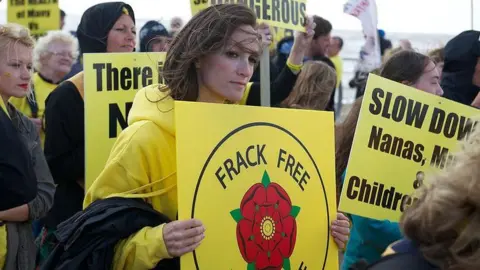
Getty Images A woman with brown hair and wearing a yellow jumper holds a yellow sign with the Lancashire rose in the centre and "frack free" written in black writing above it. Around her are other protestors with similar signs.Getty Images

The government says it plans to pass legislation to permanently ban fracking for shale gas in England.

A moratorium on the practice was put in place by the last government but the debate has been reopened in recent weeks after the political party Reform committed to backing fracking if it came to power.

The Scottish and Welsh governments continue to remain opposed to the practise.

What is fracking?

Hydraulic fracturing, or fracking, is a technique for recovering gas and oil from shale rock. It involves drilling into the earth and directing a high-pressure mixture of water, sand and chemicals at a rock layer, to release the gas inside.

Wells can be drilled vertically or horizontally in order to release the gas.

Why is fracking controversial?

The injection of fluid at high pressure into the rock can cause earth tremors - small movements in the earth's surface.

In 2019, more than 120 tremors were recorded during drilling at a Cuadrilla site in Blackpool.

Seismic events of this scale are considered minor and are rarely felt by people, but they are a concern to local residents.

Shale gas is also a fossil fuel, and campaigners say allowing fracking could distract energy firms and governments from investing in renewable and green sources of energy.

Fracking also uses huge amounts of water, which must be transported to the site at significant environmental cost.

What has the government said about fracking?

Government policy on fracking has see-sawed over recent years. Former Prime Minister Liz Truss looked to reintroduce the practice, despite local opposition - but this was subsequently reversed by Rishi Sunak who introduced a moratorium.

In October 2025, at the Labour Party Conference, Energy Secretary Ed Miliband said the government would move to legislate against fracking, banning the practice permanently.

This follows a commitment made by the Labour Party in its manifesto and further commitments by PM Sir Keir Starmer in September that the practice would be "banned for good".

But Reform has said it would seek to allow the practice should it be elected, as part of its "war" on renewable developers.

In his speech at the conference, Miliband said the practice was: "Dangerous and deeply harmful to our natural environment.

"The good news is that communities have fought back and won this fight before and will do so again," he added.
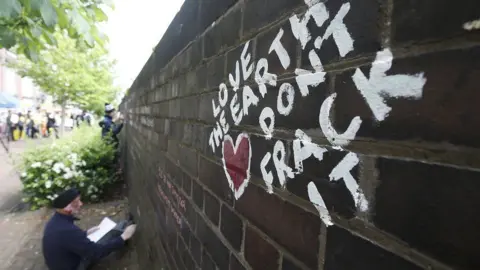
Reuters "Love the earth don't frack it" is daubed in white paint on a brown brick wall, with a red love heart. A man is crouched down in a blue jumper writing further messages on the wall. In the background is a street with people gathered and lined with trees.Reuters

An anti-fracking protester writes messages on a wall in Lancashire

Where has fracking taken place in the UK?

Fracking for shale gas in the UK has only previously taken place on a small scale, due to the many public and legal challenges.

However, exploration has identified large swathes of shale gas across the UK, particularly in northern England.

More than 100 exploration and drilling licences were awarded to firms including Third Energy, IGas, Aurora Energy Resources and Ineos.

Cuadrilla was the only company given consent to begin fracking.

It drilled two wells at a site in Lancashire but faced repeated protests from local people and campaigners.

In 2022, the Oil and Gas Authority told Cuadrilla to permanently concrete and abandon the wells.

Could fracking lower energy bills?

The UK can only meet 48% of its gas demand from domestic supplies (this would be 54% if it did not export any gas).

Some MPs have claimed that restarting drilling at Cuadrilla's two existing wells could be done quickly, and would provide significant supplies.

Cuadrilla claimed that "just 10%" of the gas from shale deposits in Lancashire and surrounding areas "could supply 50 years' worth of current UK gas demand".

Energy experts dispute this, pointing out that the UK's shale gas reserves are held in complex layers of rock.

Mike Bradshaw, professor of global energy at Warwick University, says estimates of how much shale gas the UK has are not the same as the amount of gas that could be produced commercially.

But Prof Geoffrey Maitland, professor of Energy Engineering at Imperial College London, has said fracking could provide interim relief.

"Although shale gas will not provide an immediate solution to the energy security of the country, it could be used in the medium term to replace diminishing North Sea gas production and some gas imports," he said.

Which other countries use fracking?

It is thought that fracking has given energy security to the US and Canada for the next 100 years, and has presented an opportunity to generate electricity at half the CO2 emissions of coal.

But the complex geology of the UK and the higher density of people makes extraction more challenging, according to experts.

Fracking remains banned in numerous EU countries, including Germany, France and Spain, as well as Australia.

Authorities in countries including Brazil and Argentina are split, with some banning the practice, and others allowing operations.

Read the full story here.
Photos courtesy of

Roads can become more dangerous on hot days – especially for pedestrians, cyclists and motorcyclists

We tend to adapt quickly to rain. But a growing body of research shows we also need to be more careful when it comes to travel and commuting during extreme heat.

Munbaik Cycling Clothing/UnsplashDuring heatwaves, everyday life tends to feel more difficult than on an average day. Travel and daily movement are no exception. But while most of us know rain, fog and storms can make driving conditions challenging, not many people realise heat also changes transport risk. In particular, research evidence consistently suggests roads, trips and daily commutes can become more dangerous on very hot days compared with an average day. The key questions are how much more dangerous, who is most affected, whether the risk is short-lived or lingers and how this information can be used to better manage road safety during extreme heat. Who is most at risk? The clearest picture comes from a recent multi-city study in tropical and subtropical Taiwan. Using injury data across six large cities, researchers examined how road injury risk changes as temperatures rise, and how this differs by mode of travel. The results show what researchers call a sharp, non-linear increase in risk on very hot days. It’s non-linear because road injury risk rises much more steeply once temperatures move into the 30–40°C range. It is also within this range that different travel modes begin to clearly separate in terms of their susceptibility to heat-related risk. This Taiwan study found injury risk for pedestrians more than doubled during extreme heat. Cyclist injuries soared by around 80%, and motorcyclist injuries by about 50%. In contrast, the increase for car drivers is much smaller. The pattern is clear: the more exposed the road user, the bigger the heat-related risk. The pattern is also not exclusive to a single geographical region and has been observed in other countries too. A long-running national study from Spain drew on two decades of crash data covering nearly 2 million incidents and showed crash risk increases steadily as temperatures rise. At very high temperatures, overall crash risk is about 15% higher than on cool days. Importantly, the increase is even larger for crashes linked to driver fatigue, distraction or illness. A nationwide study in the United States found a 3.4% increase in fatal traffic crashes on heatwave days versus non-heatwave days. The increase is not evenly distributed. Fatal crash risk rises more strongly: on rural roads among middle-aged and older drivers, and on hot, dry days with high UV radiation. This shows extreme heat does not just increase crash likelihood, but also the chance that crashes result in death. That’s particularly true in settings with higher speeds and less forgiving road environments. Taken together, the international evidence base is consistent: the likelihood of crashes, injury risk and fatal outcomes all increase during hot days. Why heat increases road risk, and why the effects can linger Across the three studies, the evidence points to a combination of exposure and human performance effects. The Taiwan study shows that risk increases most sharply for pedestrians, cyclists and motorcyclists. These are groups that are physically exposed to ambient heat and, in some cases, exertion. In contrast, occupants of enclosed vehicles show smaller increases in risk. This suggests that direct exposure to heat plays a role in shaping who is most affected. The Spanish study suggests that the largest heat-related increases occur in crashes involving driver fatigue, distraction, sleepiness or illness. This indicates that heat affects road safety not only through environmental conditions, but through changes in human performance that make errors more likely. Importantly, the Spanish data also show that these effects are not always confined to the hottest day itself. They can persist for several days following extreme heat, consistent with cumulative impacts such as sleep disruption and prolonged fatigue. High solar radiation refers to days with intense, direct sunlight and little cloud cover. In the US study, heat-related increases in fatal crashes were strongest under these conditions. Although visibility was not directly examined, these are also conditions associated with greater glare, which may make things even less safe. How can the extra risk be managed? The empirical evidence does not point to a single solution, but it does indicate where risk is elevated and where things become less safe. That knowledge alone can be used to manage risk. First, reducing exposure matters. Fewer trips mean less risk, and flexible work arrangements during heatwaves can indirectly reduce road exposure altogether. Second, risk awareness matters. Simply recognising that heatwaves are higher-risk travel days can help us be more cautious, especially for those travelling without the protection of an enclosed vehicle. We tend to adapt quickly to rain. As soon as the first drops hit the windscreen, we reduce speed almost subconsciously and increase distance to other vehicles. This, in fact, is a key reason traffic jams often start to develop shortly after roads become wet. But a growing body of research shows we also need to be more careful when it comes to travel and commuting during extreme heat. Milad Haghani receives funding from the Australian government (the Office of Road Safety).Zahra Shahhoseini does not work for, consult, own shares in or receive funding from any company or organisation that would benefit from this article, and has disclosed no relevant affiliations beyond their academic appointment.

West Virginia Program That Helped Communities Tackle Abandoned Buildings Is Running Out of Money

A West Virginia program that helped communities demolish abandoned buildings is running out of money, and state lawmakers haven't proposed any new solutions

From their home on Charleston’s, West Virginia's West Side, Tina and Matt Glaspey watched the house on the corner of First Avenue and Fitzgerald Street go downhill fast. A family with a young daughter left because they didn’t feel safe. The next owner died. After that, the police were responding regularly as people broke into the vacant home. The Glaspeys say that in just two years, the small brick house went from occupied to condemned, left without power or water, repeatedly entered by squatters. “One day, we noticed a bright orange sticker on the door saying the building was not safe for habitation,” Tina said. “It shows how quickly things can turn, in just two years, when nothing is done to deal with these properties.” City officials say the house is following the same path as hundreds of other vacant properties across Charleston, which slowly deteriorate until they become unsafe and are added to the city’s priority demolition list, typically including about 30 buildings at a time. Until this year, a state program helped communities tear these buildings down, preventing them from becoming safety hazards for neighborhoods and harming property values. But that money is now depleted. There is no statewide demolition program left, no replacement funding, and no legislation to keep it running, leaving municipalities on their own to absorb the costs or leave vacant buildings standing. Across West Virginia, vacant properties increase while a state program designed to help runs out of money The state’s Demolition Landfill Assistance Program was established in 2021 and was funded a year later with federal COVID-19 recovery funds. Administered through the Department of Environmental Protection, the fund reimbursed local governments for the demolition of abandoned buildings that they couldn’t afford on their own. The state survey was the first step in the program to determine the scope of the need and assess local government capacity to address it. It was distributed to all 55 counties and more than 180 municipalities. However, the need is far greater. Carrie Staton, director of the West Virginia Brownfields Assistance Center, has worked with communities on abandoned buildings for about 14 years. She said most counties don’t have the resources, funding or staffing to manage dilapidated housing on their own. “We’re just so rural and so universally rural. Other states have at least a couple of major metro areas that can support this work,” she said. “We don’t. It just takes longer to do everything.” Charleston has spent millions demolishing hundreds of vacant buildings As the state’s largest city, Charleston has more tools than most local governments, including access to federal funds that smaller communities don’t have. That has allowed the city to spend more than $12 million over the past seven years demolishing over 700 unsafe and dilapidated structures.But John Butterworth, a planner for the city, said Charleston still relied on state demolition funding to help cover those costs, which averaged about $10,000 per property, including any environmental cleanup. “It’s a real cost,” he said. “It’s a necessary one to keep neighbors safe, but it is very expensive.”He said the city received $500,000 from the state program during its last round of funding to help tear down properties that drew repeated complaints from neighbors. “I think people are really relieved when we can say that the house that’s been boarded up for a year or more is coming down,” he said. “Where the concern often comes from neighbors is, what comes next?”One vacant home on Grant Street had fallen into disrepair before being demolished in May of last year. Cracks filled the walls. Dirt and moldy debris were caked on the floors. Broken glass and boarded-up windows littered the property as plants overtook the roof and yard. Eventually, the city was able to get the owner to donate the property, which was then given to Habitat for Humanity as part of its home-building program. Now, the property is being rebuilt from scratch. Construction crews have already built the foundation, porch and frame, and it is expected to be finished within the year after its groundbreaking last October. Andrew Blackwood, executive director of Habitat for Humanity of Kanawha and Putnam counties, said the property stood for at least five years, deteriorating. The home had signs of vandalism and water damage and was completely unsalvageable. He said that of the 190 homes the organization has built in both counties, nearly 90% of them have been complete rebuilds after the previous structure was demolished. A statewide problem without a statewide plan Lawmakers have said they recognize the scale of the problem, but none have proposed other ways for tearing down dangerous structures. Fayette County used state demolition money as it was intended, which was to tear down unsafe buildings that had become public safety hazards to nearby residents. With help from the state program, the county tore down 75 dilapidated structures, officials said, removing some of the most dangerous properties while continuing to track the progress of others through a countywide system. County leaders hoped to expand their demolition efforts on their own this year, but those plans have been put on hold. The county had to take over operations of a local humane society after it faced closure and will need to fundraise, said John Breneman, president of the Fayette County Commission. Former Sen. Chandler Swope, R-Mercer, said that kind of budget pressure is exactly why he pushed for state involvement in demolition funding. Swope, who helped create the state fund for the demolition of dilapidated buildings in 2021, said the idea grew from what he saw in places where population loss left empty homes, which local governments had no way to tear down.“They didn’t have any money to tear down the dilapidated properties, so I decided that that should be a state obligation because the state has more flexibility and more access to funding,” he said.Swope said he’d always viewed the need as ongoing, even as state budgets shift from year to year.“I visualized it as a permanent need. I didn’t think you would ever get to the point where it was done,” he said. “I felt like the success of the program would carry its own priority.” But four years later, that funding is gone, and lawmakers haven’t found a replacement. Other states, meanwhile, have created long-term funding for demolition and redevelopment.Ohio, for example, operates a statewide program that provides counties with annual demolition funding. Funds are appropriated from the state budget by lawmakers. Staton said West Virginia’s lack of a plan leaves communities stuck.“Abandoned buildings are in every community, and every legislator has constituents who are dealing with this,” she said. “They know it’s just a matter of finding the funding.”And back on the West Side, the Glaspeys are left staring at boarded windows and an overgrown yard across the street. Matt said, “Sometimes you think, what’s the point of fixing up your own place if everything around you is collapsing?” This story was originally published by Mountain State Spotlight and distributed through a partnership with The Associated Press.Copyright 2026 The Associated Press. All rights reserved. This material may not be published, broadcast, rewritten or redistributed.Photos You Should See – December 2025

Webinar: Cell Tower Risks 101 - What You Need To Know To Protect Your Community

Featuring Theodora Scarato, MSW, Director of the Wireless & EMF Program at Environmental Health SciencesCell towers near homes and schools bring many health, safety and liability risks. From fire, to the fall zone, property value drops and increased RF radiation exposure, Theodora Scarato will cover the key issues that communities need to understand when a cell tower is proposed in their neighborhood.With the federal government proposing unprecedented rulemakings that would dismantle existing local government safeguards, it’s more critical than ever to understand what’s at stake for local communities and families.Webinar Date: January 7th, 2026 at 3 pm ET // 12 pm PTRegister to join this webinar HERETheodora Scarato is a leading expert in environmental health policy related to cell towers and non-ionizing electromagnetic fields. She has co-authored several scientific papers, including a foundational paper in Frontiers in Public Health entitled “U.S. policy on wireless technologies and public health protection: regulatory gaps and proposed reforms.” She will highlight key findings and policy recommendations from this publication during the webinar.To learn more about the health and safety risks of cell towers, visit the EHS Wireless & EMF Program website: Top 10 Health, Safety, and Liability Risks of Cell Towers Near Schools and HomesCell Towers Drop Property ValuesThe FCC’s Plan to Fast Track Cell TowersOfficial Letters Opposing FCC Cell Tower Fast-Track RulesWatch our previous webinar: FCC and Congressional Proposals To Strip Local Control Over Cell Towers Webinar - YouTube youtu.be

Featuring Theodora Scarato, MSW, Director of the Wireless & EMF Program at Environmental Health SciencesCell towers near homes and schools bring many health, safety and liability risks. From fire, to the fall zone, property value drops and increased RF radiation exposure, Theodora Scarato will cover the key issues that communities need to understand when a cell tower is proposed in their neighborhood.With the federal government proposing unprecedented rulemakings that would dismantle existing local government safeguards, it’s more critical than ever to understand what’s at stake for local communities and families.Webinar Date: January 7th, 2026 at 3 pm ET // 12 pm PTRegister to join this webinar HERETheodora Scarato is a leading expert in environmental health policy related to cell towers and non-ionizing electromagnetic fields. She has co-authored several scientific papers, including a foundational paper in Frontiers in Public Health entitled “U.S. policy on wireless technologies and public health protection: regulatory gaps and proposed reforms.” She will highlight key findings and policy recommendations from this publication during the webinar.To learn more about the health and safety risks of cell towers, visit the EHS Wireless & EMF Program website: Top 10 Health, Safety, and Liability Risks of Cell Towers Near Schools and HomesCell Towers Drop Property ValuesThe FCC’s Plan to Fast Track Cell TowersOfficial Letters Opposing FCC Cell Tower Fast-Track RulesWatch our previous webinar: FCC and Congressional Proposals To Strip Local Control Over Cell Towers Webinar - YouTube youtu.be

Funding bill excludes controversial pesticide provision hated by MAHA

A government funding bill released Monday excludes a controversial pesticides provision, marking a win for the Make America Healthy Again (MAHA) movement for at least the time being. The provision in question is a wonky one: It would seek to prevent pesticides from carrying warnings on their label of health effects beyond those recognized by the Environmental...

A government funding bill released Monday excludes a controversial pesticides provision, marking a win for the Make America Healthy Again (MAHA) movement for at least the time being. The provision in question is a wonky one: It would seek to prevent pesticides from carrying warnings on their label of health effects beyond those recognized by the Environmental Protection Agency (EPA). Known as Section 453 for its position in a House bill released earlier this year, it has drawn significant ire from MAHA-aligned activists. Opponents of the provision argue that it can be a liability shield for major chemical corporations, preventing them from facing failure-to-warn lawsuits by not disclosing health effects of their products. MAHA figures celebrated the provision’s exclusion from the legislation. “MAHA WE DID IT! Section 453 granting pesticide companies immunity from harm has been removed from the upcoming House spending bill!” MAHA Action, a political action committee affiliated with the movement, wrote on X. The issue is one that has divided Republicans, a party that has traditionally allied itself with big business.  “The language ensures that we do not have a patchwork of state labeling requirements. It ensures that one state is not establishing the label for the rest of the states,” Rep. Mike Simpson (R-Idaho) said earlier this year.  However, the growing MAHA movement has been critical of the chemical industry. The legislation is part of a bicameral deal reached to fund the departments of the Interior, Justice, Commerce, and Energy, as well as the EPA. And while the provision’s exclusion represents a win for the MAHA movement for the moment, the issue is far from settled. Alexandra Muñoz, a toxicologist and activist who is working with the MAHA movement said she’s “happy to see” that the provision was not included in the funding bill. However, she said, “we still have fronts that we’re fighting on because it’s still potentially going to be added in the Farm Bill.” She also noted that similar fights are ongoing at the Supreme Court and state level. The Supreme Court is currently weighing whether to take up a case about whether federal law preempts state pesticide labeling requirements and failure-to-warn lawsuits. The Trump administration said the court should side with the chemical industry. Meanwhile, a similar measure also appeared in a 2024 version of the Farm Bill. —Emily Brooks contributed. Copyright 2026 Nexstar Media Inc. All rights reserved. This material may not be published, broadcast, rewritten, or redistributed.

Suggested Viewing

Join us to forge
a sustainable future

Our team is always growing.
Become a partner, volunteer, sponsor, or intern today.
Let us know how you would like to get involved!

CONTACT US

sign up for our mailing list to stay informed on the latest films and environmental headlines.

Subscribers receive a free day pass for streaming Cinema Verde.
Thank you! Your submission has been received!
Oops! Something went wrong while submitting the form.