Cookies help us run our site more efficiently.

By clicking “Accept”, you agree to the storing of cookies on your device to enhance site navigation, analyze site usage, and assist in our marketing efforts. View our Privacy Policy for more information or to customize your cookie preferences.

This moss survived in space for 9 months

News Feed
Friday, December 12, 2025

Meet a spreading earthmoss known as Physcomitrella patens. It’s frequently used as a model organism for studies on plant evolution, development, and physiology. In this image, a reddish-brown sporophyte sits at the top center of a leafy gametophore. This capsule contains numerous spores inside. Scientists tested samples like these on the outside of the International Space Station (ISS) to see if they could tolerate the extreme airless environment. And they did. The moss survived in space for 9 months and could have lasted even longer. Image via Tomomichi Fujita/ EurekAlert! (CC BY-SA). Space is a deadly environment, with no air, extreme temperature swings and harsh radiation. Could any life survive there? Reasearchers in Japan tested a type of moss called spreading earthmoss on the exterior of the International Space Station. The moss survived for nine months, and the spores were still able to reproduce when brought back to Earth. Moss survived in space for 9 months Can life exist in space? Not simply on other planets or moons, but in the cold, dark, airless void of space itself? Most organisms would perish almost immediately, to be sure. But researchers in Japan recently experimented with moss, with surprising results. They said on November 20, 2025, that more than 80% of their moss spores survived nine months on the outside of the International Space Station. Not only that, but when brought back to Earth, they were still capable of reproducing. Nature, it seems, is even tougher than we thought! Amazingly, the results show that some primitive plants – not even just microorganisms – can survive long-term exposure to the extreme space environment. The researchers published their peer-reviewed findings in the journal iScience on November 20, 2025. A deadly environment for life Space is a horrible place for life. The lack of air, radiation and extreme cold make it pretty much unsurvivable for life as we know it. As lead author Tomomichi Fujita at Hokkaido University in Japan stated: Most living organisms, including humans, cannot survive even briefly in the vacuum of space. However, the moss spores retained their vitality after nine months of direct exposure. This provides striking evidence that the life that has evolved on Earth possesses, at the cellular level, intrinsic mechanisms to endure the conditions of space. This #moss survived 9 months directly exposed to the vacuum space and could still reproduce after returning to Earth. ? ? spkl.io/63322AdFrpTomomichi Fujita & colleagues@cp-iscience.bsky.social — Cell Press (@cellpress.bsky.social) 2025-11-24T16:00:02.992Z What about moss? Researchers wanted to see if any Earthly life could survive in space’s deadly environment for the long term. To find out, they decided to do some experiments with a type of moss called spreading earthmoss, or Physcomitrium patens. The researchers sent hundreds of sporophytes – encapsulated moss spores – to the International Space Station in March 2022, aboard the Cygnus NG-17 spacecraft. They attached the sporophyte samples to the outside of the ISS, where they were exposed to the vacuum of space for 283 days. By doing so, the samples were subjected to high levels of UV (ultraviolet) radiation and extreme swings of temperature. The samples later returned to Earth in January 2023. The researchers tested three parts of the moss. These were the protonemata, or juvenile moss; brood cells, or specialized stem cells that emerge under stress conditions; and the sporophytes. Fujita said: We anticipated that the combined stresses of space, including vacuum, cosmic radiation, extreme temperature fluctuations and microgravity, would cause far greater damage than any single stress alone. Astronauts placed the moss samples on the outside of the International Space Station for the 9-month-long experiment. Incredibly, more than 80% of the the encapsulated spores survived the trip to space and back to Earth. Image via NASA/ Roscosmos. The moss survived! So, how did the moss do? The results were mixed, but overall showed that the moss could survive in space. The radiation was the most difficult aspect of the space environment to withstand. The sporophytes were the most resilient. Incredibly, they were able to survive and germinate after being exposed to -196 degrees Celsius (-320 degrees Fahrenheit) for more than a week. At the other extreme, they also survived in 55° degrees C (131 degrees F) heat for a month. Some brood cells survived as well, but the encased spores were about 1,000 times more tolerant to the UV radiation. On the other hand, none of the juvenile moss survived the high UV levels or the extreme temperatures. Samples of moss spores that germinated after their 9-month exposure to space. Image via Dr. Chang-hyun Maeng/ Maika Kobayashi/ EurekAlert!. (CC BY-SA). How did the spores survive? So why did the encapsulated spores do so well? The researchers said the natural structure surrounding the spore itself helps to protect the spore. Essentially, it absorbs the UV radiation and surrounds the inner spore both physically and chemically to prevent damage. As it turns out, this might be associated with the evolution of mosses. This is an adaptation that helped bryophytes – the group of plants to which mosses belong – to make the transition from aquatic to terrestrial plants 500 million years ago. Overall, more than 80% of the spores survived the journey to space and then back to Earth. And only 11% were unable to germinate after being brought back to the lab on Earth. That’s impressive! In addition, the researchers also tested the levels of chlorophyll in the spores. After the exposure to space, the spores still had normal amounts of chlorophyll, except for chlorophyll a specifically. In that case, there was a 20% reduction. Chlorophyll a is used in oxygenic photosynthesis. It absorbs the most energy from wavelengths of violet-blue and orange-red light. Tomomichi Fujita at Hokkaido University in Japan is the lead author of the new study about moss in space. Image via Hokkaido University. Spores could have survived for 15 years The time available for the experiment was limited to the several months. However, the researchers wondered if the moss spores could have survived even longer. And using mathematical models, they determined the spores would likely have continued to live in space for about 15 years, or 5,600 days, altogether. The researchers note this prediction is a rough estimate. More data would still be needed to make that assessment even more accurate. So the results show just how resilient moss is, and perhaps some other kinds of life, too. Fujita said: This study demonstrates the astonishing resilience of life that originated on Earth. Ultimately, we hope this work opens a new frontier toward constructing ecosystems in extraterrestrial environments such as the moon and Mars. I hope that our moss research will serve as a starting point. Bottom line: In an experiment on the outside of the International Space Station, a species of moss survived in space for nine months. And it could have lasted much longer. Source: Extreme environmental tolerance and space survivability of the moss, Physcomitrium patens Via EurekAlert! Read more: This desert moss could grow on Mars, no greenhouse needed Read more: Colorful life on exoplanets might be lurking in cloudsThe post This moss survived in space for 9 months first appeared on EarthSky.

In an experiment on the outside of the International Space Station, a species of moss survived in space for 9 months. And it could have lasted much longer. The post This moss survived in space for 9 months first appeared on EarthSky.

Moss survived in space: Closeup of tiny green plant with spiky, pointed leaves and a round bulb in the center.
Meet a spreading earthmoss known as Physcomitrella patens. It’s frequently used as a model organism for studies on plant evolution, development, and physiology. In this image, a reddish-brown sporophyte sits at the top center of a leafy gametophore. This capsule contains numerous spores inside. Scientists tested samples like these on the outside of the International Space Station (ISS) to see if they could tolerate the extreme airless environment. And they did. The moss survived in space for 9 months and could have lasted even longer. Image via Tomomichi Fujita/ EurekAlert! (CC BY-SA).
  • Space is a deadly environment, with no air, extreme temperature swings and harsh radiation. Could any life survive there?
  • Reasearchers in Japan tested a type of moss called spreading earthmoss on the exterior of the International Space Station.
  • The moss survived for nine months, and the spores were still able to reproduce when brought back to Earth.

Moss survived in space for 9 months

Can life exist in space? Not simply on other planets or moons, but in the cold, dark, airless void of space itself? Most organisms would perish almost immediately, to be sure. But researchers in Japan recently experimented with moss, with surprising results. They said on November 20, 2025, that more than 80% of their moss spores survived nine months on the outside of the International Space Station. Not only that, but when brought back to Earth, they were still capable of reproducing. Nature, it seems, is even tougher than we thought!

Amazingly, the results show that some primitive plants – not even just microorganisms – can survive long-term exposure to the extreme space environment.

The researchers published their peer-reviewed findings in the journal iScience on November 20, 2025.

A deadly environment for life

Space is a horrible place for life. The lack of air, radiation and extreme cold make it pretty much unsurvivable for life as we know it. As lead author Tomomichi Fujita at Hokkaido University in Japan stated:

Most living organisms, including humans, cannot survive even briefly in the vacuum of space. However, the moss spores retained their vitality after nine months of direct exposure. This provides striking evidence that the life that has evolved on Earth possesses, at the cellular level, intrinsic mechanisms to endure the conditions of space.

This #moss survived 9 months directly exposed to the vacuum space and could still reproduce after returning to Earth. ? ? spkl.io/63322AdFrpTomomichi Fujita & colleagues@cp-iscience.bsky.social

Cell Press (@cellpress.bsky.social) 2025-11-24T16:00:02.992Z

What about moss?

Researchers wanted to see if any Earthly life could survive in space’s deadly environment for the long term. To find out, they decided to do some experiments with a type of moss called spreading earthmoss, or Physcomitrium patens. The researchers sent hundreds of sporophytes – encapsulated moss spores – to the International Space Station in March 2022, aboard the Cygnus NG-17 spacecraft. They attached the sporophyte samples to the outside of the ISS, where they were exposed to the vacuum of space for 283 days.

By doing so, the samples were subjected to high levels of UV (ultraviolet) radiation and extreme swings of temperature. The samples later returned to Earth in January 2023.

The researchers tested three parts of the moss. These were the protonemata, or juvenile moss; brood cells, or specialized stem cells that emerge under stress conditions; and the sporophytes. Fujita said:

We anticipated that the combined stresses of space, including vacuum, cosmic radiation, extreme temperature fluctuations and microgravity, would cause far greater damage than any single stress alone.

Space station with large solar panels on either end floating above Earth.
Astronauts placed the moss samples on the outside of the International Space Station for the 9-month-long experiment. Incredibly, more than 80% of the the encapsulated spores survived the trip to space and back to Earth. Image via NASA/ Roscosmos.

The moss survived!

So, how did the moss do? The results were mixed, but overall showed that the moss could survive in space. The radiation was the most difficult aspect of the space environment to withstand. The sporophytes were the most resilient. Incredibly, they were able to survive and germinate after being exposed to -196 degrees Celsius (-320 degrees Fahrenheit) for more than a week. At the other extreme, they also survived in 55° degrees C (131 degrees F) heat for a month.

Some brood cells survived as well, but the encased spores were about 1,000 times more tolerant to the UV radiation.

On the other hand, none of the juvenile moss survived the high UV levels or the extreme temperatures.
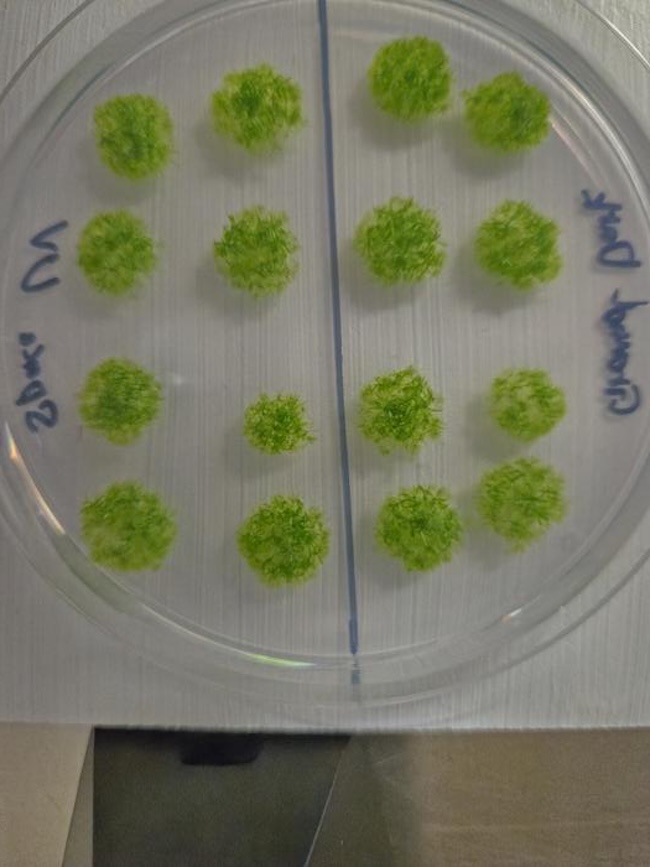
Small round glass dish with 16 round green plant samples in it.
Samples of moss spores that germinated after their 9-month exposure to space. Image via Dr. Chang-hyun Maeng/ Maika Kobayashi/ EurekAlert!. (CC BY-SA).

How did the spores survive?

So why did the encapsulated spores do so well? The researchers said the natural structure surrounding the spore itself helps to protect the spore. Essentially, it absorbs the UV radiation and surrounds the inner spore both physically and chemically to prevent damage.

As it turns out, this might be associated with the evolution of mosses. This is an adaptation that helped bryophytes – the group of plants to which mosses belong – to make the transition from aquatic to terrestrial plants 500 million years ago.

Overall, more than 80% of the spores survived the journey to space and then back to Earth. And only 11% were unable to germinate after being brought back to the lab on Earth. That’s impressive!

In addition, the researchers also tested the levels of chlorophyll in the spores. After the exposure to space, the spores still had normal amounts of chlorophyll, except for chlorophyll a specifically. In that case, there was a 20% reduction. Chlorophyll a is used in oxygenic photosynthesis. It absorbs the most energy from wavelengths of violet-blue and orange-red light.

Smiling man with eyeglasses wearing a striped dress shirt under a red sweater.
Tomomichi Fujita at Hokkaido University in Japan is the lead author of the new study about moss in space. Image via Hokkaido University.

Spores could have survived for 15 years

The time available for the experiment was limited to the several months. However, the researchers wondered if the moss spores could have survived even longer. And using mathematical models, they determined the spores would likely have continued to live in space for about 15 years, or 5,600 days, altogether. The researchers note this prediction is a rough estimate. More data would still be needed to make that assessment even more accurate.

So the results show just how resilient moss is, and perhaps some other kinds of life, too. Fujita said:

This study demonstrates the astonishing resilience of life that originated on Earth.

Ultimately, we hope this work opens a new frontier toward constructing ecosystems in extraterrestrial environments such as the moon and Mars. I hope that our moss research will serve as a starting point.

Bottom line: In an experiment on the outside of the International Space Station, a species of moss survived in space for nine months. And it could have lasted much longer.

Source: Extreme environmental tolerance and space survivability of the moss, Physcomitrium patens

Via EurekAlert!

Read more: This desert moss could grow on Mars, no greenhouse needed

Read more: Colorful life on exoplanets might be lurking in clouds

The post This moss survived in space for 9 months first appeared on EarthSky.

Read the full story here.
Photos courtesy of

Forever Chemicals' Might Triple Teens' Risk Of Fatty Liver Disease

By Dennis Thompson HealthDay ReporterTHURSDAY, Jan. 8, 2026 (HealthDay News) — PFAS “forever chemicals” might nearly triple a young person’s risk...

By Dennis Thompson HealthDay ReporterTHURSDAY, Jan. 8, 2026 (HealthDay News) — PFAS “forever chemicals” might nearly triple a young person’s risk of developing fatty liver disease, a new study says.Each doubling in blood levels of the PFAS chemical perfluorooctanoic acid is linked to 2.7 times the odds of fatty liver disease among teenagers, according to findings published in the January issue of the journal Environmental Research.Fatty liver disease — also known as metabolic dysfunction-associated steatotic liver disease (MASLD) — occurs when fat builds up in the organ, leading to inflammation, scarring and increased risk of cancer.About 10% of all children, and up to 40% of children with obesity, have fatty liver disease, researchers said in background notes.“MASLD can progress silently for years before causing serious health problems,” said senior researcher Dr. Lida Chatzi, a professor of population and public health sciences and pediatrics at the Keck School of Medicine of USC in Los Angeles.“When liver fat starts accumulating in adolescence, it may set the stage for a lifetime of metabolic and liver health challenges,” Chatzi added in a news release. “If we reduce PFAS exposure early, we may help prevent liver disease later. That’s a powerful public health opportunity.”Per- and polyfluoroalkyl substances (PFAS) are called “forever chemicals” because they combine carbon and fluorine molecules, one of the strongest chemical bonds possible. This makes PFAS removal and breakdown very difficult.PFAS compounds have been used in consumer products since the 1940s, including fire extinguishing foam, nonstick cookware, food wrappers, stain-resistant furniture and waterproof clothing.More than 99% of Americans have measurable PFAS in their blood, and at least one PFAS chemical is present in roughly half of U.S. drinking water supplies, researchers said.“Adolescents are particularly more vulnerable to the health effects of PFAS as it is a critical period of development and growth,” lead researcher Shiwen “Sherlock” Li, an assistant professor of public health sciences at the University of Hawaii, said in a news release.“In addition to liver disease, PFAS exposure has been associated with a range of adverse health outcomes, including several types of cancer,” Li said.For the new study, researchers examined data on 284 Southern California adolescents and young adults gathered as part of two prior USC studies.All of the participants already had a high risk of metabolic disease because their parents had type 2 diabetes or were overweight, researchers said.Their PFAS levels were measured through blood tests, and liver fat was assessed using MRI scans.Higher blood levels of two common PFAS — perfluorooctanoic acid (PFOA) and perfluoroheptanoic acid (PFHpA) — were linked to an increased risk of fatty liver disease.Results showed a young person’s risk was even higher if they smoked or carried a genetic variant known to influence liver fat.“These findings suggest that PFAS exposures, genetics and lifestyle factors work together to influence who has greater risk of developing MASLD as a function of your life stage,” researcher Max Aung, assistant professor of population and public health sciences at the Keck School of Medicine, said in a news release.“Understanding gene and environment interactions can help advance precision environmental health for MASLD,” he added.The study also showed that fatty liver disease became more common as teens grew older, adding to evidence that younger people might be more vulnerable to PFAS exposure, Chatzi said.“PFAS exposures not only disrupt liver biology but also translate into real liver disease risk in youth,” Chatzi said. “Adolescence seems to be a critical window of susceptibility, suggesting PFAS exposure may matter most when the liver is still developing.”The Environmental Working Group has more on PFAS.SOURCES: Keck School of Medicine of USC, news release, Jan. 6, 2026; Environmental Research, Jan. 1, 2026Copyright © 2026 HealthDay. All rights reserved.

China Announces Another New Trade Measure Against Japan as Tensions Rise

China has escalated its trade tensions with Japan by launching an investigation into imported dichlorosilane, a chemical gas used in making semiconductors

BEIJING (AP) — China escalated its trade tensions with Japan on Wednesday by launching an investigation into imported dichlorosilane, a chemical gas used in making semiconductors, a day after it imposed curbs on the export of so-called dual-use goods that could be used by Japan’s military.The Chinese Commerce Ministry said in a statement that it had launched the investigation following an application from the domestic industry showing the price of dichlorosilane imported from Japan had decreased 31% between 2022 and 2024.“The dumping of imported products from Japan has damaged the production and operation of our domestic industry,” the ministry said.The measure comes a day after Beijing banned exports to Japan of dual-use goods that can have military applications.Beijing has been showing mounting displeasure with Tokyo after new Japanese Prime Minister Sanae Takaichi suggested late last year that her nation's military could intervene if China were to take action against Taiwan — an island democracy that Beijing considers its own territory.Tensions were stoked again on Tuesday when Japanese lawmaker Hei Seki, who last year was sanctioned by China for “spreading fallacies” about Taiwan and other disputed territories, visited Taiwan and called it an independent country. Also known as Yo Kitano, he has been banned from entering China. He told reporters that his arrival in Taiwan demonstrated the two are “different countries.”“I came to Taiwan … to prove this point, and to tell the world that Taiwan is an independent country,” Hei Seki said, according to Taiwan’s Central News Agency.“The nasty words of a petty villain like him are not worth commenting on,” Chinese Foreign Ministry spokesperson Mao Ning retorted when asked about his comment. Fears of a rare earths curb Masaaki Kanai, head of Asia Oceanian Affairs at Japan's Foreign Ministry, urged China to scrap the trade curbs, saying a measure exclusively targeting Japan that deviates from international practice is unacceptable. Japan, however, has yet to announce any retaliatory measures.As the two countries feuded, speculation rose that China might target rare earths exports to Japan, in a move similar to the rounds of critical minerals export restrictions it has imposed as part of its trade war with the United States.China controls most of the global production of heavy rare earths, used for making powerful, heat-resistance magnets used in industries such as defense and electric vehicles.While the Commerce Ministry did not mention any new rare earths curbs, the official newspaper China Daily, seen as a government mouthpiece, quoted anonymous sources saying Beijing was considering tightening exports of certain rare earths to Japan. That report could not be independently confirmed. Improved South Korean ties contrast with Japan row As Beijing spars with Tokyo, it has made a point of courting a different East Asian power — South Korea.On Wednesday, South Korean President Lee Jae Myung wrapped up a four-day trip to China – his first since taking office in June. Lee and Chinese President Xi Jinping oversaw the signing of cooperation agreements in areas such as technology, trade, transportation and environmental protection.As if to illustrate a contrast with the China-Japan trade frictions, Lee joined two business events at which major South Korean and Chinese companies pledged to collaborate.The two sides signed 24 export contracts worth a combined $44 million, according to South Korea’s Ministry of Trade, Industry and Resources. During Lee’s visit, Chinese media also reported that South Korea overtook Japan as the leading destination for outbound flights from China’s mainland over the New Year’s holiday.China has been discouraging travel to Japan, saying Japanese leaders’ comments on Taiwan have created “significant risks to the personal safety and lives of Chinese citizens in Japan.”Copyright 2026 The Associated Press. All rights reserved. This material may not be published, broadcast, rewritten or redistributed.Photos You Should See – December 2025

Pesticide industry ‘immunity shield’ stripped from US appropriations bill

Democrats and the Make America Healthy Again movement pushed back on the rider in a funding bill led by BayerIn a setback for the pesticide industry, Democrats have succeeded in removing a rider from a congressional appropriations bill that would have helped protect pesticide makers from being sued and could have hindered state efforts to warn about pesticide risks.Chellie Pingree, a Democratic representative from Maine and ranking member of the House appropriations interior, environment, and related agencies subcommittee, said Monday that the controversial measure pushed by the agrochemical giant Bayer and industry allies has been stripped from the 2026 funding bill. Continue reading...

In a setback for the pesticide industry, Democrats have succeeded in removing a rider from a congressional appropriations bill that would have helped protect pesticide makers from being sued and could have hindered state efforts to warn about pesticide risks.Chellie Pingree, a Democratic representative from Maine and ranking member of the House appropriations interior, environment, and related agencies subcommittee, said Monday that the controversial measure pushed by the agrochemical giant Bayer and industry allies has been stripped from the 2026 funding bill.The move is final, as Senate Republican leaders have agreed not to revisit the issue, Pingree said.“I just drew a line in the sand and said this cannot stay in the bill,” Pingree told the Guardian. “There has been intensive lobbying by Bayer. This has been quite a hard fight.”The now-deleted language was part of a larger legislative effort that critics say is aimed at limiting litigation against pesticide industry leader Bayer, which sells the widely used Roundup herbicides.An industry alliance set up by Bayer has been pushing for both state and federal laws that would make it harder for consumers to sue over pesticide risks to human health and has successfully lobbied for the passing of such laws in Georgia and North Dakota so far.The specific proposed language added to the appropriations bill blocked federal funds from being used to “issue or adopt any guidance or any policy, take any regulatory action, or approve any labeling or change to such labeling” inconsistent with the conclusion of an Environmental Protection Agency (EPA) human health assessment.Critics said the language would have impeded states and local governments from warning about risks of pesticides even in the face of new scientific findings about health harms if such warnings were not consistent with outdated EPA assessments. The EPA itself would not be able to update warnings without finalizing a new assessment, the critics said.And because of the limits on warnings, critics of the rider said, consumers would have found it difficult, if not impossible, to sue pesticide makers for failing to warn them of health risks if the EPA assessments do not support such warnings.“This provision would have handed pesticide manufacturers exactly what they’ve been lobbying for: federal preemption that stops state and local governments from restricting the use of harmful, cancer-causing chemicals, adding health warnings, or holding companies accountable in court when people are harmed,” Pingree said in a statement. “It would have meant that only the federal government gets a say – even though we know federal reviews can take years, and are often subject to intense industry pressure.”Pingree tried but failed to overturn the language in a July appropriations committee hearing.Bayer, the key backer of the legislative efforts, has been struggling for years to put an end to thousands of lawsuits filed by people who allege they developed cancer from their use of Roundup and other glyphosate-based weed killers sold by Bayer. The company inherited the litigation when it bought Monsanto in 2018 and has paid out billions of dollars in settlements and jury verdicts but still faces several thousand ongoing lawsuits. Bayer maintains its glyphosate-based herbicides do not cause cancer and are safe when used as directed.When asked for comment on Monday, Bayer said that no company should have “blanket immunity” and it disputed that the appropriations bill language would have prevented anyone from suing pesticide manufacturers. The company said it supports state and federal legislation “because the future of American farming depends on reliable science-based regulation of important crop protection products – determined safe for use by the EPA”.The company additionally states on its website that without “legislative certainty”, lawsuits over its glyphosate-based Roundup and other weed killers can impact its research and product development and other “important investments”.Pingree said her efforts were aided by members of the Make America Healthy Again (Maha) movement who have spent the last few months meeting with congressional members and their staffers on this issue. She said her team reached out to Maha leadership in the last few days to pressure Republican lawmakers.“This is the first time that we’ve had a fairly significant advocacy group working on the Republican side,” she said.Last week, Zen Honeycutt, a Maha leader and founder of the group Moms Across America, posted a “call to action”, urging members to demand elected officials “Stop the Pesticide Immunity Shield”.“A lot of people helped make this happen,” Honeycutt said. “Many health advocates have been fervently expressing their requests to keep chemical companies accountable for safety … We are delighted that our elected officials listened to so many Americans who spoke up and are restoring trust in the American political system.”Pingree said the issue is not dead. Bayer has “made this a high priority”, and she expects to see continued efforts to get industry friendly language inserted into legislation, including into the new Farm Bill.“I don’t think this is over,” she said.This story is co-published with the New Lede, a journalism project of the Environmental Working Group

Forever Chemicals' Common in Cosmetics, but FDA Says Safety Data Are Scant

By Deanna Neff HealthDay ReporterSATURDAY, Jan. 3, 2026 (HealthDay News) — Federal regulators have released a mandated report regarding the...

By Deanna Neff HealthDay ReporterSATURDAY, Jan. 3, 2026 (HealthDay News) — Federal regulators have released a mandated report regarding the presence of "forever chemicals" in makeup and skincare products. Forever chemicals — known as perfluoroalkyl and polyfluoroalkyl substances or PFAS — are manmade chemicals that don't break down and have built up in people’s bodies and the environment. They are sometimes added to beauty products intentionally, and sometimes they are contaminants. While the findings confirm that PFAS are widely used in the beauty industry, the U.S. Food and Drug Administration (FDA) admitted it lacks enough scientific evidence to determine if they are truly safe for consumers.The new report reveals that 51 forever chemicals — are used in 1,744 cosmetic formulations. These synthetic chemicals are favored by manufacturers because they make products waterproof, increase their durability and improve texture.FDA scientists focused their review on the 25 most frequently used PFAS, which account for roughly 96% of these chemicals found in beauty products. The results were largely unclear. While five were deemed to have low safety concerns, one was flagged for potential health risks, and safety of the rest could not be confirmed.FDA Commissioner Dr. Marty Makary expressed concern over the difficulty in accessing private research. “Our scientists found that toxicological data for most PFAS are incomplete or unavailable, leaving significant uncertainty about consumer safety,” Makary said in a news release, adding that “this lack of reliable data demands further research.”Despite growing concerns about their potential toxicity, no federal laws specifically ban their use in cosmetics.The FDA report focuses on chemicals that are added to products on purpose, rather than those that might show up as accidental contaminants. Moving forward, FDA plans to work closely with the U.S. Centers for Disease Control and Prevention (CDC) and the Environmental Protection Agency (EPA) to update and strengthen recommendations on PFAS across the retail and food supply chain, Makary said. The agency has vowed to devote more resources to monitoring these chemicals and will take enforcement action if specific products are proven to be dangerous.The U.S. Food and Drug Administration provides updates and consumer guidance on the use of PFAS in cosmetics.SOURCE: U.S. Food and Drug Administration, news release, Dec. 29, 2025Copyright © 2026 HealthDay. All rights reserved.

Suggested Viewing

Join us to forge
a sustainable future

Our team is always growing.
Become a partner, volunteer, sponsor, or intern today.
Let us know how you would like to get involved!

CONTACT US

sign up for our mailing list to stay informed on the latest films and environmental headlines.

Subscribers receive a free day pass for streaming Cinema Verde.
Thank you! Your submission has been received!
Oops! Something went wrong while submitting the form.