Cookies help us run our site more efficiently.

By clicking “Accept”, you agree to the storing of cookies on your device to enhance site navigation, analyze site usage, and assist in our marketing efforts. View our Privacy Policy for more information or to customize your cookie preferences.

This county is California’s harshest charging ‘desert’ for electric cars. Local activists want to change that 

News Feed
Tuesday, May 21, 2024

In summary Lack of EV chargers in remote areas could derail California’s aim to electrify cars. In Imperial County, residents have access to few public chargers and buy electric cars at only a fifth of the statewide rate. Few places in California are as unforgiving for driving an electric car as the remote and sparsely populated Imperial Valley. Only four fast-charging public stations are spread across the valley’s vast 4,500 square miles just north of the US-Mexico border, according to the U.S. Department of Energy. That means if you’re Greg Gelman — one of only about 1,200 Imperial County residents who own an electric car — traveling almost anywhere is a maddening logistical challenge. “It’s been, I won’t say a nightmare, but it’s been very, very, very inconvenient,” Gelman said on a recent afternoon as he charged his all-electric Mercedes-Benz at a charging station in a Bank of America parking lot in El Centro. “Would I do it again? No.” California’s electric charging “deserts” like the Imperial Valley pose one of the biggest obstacles to the state’s efforts to combat climate change and air pollution by electrifying cars and trucks. Experts say the slow installation of chargers in California’s remote regions could jeopardize the state’s phaseout of new gas-powered cars. Under the state’s mandate, 35% of sales of 2026 models must be zero-emissions, ramping up to 68% in 2030 and 100% in 2035. Nestled in the desert in California’s far southeast corner, Imperial County ranks dead last in electric car ownership among California counties with populations of 100,000 or more, according to a CalMatters analysis of 2023 data. Only 7 out of every 1,000 cars are battery-powered there, compared with 51 out of every 1,000 statewide. High poverty and unemployment are a major factor in the region’s slow transition to electric cars, but its lack of public chargers are a big drawback, too. People living in rural, low-income regions like the Imperial Valley have the least access to electric car chargers, according to a state Energy Commission analysis. More than two-thirds of California’s low-income residents are a 10-minute drive or longer from a publicly available fast charger. Luis Olmedo, executive director of El Comite Civico del Valle, a nonprofit advocating for environmental justice, has battled for years against the Imperial Valley’s unhealthy air. Now he is making a bid to become its go-to supplier of charging stations for zero-emissions cars. Olmedo isn’t waiting for businesses or the state to make chargers a reality in Imperial County. Instead, his group has embarked on a $5-million, high-stakes crusade to build a network of 40 fast chargers at various locations. It’s an open question whether his somewhat quixotic endeavor will succeed. Electric car chargers “are an opportunity for us to be able to breathe cleaner air,” Olmedo said. “It’s about equity. It’s about justice. It’s about making sure that everybody has chargers.” Luis Olmedo, executive director of Comite Civico Del Valle, shown at a charging station in Calexico, is trying to build 40 fast chargers in the Imperial Valley. Photo by Adriana Heldiz, CalMatters Esther Conrad, a researcher at Stanford University who focuses on environmental sustainability, said getting chargers in places like Imperial County is critical to California’s effort to transition to electric vehicles in an equitable way. Apartment dwellers and others who don’t have charging at home need nearby and reliable places to charge.  “When you have a rural community that’s low-income and distant from other locations, it’s incredibly important to enable people to get places where they need to go,” Conrad said. Hours from urban centers A car is essential for traversing Imperial County, which is the most sparsely populated county in Southern California. Its neighborhoods are vast distances from urban centers that provide the services that residents need: El Centro — its biggest town, home to about 44,000 people — is much closer to Mexicali, Mexico, than it is to San Diego, which is about a two-hour drive away, or Riverside, nearly three hours. Its highways and roads cross boundless fields of lettuce and other crops that give way to strip malls, apartments and suburban tracts — and then even more crops and open desert.  Map highlighting Imperial County. If you drive an electric car the 109 miles from El Centro to Palm Springs, your route takes you through farmland, desert and around California’s largest lake, the Salton Sea, which is also one of its biggest environmental calamities. The Salton Sea has been receding in recent years, causing toxic dust to blow into Imperial Valley towns. The region’s air quality is among the worst in the state, with dust storms and a brown haze emanating from agricultural burning and factories in the valley or from across the border in Mexicali, a city of a million people. About 16% of Imperial County’s 179,000 residents have asthma, higher than the state average. The air violates national health standards for both fine particles, or soot, as well as ozone, the main ingredient of smog; both pollutants can trigger asthma attacks and other respiratory diseases. More than 85% of Imperial County’s residents are Latino, and Spanish is widely spoken here. Agriculture is a major employer, and many businesses are dependent on cross-border trade and traffic from Mexico. The county’s median household income is $53,847, much lower than the statewide median, and 21% of people live in poverty. El Centro, the biggest town in the Imperial Valley, is home to about 44,000 people. Photo by Adriana Heldiz, CalMatters Now the discovery of lithium, used to manufacture EV batteries, at the Salton Sea has the potential to transform the region’s economy. State officials say the deposit could produce 600,000 tons a year, valued at $7.2 billion, and assist the U.S. as it tries to foster a domestic electric car industry that rivals China’s.  But Olmedo worries that when the mineral is removed from the valley, it won’t meaningfully change people’s livelihoods or their health. He points to examples in the developing world where local people have been left behind as extractive industries take what they need. “We’re about to extract, perhaps, the world’s supply of lithium here, yet we don’t even have the simplest, the lowest of offerings, which is: Let’s build you chargers,” Olmedo said. Chicken and egg: Too few EVs and too few chargers Last year, electric cars were only 5% of all new cars sold in Imperial County, compared with 25% statewide. Getting chargers into low-income and rural places will become more and more important as California struggles to meet its ambitious climate targets. The Energy Commission estimates that California will need 1.01 million chargers outside of private homes by 2030 and 2.11 million by 2035, when more than 15 million electric cars are expected on the roads. So far the state has only about 105,000 nonprivate chargers.  Edgar Ruiz, air control technician, and José Flores, research and advocacy specialist with Comite Civico Del Valle, demonstrate how electric vehicle charging stations will work when installed in the Imperial Valley. Photo by Adriana Heldiz, CalMatters First: New electric vehicle chargers in Calexico. Last: Components of an electric vehicle charging station. Photos by Adriana Heldiz, CalMatters Nick Nigro, founder of Atlas Public Policy, which researches the electric car market, said charging companies won’t locate chargers in regions with few electric vehicles. “You need revenue, and if the EVs aren’t there, then your customers aren’t necessarily there, so you do have a legitimate chicken and egg problem,” Nigro said. “We have to look to public policy to help that market failure.” The Biden administration will invest $384 million in California’s electric car infrastructure over five years. And state officials are investing almost $2 billion in grants for funding zero-emission vehicle chargers over the next four years, including some special grants in rural, inland areas for up to  $80,000 per charger.  Olmedo says the funding has been insufficient so he’s had to turn to donations and other sources of funding. Patty Monahan, one of five members of the California Energy Commission, said “it’s particularly important that we see chargers in the Imperial Valley and other low-income counties with poor air quality. Imperial Valley has only four fast-charging stations open for public use, where people can find chargers capable of juicing their batteries up to 80% in under an hour, according to the U.S. Department of Energy. Three of those stations are in El Centro, with one exclusively for Teslas; another is in the border town of Calexico and was recently installed by El Comite. Another six stations offer only slower chargers. Olmedo envisions a network of 40 publicly accessible chargers throughout the valley. El Comite has received funding from the California Energy Commission as well as donations from Waverley Streets Foundation, the United Auto Workers and General Motors. The group is seeking more state funding. Olmedo acknowledged that he is facing a slew of challenges with his project, including some local opposition and the high cost of installation and maintenance. At a warehouse in the city of Imperial where El Comite stores the chargers, Jose Flores, project manager for the group’s charging initiative, said he and three colleagues spent four days in Santa Ana, about 200 miles north, at a facility managed by BTC, the company that makes the chargers that El Comite is installing. They received training on installation and maintenance techniques, and discussed how not all chargers can be used by all electric vehicles. He learned about payment and cooling systems, and that the chargers might need more frequent maintenance because of Imperial Valley’s harsh desert conditions. “We’re like a testing ground because we have poor air quality here due to the Salton Sea and being in a desert,” he said. Chris Aldaz, of Calexico, charges his car at an Electrify America charging station in El Centro. Photo by Adriana Heldiz, CalMatters El Comite installed its first charger at its Brawley headquarters in 2022. Last December, El Civico pressed ahead with a more ambitious project: Four of their fast chargers are now operating in a park in the border town of Calexico. Chris Aldaz, 35, a U.S. Postal Service worker who lives in Calexico, charges at home, but at times uses chargers at the group’s Brawley headquarters that people can use for free. It is a Level 2, which can take several hours to charge. “The reason why I wanted to get an EV was that it was cheaper,” Aldaz told CalMatters. “I don’t want to be spending all this money on gas, and on maintenance, and it was better for the environment.” Nevertheless, Olmedo’s electric car chargers have become a local political issue. Maritza Hurtado, Calexico’s ex-mayor, and coordinator of a City Council recall campaign, said it was inappropriate for El Comite to have built four electric car chargers in a downtown park. The chargers were a distraction “from our police needs and our actual community infrastructure needs,” Hurtado said at a public hearing at the county’s utility, the Imperial Irrigation District, in January. She declined to speak to CalMatters. “We had no idea they were going to take our parkland,” Hurtado said at the hearing. “It is very upsetting and disrespectful to our community for Comite Civico to come to Calexico and take our land.” Olmedo hopes that the chargers ultimately will be something the county’s Latino community takes pride in. “Put this in perspective: It’s a farmworker-founded organization, an environmental justice organization, that is building the infrastructure. It’s not the lithium industry. It’s us, building it for ourselves.” Data journalist Erica Yee contributed to this report.

Lack of EV chargers in remote areas could derail California’s aim to electrify cars. In Imperial County, residents have access to few public chargers and buy electric cars at only a fifth of the statewide rate.

In summary

Lack of EV chargers in remote areas could derail California’s aim to electrify cars. In Imperial County, residents have access to few public chargers and buy electric cars at only a fifth of the statewide rate.

Few places in California are as unforgiving for driving an electric car as the remote and sparsely populated Imperial Valley.

Only four fast-charging public stations are spread across the valley’s vast 4,500 square miles just north of the US-Mexico border, according to the U.S. Department of Energy. That means if you’re Greg Gelman — one of only about 1,200 Imperial County residents who own an electric car — traveling almost anywhere is a maddening logistical challenge.

“It’s been, I won’t say a nightmare, but it’s been very, very, very inconvenient,” Gelman said on a recent afternoon as he charged his all-electric Mercedes-Benz at a charging station in a Bank of America parking lot in El Centro. “Would I do it again? No.”

California’s electric charging “deserts” like the Imperial Valley pose one of the biggest obstacles to the state’s efforts to combat climate change and air pollution by electrifying cars and trucks.

Experts say the slow installation of chargers in California’s remote regions could jeopardize the state’s phaseout of new gas-powered cars. Under the state’s mandate, 35% of sales of 2026 models must be zero-emissions, ramping up to 68% in 2030 and 100% in 2035.

Nestled in the desert in California’s far southeast corner, Imperial County ranks dead last in electric car ownership among California counties with populations of 100,000 or more, according to a CalMatters analysis of 2023 data. Only 7 out of every 1,000 cars are battery-powered there, compared with 51 out of every 1,000 statewide.

High poverty and unemployment are a major factor in the region’s slow transition to electric cars, but its lack of public chargers are a big drawback, too.

People living in rural, low-income regions like the Imperial Valley have the least access to electric car chargers, according to a state Energy Commission analysis. More than two-thirds of California’s low-income residents are a 10-minute drive or longer from a publicly available fast charger.

Luis Olmedo, executive director of El Comite Civico del Valle, a nonprofit advocating for environmental justice, has battled for years against the Imperial Valley’s unhealthy air. Now he is making a bid to become its go-to supplier of charging stations for zero-emissions cars.

Olmedo isn’t waiting for businesses or the state to make chargers a reality in Imperial County. Instead, his group has embarked on a $5-million, high-stakes crusade to build a network of 40 fast chargers at various locations. It’s an open question whether his somewhat quixotic endeavor will succeed.

Electric car chargers “are an opportunity for us to be able to breathe cleaner air,” Olmedo said. “It’s about equity. It’s about justice. It’s about making sure that everybody has chargers.”

Luis Olmedo, executive director of Comite Civico Del Valle, shown at a charging station in Calexico, is trying to build 40 fast chargers in the Imperial Valley. Photo by Adriana Heldiz, CalMatters


Esther Conrad, a researcher at Stanford University who focuses on environmental sustainability, said getting chargers in places like Imperial County is critical to California’s effort to transition to electric vehicles in an equitable way. Apartment dwellers and others who don’t have charging at home need nearby and reliable places to charge. 

“When you have a rural community that’s low-income and distant from other locations, it’s incredibly important to enable people to get places where they need to go,” Conrad said.

Hours from urban centers

A car is essential for traversing Imperial County, which is the most sparsely populated county in Southern California.

Its neighborhoods are vast distances from urban centers that provide the services that residents need: El Centro — its biggest town, home to about 44,000 people — is much closer to Mexicali, Mexico, than it is to San Diego, which is about a two-hour drive away, or Riverside, nearly three hours. Its highways and roads cross boundless fields of lettuce and other crops that give way to strip malls, apartments and suburban tracts — and then even more crops and open desert. 

Map showing Imperial County's location in California and its biggest towns.
Map highlighting Imperial County.

If you drive an electric car the 109 miles from El Centro to Palm Springs, your route takes you through farmland, desert and around California’s largest lake, the Salton Sea, which is also one of its biggest environmental calamities.

The Salton Sea has been receding in recent years, causing toxic dust to blow into Imperial Valley towns. The region’s air quality is among the worst in the state, with dust storms and a brown haze emanating from agricultural burning and factories in the valley or from across the border in Mexicali, a city of a million people.

About 16% of Imperial County’s 179,000 residents have asthma, higher than the state average. The air violates national health standards for both fine particles, or soot, as well as ozone, the main ingredient of smog; both pollutants can trigger asthma attacks and other respiratory diseases.

More than 85% of Imperial County’s residents are Latino, and Spanish is widely spoken here. Agriculture is a major employer, and many businesses are dependent on cross-border trade and traffic from Mexico. The county’s median household income is $53,847, much lower than the statewide median, and 21% of people live in poverty.

El Centro, the biggest town in the Imperial Valley, is home to about 44,000 people. Photo by Adriana Heldiz, CalMatters

Now the discovery of lithium, used to manufacture EV batteries, at the Salton Sea has the potential to transform the region’s economy. State officials say the deposit could produce 600,000 tons a year, valued at $7.2 billion, and assist the U.S. as it tries to foster a domestic electric car industry that rivals China’s. 

But Olmedo worries that when the mineral is removed from the valley, it won’t meaningfully change people’s livelihoods or their health. He points to examples in the developing world where local people have been left behind as extractive industries take what they need.

“We’re about to extract, perhaps, the world’s supply of lithium here, yet we don’t even have the simplest, the lowest of offerings, which is: Let’s build you chargers,” Olmedo said.

Chicken and egg: Too few EVs and too few chargers

Last year, electric cars were only 5% of all new cars sold in Imperial County, compared with 25% statewide. Getting chargers into low-income and rural places will become more and more important as California struggles to meet its ambitious climate targets.

The Energy Commission estimates that California will need 1.01 million chargers outside of private homes by 2030 and 2.11 million by 2035, when more than 15 million electric cars are expected on the roads. So far the state has only about 105,000 nonprivate chargers. 
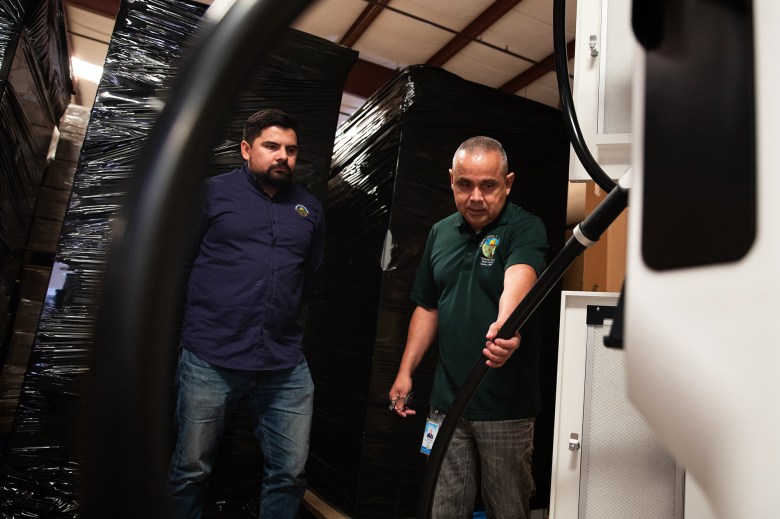
Edgar Ruiz, air control technician, and José Flores, research and advocacy specialist with Comite Civico Del Valle, demonstrate how electric vehicle charging stations will work when installed in the Imperial Valley. Photo by Adriana Heldiz, CalMatters

Nick Nigro, founder of Atlas Public Policy, which researches the electric car market, said charging companies won’t locate chargers in regions with few electric vehicles.

“You need revenue, and if the EVs aren’t there, then your customers aren’t necessarily there, so you do have a legitimate chicken and egg problem,” Nigro said. “We have to look to public policy to help that market failure.”

The Biden administration will invest $384 million in California’s electric car infrastructure over five years. And state officials are investing almost $2 billion in grants for funding zero-emission vehicle chargers over the next four years, including some special grants in rural, inland areas for up to  $80,000 per charger.  Olmedo says the funding has been insufficient so he’s had to turn to donations and other sources of funding.

Patty Monahan, one of five members of the California Energy Commission, said “it’s particularly important that we see chargers in the Imperial Valley and other low-income counties with poor air quality.

Imperial Valley has only four fast-charging stations open for public use, where people can find chargers capable of juicing their batteries up to 80% in under an hour, according to the U.S. Department of Energy. Three of those stations are in El Centro, with one exclusively for Teslas; another is in the border town of Calexico and was recently installed by El Comite. Another six stations offer only slower chargers.

Olmedo envisions a network of 40 publicly accessible chargers throughout the valley. El Comite has received funding from the California Energy Commission as well as donations from Waverley Streets Foundation, the United Auto Workers and General Motors. The group is seeking more state funding.

Olmedo acknowledged that he is facing a slew of challenges with his project, including some local opposition and the high cost of installation and maintenance.

At a warehouse in the city of Imperial where El Comite stores the chargers, Jose Flores, project manager for the group’s charging initiative, said he and three colleagues spent four days in Santa Ana, about 200 miles north, at a facility managed by BTC, the company that makes the chargers that El Comite is installing.

They received training on installation and maintenance techniques, and discussed how not all chargers can be used by all electric vehicles. He learned about payment and cooling systems, and that the chargers might need more frequent maintenance because of Imperial Valley’s harsh desert conditions.

“We’re like a testing ground because we have poor air quality here due to the Salton Sea and being in a desert,” he said.

Chris Aldaz, of Calexico, charges his car at an Electrify America charging station in El Centro. Photo by Adriana Heldiz, CalMatters

El Comite installed its first charger at its Brawley headquarters in 2022. Last December, El Civico pressed ahead with a more ambitious project: Four of their fast chargers are now operating in a park in the border town of Calexico.

Chris Aldaz, 35, a U.S. Postal Service worker who lives in Calexico, charges at home, but at times uses chargers at the group’s Brawley headquarters that people can use for free. It is a Level 2, which can take several hours to charge.

“The reason why I wanted to get an EV was that it was cheaper,” Aldaz told CalMatters. “I don’t want to be spending all this money on gas, and on maintenance, and it was better for the environment.”

Nevertheless, Olmedo’s electric car chargers have become a local political issue.

Maritza Hurtado, Calexico’s ex-mayor, and coordinator of a City Council recall campaign, said it was inappropriate for El Comite to have built four electric car chargers in a downtown park. The chargers were a distraction “from our police needs and our actual community infrastructure needs,” Hurtado said at a public hearing at the county’s utility, the Imperial Irrigation District, in January. She declined to speak to CalMatters.

“We had no idea they were going to take our parkland,” Hurtado said at the hearing. “It is very upsetting and disrespectful to our community for Comite Civico to come to Calexico and take our land.”

Olmedo hopes that the chargers ultimately will be something the county’s Latino community takes pride in.

“Put this in perspective: It’s a farmworker-founded organization, an environmental justice organization, that is building the infrastructure. It’s not the lithium industry. It’s us, building it for ourselves.”

Data journalist Erica Yee contributed to this report.

Read the full story here.
Photos courtesy of

10 Farm Bill Proposals to Watch in 2026

Called marker bills, the proposals cover a wide range of farm group priorities, from access to credit to forever-chemical contamination to investment in organic agriculture. House Agriculture Committee Chair G.T. Thompson (R-Pennsylvania) told Politico in December that he would restart the farm bill process this month. In an interview with Agri-Pulse, Senate Agriculture Committee Chair […] The post 10 Farm Bill Proposals to Watch in 2026 appeared first on Civil Eats.

As lawmakers wrapped up 2025 and agriculture leaders signaled they intend to move forward on a five-year farm bill early this year, many introduced bills that would typically be included in that larger legislative package. Called marker bills, the proposals cover a wide range of farm group priorities, from access to credit to forever-chemical contamination to investment in organic agriculture. House Agriculture Committee Chair G.T. Thompson (R-Pennsylvania) told Politico in December that he would restart the farm bill process this month. In an interview with Agri-Pulse, Senate Agriculture Committee Chair John Boozman (R-Arkansas) said his chamber would work on it “right after the first of the year.” But most experts say there’s no clear path forward for a new farm bill. The last five-year farm bill expired in September 2023. Because Congress had not completed a new one, they extended the previous bill, then extended it again in 2024. In 2025, Republicans included in their One Big Beautiful Bill the biggest-ever cuts to the Supplemental Nutrition Assistance Program (SNAP) and a boost in commodity crop subsidies, and later extended other farm programs in the bill package that ended the government shutdown. The SNAP actions torpedoed Democrats’ willingness to compromise (some have signaled they won’t support a farm bill unless it rolls back some of the cuts), while the extension of the big farm programs took pressure off both parties. Still, that didn’t stop lawmakers from introducing and reintroducing over the last month many marker bills they hope to get in an actual farm bill package if things change. Here are 10 recent proposals important to farmers, most of which have bipartisan support. Fair Credit for Farmers Act: Makes changes to the U.S. Department of Agriculture (USDA) Farm Service Agency (FSA) to make it easier for farmers to get loans. Introduced by Representative Alma Adams (D-North Carolina) in the House and Senator Peter Welch (D-Vermont) in the Senate. Key supporters: National Family Farm Coalition, RAFI. FARM Home Loans Act: Increases rural homebuyers’ access to Farm Credit loans by expanding the definition of “rural area” to include areas with larger populations. Introduced by Representatives Kristen McDonald Rivet (D-Michigan) and Bill Huizeng (R-Michigan). Key supporters: Farm Credit Council. USDA Loan Modernization Act: Updates USDA loan requirements to allow farmers with at least a 50 percent operational interest to qualify. Introduced by Representatives Mike Bost (R-Illinois) and Nikki Budzinski (D-Illinois). Key supporters: Illinois Corn Growers Association, Illinois Pork Producers Association. Relief for Farmers Hit With PFAS Act: Sets up a USDA grant program for states to help farmers affected by forever-chemical contamination in their fields, test soil, monitor farmer health impacts, and conduct research on farms. Introduced by Senators Susan Collins (R-Maine) and Jeanne Shaheen (D-New Hampshire) in the Senate and Representatives Chellie Pingree (D-Maine) and Mike Lawler (R-New York) in the House. Key supporters: Maine Organic Farmers and Gardeners Association. EFFECTIVE Food Procurement Act: Requires the USDA to weigh factors including environmental sustainability, social and racial equity, worker well-being, and animal welfare in federal food purchasing, and helps smaller farms and food companies meet requirements to become USDA vendors. Introduced by Senator Ed Markey (D-Massachusetts) and several co-sponsors in the Senate, and Representative Alma Adams (D-North Carolina) and several co-sponsors in the House. Key supporters: National Sustainable Agriculture Coalition. AGRITOURISM Act: Designates an Agritourism Advisor at the USDA to support the economic viability of family farms. Introduced by Senator Kirsten Gillibrand (D-New York) and several co-sponsors in the Senate, and Representatives Suhas Subramanyam (D-Virginia) and Dan Newhouse (R-Washington) in the House. Key supporters: Brewers Association, WineAmerica. Domestic Organic Investment Act: Creates a USDA grant program to fund expansion of the domestic certified-organic food supply chain, including expanding storage, processing, and distribution. Introduced by Senators Tammy Baldwin (D-Wisconsin) and Susan Collins (R-Maine) in the Senate, and Representatives Andrea Salinas (D-Oregon) and Derrick Van Orden (R-Wisconsin) in the House. Key supporters: Organic Trade Association. Zero Food Waste Act: Creates a new Environmental Protection Agency (EPA) grant program to fund projects that prevent, divert, or recycle food waste. Introduced by Representatives Chellie Pingree (D-Maine) and Julia Brownley (D-California) in the House, and Senator Cory Booker (D-New Jersey) in the Senate. Key supporters: Natural Resources Defense Council, ReFed. LOCAL Foods Act: Allows farmers to process animals on their farms without meeting certain regulations if the meat will not be sold. Introduced by Senator Peter Welch (D-Vermont) and several co-sponsors in the Senate, and Representative Eugene Vindman (D-Virginia) and several co-sponsors in the House. Key supporters: Rural Vermont, National Family Farm Coalition. PROTEIN Act: Directs more than $500 million in federal support over the next five years toward research and development for “alternative proteins.” Introduced by Senator Adam Schiff (D-California) in the Senate, and Representative Julia Brownley (D-California) in the House. Key supporters: Good Food Institute, Plant-Based Foods Institute. The post 10 Farm Bill Proposals to Watch in 2026 appeared first on Civil Eats.

China and South Korea Pledge to Bolster Ties as Regional Tensions Rise

South Korea and China have pledged to boost trade and safeguard regional stability

BEIJING (AP) — China and South Korea’s leaders pledged to boost trade and safeguard regional stability on Monday during a visit to Beijing by the South Korean president that was overshadowed by North Korea’s recent ballistic missile tests.South Korean President Lee Jae Myung met Chinese President Xi Jinping as part of his four-day trip to China — his first since taking office, in June.As Xi hosted Lee at the imposing Great Hall of the People, the Chinese president stressed the two countries’ “important responsibilities in maintaining regional peace and promoting global development,” according to a readout of their meeting broadcast by state-run CCTV.Lee spoke about opening “a new chapter in the development of Korea-China relations” during “changing times.”“The two countries should make joint contributions to promote peace, which is the foundation for prosperity and growth,” Lee said.The visit comes as China wants to shore up regional support amid rising tensions with Japan. Beijing and South Korea’s ties themselves have fluctuated in recent years, with frictions over South Korea’s hosting of U.S. military troops and armaments. North Korea launches ballistic missiles ahead of the meeting Just hours before Lee’s arrival in China, North Korea launched several ballistic missiles into the sea, including, it said, hypersonic missiles, which travel at five times the speed of sound and are extra-difficult to detect and intercept.The tests came as Pyongyang criticized a U.S. attack on Venezuela that included the removal of its strongman leader Nicolás Maduro.North Korea, which has long feared the U.S. might seek regime change in Pyongyang, criticized the attack as a wild violation of Venezuela's sovereignty and an example of the “rogue and brutal nature of the U.S.”China had also condemned the U.S. attack, which it said violated international law and threatened peace in Latin America.China is North Korea’s strongest backer and economic lifeline amid U.S. sanctions targeting Pyongyang's missile and nuclear program. China’s frictions with Japan also loom over the visit Lee’s visit also coincided, more broadly, with rising tensions between China and Japan over recent comments by Japan’s new leader that Tokyo could intervene in a potential Chinese attack on Taiwan, the island democracy China claims as its own.Last week, China staged large-scale military drills around the island for two days to warn against separatist and “external interference” forces. In his meeting with Lee, Xi mentioned China and Korea’s historical rivalry against Japan, calling on the two countries to “join hands to defend the fruits of victory in World War II and safeguard peace and stability in Northeast Asia.”Regarding South Korea's military cooperation with the U.S., Lee said during an interview with CCTV ahead of his trip that it shouldn't mean that South Korea-China relations should move toward confrontation. He added that his visit to China aimed to “minimize or eliminate past misunderstandings or contradictions (and) elevate and develop South Korea-China relations to a new stage.” Agreements in technology, trade and transportation China and South Korea maintain robust trade ties, with bilateral trade reaching about $273 billion in 2024.During their meeting, Xi and Lee oversaw the signing of 15 cooperation agreements in areas such as technology, trade, transportation and environmental protection, CCTV reported.Earlier on Monday, Lee had attended a business forum in Beijing with representatives of major South Korean and Chinese companies, including Samsung, Hyundai, LG and Alibaba Group.At that meeting, Lee and Chinese Vice Premier He Lifeng oversaw the signing of agreements in areas such as consumer goods, agriculture, biotechnology and entertainment.AP reporter Hyung-jin Kim in Seoul contributed to this report.Copyright 2026 The Associated Press. All rights reserved. This material may not be published, broadcast, rewritten or redistributed.Photos You Should See – December 2025

GOP lawmakers’ power transfers are reshaping North Carolina

North Carolina’s Republican-led legislature has siphoned off some of the governor’s traditional powers

North Carolina voters have chosen Democrats in three straight elections for governor; the state’s Republican-led legislature has countered by siphoning off some of the powers that traditionally came with the job. These power grabs have had a profound effect on both democracy in the state and on the everyday lives of North Carolina residents, Democrats argue. The changes are “weakening environmental protections, raising energy costs, and politicizing election administration,” Josh Stein, North Carolina’s governor, said in a text message responding to questions from ProPublica. Republican leaders in the General Assembly did not respond to requests for comment or emailed questions about the power shifts. In the past, they have defended these actions as reflecting the will of voters, with the senate president describing one key bill as balancing “appointment power between the legislative and executive branches.” Former state Sen. Bob Rucho, a Republican picked to sit on the state elections board after lawmakers shifted control from Stein to the Republican state auditor, said the changes would fix problems created by Democrats. “Republicans are very proud of what’s been accomplished,” Rucho said. Shifting authority over the elections board, he argued, would “reestablish a level of confidence in the electoral process” that Democrats had lost. ProPublica recently chronicled the nearly 10-year push to take over the board, which sets rules and settles disputes in elections in the closely divided swing state. Decisions made by the board’s new leadership — particularly on the locations and numbers of early voting sites — could affect outcomes in the 2026 midterms. Below, we examine how other power transfers driven by North Carolina’s Republican legislature are reshaping everything from the regulations that protect residents’ drinking water to the rates they pay for electricity to the culture of their state university system. Related “Biblical justice for all”: How North Carolina’s chief justice transformed his state Environmental Management Commission What it is: The Environmental Management Commission adopts rules that protect the state’s air and water, such as those that regulate industries discharging potentially carcinogenic chemicals in rivers. Power transfer: In October 2023, Republican legislators passed a law shifting the power to appoint the majority of the commission’s members from the governor to themselves and the state’s commissioner of agriculture, who is a Republican. What’s happened since: The new Republican-led commission has stymied several efforts by the state’s Department of Environmental Quality to regulate a potentially harmful chemical, 1,4-dioxane, in drinking water. Advocates for businesses, including the North Carolina Chamber of Commerce, had criticized some regulations and urged the commission to intervene. “Clean water is worth the cost, but regulators should not arbitrarily establish a level that is low for the sake of being low,” the chamber said in a press release. The Southern Environmental Law Center, which has pressed the state to regulate the chemical, has said the commission’s rulings are “crippling the state’s ability to protect its waterways, drinking water sources, and communities from harmful pollution.” Utilities Commission What it is: The North Carolina Utilities Commission regulates the rates and services of the state’s public utilities, which include providers of electricity, natural gas, water and telephone service. The commission also oversees movers, brokers, ferryboats and wastewater. Power transfer: In June 2025, a trial court sided with the General Assembly in allowing a law passed in 2024 to take effect, removing the governor’s power to appoint a majority of the commission’s members and transferring that power to legislative leaders and the state treasurer, who is a Republican. What’s happened since: The state’s primary utility, Duke Energy, has backed off from some plans to rely more on clean energy and retire coal-fired power plants. In November, the company said it would seek the commission’s approval to raise rates by 15%. In response to a new resource plan the company filed in October, the executive director of NC WARN, a climate and environmental justice nonprofit, said in a statement that Duke’s actions would cause “power bills to double or triple over time” and increase carbon emissions. The state’s governor and attorney general, both Democrats, have said they oppose the rate hike. Garrett Poorman, a spokesperson for Duke Energy, said that the company is “focused on keeping costs as low as possible while meeting growing energy needs across our footprint” and that the company had recently lowered its forecasted costs. The commission will decide whether to approve the proposed rate hikes in 2026. University of North Carolina System What it is: The University of North Carolina System encompasses 17 institutions and more than 250,000 students, including at the University of North Carolina-Chapel Hill, considered one of best in the nation. Power transfer: Though the legislature has traditionally appointed the majority of the trustees for individual schools, the governor also made a share of these appointments. In 2016, the legislature passed a law that eliminated the governor’s ability to make university trustee appointments. In 2023, changes inserted into the state budget bill gave the legislature power to appoint all of the members of the state board that oversees community colleges and most of those colleges’ trustees. The governor had previously chosen some board members and trustees. What’s happened since: The system has created a center for conservative thought, repealed racial equity initiatives, suspended a left-leaning professor, gutted a civil rights center led by a professor long critical of Republican lawmakers and appointed politically connected Republicans to the boards. Republicans say the moves are reversing the system’s long-term leftward drift. “Ultimately, the board stays in for a while, and you change administrators, and then start to moderate the culture of the UNC schools,” said David Lewis, a former Republican House member who helped drive the changes to the university system. Democrats, including former Gov. Roy Cooper, have criticized the board changes as partisan meddling. “These actions will ultimately hurt our state’s economy and reputation,” Cooper said in a 2023 press release. Read more about this topic Democrats sound alarm on Trump administration’s attacks on voting rights “Still angry”: Voters say they won’t forget that the North Carolina GOP tried to trash their ballots “We will bring this home”: North Carolina Democrats confident they’ll defeat GOP election denial The post GOP lawmakers’ power transfers are reshaping North Carolina appeared first on Salon.com.

Our Biggest Farming Stories of 2025

Trump’s tariffs created more headaches for farmers, particularly soybean producers, who saw their biggest buyer—China—walk away during the trade fight as their costs for fertilizer and other materials increased. Farming groups also protested when the Trump administration announced it would import 80,000 metric tons of beef from Argentina, about four times the regular quota. We […] The post Our Biggest Farming Stories of 2025 appeared first on Civil Eats.

When we started Civil Eats, we sought to report on farming from a different perspective, focusing on underrepresented voices and issues. This year, most American farmers faced significant challenges, and we strove to tell their stories. Federal budget cuts were a major disruption, impacting USDA grants that helped farmers build soil health, increase biodiversity, generate renewable energy, and sell their crops to local schools and food banks, among other projects. Trump’s tariffs created more headaches for farmers, particularly soybean producers, who saw their biggest buyer—China—walk away during the trade fight as their costs for fertilizer and other materials increased. Farming groups also protested when the Trump administration announced it would import 80,000 metric tons of beef from Argentina, about four times the regular quota. We also identified as many solutions as we could in this turbulent year by highlighting farmers’ extraordinary resilience and resourcefulness, from finding sustainable ways to grow food to fighting corporate consolidation to opening their own meat-processing cooperative. Here are our biggest farming stories of 2025, in chronological order. Farmers Need Help to Survive. A New Crop of Farm Advocates Is on the Way. Farmers with expertise in law and finance have long guided the farming community through tough situations, but their numbers have been dropping. Now, thanks to federally funded training, farm advocates are coming back. California Decides What ‘Regenerative Agriculture’ Means. Sort of. A new definition for an old way of farming may help California soil, but it won’t mean organic. Butterbee Farm, in Maryland, has received several federal grants that have been crucial for the farm’s survival. (Photo credit: L.A. Birdie Photography) Trump’s Funding Freeze Creates Chaos and Financial Distress for Farmers Efforts to transition farms to regenerative agriculture are stalled, and the path forward is unclear. How Trump’s Tariffs Will Affect Farmers and Food Prices Economists say tariffs will likely lead to higher food prices, while farmers are worried about fertilizer imports and their export markets. USDA Continues to Roll Out Deeper Cuts to Farm Grants: A List In addition to the end of two local food programs that support schools and food banks sourcing from small farms, more cuts are likely. USDA Prioritizes Economic Relief for Commodity Farmers The agency announced it will roll out economic relief payments to growers of corn, soybeans, oilseeds, and other row crops. Will Local Food Survive Trump’s USDA? Less than two months in, Trump’s USDA is bulldozing efforts that help small farms and food producers sell healthy food directly to schools, food banks, and their local communities. USDA Unfreezes Energy Funds for Farmers, but Demands They Align on DEI USDA is requesting farmers make changes to their projects so that they align with directives on energy production and DEI, a task experts say may not be legal or possible. Ranchers herd cattle across open range in the Sangre de Cristo Mountains, New Mexico, where conservation initiatives help restore grasslands and protect water resources. (Photo courtesy Ariel Greenwood) Trump Announces Higher Tariffs on Major Food and Agricultural Trade Partners The president says the tariffs will boost American manufacturing and make the country wealthy, but many expect farmers to suffer losses and food prices to rise. USDA Introduces Policy Agenda Focused on Small Farms Agriculture Secretary Brooke Rollins rolls out a 10-point plan that includes environmental deregulation and utilizing healthy food programs that have recently lost funding. USDA Drops Rules Requiring Farmers to Record Their Use of the Most Toxic Pesticides Pesticide watchdog groups say the regulations should be strengthened, not thrown out. Conservation Work on Farms and Ranches Could Take a Hit as USDA Cuts Staff Close to 2,400 employees of the Natural Resources Conservation Service have accepted an offer to resign, leaving fewer hands to protect rural landscapes. USDA Cancels Additional Grants Funding Land Access and Training for Young Farmers The future of other awards in the Increasing Land, Capital, and Market Access Program remains unclear. House Bill Would Halt Assessment of PFAS Risk on Farms The bill also strengthens EPA authority around pesticide labeling, which could prevent states from adopting their own versions of labels. Should Regenerative Farmers Pin Hopes on RFK Jr.’s MAHA? While the Make America Health Again movement supports alternative farming, few of Trump’s policies promote healthy agricultural landscapes. A leaked version of the second MAHA Commission Report underscores these concerns. Minnesota Governor Tim Walz, the Democratic nominee for vice president in 2024, introduces Willie Nelson at Farm Aid’s 40th anniversary this year, in St. Paul, Minnesota. (Photo credit: Lisa Held) At 40, Farm Aid Is Still About Music. It’s Also a Movement. Willie Nelson launched the music festival in 1985 as a fundraiser to save family farms. With corporate consolidation a continuing threat to farms, it’s now a platform for populist organizing, too. Agriculture Secretary Confirms US Plan to Buy Beef from Argentina Brooke Rollins on Tuesday defended a Trump administration plan that has ignited criticism from farm groups and some Republicans. For Farmers, the Government Shutdown Adds More Challenges With no access to local ag-related offices, critical loans, or disaster assistance, farmers are facing even more stressors. Farmers Struggle With Tariffs, Despite China Deal to Buy US Soybeans While the Supreme Court considers Trump’s tariffs, the farm economy falters. This Farmer-Owned Meat Processing Co-op in Tennessee Changes the Game A Q&A with Lexy Close of the Appalachian Producers Cooperative, who says the new facility has dramatically decreased processing wait times and could revive the area’s local meat economy. Farmers Face Prospect of Skyrocketing Healthcare Premiums More than a quarter of U.S. farmers rely on the Affordable Care Act, but Biden-era tax credits expire at the end of the year. After 150 Years, California’s Sugar Beet Industry Comes to an End The Imperial Valley might be the best place in the world to grow beets. What went wrong? Trump Farmer Bailout Primarily Benefits Commodity Farms Of the $12 billion the administration will send to farmers, $11 billion is reserved for ranchers and major row crop farmers. The post Our Biggest Farming Stories of 2025 appeared first on Civil Eats.

Defunding fungi: US’s living library of ‘vital ecosystem engineers’ is in danger of closing

These fungi boost plant growth and restore depleted ecosystems, but federal funding for a library housing them has been cut – and it may be forced to closeInside a large greenhouse at the University of Kansas, Professor Liz Koziol and Dr Terra Lubin tend rows of sudan grass in individual plastic pots. The roots of each straggly plant harbor a specific strain of invisible soil fungus. The shelves of a nearby cold room are stacked high with thousands of plastic bags and vials containing fungal spores harvested from these plants, then carefully preserved by the researchers.The samples in this seemingly unremarkable room are part of the International Collection of Vesicular Arbuscular Mycorrhizal Fungi (INVAM), the world’s largest living library of soil fungi. Four decades in the making, it could cease to exist within a year due to federal budget cuts. Continue reading...

Inside a large greenhouse at the University of Kansas, Professor Liz Koziol and Dr Terra Lubin tend rows of sudan grass in individual plastic pots. The roots of each straggly plant harbor a specific strain of invisible soil fungus. The shelves of a nearby cold room are stacked high with thousands of plastic bags and vials containing fungal spores harvested from these plants, then carefully preserved by the researchers.The samples in this seemingly unremarkable room are part of the International Collection of Vesicular Arbuscular Mycorrhizal Fungi (INVAM), the world’s largest living library of soil fungi. Four decades in the making, it could cease to exist within a year due to federal budget cuts.For leading mycologist Toby Kiers, this would be catastrophic. “INVAM represents a library of hundreds of millions of years of evolution,” said Kiers, executive director of the Society for Protection of Underground Networks (Spun). “Ending INVAM for scientists is like closing the Louvre for artists.”The arbuscular mycorrhizal (AM) fungi conserved by INVAM are symbiotic organisms that support the growth of 70% of land plant species across all ecosystems. In exchange for sugars and fats, they provide plants with vital nutrients – phosphorus, nitrogen, trace metals – and buffer them against drought, disease and other stressors. They also represent a substantial underground sink for carbon dioxide. INVAM maintains living spores of more than 900 distinct fungal strains collected from six continents. It’s an irreplaceable hub for mycological research worldwide – but these fungi also have practical power: restoring degraded ecosystems, rebuilding damaged soils and slashing artificial fertilizer use. They are essential tools for growing food and undoing the environmental harm caused by agriculture.Established in 1985, INVAM has relied on successive federal grants for its entire existence. Its latest US National Science Foundation (NSF) funding ended in May. As curator and professor Jim Bever and team prepare a new funding proposal, the outlook is ominous: the Trump administration’s proposed budget for fiscal year 2026 would slash NSF funding by 57% and make it even more difficult to win the remaining funds.Without another grant, Bever estimates the collection can limp along for perhaps another year. Beyond that, INVAM could be forced to close. “I have a hard time thinking about that possibility,” Bever said, “but we can’t deny it’s true.” For now, INVAM is surviving on temporary research grants and volunteer labor. Unlike the collection’s previous home at West Virginia University, which provided institutional support for personnel, the University of Kansas covers infrastructure and overhead costs but not staffing.Liz Koziol and Terra Lubin stand amid sudan grass plants used to culture AM fungal spores in INVAM’s greenhouse at the University of Kansas in Lawrence. Photograph: Ben MartynogaAnd the staff are critical. Unlike seeds stored in vaults or cells frozen indefinitely, without sustained, meticulous work, the spores of AM fungi die. At INVAM, associate curator Lubin works at a microscope to isolate and identify AM spores from intact soils. Seen through the microscope, these spores are visually stunning: glistening orbs, packed with nutrients needed to support young fungi.Lubin then paints isolated spores onto the roots of a sudan grass seedling. These host plants will grow in a sterile greenhouse for 12 weeks while fungi colonize their roots and soil. Then the plants will be water-starved, prompting the fungus to produce millions of spores, which workers harvest and store in the adjoining cold room. For every one of INVAM’s 900-plus strains, this process must be repeated annually.“The isolation and maintenance of AM fungi requires an arcane skillset,” said Bever. “There really isn’t another lab in the US that has been doing this.”Most commercial biofertilizers are ‘really just terrible’INVAM prepares small batches of AM fungal spores to distribute or sell to other researchers and land managers. But Bever is clear this isn’t a commercial operation, and INVAM has neither the capacity nor the ambition to scale up production. That matters because the commercial AM fungus market is rife with problems.In a 2024 study, Bever and colleagues tested 23 products marketed as fungal biofertilizers – AM spores alleged to boost plant growth naturally. Eighty-seven per cent failed to colonize plant roots. Many contained only dead spores or no spores at all. Some products contained known plant pathogens. A large-scale 2022 study by European researchers revealed similar failings. Bever and Koziol’s 2024 mata-analysis of global research reached the same disturbing conclusion: the majority of commercial AM fertilizers are worthless.“Unfortunately, the quality of most products available to farmers or restoration practitioners is really just terrible,” said Bever.Yet land managers are buying them. The global market for fungal biofertilizers is worth $1.29bn. Most of that money is being wasted on products that simply do not work. Bever sees two key problems: the industry lacks regulation, and most producers lack the specialized expertise needed to steward and distribute these delicate organisms effectively. Meanwhile, the public research infrastructure that could provide real solutions struggles to survive.But quality biofertilizers can be pricelessThe failure of most commercial biofertilizers stands in stark contrast to research demonstrating what these organisms can actually achieve.At a field research plot near INVAM’s base in Lawrence, Kansas, the impact of invisible fungi is obvious. Nine years ago, this was a tired old hay field, dominated by invasive grass. Today it is a riot of color and diversity. Twelve-foot prairie docks tower over head-tall grasses; grasshoppers leap and butterflies flit between late blooming flowers, even in October. This small patch has become a reincarnation of the tall-grass prairie that once dominated the central US states. It was this ecosystem that built the deep, fertile soils that made this area such a prime target for conversion to farmland – a shift that has diminished the prairie to a mere 1-4% of its original extent.AM fungi drove the transformation. In 2016, INVAM curator Koziol seeded plots with dozens of native prairie plants, plus AM spores from surviving old-growth prairie fragments. Control plots received the seeds but not the fungi. As a result, dozens of plants in the control plots failed to establish and all plants grew slowly. Nine years on, the difference between control and AM-treated plots is still clear.Modern agriculture decimates AM fungi – which is why reintroducing them can deliver such dramatic results. Fungicides used to control plant diseases seep into soils, killing AM fungi. Excessive synthetic fertilizer application causes plants to break symbiotic ties, starving fungi. Ploughing destroys their underground networks. As a result, AM fungi often vanish entirely from cultivated land, “We can barely even find the DNA [of AM fungi] in some of the soils that have been in intensive agricultural production,” said leading fungal ecologist Matthias Rillig of Freie Universität Berlin.This matters because AM fungi disperse slowly – they produce no above-ground fruiting bodies to scatter spores on the wind. As a result, reintroduction is often essential for restoration.Building on their successful prairie restoration experiments, Bever and Koziol see potential for AM fungi in establishing prairie strips – patches of deep-rooted, species-rich perennial plants within existing farm fields that boost pollinators and limit fertilizer runoff, which contaminates groundwater and creates dead zones in bodies of water.“Prairie strips are awesome,” said Bever, but he believes there’s grander potential in the Conservation Reserve Program. This federal scheme has already enlisted more than 20m acres, supporting landowners to transition marginal farmland into native grassland and woodland to improve soil health, retain water and store carbon. “The return on that investment would be much greater if there was a national policy to reinoculate with native mycorrhizal fungi,” he said.Beyond habitat restoration, and despite the current failure of most commercial fungal biofertilizers, AM fungi can be useful in mainstream agriculture. In 2016, Koziol founded MycoBloom to produce high-quality preparations of old-growth prairie fungus spores. In addition to restoration practitioners, customers report promising results in vineyards, orange orchards, and high-value organic crops such as peppers and tomatoes.The effects of AM fungi are likely to be strongest in perennial crops, including new grains like Kernza, whose roots remain in the ground long enough for stable symbiosis to establish. But evidence shows AM fungi can also boost growth of annual staples such as maize.“The benefits of mycorrhizal fungi are real,” said Bever. Yet scientists are only beginning to understand how these organisms work. Numerous research questions about AM fungi can only be answered with living libraries such as INVAM, Bever added. Why do AM fungal cells contain thousands of nuclei, for instance, when ours need just one? And how can apparently distinct species merge their cells to create hybrids? “Research on mycorrhizal fungi is totally dependent on having these fungi in culture,” Bever said.“The current administration has shifted funding away from basic science,” he added, “and while there is always a hope that private donors could fill that void, I don’t think there is a real substitute for federal investment.”Kiers, now a professor at Vrije Universiteit Amsterdam, described how visiting INVAM in the 1990s to identify spores collected from Panama’s hyper-diverse rainforests shaped her entire career: “After seeing the collection, I was hooked. It changed the way I saw the underground.”“To have any hope in leveraging fungi for future climate change strategies, restoration efforts and regenerative agriculture, we need to safeguard this collection,” Kiers said.Merlin Sheldrake, mycologist and author of Entangled Life: How Fungi Make Our Worlds, Change Our Minds and Shape Our Futures, agreed emphatically.“These organisms are vital ecosystem engineers that hold the key to so many problems we face,” he said. “To lose this library would be an unimaginable tragedy.”

Suggested Viewing

Join us to forge
a sustainable future

Our team is always growing.
Become a partner, volunteer, sponsor, or intern today.
Let us know how you would like to get involved!

CONTACT US

sign up for our mailing list to stay informed on the latest films and environmental headlines.

Subscribers receive a free day pass for streaming Cinema Verde.
Thank you! Your submission has been received!
Oops! Something went wrong while submitting the form.