Cookies help us run our site more efficiently.

By clicking “Accept”, you agree to the storing of cookies on your device to enhance site navigation, analyze site usage, and assist in our marketing efforts. View our Privacy Policy for more information or to customize your cookie preferences.

Is AI being shoved down your throat at work? Here’s how to fight back.

News Feed
Sunday, November 16, 2025

Is it possible to fight against the integration of AI in the workplace? Your Mileage May Vary is an advice column offering you a unique framework for thinking through your moral dilemmas. It’s based on value pluralism, the idea that each of us has multiple values that are equally valid but that often conflict with each other. To submit a question, fill out this anonymous form. Here’s this week’s question from a reader, condensed and edited for clarity. I’m an AI engineer working at a medium-sized ad agency, mostly on non-generative machine learning models (think ad performance prediction, not ad creation). Lately, it feels like people, specifically senior and mid-level managers who do not have engineering experience, are pushing the adoption and development of various AI tools. Honestly, it feels like an unthinking melee. I consider myself a conscientious objector to the use of AI, especially generative AI; I’m not fully opposed to it, but I constantly ask who actually benefits from the application of AI and what its financial, human, and environmental costs are beyond what is right in front of our noses. Yet, as a rank-and-file employee, I find myself with no real avenue to relay those concerns to people who have actual power to decide. Worse, I feel that even voicing such concerns, admittedly running against the almost blind optimism that I assume affects most marketing companies, is turning me into a pariah in my own workplace. So my question is this: Considering the difficulty of finding good jobs in AI, is it “worth it” trying to encourage critical AI use in my company, or should I tone it down if only to keep paying the bills? Dear Conscientious Objector, You’re definitely not alone in hating the uncritical rollout of generative AI. Lots of people hate it, from artists, to coders, to students. I bet there are people in your own company who hate it, too. But they’re not speaking up — and, of course, there’s a reason for that: They’re afraid to lose their jobs. Honestly, it’s a fair concern. And it’s the reason why I’m not going to advise you to stick your neck out and fight this crusade alone. If you as an individual object to your company’s AI use, you become legible to the company as a “problem” employee. There could be consequences to that, and I don’t want to see you lose your paycheck.  But I also don’t want to see you lose your moral integrity. You’re absolutely right to constantly ask who actually benefits from the unthinking application of AI and whether the benefits outweigh the costs.  So, I think you should fight for what you believe in — but fight as part of a collective. The real question here is not, “Should you voice your concerns about AI or stay quiet?” It’s, “How can you build solidarity with others who want to be part of a resistance movement with you?” Teaming up is both safer for you as an employee and more likely to have an impact. “The most important thing an individual can do is be somewhat less of an individual,” the environmentalist Bill McKibben once said. “Join together with others in movements large enough to have some chance at changing those political and economic ground rules that keep us locked on this current path.” Now, you know what word I’m about to say next, right? Unionize. If your workplace can be organized, that’ll be a key strategy for allowing you to fight AI policies you disagree with. If you need a bit of inspiration, look at what some labor unions have already achieved — from the Writers Guild of America, which won important protections around AI for Hollywood writers, to the Service Employees International Union, which negotiated with Pennsylvania’s governor to create a worker board overseeing the implementation of generative AI in government services. Meanwhile, this year saw thousands of nurses marching in the streets as National Nurses United pushed for the right to determine how AI does and doesn’t get used in patient interactions. “There’s a whole range of different examples where unions have been able to really be on the front foot in setting the terms for how AI gets used — and whether it gets used at all,” Sarah Myers West, co-executive director of the AI Now Institute, told me recently. If it’s too hard to get a union off the ground at your workplace, there are plenty of organizations you can join forces with. Check out the Algorithmic Justice League or Fight for the Future, which push for equitable and accountable tech. There are also grassroots groups like Stop Gen AI, which aims to organize both a resistance movement and a mutual aid program to help those who’ve lost work due to the AI rollout. You can also consider hyperlocal efforts, which have the benefit of creating community. One of the big ways those are showing up right now is in the fight against the massive buildout of energy-hungry data centers meant to power the AI boom.  “It’s where we have seen many people fighting back in their communities — and winning,” Myers West told me. “They’re fighting on behalf of their own communities, and working collectively and strategically to say, ‘We’re being handed a really raw deal here. And if you [the companies] are going to accrue all the benefits from this technology, you need to be accountable to the people on whom it’s being used.’” Already, local activists have blocked or delayed $64 billion worth of data center projects across the US, according to a study by Data Center Watch, a project run by AI research firm 10a Labs. Yes, some of those data centers may eventually get built anyway. Yes, fighting the uncritical adoption of AI can sometimes feel like you’re up against an undefeatable behemoth. But it helps to preempt discouragement if you take a step back to think about what it really looks like when social change is happening. In a new book, Somebody Should Do Something, three philosophers — Michael Brownstein, Alex Madva, and Daniel Kelly — show how anyone can help create social change. The key, they argue, is to realize that when we join forces with others, our actions can lead to butterfly effects:  Minor actions can set off cascades that lead, in a surprisingly short time, to major structural outcomes. This reflects a general feature of complex systems. Causal effects in such systems don’t always build on each other in a smooth or continuous way. Sometimes they build nonlinearly, allowing seemingly small events to produce disproportionately large changes.  The authors explain that, because society is a complex system, your actions aren’t a meaningless “drop in the bucket.” Adding water to a bucket is linear; each drop has equal impact. Complex systems behave more like heating water: Not every degree has the same effect, and the shift from 99°C to 100°C crosses a tipping point that triggers a phase change.  We all know the boiling point of water, but we don’t know the tipping point for changes in the social world. That means it’s going to be hard for you to tell, at any given moment, how close you are to creating a cascade of change. But that doesn’t mean change is not happening.  According to Harvard political scientist Erica Chenoweth’s research, if you want to achieve systemic social change, you need to mobilize 3.5 percent of the population around your cause. Though we have not yet seen AI-related protests on that scale, we do have data indicating the potential for a broad base. A full 50 percent of Americans are more concerned than excited about the rise of AI in daily life, according to a recent survey from the Pew Research Center. And 73 percent support robust regulation of AI, according to the Future of Life Institute.  So, even though you might feel alone in your workplace, there are people out there who share your concerns. Find your teammates. Come up with a positive vision for the future of tech. Then, fight for the future you want. Bonus: What I’m reading Microsoft’s announcement that it wants to build “humanist superintelligence” caught my eye. Whether you think that’s an oxymoron or not, I take it as a sign that at least some of the powerful players hear us when we say we want AI that solves real concrete problems for real flesh-and-blood people — not some fanciful AI god.  The Economist article “Meet the real screen addicts: the elderly” is so spot-on. When it comes to digital media, everyone is always worrying about The Youth, but I think not enough research has been devoted to the elderly, who are often positively glued to their devices.  Hallelujah, some AI researchers are finally adopting a pragmatic approach to the whole, “Can AI be conscious?” debate! I’ve long suspected that “conscious” is a pragmatic tool we use as a way of saying, “This thing should be in our moral circle,” so whether AI is conscious isn’t something we’ll discover — it’s something we’ll decide. 

Your Mileage May Vary is an advice column offering you a unique framework for thinking through your moral dilemmas. It’s based on value pluralism, the idea that each of us has multiple values that are equally valid but that often conflict with each other. To submit a question, fill out this anonymous form. Here’s this week’s question from a […]
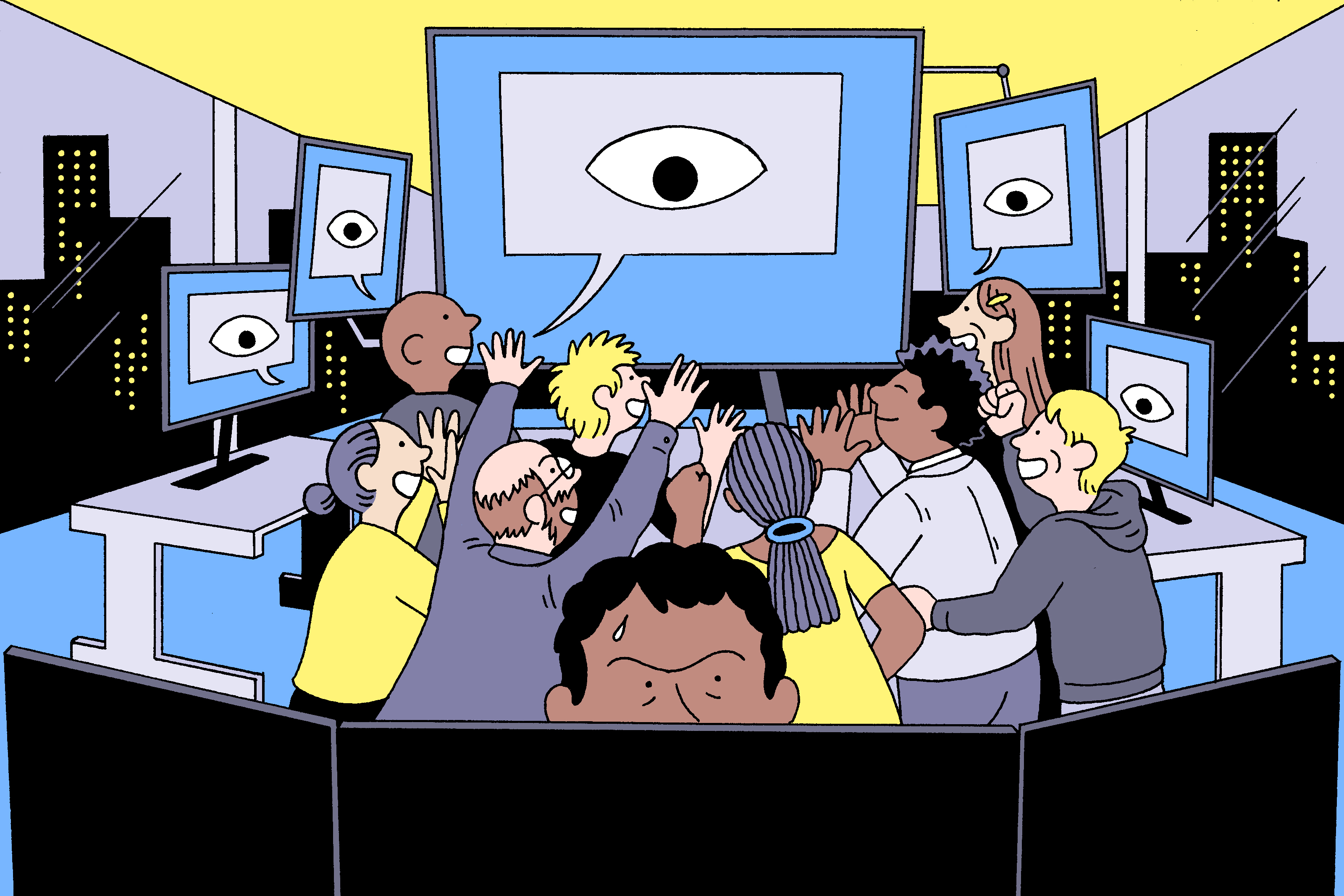
Is it possible to fight against the integration of AI in the workplace?

Your Mileage May Vary is an advice column offering you a unique framework for thinking through your moral dilemmas. It’s based on value pluralism, the idea that each of us has multiple values that are equally valid but that often conflict with each other. To submit a question, fill out this anonymous form. Here’s this week’s question from a reader, condensed and edited for clarity.

I’m an AI engineer working at a medium-sized ad agency, mostly on non-generative machine learning models (think ad performance prediction, not ad creation). Lately, it feels like people, specifically senior and mid-level managers who do not have engineering experience, are pushing the adoption and development of various AI tools. Honestly, it feels like an unthinking melee.

I consider myself a conscientious objector to the use of AI, especially generative AI; I’m not fully opposed to it, but I constantly ask who actually benefits from the application of AI and what its financial, human, and environmental costs are beyond what is right in front of our noses. Yet, as a rank-and-file employee, I find myself with no real avenue to relay those concerns to people who have actual power to decide. Worse, I feel that even voicing such concerns, admittedly running against the almost blind optimism that I assume affects most marketing companies, is turning me into a pariah in my own workplace.

So my question is this: Considering the difficulty of finding good jobs in AI, is it “worth it” trying to encourage critical AI use in my company, or should I tone it down if only to keep paying the bills?

Dear Conscientious Objector,

You’re definitely not alone in hating the uncritical rollout of generative AI. Lots of people hate it, from artists, to coders, to students. I bet there are people in your own company who hate it, too.

But they’re not speaking up — and, of course, there’s a reason for that: They’re afraid to lose their jobs.

Honestly, it’s a fair concern. And it’s the reason why I’m not going to advise you to stick your neck out and fight this crusade alone. If you as an individual object to your company’s AI use, you become legible to the company as a “problem” employee. There could be consequences to that, and I don’t want to see you lose your paycheck. 

But I also don’t want to see you lose your moral integrity. You’re absolutely right to constantly ask who actually benefits from the unthinking application of AI and whether the benefits outweigh the costs. 

So, I think you should fight for what you believe in — but fight as part of a collective. The real question here is not, “Should you voice your concerns about AI or stay quiet?” It’s, “How can you build solidarity with others who want to be part of a resistance movement with you?” Teaming up is both safer for you as an employee and more likely to have an impact.

“The most important thing an individual can do is be somewhat less of an individual,” the environmentalist Bill McKibben once said. “Join together with others in movements large enough to have some chance at changing those political and economic ground rules that keep us locked on this current path.”

Now, you know what word I’m about to say next, right? Unionize. If your workplace can be organized, that’ll be a key strategy for allowing you to fight AI policies you disagree with.

If you need a bit of inspiration, look at what some labor unions have already achieved — from the Writers Guild of America, which won important protections around AI for Hollywood writers, to the Service Employees International Union, which negotiated with Pennsylvania’s governor to create a worker board overseeing the implementation of generative AI in government services. Meanwhile, this year saw thousands of nurses marching in the streets as National Nurses United pushed for the right to determine how AI does and doesn’t get used in patient interactions.

“There’s a whole range of different examples where unions have been able to really be on the front foot in setting the terms for how AI gets used — and whether it gets used at all,” Sarah Myers West, co-executive director of the AI Now Institute, told me recently.

If it’s too hard to get a union off the ground at your workplace, there are plenty of organizations you can join forces with. Check out the Algorithmic Justice League or Fight for the Future, which push for equitable and accountable tech. There are also grassroots groups like Stop Gen AI, which aims to organize both a resistance movement and a mutual aid program to help those who’ve lost work due to the AI rollout.

You can also consider hyperlocal efforts, which have the benefit of creating community. One of the big ways those are showing up right now is in the fight against the massive buildout of energy-hungry data centers meant to power the AI boom. 

“It’s where we have seen many people fighting back in their communities — and winning,” Myers West told me. “They’re fighting on behalf of their own communities, and working collectively and strategically to say, ‘We’re being handed a really raw deal here. And if you [the companies] are going to accrue all the benefits from this technology, you need to be accountable to the people on whom it’s being used.’”

Already, local activists have blocked or delayed $64 billion worth of data center projects across the US, according to a study by Data Center Watch, a project run by AI research firm 10a Labs.

Yes, some of those data centers may eventually get built anyway. Yes, fighting the uncritical adoption of AI can sometimes feel like you’re up against an undefeatable behemoth. But it helps to preempt discouragement if you take a step back to think about what it really looks like when social change is happening.

In a new book, Somebody Should Do Something, three philosophers — Michael Brownstein, Alex Madva, and Daniel Kelly — show how anyone can help create social change. The key, they argue, is to realize that when we join forces with others, our actions can lead to butterfly effects: 

Minor actions can set off cascades that lead, in a surprisingly short time, to major structural outcomes. This reflects a general feature of complex systems. Causal effects in such systems don’t always build on each other in a smooth or continuous way. Sometimes they build nonlinearly, allowing seemingly small events to produce disproportionately large changes. 

The authors explain that, because society is a complex system, your actions aren’t a meaningless “drop in the bucket.” Adding water to a bucket is linear; each drop has equal impact. Complex systems behave more like heating water: Not every degree has the same effect, and the shift from 99°C to 100°C crosses a tipping point that triggers a phase change. 

We all know the boiling point of water, but we don’t know the tipping point for changes in the social world. That means it’s going to be hard for you to tell, at any given moment, how close you are to creating a cascade of change. But that doesn’t mean change is not happening. 

According to Harvard political scientist Erica Chenoweth’s research, if you want to achieve systemic social change, you need to mobilize 3.5 percent of the population around your cause. Though we have not yet seen AI-related protests on that scale, we do have data indicating the potential for a broad base. A full 50 percent of Americans are more concerned than excited about the rise of AI in daily life, according to a recent survey from the Pew Research Center. And 73 percent support robust regulation of AI, according to the Future of Life Institute. 

So, even though you might feel alone in your workplace, there are people out there who share your concerns. Find your teammates. Come up with a positive vision for the future of tech. Then, fight for the future you want.

Bonus: What I’m reading

  • Microsoft’s announcement that it wants to build “humanist superintelligence” caught my eye. Whether you think that’s an oxymoron or not, I take it as a sign that at least some of the powerful players hear us when we say we want AI that solves real concrete problems for real flesh-and-blood people — not some fanciful AI god
  • The Economist article “Meet the real screen addicts: the elderly” is so spot-on. When it comes to digital media, everyone is always worrying about The Youth, but I think not enough research has been devoted to the elderly, who are often positively glued to their devices. 
  • Hallelujah, some AI researchers are finally adopting a pragmatic approach to the whole, “Can AI be conscious?” debate! I’ve long suspected that “conscious” is a pragmatic tool we use as a way of saying, “This thing should be in our moral circle,” so whether AI is conscious isn’t something we’ll discover — it’s something we’ll decide. 
Read the full story here.
Photos courtesy of

Buddhist Monks Persist in Peace Walk Despite Injuries as Thousands Follow Them on Social Media

A group of Buddhist monks is persevering in their peace walk across much of the U.S. even after two participants were injured when a truck hit their escort vehicle

ATLANTA (AP) — A group of Buddhist monks is persevering in their walking trek across much of the U.S. to promote peace, even after two of its members were injured when a truck hit their escort vehicle.After starting their walk in Fort Worth, Texas, on Oct. 26, the group of about two dozen monks has made it to Georgia as they continue on a path to Washington, D.C., highlighting Buddhism's long tradition of activism for peace.The group planned to walk its latest segment through Georgia on Tuesday from the town of Morrow to Decatur, on the eastern edge of Atlanta. Marking day 66 of the walk, the group invited the public to a Peace Gathering in Decatur Tuesday afternoon.The monks and their loyal dog Aloka are traveling through 10 states en route to Washington, D.C. In coming days, they plan to pass through or very close to Athens, Georgia; the North Carolina cities of Charlotte, Greensboro and Raleigh; and Richmond, Virginia, on their way to the nation’s capital city.The group has amassed a huge audience on social media, with more than 400,000 followers on Facebook. Aloka has its own hashtag, #AlokathePeaceDog.The group's Facebook page is frequently updated with progress reports, inspirational notes and poetry.“We do not walk alone. We walk together with every person whose heart has opened to peace, whose spirit has chosen kindness, whose daily life has become a garden where understanding grows," the group posted recently.The trek has not been without danger. Last month outside Houston, the monks were walking on the side of a highway near Dayton, Texas, when their escort vehicle, which had its hazard lights on, was hit by a truck, Dayton Interim Police Chief Shane Burleigh said.The truck “didn’t notice how slow the vehicle was going, tried to make an evasive maneuver to drive around the vehicle, and didn’t do it in time,” Burleigh said at the time. “It struck the escort vehicle in the rear left, pushed the escort into two of the monks.”One of the monks had “substantial leg injuries” and was flown by helicopter to a hospital in Houston, Burleigh said. The other monk with less serious injuries was taken by ambulance to another hospital in suburban Houston. The monk who sustained the serious leg injuries was expected to have a series of surgeries to heal a broken bone, but his prognosis for recovery was good, a spokeswoman for the group said.Buddhism is a religion and philosophy that evolved from the teachings of Gautama Buddha, a prince turned teacher who is believed to have lived in northern India and attained enlightenment between the 6th and 4th centuries B.C. The religion spread to other parts of Asia after his death and came to the West in the 20th century. The Buddha taught that the path to end suffering and become liberated from the cycle of birth, death and reincarnation, includes the practice of non-violence, mental discipline through meditation and showing compassion for all beings.While Buddhism has branched into a number of sects over the centuries, its rich tradition of peace activism continues. Its social teaching was pioneered by figures like the Dalai Lama and Thich Nhat Hanh, who have applied core principles of compassion and non-violence to political, environmental and social justice as well as peace-building efforts around the world.Associated Press Writers Jeff Martin in Atlanta and Deepa Bharath in Los Angeles contributed.Copyright 2025 The Associated Press. All rights reserved. This material may not be published, broadcast, rewritten or redistributed.Photos You Should See – December 2025

Brigitte Bardot: French screen legend and controversial activist dead at 91

The actress who rose to fame in 1956 with "And God Created Woman" later abandoned her film career to become a passionate and often polarizing animal rights advocate.

By THOMAS ADAMSON and ELAINE GANLEY, The Associated PressPARIS (AP) — Brigitte Bardot, the French 1960s sex symbol who became one of the greatest screen sirens of the 20th century and later a militant animal rights activist and far-right supporter, has died. She was 91.Bardot died Sunday at her home in southern France, according to Bruno Jacquelin, of the Brigitte Bardot Foundation for the protection of animals. Speaking to The Associated Press, he gave no cause of death and said that no arrangements had been made for funeral or memorial services. She had been hospitalized last month.Bardot became an international celebrity as a sexualized teen bride in the 1956 movie, “And God Created Woman.” Directed by then husband, Roger Vadim, it triggered a scandal with scenes of the long-legged beauty dancing on tables naked.At the height of a cinema career that spanned more than two dozen films and three marriages, Bardot came to symbolize a nation bursting out of bourgeois respectability. Her tousled, blond hair, voluptuous figure and pouty irreverence made her one of France’s best-known stars, even as she struggled with depression.Such was her widespread appeal that in 1969 her features were chosen to be the model for “Marianne,” the national emblem of France and the official Gallic seal. Bardot’s face appeared on statues, postage stamps and coins.‘’We are mourning a legend,’’ French President Emmanuel Macron said in an X post.Bardot’s second career as an animal rights activist was equally sensational. She traveled to the Arctic to blow the whistle on the slaughter of baby seals. She also condemned the use of animals in laboratory experiments, and she opposed Muslim slaughter rituals.“Man is an insatiable predator,” Bardot told The Associated Press on her 73rd birthday in 2007. “I don’t care about my past glory. That means nothing in the face of an animal that suffers, since it has no power, no words to defend itself.”Her activism earned her compatriots’ respect and, in 1985, she was awarded the Legion of Honor, the nation’s highest recognition.Turn to the far rightLater, however, she fell from public grace as her animal protection diatribes took on a decidedly extremist tone. She frequently decried the influx of immigrants into France, especially Muslims.She was convicted and fined five times in French courts of inciting racial hatred, in incidents inspired by her opposition to the Muslim practice of slaughtering sheep during annual religious holidays.Bardot’s 1992 marriage to fourth husband Bernard d’Ormale, a onetime adviser to far-right National Front leader Jean-Marie Le Pen, contributed to her political shift. She described Le Pen, an outspoken nationalist with multiple racism convictions of his own, as a “lovely, intelligent man.”FILE - French actress Brigitte Bardot poses with a huge sombrero she brought back from Mexico, as she arrives at Orly Airport in Paris, France, on May 27, 1965. (AP Photo/File)APIn 2012, she supported the presidential bid of Marine Le Pen, who now leads her father’s renamed National Rally party. Le Pen paid homage Sunday to an “exceptional woman” who was “incredibly French.”In 2018, at the height of the #MeToo movement, Bardot said in an interview that most actors protesting sexual harassment in the film industry were “hypocritical,” because many played “the teases” with producers to land parts.She said she had never had been a victim of sexual harassment and found it “charming to be told that I was beautiful or that I had a nice little ass.”Privileged but ‘difficult’ upbringingBrigitte Anne-Marie Bardot was born Sept. 28, 1934, to a wealthy industrialist. A shy child, she studied classical ballet and was discovered by a family friend who put her on the cover of Elle magazine at age 14.Bardot once described her childhood as “difficult” and said that her father was a strict disciplinarian who would sometimes punish her with a horse whip.Vadim, a French movie produce who she married in 1952, saw her potential and wrote “And God Created Woman” to showcase her provocative sensuality, an explosive cocktail of childlike innocence and raw sexuality.The film, which portrayed Bardot as a teen who marries to escape an orphanage and then beds her brother-in-law, had a decisive influence on New Wave directors Jean-Luc Godard and François Truffaut, and came to embody the hedonism and sexual freedom of the 1960s.The film was a box-office hit, and it made Bardot a superstar. Her girlish pout, tiny waist and generous bust were often more appreciated than her talent.“It’s an embarrassment to have acted so badly,” Bardot said of her early films. “I suffered a lot in the beginning. I was really treated like someone less than nothing.”Bardot’s unabashed, off-screen love affair with co-star Jean-Louis Trintignant eradicated the boundaries between her public and private life and turned her into a hot prize for paparazzi.Bardot never adjusted to the limelight. She blamed the constant media attention for the suicide attempt that followed 10 months after the birth of her only child, Nicolas. Photographers had broken into her house two weeks before she gave birth to snap a picture of her pregnant.Nicolas’ father was Jacques Charrier, a French actor who she married in 1959 but who never felt comfortable in his role as Monsieur Bardot. Bardot soon gave up her son to his father, and later said she had been chronically depressed and unready for the duties of being a mother.“I was looking for roots then,” she said in an interview. “I had none to offer.”FILE - French Actress Brigitte Bardot with a dog in the Gennevilliers, Paris, while supporting the French animal protection society operation, Feb. 10, 1982. (AP Photo/Duclos, File)APIn her 1996 autobiography “Initiales B.B.,” she likened her pregnancy to “a tumor growing inside me,” and described Charrier as “temperamental and abusive.”Bardot married her third husband, West German millionaire playboy Gunther Sachs, in 1966, and they divorced three years later.Among her films were “A Parisian” (1957); “In Case of Misfortune,” in which she starred in 1958 with screen legend Jean Gabin; “The Truth” (1960); “Private Life” (1962); “A Ravishing Idiot” (1964); “Shalako” (1968); “Women” (1969); “The Bear And The Doll” (1970); “Rum Boulevard” (1971); and “Don Juan” (1973).With the exception of 1963’s critically acclaimed “Contempt,” directed by Godard, Bardot’s films were rarely complicated by plots. Often they were vehicles to display Bardot in scanty dresses or frolicking nude in the sun.“It was never a great passion of mine,” she said of filmmaking. “And it can be deadly sometimes. Marilyn (Monroe) perished because of it.”Bardot retired to her Riviera villa in St. Tropez at the age of 39 in 1973 after “The Woman Grabber.” As fans brought flowers to her home Sunday, the local St. Tropez administration called for “respect for the privacy of her family and the serenity of the places where she lived.”Middle-aged reinventionShe emerged a decade later with a new persona: An animal rights lobbyist, her face was wrinkled and her voice was deep following years of heavy smoking. She abandoned her jet-set life and sold off movie memorabilia and jewelry to create a foundation devoted exclusively to the prevention of animal cruelty.Depression sometimes dogged her, and she said that she attempted suicide again on her 49th birthday.Her activism knew no borders. She urged South Korea to ban the sale of dog meat and once wrote to U.S. President Bill Clinton asking why the U.S. Navy recaptured two dolphins it had released into the wild.She attacked centuries-old French and Italian sporting traditions including the Palio, a free-for-all horse race, and campaigned on behalf of wolves, rabbits, kittens and turtle doves.“It’s true that sometimes I get carried away, but when I see how slowly things move forward ... my distress takes over,” Bardot told the AP when asked about her racial hatred convictions and opposition to Muslim ritual slaughter,In 1997, several towns removed Bardot-inspired statues of Marianne after the actress voiced anti-immigrant sentiment. Also that year, she received death threats after calling for a ban on the sale of horse meat.Environmental campaigner Paul Watson, who was beaten on a seal hunt protest in Canada alongside Bardot in 1977 and campaigned with her for five decades, acknowledged that “many disagreed with Brigitte’s politics or some of her views.”FILE - French actress Brigitte Bardot poses in character from the motion picture "Voulez-Vous Danser Avec Moi" (Do you Want to Dance With Me), on Sept. 10, 1959. (AP Photo/File)AP“Her allegiance was not to the world of humans,” he said. “The animals of this world lost a wonderful friend today.”Bardot once said that she identified with the animals that she was trying to save.“I can understand hunted animals, because of the way I was treated,” Bardot said. “What happened to me was inhuman. I was constantly surrounded by the world press.”Elaine Ganley provided reporting for this story before her retirement. Angela Charlton contributed to this report.

12 Environmental Commentaries That Defined Our Year in 2025

These expert opinions address opportunities to make a difference — and point out a few of our failures. The post 12 Environmental Commentaries That Defined Our Year in 2025 appeared first on The Revelator.

Some of my favorite emails contain variations on an exciting phrase: “I’ve enclosed an op-ed for your consideration.” These messages — and their accompanying commentaries — come to us from environmental experts all over the world who have something important to say about saving life on this big blue marble we call home. Some of them offer roadmaps for improving our efforts to address problems like conservation, environmental injustice, or climate change. Others point out lesser-known threats we should do more to address. Many authors share personal insights and experiences that most readers would otherwise rarely encounter. Here are 12 of our favorite environmental commentaries of the past year, addressing Indigenous rights, coral reefs, activism, some iconic or lesser-known endangered species, and more: ‘Active Management’ Harms Forests — And It’s About to Get a Whole Lot Worse Birding’s Tragic Blind Spot Ghost Reefs of 2083: The Paleontology of Color (A Speculative ‘Fiction’) The Last Breath of the Himalayas: Can We Stop the Collapse? Nature Is ‘Not for Sale’ Palm Oil Continues to Plague Borneo’s Orangutans, Elephants, and Other Icons Rare Earth Metals Must Not Come at the Cost of Indigenous Rights Saving America’s National Parks and Forests Means Shaking Off the Rust of Inaction Saving the Ryukyu Rabbit Tick: The Posterchild of Parasite Conservation Trump’s Approach to Public Lands? Expanding the Extractive Economy and Declaring a War on Nature What Catastrophes Get Our Attention and Why It Matters Who Heals the Earth’s Healers? Ways to Avert Burnout for Environmental Advocates Truthfully, this list could have been twice as long — and it still wouldn’t have included every inspirational or intriguing expert opinion we published in 2025. I encourage you to scroll through our entire Ideas category, where you’ll find a few dozen more essays worth reading. (While you’re at it, keep going back into 2024 or earlier — most of our commentaries have a long shelf life and remain of interest for quite a while after they’re published.) Meanwhile, don’t forget that a different kind of commentary appears a couple of times a month in our newsletter: exclusive cartoons by Tom Toro. Here’s one of my favorites from the past year: Do you have a story to tell in the year ahead? We’re always open to op-eds and commentaries from activists, scientists, conservationists, legislators, government employees, and others — especially anyone with insight about the regressive and repressive second Trump administration. You can find out how to submit here, or drop me a line at any time. The post 12 Environmental Commentaries That Defined Our Year in 2025 appeared first on The Revelator.

Sarah Burton obituary

My partner, Sarah Burton, who has died of cancer of the appendix aged 73, was a formidable legal and environmental activist. She held senior roles at Greenpeace UK, Greenpeace International and Amnesty International.She joined the law firm of Seifert Sedley in the late 1970s, after impressing them with her negotiating skills for the Seymour Place Co-operative, in London. During the 1980 Blair Peach inquest, Sarah secured a high court order stopping proceedings and requiring the coroner to sit with a jury. Continue reading...

My partner, Sarah Burton, who has died of cancer of the appendix aged 73, was a formidable legal and environmental activist. She held senior roles at Greenpeace UK, Greenpeace International and Amnesty International.She joined the law firm of Seifert Sedley in the late 1970s, after impressing them with her negotiating skills for the Seymour Place Co-operative, in London. During the 1980 Blair Peach inquest, Sarah secured a high court order stopping proceedings and requiring the coroner to sit with a jury.In the mid-80s, with her law partner Mike Seifert, she coordinated representation for thousands of striking miners and fought off countless injunctions. During the strike, she gave birth to her daughter, Hannah, receiving a large bouquet from Arthur Scargill.Born in New York to Henrietta (nee Berman), an accountant, and Irving Novak, a garment worker who owned his own business, Sarah went to Long Beach high school, Long Island. She moved to Britain in the early 70s, worked as a legal secretary, and took evening classes to become a solicitor; she qualified in 1980. She married Rick Burton in 1973 and they divorced amicably three years later, remaining friends.In 1990, Sarah joined Greenpeace UK as their first in-house lawyer. When British Nuclear Fuels obtained an injunction preventing Greenpeace UK from stopping BNFL dumping nuclear waste into the Irish Sea, Sarah advised that foreign activists – not bound by UK courts – could lawfully block BNFL’s wastepipe. She was right. She left in 2002 and became an independent consultant for a number of NGOs and charities; in 2006 she joined Amnesty International as campaign programme director.From 2009 to 2018 she managed senior programme staff at Greenpeace International, in Amsterdam. In 2009 she travelled to Sumatra, where illegal logging threatened a local community. When told to bring whatever she would take on a camping trip, she replied: “A hotel reservation?” Surrounded by armed soldiers, she asked the community whether they wanted to move or stay. They chose to stay, and she insisted Greenpeace stay with them. In time, the soldiers withdrew.Sarah retired in 2018 and we moved to Bridport, Dorset, in 2020, where she embraced painting and steel drumming. A founder of Lawyers for Nuclear Disarmament, she also served on the boards of Natural England, English Nature and the Public Law Project.Though known for her courage, Sarah was proudest of mentoring young women activists who went on to lead within Greenpeace and other NGOs. After 20 years together we celebrated our civil partnership in April.She is survived by me, her daughter, Hannah, and her brother, Milton.

Suggested Viewing

Join us to forge
a sustainable future

Our team is always growing.
Become a partner, volunteer, sponsor, or intern today.
Let us know how you would like to get involved!

CONTACT US

sign up for our mailing list to stay informed on the latest films and environmental headlines.

Subscribers receive a free day pass for streaming Cinema Verde.
Thank you! Your submission has been received!
Oops! Something went wrong while submitting the form.