Cookies help us run our site more efficiently.

By clicking “Accept”, you agree to the storing of cookies on your device to enhance site navigation, analyze site usage, and assist in our marketing efforts. View our Privacy Policy for more information or to customize your cookie preferences.

Humans killed millions of vultures. Now people are paying the price.

News Feed
Saturday, November 29, 2025

Humans killed millions of vultures. Now people are paying the price.As vultures vanished, dogs multiplied, and rabies spread. Humans are living with the consequences.Johnson traveled to Bikaner, Hyderabad and Bangalore to report this story. This reporting was supported by the Pulitzer Center....moreJohnson traveled to Bikaner, Hyderabad and Bangalore to report this story. This reporting was supported by the Pulitzer Center....moreNovember 29, 2025 at 5:00 a.m. EST8 minutes agoBIKANER, India — Dogs roam a field of cattle carcasses at the Jorbeer dump in northern India, passing hollowed-out rib cages and tugging at pink flesh decaying in the sun. Nearby, workers skin hides for leather from the 40 carcasses that arrive daily, fighting heat and a suffocating stench.Competing with the dogs for carrion and circling the hazy skies above are vultures, remnants of a population almost completely wiped out by humans. Between 1992 and 2007, the populations of three species — the long-billed vulture, slender-billed vulture and white-rumped vulture — plummeted more than 100-fold from roughly 4 million to 32,000. The speed of the birds’ decline, scientists say, rivals the passenger pigeon’s plunge from 3 billion or more in the early 1800s to extinction in 1914.Some 800 miles south of the dump, in the city of Hyderabad, a slender boy named Maniteja, 7, lies beneath a pink blanket, unresponsive, breathing through a ventilator. His dark eyes drift. For nine months, no words have come from his lips, only small cries. The family leaves a window open, hoping the sounds of friends playing outside will pierce the fog and restore him to consciousness.A woman with other patients who have been bitten by a dog at Government Fever Hospital in Hyderabad, India. Syringes for treatment of dog bites at the only hospital in India dedicated to treating patients with infectious diseases, communicable diseases and dog bites. Last December, one of India’s estimated 62 million free-ranging dogs ― a population that surged as the vultures declined ― lunged at Maniteja and sank its teeth into his left shoulder. Although his parents got him vaccinated against rabies within an hour, a few weeks later the boy became feverish. On Jan. 18, a doctor asked if he knew the man beside him. “My papa,” Maniteja said, his last words before losing the ability to speak.The decimated vultures competing for dead cattle, the dogs that have become their rivals and the boy fighting for his life all form links in an ecological chain reaction, according to scientists. The sequence, triggered by human action that took a decade to identify, carries a warning as we drive Earth deeper into what many scientists consider to be a sixth mass extinction.When we endanger other species, we endanger ourselves.Dogs fight to claim their stake at carcasses, surrounded by vultures and other birds at the Jorbeer dump in northern India. Dogs, vultures and other birds descend upon carcasses of dead animals left at the Jorbeer dump site. A 2008 paper in the journal Ecological Economics found that between 1992 and 2007 the loss of vultures in India led to an estimated increase of about 5.5 million dogs, 38 million additional dog bites and more than 47,000 extra deaths from rabies.A paper published a year ago in the American Economic Review concluded that in certain districts, “the functional extinction of vultures — efficient scavengers who removed carcasses from the environment — increased human mortality by over 4% because of a large negative shock to sanitation.”That analysis considered not just rabies, but all human deaths related to the loss of vultures — including those from water contaminated by cattle carcasses. Researchers estimated that India suffered, on average, 104,386 additional deaths, and almost $70 billion in extra costs, each year.50 Species that Save UsThis series highlights emerging research on how plants and animals protect human health – and how their disappearance is already sickening thousands of people around the world.India has fought back, banning veterinary use of some chemicals harmful to vultures, establishing programs to protect the birds and launching campaigns to immunize free-ranging dogs against rabies. Conservationists even set up a few “vulture restaurants,” serving cow carcasses known to be safe for consumption.But the damage is hard to reverse.Vultures still face some toxic exposure, though at a lower level, and India’s push to modernize has added new threats: power lines and wind turbines. Captive-breeding programs are slow; vultures breed once a year, usually producing a single egg.“If you take 100 people from any city, it is very unlikely you will get anyone who will say they have seen a vulture,” said Chetan Misher, a wildlife researcher and ecologist who has been working in western India for the past decade.“If it remains like this for a long time, people will think they are imaginary birds.”The loss of vultures is all the more surprising given India’s reverence for animals.It is a country “that believes humans and animals coexist,” explained Kedar Girish Gore, director of the nonprofit Corbett Foundation in Mumbai, which is dedicated to wildlife conservation and environmental awareness.Signs of coexistence are everywhere. In the northwestern state of Rajasthan and in cities like Hyderabad in the south, cars, trucks and motorcycles share crowded roadways with free-ranging dogs and cattle, goats, schoolchildren and other pedestrians.Cows are revered: It is illegal in many states to kill them, even if they’re old or injured. Instead, people bring them to retirement homes called gaushalas where the cattle are fed and cared for by workers who consider it a sacred duty.“The main slogan in India is, ‘A cow is our mother,’” said Shree Gopalacharya, who manages a gaushala in Rajasthan where 70 workers care for about 1,800 bulls.In cities like Delhi, people put out chapati and milk for street dogs. Some even cook and distribute large amounts of chicken biryani, enough to feed up to 200 dogs, said Nishant Kumar, a DBT/Wellcome Trust fellow at the National Center for Biological Sciences in Bangalore.Rahul Malik, 27, administers anti-rabies vaccination to stray dogs in Noida, India. Stray dogs loiter in the neighborhood of Nizamuddin East in Delhi. Even vultures, a bird many in the West consider ugly and use as a metaphor for people who prey on others, enjoy widespread respect in India.Followers of Zoroastrianism, an ancient Persian faith, place their dead atop Towers of Silence for vultures to consume, thus freeing the soul without polluting the sacred elements: earth, fire and water.A vulture is even one of the heroes of Hindu mythology: Jatayu, the vulture demigod, sacrificed his life to save the goddess Sita.“The lesson we learn here is that every species, vultures included, no matter how ugly we think they are, they have sacrificed something that we as humans must decipher,” said Munir Virani, chief executive of the Mohamed Bin Zayed Raptor Conservation Fund in Abu Dhabi in the United Arab Emirates. “They are giving us a warning.”For centuries, vultures provided a highly efficient sanitation system, cleaning the carcasses of millions of dead cattle.“You could argue that the way of life of Indian livestock farming kind of developed hand-in-hand with vultures,” said John Mallord, who works for the Royal Society for the Protection of Birds in Britain. “Without the vultures to clean up the environment, people wouldn’t have been able to just leave the cows where they [died] because it would have proved to be a disease threat.”Although other animals scavenge dead cattle, none do so as effectively as vultures. The birds will pick clean a bull carcass in 30 to 40 minutes.Vultures and humans have long collaborated on disposal of dead cattle. Workers removed the hides for leather, leaving the meat more accessible to birds. Vultures then cleaned the carcasses, leaving bones to be harvested by a second group of workers. Collectors sold the bones for use in fertilizer and animal feed.Biologists once counted India’s vultures among the world’s most common birds of prey. The birds often nested in gardens with large trees, including some foreign embassies, said Rhys Green, an honorary professor of conservation science at the University of Cambridge.Large numbers of vultures in India, seen in a 1967 photo. (Paolo Koch/Getty Images)A herd of cattle wait outside a cattle shed in Surdhana, India. Virani remembers being on a cricket tour in the late 1980s and walking along Malabar Hill in what was then Bombay, staring into a vulture-filled sky.“There could have been thousands,” he said.But in the mid-1990s letters began appearing in the Times of India noting the vultures’ disappearance. When people did see the birds, something seemed off.“They wouldn’t be flying around as they normally do. They would just sit there,” Green said. “The head and neck were pointing downwards, which is a thing vultures do when they’re sick.”The scale of the loss was staggering. If vultures were unable to breed in a given year, the overall population would decline about 5 percent, Green said. But road surveys showed that the three vulture species were declining far more rapidly, at rates of between 2o percent and 50 percent each year for many successive years. Between 1992 and 2007, the population of 2.9 million white-rumped vultures in India declined by 99.9 percent.Similar losses were occurring in Pakistan and Nepal.Vibhu Prakash, who worked for the Bombay Natural History Society and had been conducting vulture counts in a national park, sounded the alarm. His papers in biological journals in 1999 and 2003 raised a question no one could answer: What was killing the birds?To solve the mystery, a team of researchers led by American veterinary pathologist J. Lindsay Oaks performed meticulous postmortems on dead white-rumped vultures in Pakistan. They found that 85 percent had visceral gout, which can occur when birds’ kidneys fail.Oaks, who would die in 2011, knew that painkillers called nonsteroidal anti-inflammatories caused kidney failure in certain birds of prey. When members of Oaks’s team surveyed dozens of veterinarians and drug retailers, they learned of a livestock medicine that was toxic to kidneys: diclofenac. The painkiller, a nonsteroidal anti-inflammatory also given to humans, was widely used to treat sick and dying cattle for pain, fever and inflammation.Laborers skin the carcasses of dead animals even as dogs feed on them at the Jorbeer dump yard in northern India. Scientists tested a subset of the dead vultures, comparing those that had visceral gout with those that did not. Tests revealed diclofenac residue in every bird with kidney failure. Every dead bird that contained no diclofenac showed no signs of kidney failure. When they fed 20 vultures meat from animals treated with various doses of diclofenac, 13 died of renal failure.The timing made sense. The drug’s main international patent had expired in 1993, leading to the approval of cheaper generic versions in India.Vultures diagramAfter the journal Nature published Oaks’s results, other researchers confirmed his findings, and conservationists held conferences on the fate of the vultures. In 2006, Green and the Indian Veterinary Research Institute identified meloxicam as a painkiller safe for vultures.The Indian government enacted a ban on veterinary use of diclofenac that took effect in May 2006, a little more than two years after the drug was found to be lethal to the birds. Pakistan and Nepal issued bans of their own in 2006.“That is actually very quick for how these things work,” Green said. The United States took a decade to ban DDT after the book “Silent Spring” showed the harm pesticides were doing to birds and other wildlife.Even after the diclofenac ban, the number of vultures continued to decline, reaching 19,000 in 2015. Subsequently, three more painkillers given to cows were found to be toxic to vultures and were banned in India.Rabies and the rise of the dogsAs scientists sought an explanation for the vulture decline, the ecosystem changed dramatically.“Dogs have replaced vultures as the main scavenger at carcass dumps monitored,” according to the 2008 paper in Ecological Economics. “It is thus reasonable to assume that the increase in dogs has partially resulted from the decline in vultures.”Estimates of the nation’s dog population vary widely ― anywhere from 15 million in India’s 2019 Livestock Census to as high as 80 million in some news reports. The most common figure is about 62 million.More dogs, researchers found, translated into more dog bites and more deaths from rabies in a country that accounts for 36 percent of worldwide deaths from the disease.Before 1960, rabies killed several hundred people a year in the U.S. Widespread vaccination of pets, however, reduced human deaths to a rarity; in 2024, there were only four deaths in the U.S., none caused by dog bites.A woman waits for her turn to receive treatment for a dog bite in the emergency room at Government Fever Hospital in Hyderabad. The hospital has received 32 cases of rabies this year through mid-November. A man who was bitten by a dog receives treatment at the hospital. In India, someone is bitten by a dog every two seconds, and 18,000 to 20,000 people die each year of rabies, according to the World Health Organization (though the Indian government reported just 54 deaths from rabies in 2024). The government introduced an ambitious rabies plan in 2021 that set a goal of eliminating human deaths from the disease by 2030.Rabies, which has a fatality rate approaching 100 percent, is transmitted through saliva. Once the virus enters the body it creeps along the nerves into the central nervous system, producing fever, nausea, flu-like symptoms and finally coma and death.“By the time the patients come with symptoms you are at the point of no return,” said Lokesh Lingappa, a doctor who has treated the disease at Rainbow Children’s Hospital in Hyderabad’s Banjara Hills.He recalls the case of a 5-year-old boy whose parents brought him to the hospital with only a scratch. They had not even seen a dog bite the boy, Lingappa said, “but maybe there was a lick on some open cut.”A boy who got a dog bite cries as he receives treatment at the hospital. The child, who had not been vaccinated, soon developed aerophobia, an intense fear of puffs of fresh air and a symptom of rabies. The parents “wanted us to say this is not rabies,” Lingappa recalled; he had to tell them that it was. The boy died a week later.In Hyderabad, Maniteja’s relatives watch his bedside in shifts covering every hour of every day. The boy’s mother starts at 6 in the morning and does not finish until 11 at night. She prepares his liquid feedings ― rice water, carrot juice and vegetable soup.Maniteja’s father watches him from 11 at night until 3 in the morning, when an uncle takes over for the last three hours. Before the dog bite, the boy played with friends and rode his bicycle. Today, he receives 30-minute physical therapy sessions.To care for Maniteja at home, his family rents medical equipment at a cost of about $900 a month. The father’s job in technical support pays up to $800 a month, leaving money a constant worry. “What can we do?” the father said.The boy cannot recognize his mother and father at his bedside. Sometimes his father strokes his forehead calling, “Maniteja? Maniteja? Maniteja?” searching for some response. “My heart is breaking watching my child like this,” his father said.A hospital staff member looks at the queue of patients. Free-ranging dogs have long posed a challenge for India.“There is a dog right next to the place where we have our research camp in Delhi, and it has bitten 150 people, probably more in the last three years,” Kumar explained. “And you cannot remove the dog because that dog is protected by the people who love it.”In the summer, India’s Supreme Court ordered authorities in Delhi and its suburbs to round up all street dogs and put them in shelters, then modified the order after criticism. Strays must now be taken to shelters, immunized and sterilized, but then returned to the streets they live on.Kumar said the Indian concept of “community dogs” that live in a neighborhood is complex, and it varies according to economic means, where people live, and many other factors.In a research paper yet to be published, Kumar noted, “We are witnessing two parallel realities: visible acts of kindness masking invisible cycles of suffering.”Stemming vulture extinctionA few hours southwest of Bangalore, 25 to 30 breeding pairs of long-billed vultures, also known as Indian vultures, once nested in the cliffs at the Ramadevarabetta Vulture Sanctuary.“That was over 30 years ago, and now we are down to just one breeding pair,” said Chris Bowden, vulture conservation program manager for the Royal Society for the Protection of Birds. “We’re hoping those vultures will come back later this evening because they generally roost here.”On a hot day in early October, hours passed, and the pair was never spotted in the country’s only designated vulture sanctuary. It is uncertain whether long-billed vultures in the area will rebuild from the single pair.“We hope they will,” said Bowden, who advises the Saving Asia’s Vultures From Extinction consortium. But protecting them in “this spectacular rocky landscape is not enough to protect them from the main threats.”Green and others have carried out undercover surveys of Indian pharmacies to see how many still sell diclofenac for veterinary use. While more veterinarians are now using vulture-safe meloxicam, Green said, “the amount of toxic diclofenac in cattle didn’t go down to zero.” The problem, he said, has been a lack of awareness and enforcement.Conservationists have also taken steps to discourage deliberate poisonings, a practice in which farmers who have suffered livestock losses from other predators put out poison bait. Vultures die by consuming either the bait or the bodies of poisoned predators.Birds claim their stake to the remains of a dead animal at the Jorbeer dump site. Birds and dogs surround a landscape of carcasses of dead animals at the Jorbeer dump site. For 20 years, the Corbett Foundation has provided immediate compensation to farmers who lose livestock to predators. Gore, the director, estimates the group has paid out for about 20,000 livestock kills.Yet experts say it is unlikely the vulture will ever play the role it once did, a role the Madras High Court once as described as not a scavenger, but a “natural sanitary worker.”Some people now bury cattle carcasses, putting them out of the reach of vultures. When carcasses are left in the open at places like the Jorbeer dump, the competition can be fierce. Misher, the ecologist in western India, has watched dogs harass and chase vultures.Mallord at the Royal Society for the Protection of Birds said the vultures’ population crash is over, though “it’s too early to crack open the bottle of champagne.”It once seemed unthinkable that birds as common as India’s vultures could approach extinction. But the same was true of the passenger pigeon, Mallord said.“Nothing’s safe.”About this storyPhotography by Saumya Khandelwal. G.B.S.N.P. Varma contributed to this report. Design, development and illustrations by Hailey Haymond. Editing by Lynh Bui, Maya Valentine, Joe Moore and Juliet Eilperin. Copy editing by Dorine Bethea.

The near-extinction of vultures in India has had severe consequences.

Humans killed millions of vultures. Now people are paying the price.

As vultures vanished, dogs multiplied, and rabies spread. Humans are living with the consequences.

Johnson traveled to Bikaner, Hyderabad and Bangalore to report this story. This reporting was supported by the Pulitzer Center....more

Johnson traveled to Bikaner, Hyderabad and Bangalore to report this story. This reporting was supported by the Pulitzer Center....more

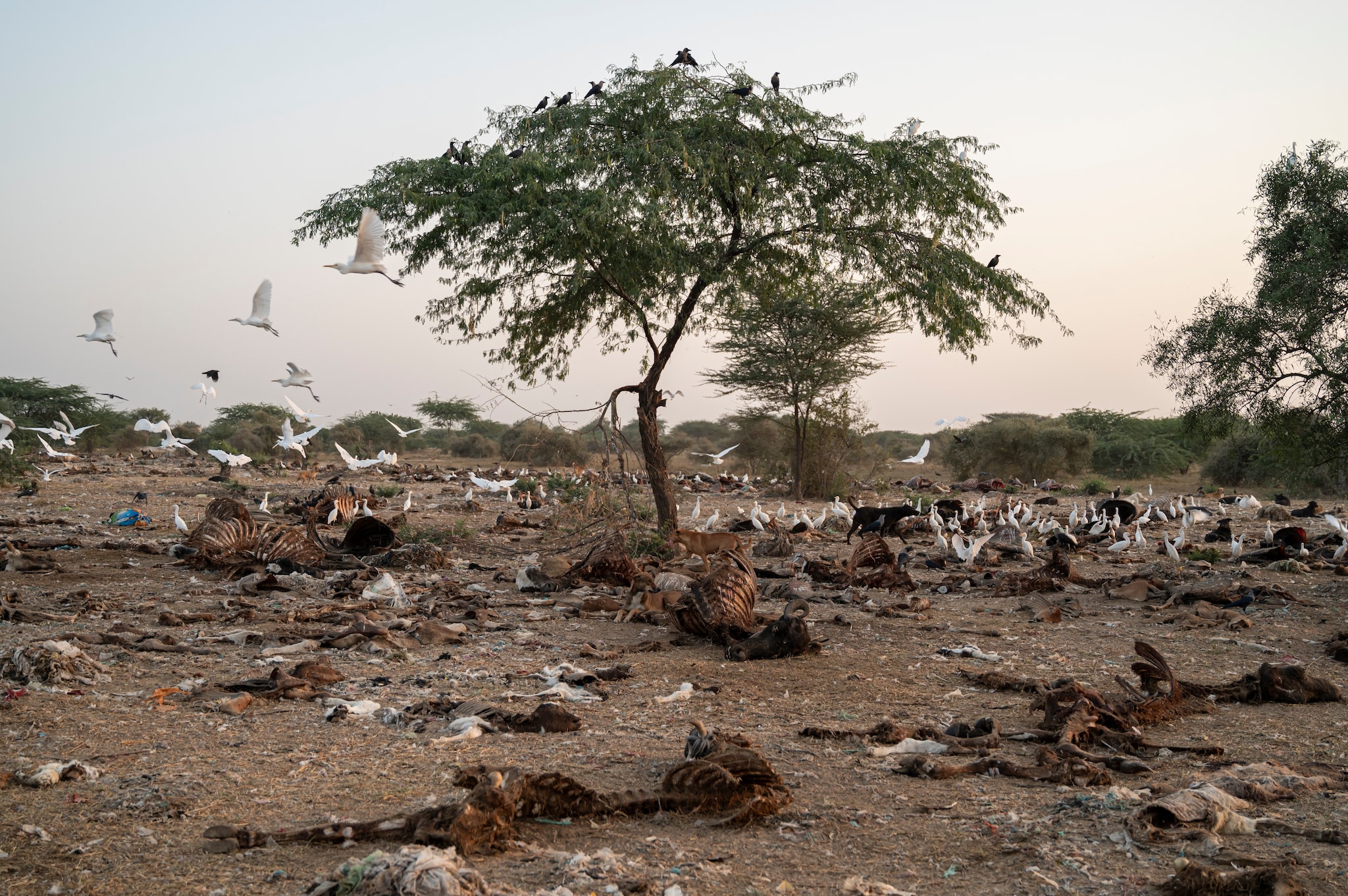
BIKANER, India — Dogs roam a field of cattle carcasses at the Jorbeer dump in northern India, passing hollowed-out rib cages and tugging at pink flesh decaying in the sun. Nearby, workers skin hides for leather from the 40 carcasses that arrive daily, fighting heat and a suffocating stench.

Competing with the dogs for carrion and circling the hazy skies above are vultures, remnants of a population almost completely wiped out by humans. Between 1992 and 2007, the populations of three species — the long-billed vulture, slender-billed vulture and white-rumped vulture — plummeted more than 100-fold from roughly 4 million to 32,000. The speed of the birds’ decline, scientists say, rivals the passenger pigeon’s plunge from 3 billion or more in the early 1800s to extinction in 1914.

Some 800 miles south of the dump, in the city of Hyderabad, a slender boy named Maniteja, 7, lies beneath a pink blanket, unresponsive, breathing through a ventilator. His dark eyes drift. For nine months, no words have come from his lips, only small cries. The family leaves a window open, hoping the sounds of friends playing outside will pierce the fog and restore him to consciousness.

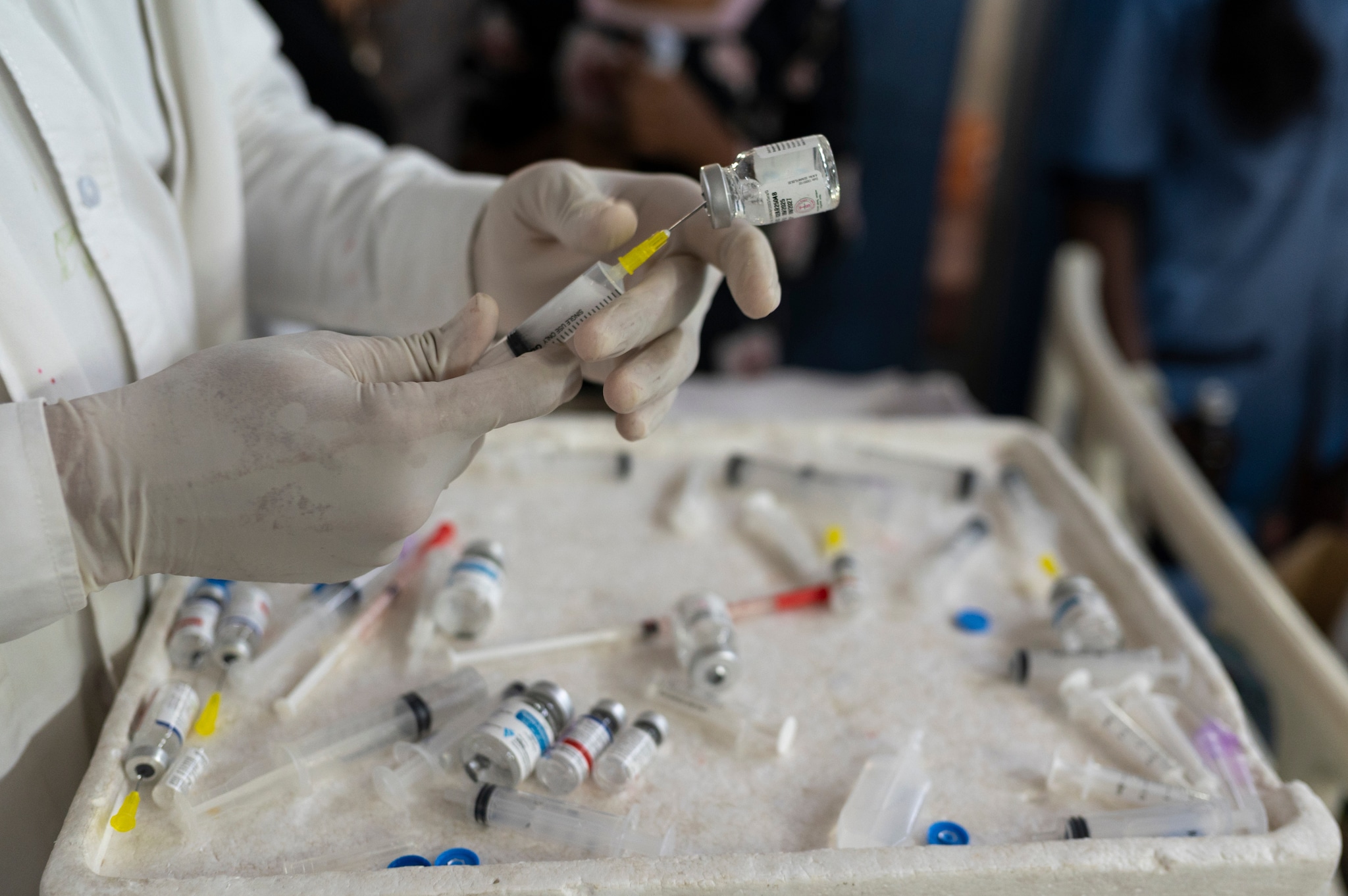
A woman with other patients who have been bitten by a dog at Government Fever Hospital in Hyderabad, India.
Syringes for treatment of dog bites at the only hospital in India dedicated to treating patients with infectious diseases, communicable diseases and dog bites.

Last December, one of India’s estimated 62 million free-ranging dogs ― a population that surged as the vultures declined ― lunged at Maniteja and sank its teeth into his left shoulder. Although his parents got him vaccinated against rabies within an hour, a few weeks later the boy became feverish. On Jan. 18, a doctor asked if he knew the man beside him. “My papa,” Maniteja said, his last words before losing the ability to speak.

The decimated vultures competing for dead cattle, the dogs that have become their rivals and the boy fighting for his life all form links in an ecological chain reaction, according to scientists. The sequence, triggered by human action that took a decade to identify, carries a warning as we drive Earth deeper into what many scientists consider to be a sixth mass extinction.

When we endanger other species, we endanger ourselves.
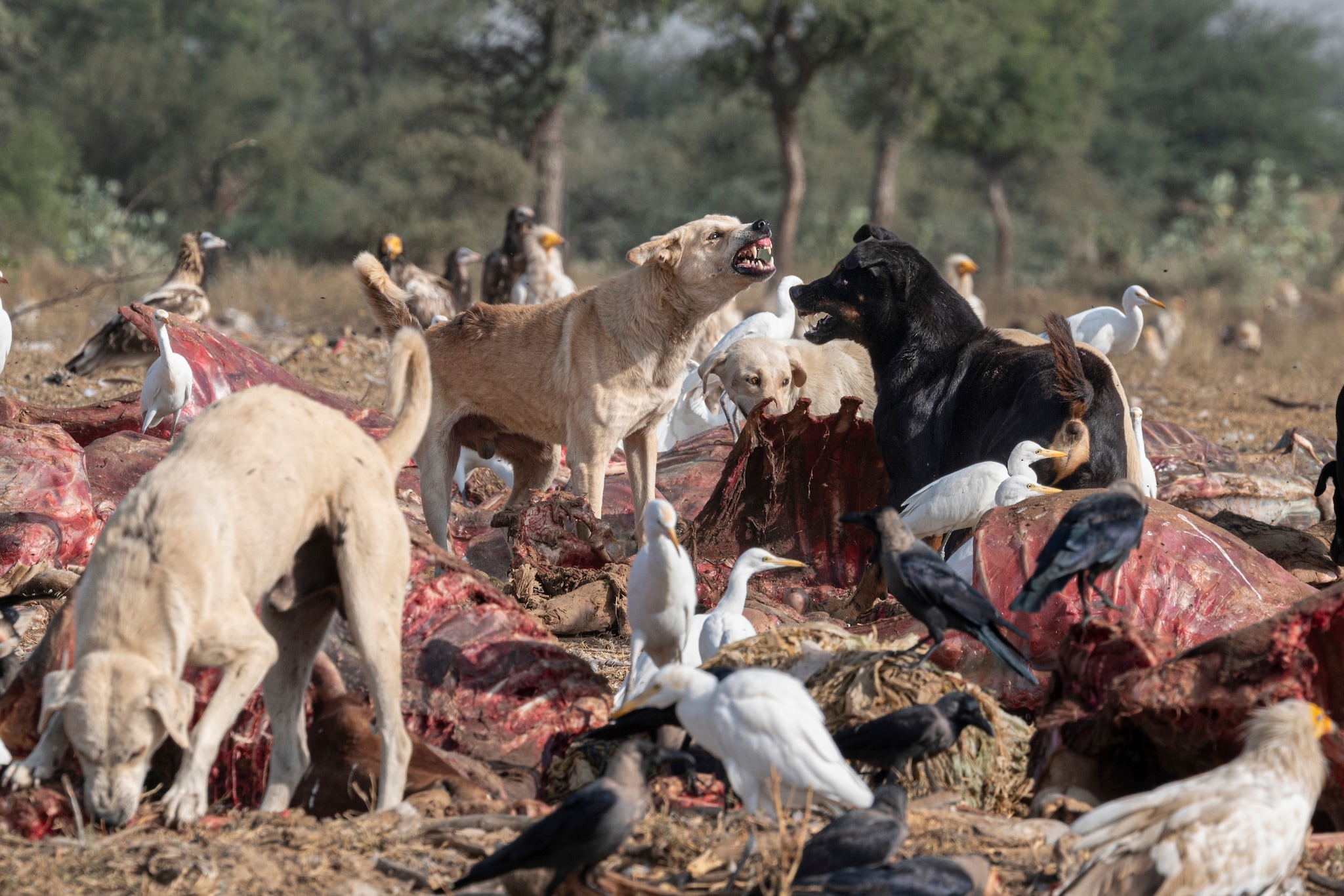
Dogs fight to claim their stake at carcasses, surrounded by vultures and other birds at the Jorbeer dump in northern India.
Dogs, vultures and other birds descend upon carcasses of dead animals left at the Jorbeer dump site.

A 2008 paper in the journal Ecological Economics found that between 1992 and 2007 the loss of vultures in India led to an estimated increase of about 5.5 million dogs, 38 million additional dog bites and more than 47,000 extra deaths from rabies.

A paper published a year ago in the American Economic Review concluded that in certain districts, “the functional extinction of vultures — efficient scavengers who removed carcasses from the environment — increased human mortality by over 4% because of a large negative shock to sanitation.”

That analysis considered not just rabies, but all human deaths related to the loss of vultures — including those from water contaminated by cattle carcasses. Researchers estimated that India suffered, on average, 104,386 additional deaths, and almost $70 billion in extra costs, each year.

50 Species that Save Us

This series highlights emerging research on how plants and animals protect human health – and how their disappearance is already sickening thousands of people around the world.

India has fought back, banning veterinary use of some chemicals harmful to vultures, establishing programs to protect the birds and launching campaigns to immunize free-ranging dogs against rabies. Conservationists even set up a few “vulture restaurants,” serving cow carcasses known to be safe for consumption.

But the damage is hard to reverse.

Vultures still face some toxic exposure, though at a lower level, and India’s push to modernize has added new threats: power lines and wind turbines. Captive-breeding programs are slow; vultures breed once a year, usually producing a single egg.

“If you take 100 people from any city, it is very unlikely you will get anyone who will say they have seen a vulture,” said Chetan Misher, a wildlife researcher and ecologist who has been working in western India for the past decade.

“If it remains like this for a long time, people will think they are imaginary birds.”

The loss of vultures is all the more surprising given India’s reverence for animals.

It is a country “that believes humans and animals coexist,” explained Kedar Girish Gore, director of the nonprofit Corbett Foundation in Mumbai, which is dedicated to wildlife conservation and environmental awareness.

Signs of coexistence are everywhere. In the northwestern state of Rajasthan and in cities like Hyderabad in the south, cars, trucks and motorcycles share crowded roadways with free-ranging dogs and cattle, goats, schoolchildren and other pedestrians.

Cows are revered: It is illegal in many states to kill them, even if they’re old or injured. Instead, people bring them to retirement homes called gaushalas where the cattle are fed and cared for by workers who consider it a sacred duty.

“The main slogan in India is, ‘A cow is our mother,’” said Shree Gopalacharya, who manages a gaushala in Rajasthan where 70 workers care for about 1,800 bulls.

In cities like Delhi, people put out chapati and milk for street dogs. Some even cook and distribute large amounts of chicken biryani, enough to feed up to 200 dogs, said Nishant Kumar, a DBT/Wellcome Trust fellow at the National Center for Biological Sciences in Bangalore.

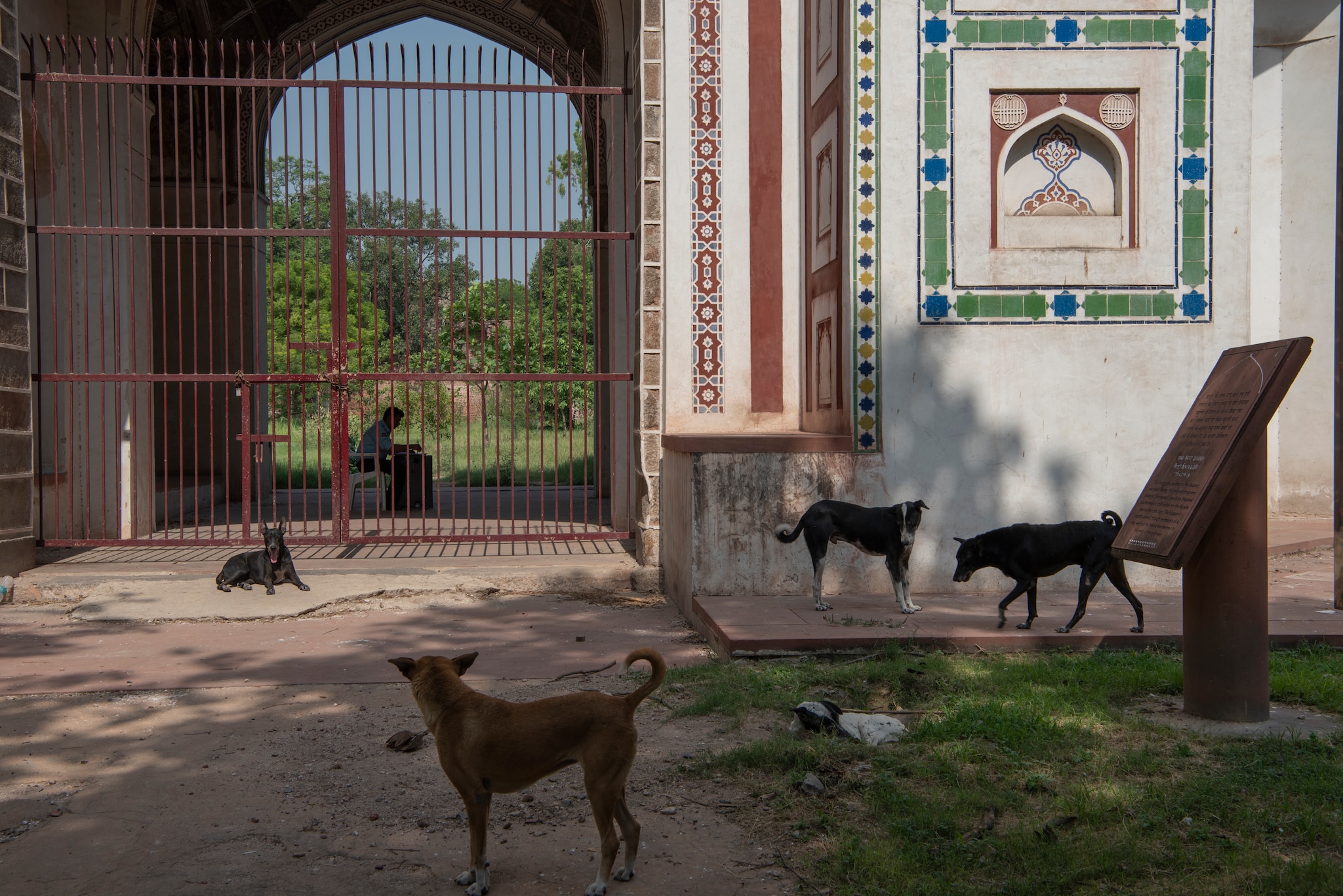
Rahul Malik, 27, administers anti-rabies vaccination to stray dogs in Noida, India.
Stray dogs loiter in the neighborhood of Nizamuddin East in Delhi.

Even vultures, a bird many in the West consider ugly and use as a metaphor for people who prey on others, enjoy widespread respect in India.

Followers of Zoroastrianism, an ancient Persian faith, place their dead atop Towers of Silence for vultures to consume, thus freeing the soul without polluting the sacred elements: earth, fire and water.

A vulture is even one of the heroes of Hindu mythology: Jatayu, the vulture demigod, sacrificed his life to save the goddess Sita.

“The lesson we learn here is that every species, vultures included, no matter how ugly we think they are, they have sacrificed something that we as humans must decipher,” said Munir Virani, chief executive of the Mohamed Bin Zayed Raptor Conservation Fund in Abu Dhabi in the United Arab Emirates. “They are giving us a warning.”

For centuries, vultures provided a highly efficient sanitation system, cleaning the carcasses of millions of dead cattle.

“You could argue that the way of life of Indian livestock farming kind of developed hand-in-hand with vultures,” said John Mallord, who works for the Royal Society for the Protection of Birds in Britain. “Without the vultures to clean up the environment, people wouldn’t have been able to just leave the cows where they [died] because it would have proved to be a disease threat.”

Although other animals scavenge dead cattle, none do so as effectively as vultures. The birds will pick clean a bull carcass in 30 to 40 minutes.

Vultures and humans have long collaborated on disposal of dead cattle. Workers removed the hides for leather, leaving the meat more accessible to birds. Vultures then cleaned the carcasses, leaving bones to be harvested by a second group of workers. Collectors sold the bones for use in fertilizer and animal feed.

Biologists once counted India’s vultures among the world’s most common birds of prey. The birds often nested in gardens with large trees, including some foreign embassies, said Rhys Green, an honorary professor of conservation science at the University of Cambridge.
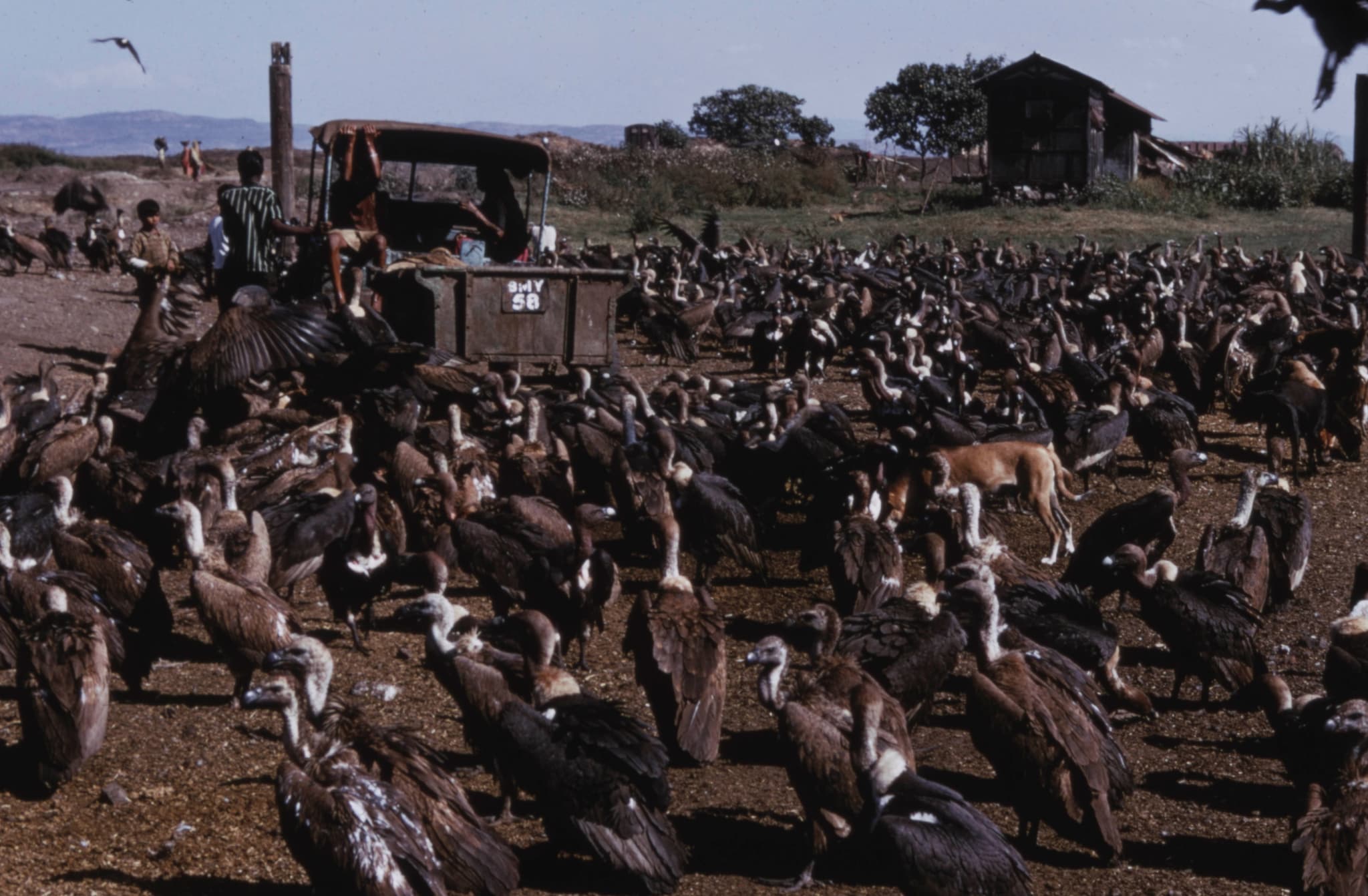
Large numbers of vultures in India, seen in a 1967 photo. (Paolo Koch/Getty Images)
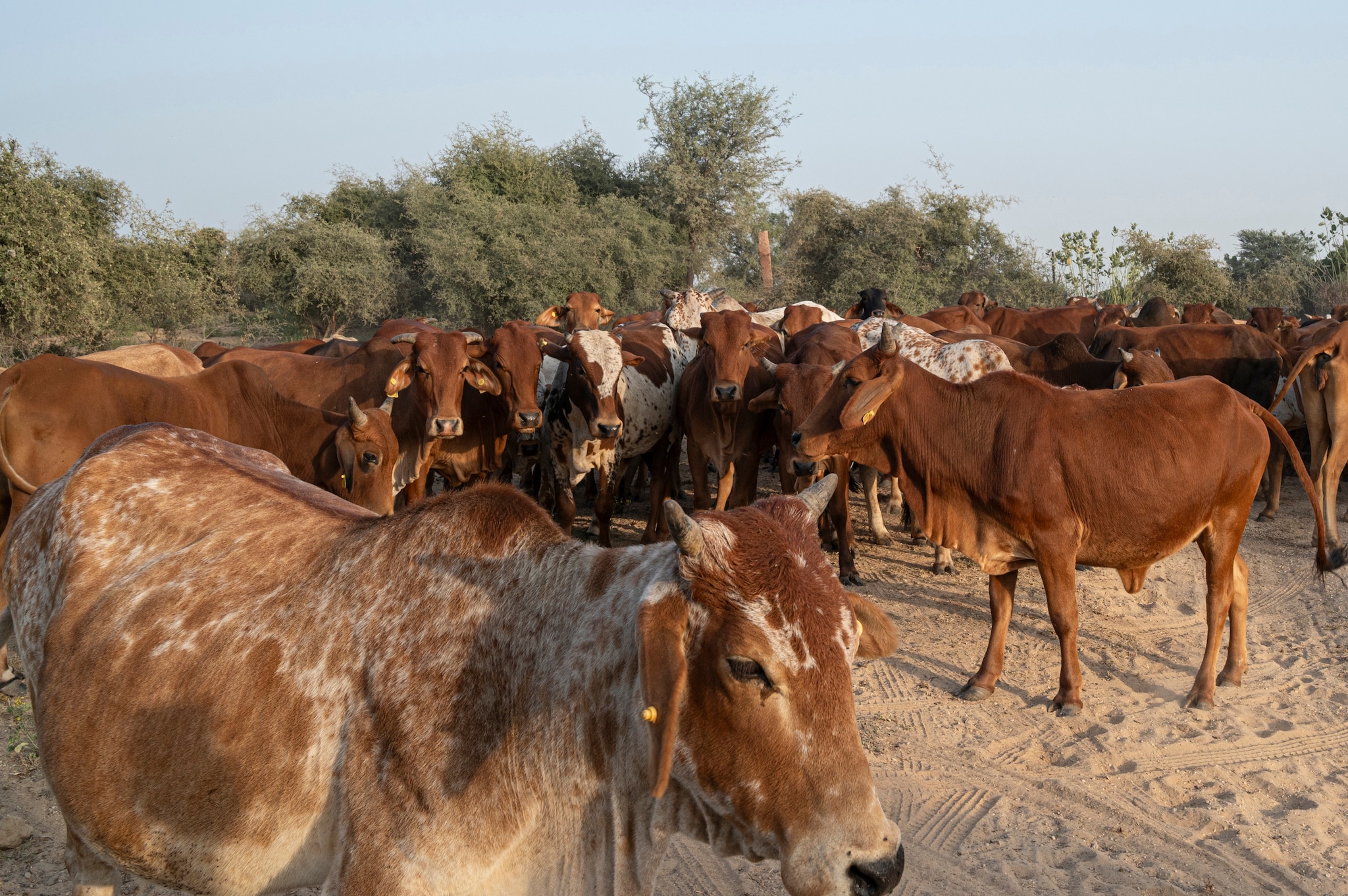
A herd of cattle wait outside a cattle shed in Surdhana, India.

Virani remembers being on a cricket tour in the late 1980s and walking along Malabar Hill in what was then Bombay, staring into a vulture-filled sky.

“There could have been thousands,” he said.

But in the mid-1990s letters began appearing in the Times of India noting the vultures’ disappearance. When people did see the birds, something seemed off.

“They wouldn’t be flying around as they normally do. They would just sit there,” Green said. “The head and neck were pointing downwards, which is a thing vultures do when they’re sick.”

The scale of the loss was staggering. If vultures were unable to breed in a given year, the overall population would decline about 5 percent, Green said. But road surveys showed that the three vulture species were declining far more rapidly, at rates of between 2o percent and 50 percent each year for many successive years. Between 1992 and 2007, the population of 2.9 million white-rumped vultures in India declined by 99.9 percent.

Similar losses were occurring in Pakistan and Nepal.

Vibhu Prakash, who worked for the Bombay Natural History Society and had been conducting vulture counts in a national park, sounded the alarm. His papers in biological journals in 1999 and 2003 raised a question no one could answer: What was killing the birds?

To solve the mystery, a team of researchers led by American veterinary pathologist J. Lindsay Oaks performed meticulous postmortems on dead white-rumped vultures in Pakistan. They found that 85 percent had visceral gout, which can occur when birds’ kidneys fail.

Oaks, who would die in 2011, knew that painkillers called nonsteroidal anti-inflammatories caused kidney failure in certain birds of prey. When members of Oaks’s team surveyed dozens of veterinarians and drug retailers, they learned of a livestock medicine that was toxic to kidneys: diclofenac. The painkiller, a nonsteroidal anti-inflammatory also given to humans, was widely used to treat sick and dying cattle for pain, fever and inflammation.
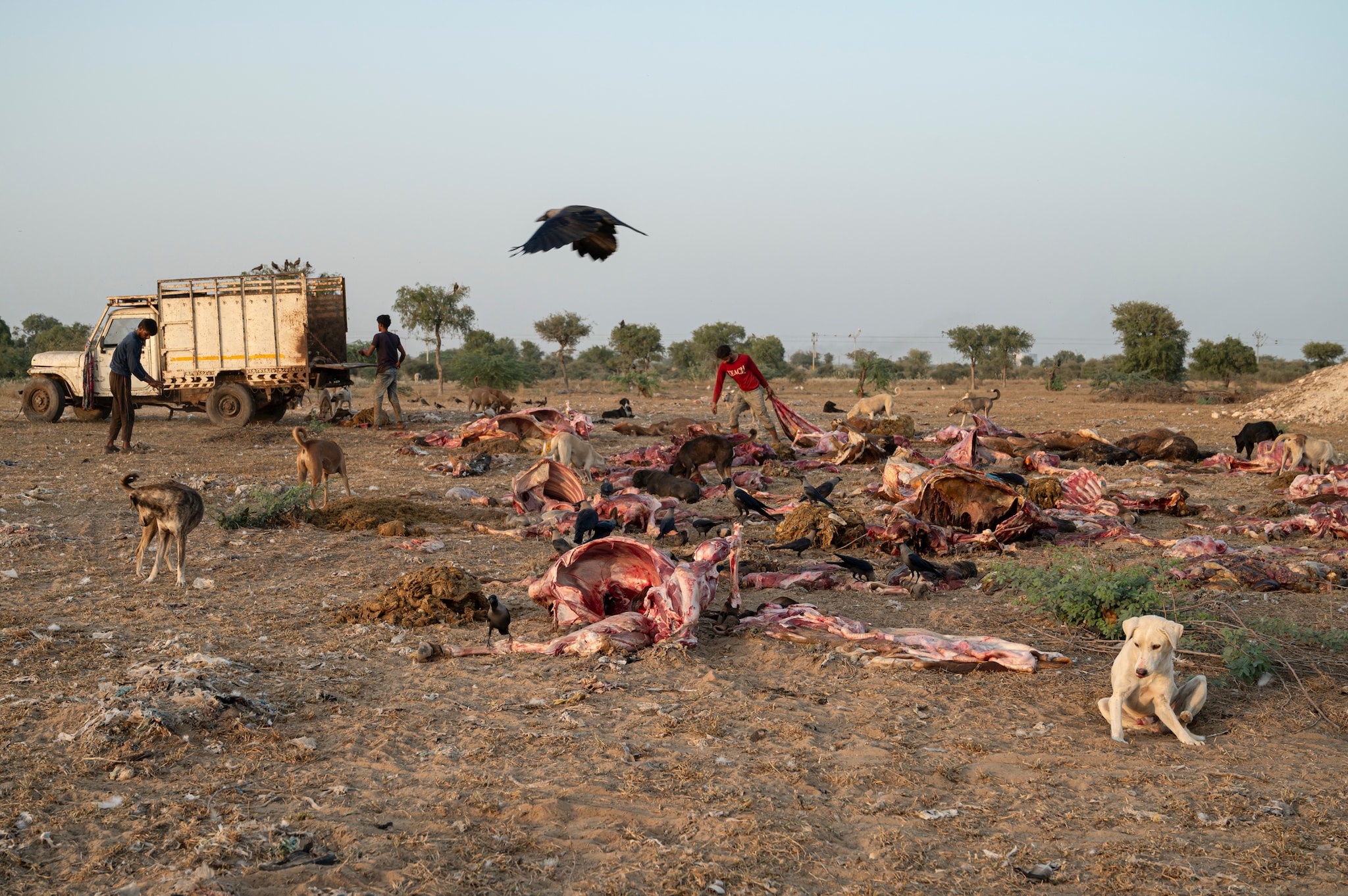
Laborers skin the carcasses of dead animals even as dogs feed on them at the Jorbeer dump yard in northern India.

Scientists tested a subset of the dead vultures, comparing those that had visceral gout with those that did not. Tests revealed diclofenac residue in every bird with kidney failure. Every dead bird that contained no diclofenac showed no signs of kidney failure. When they fed 20 vultures meat from animals treated with various doses of diclofenac, 13 died of renal failure.

The timing made sense. The drug’s main international patent had expired in 1993, leading to the approval of cheaper generic versions in India.

Vultures diagram

After the journal Nature published Oaks’s results, other researchers confirmed his findings, and conservationists held conferences on the fate of the vultures. In 2006, Green and the Indian Veterinary Research Institute identified meloxicam as a painkiller safe for vultures.

The Indian government enacted a ban on veterinary use of diclofenac that took effect in May 2006, a little more than two years after the drug was found to be lethal to the birds. Pakistan and Nepal issued bans of their own in 2006.

“That is actually very quick for how these things work,” Green said. The United States took a decade to ban DDT after the book “Silent Spring” showed the harm pesticides were doing to birds and other wildlife.

Even after the diclofenac ban, the number of vultures continued to decline, reaching 19,000 in 2015. Subsequently, three more painkillers given to cows were found to be toxic to vultures and were banned in India.

Rabies and the rise of the dogs

As scientists sought an explanation for the vulture decline, the ecosystem changed dramatically.

“Dogs have replaced vultures as the main scavenger at carcass dumps monitored,” according to the 2008 paper in Ecological Economics. “It is thus reasonable to assume that the increase in dogs has partially resulted from the decline in vultures.”

Estimates of the nation’s dog population vary widely ― anywhere from 15 million in India’s 2019 Livestock Census to as high as 80 million in some news reports. The most common figure is about 62 million.

More dogs, researchers found, translated into more dog bites and more deaths from rabies in a country that accounts for 36 percent of worldwide deaths from the disease.

Before 1960, rabies killed several hundred people a year in the U.S. Widespread vaccination of pets, however, reduced human deaths to a rarity; in 2024, there were only four deaths in the U.S., none caused by dog bites.

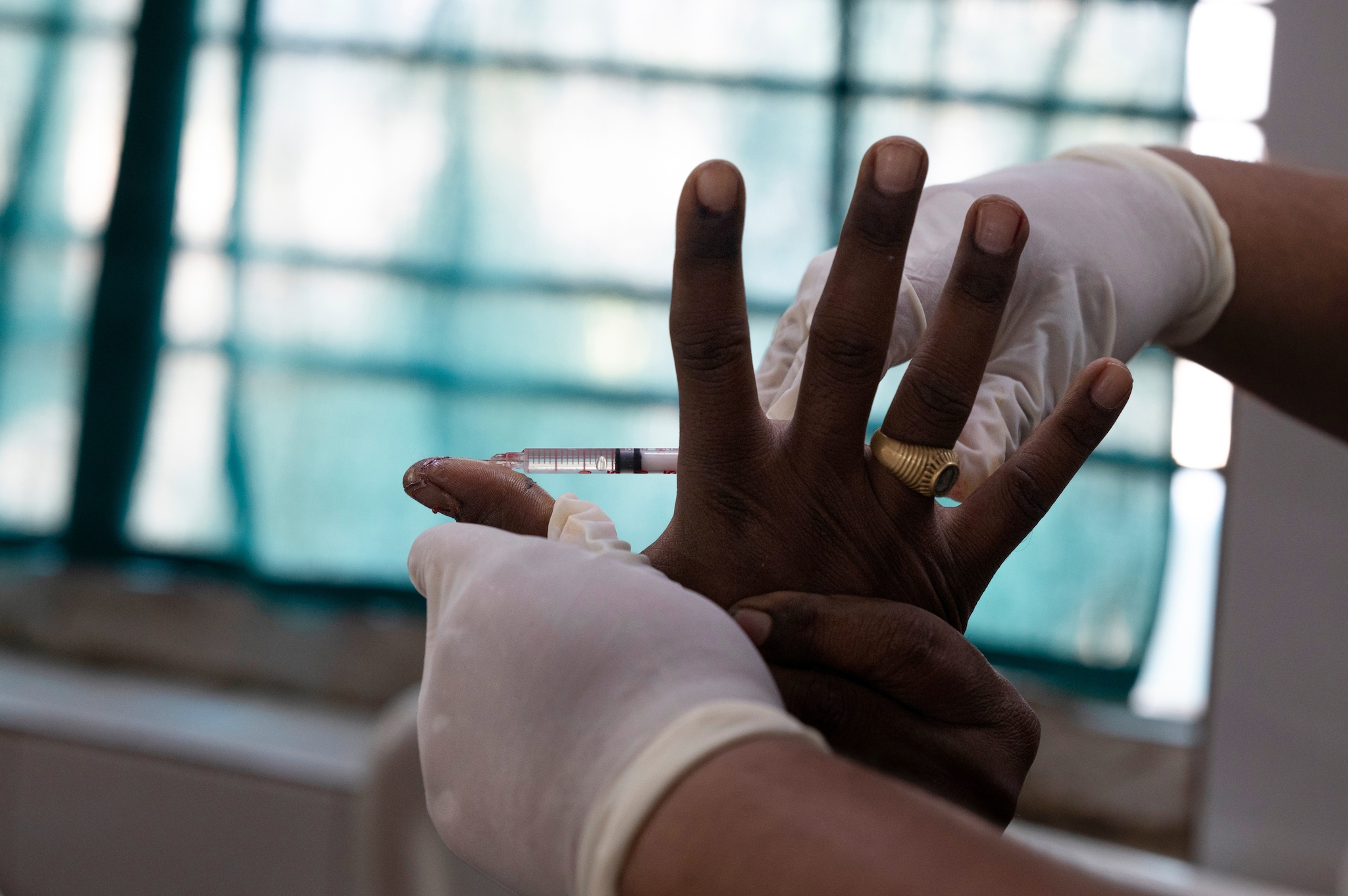
A woman waits for her turn to receive treatment for a dog bite in the emergency room at Government Fever Hospital in Hyderabad. The hospital has received 32 cases of rabies this year through mid-November.
A man who was bitten by a dog receives treatment at the hospital.

In India, someone is bitten by a dog every two seconds, and 18,000 to 20,000 people die each year of rabies, according to the World Health Organization (though the Indian government reported just 54 deaths from rabies in 2024). The government introduced an ambitious rabies plan in 2021 that set a goal of eliminating human deaths from the disease by 2030.

Rabies, which has a fatality rate approaching 100 percent, is transmitted through saliva. Once the virus enters the body it creeps along the nerves into the central nervous system, producing fever, nausea, flu-like symptoms and finally coma and death.

“By the time the patients come with symptoms you are at the point of no return,” said Lokesh Lingappa, a doctor who has treated the disease at Rainbow Children’s Hospital in Hyderabad’s Banjara Hills.

He recalls the case of a 5-year-old boy whose parents brought him to the hospital with only a scratch. They had not even seen a dog bite the boy, Lingappa said, “but maybe there was a lick on some open cut.”
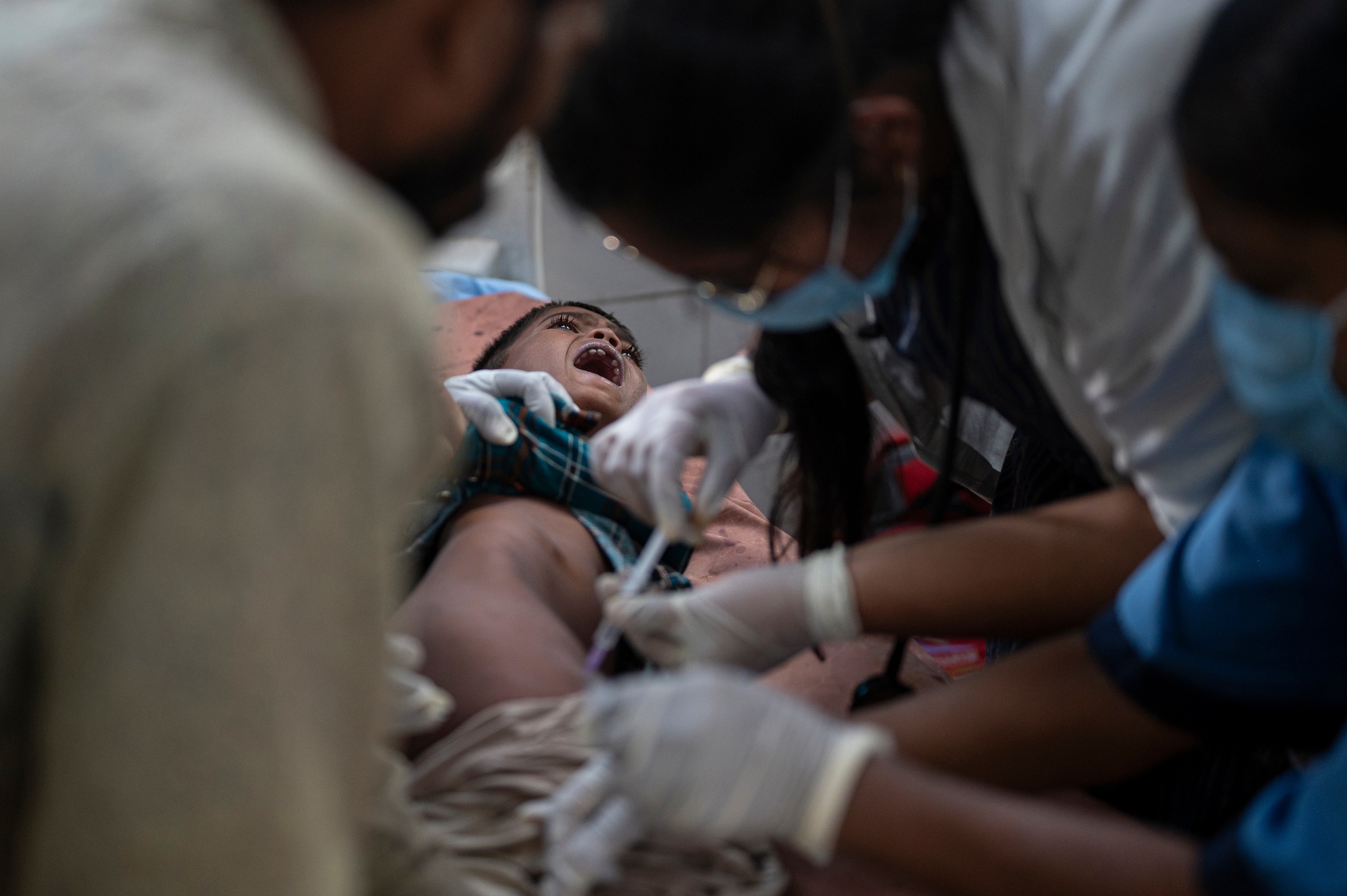
A boy who got a dog bite cries as he receives treatment at the hospital.

The child, who had not been vaccinated, soon developed aerophobia, an intense fear of puffs of fresh air and a symptom of rabies. The parents “wanted us to say this is not rabies,” Lingappa recalled; he had to tell them that it was. The boy died a week later.

In Hyderabad, Maniteja’s relatives watch his bedside in shifts covering every hour of every day. The boy’s mother starts at 6 in the morning and does not finish until 11 at night. She prepares his liquid feedings ― rice water, carrot juice and vegetable soup.

Maniteja’s father watches him from 11 at night until 3 in the morning, when an uncle takes over for the last three hours. Before the dog bite, the boy played with friends and rode his bicycle. Today, he receives 30-minute physical therapy sessions.

To care for Maniteja at home, his family rents medical equipment at a cost of about $900 a month. The father’s job in technical support pays up to $800 a month, leaving money a constant worry. “What can we do?” the father said.

The boy cannot recognize his mother and father at his bedside. Sometimes his father strokes his forehead calling, “Maniteja? Maniteja? Maniteja?” searching for some response. “My heart is breaking watching my child like this,” his father said.

A hospital staff member looks at the queue of patients.

Free-ranging dogs have long posed a challenge for India.

“There is a dog right next to the place where we have our research camp in Delhi, and it has bitten 150 people, probably more in the last three years,” Kumar explained. “And you cannot remove the dog because that dog is protected by the people who love it.”

In the summer, India’s Supreme Court ordered authorities in Delhi and its suburbs to round up all street dogs and put them in shelters, then modified the order after criticism. Strays must now be taken to shelters, immunized and sterilized, but then returned to the streets they live on.

Kumar said the Indian concept of “community dogs” that live in a neighborhood is complex, and it varies according to economic means, where people live, and many other factors.

In a research paper yet to be published, Kumar noted, “We are witnessing two parallel realities: visible acts of kindness masking invisible cycles of suffering.”

Stemming vulture extinction

A few hours southwest of Bangalore, 25 to 30 breeding pairs of long-billed vultures, also known as Indian vultures, once nested in the cliffs at the Ramadevarabetta Vulture Sanctuary.

“That was over 30 years ago, and now we are down to just one breeding pair,” said Chris Bowden, vulture conservation program manager for the Royal Society for the Protection of Birds. “We’re hoping those vultures will come back later this evening because they generally roost here.”

On a hot day in early October, hours passed, and the pair was never spotted in the country’s only designated vulture sanctuary. It is uncertain whether long-billed vultures in the area will rebuild from the single pair.

“We hope they will,” said Bowden, who advises the Saving Asia’s Vultures From Extinction consortium. But protecting them in “this spectacular rocky landscape is not enough to protect them from the main threats.”

Green and others have carried out undercover surveys of Indian pharmacies to see how many still sell diclofenac for veterinary use. While more veterinarians are now using vulture-safe meloxicam, Green said, “the amount of toxic diclofenac in cattle didn’t go down to zero.” The problem, he said, has been a lack of awareness and enforcement.

Conservationists have also taken steps to discourage deliberate poisonings, a practice in which farmers who have suffered livestock losses from other predators put out poison bait. Vultures die by consuming either the bait or the bodies of poisoned predators.
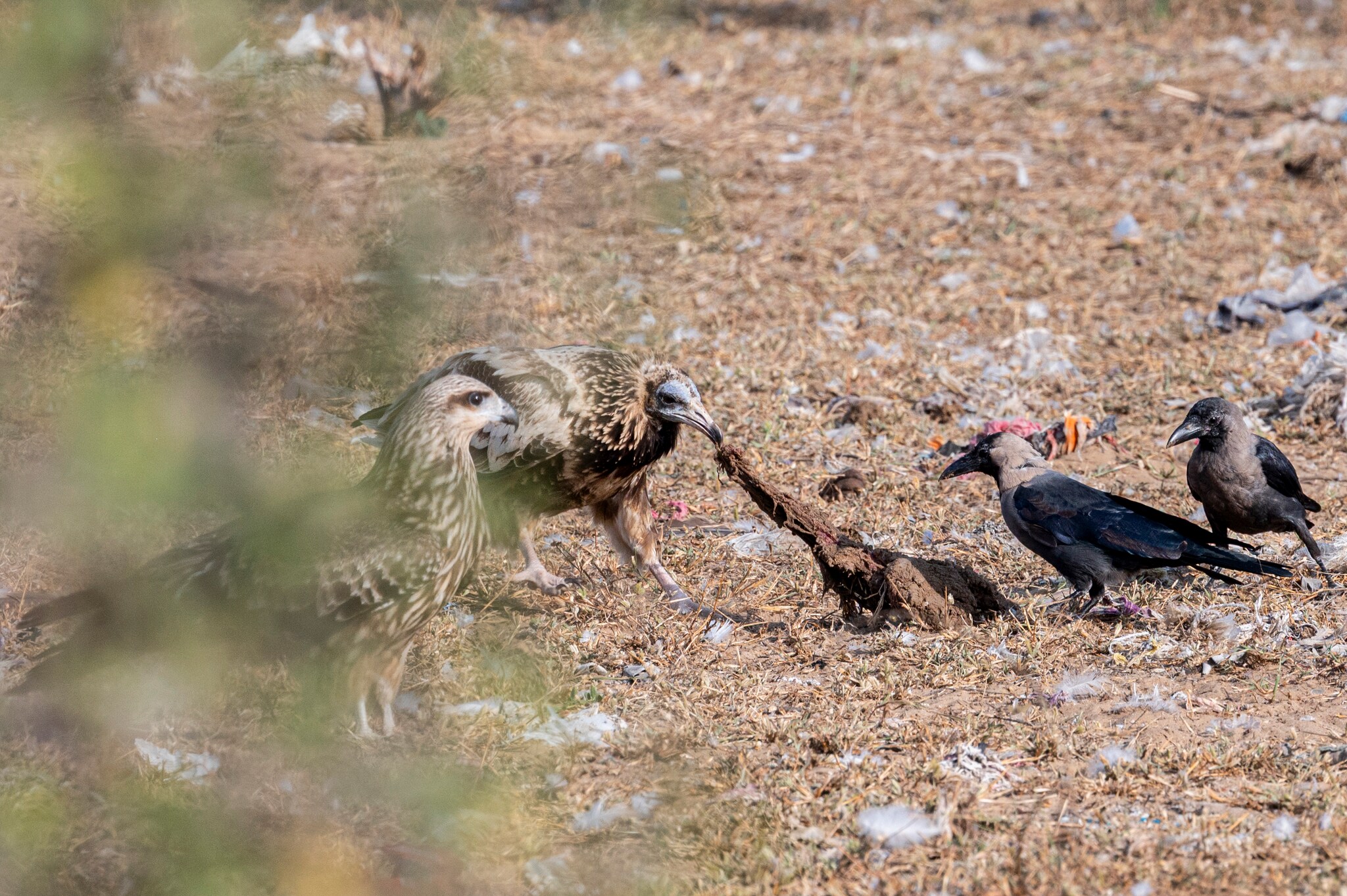
Birds claim their stake to the remains of a dead animal at the Jorbeer dump site.
Birds and dogs surround a landscape of carcasses of dead animals at the Jorbeer dump site.

For 20 years, the Corbett Foundation has provided immediate compensation to farmers who lose livestock to predators. Gore, the director, estimates the group has paid out for about 20,000 livestock kills.

Yet experts say it is unlikely the vulture will ever play the role it once did, a role the Madras High Court once as described as not a scavenger, but a “natural sanitary worker.”

Some people now bury cattle carcasses, putting them out of the reach of vultures. When carcasses are left in the open at places like the Jorbeer dump, the competition can be fierce. Misher, the ecologist in western India, has watched dogs harass and chase vultures.

Mallord at the Royal Society for the Protection of Birds said the vultures’ population crash is over, though “it’s too early to crack open the bottle of champagne.”

It once seemed unthinkable that birds as common as India’s vultures could approach extinction. But the same was true of the passenger pigeon, Mallord said.

“Nothing’s safe.”

About this story

Photography by Saumya Khandelwal. G.B.S.N.P. Varma contributed to this report. Design, development and illustrations by Hailey Haymond. Editing by Lynh Bui, Maya Valentine, Joe Moore and Juliet Eilperin. Copy editing by Dorine Bethea.

Read the full story here.
Photos courtesy of

Whooping Cranes Came Back From the Brink of Extinction. Now, New Threats Are Converging on Their Texas Wintering Grounds

Some residents along the Gulf Coast are creating habitat for the endangered birds on their properties, but development, saltwater intrusion and bird flu are putting pressure on the species' recovery

Whooping Cranes Came Back From the Brink of Extinction. Now, New Threats Are Converging on Their Texas Wintering Grounds Some residents along the Gulf Coast are creating habitat for the endangered birds on their properties, but development, saltwater intrusion and bird flu are putting pressure on the species’ recovery Rene Ebersole, Undark January 8, 2026 7:30 a.m. A whooping crane in flight in Texas John Noll / USDA Each fall—always before Thanksgiving—Diane Johnson looks to the sky above her home, waiting for the moment when her birds return. “You look up, and they’re here,” she says. “And you remember how magnificent they really are.” Twenty-six years ago, though, those same magnificent birds had Johnson and her husband, Al, worried their dream of building their forever home on the Texas Gulf Coast’s Lamar Peninsula—a weather-worn stretch of marsh, coastal plain and live oak woodlands—might be slipping away. It was the winter of 1999, and Al, a home builder, and Diane, a stay-at-home mom, had just scraped together practically every last dollar to buy 828 acres about 20 minutes northeast of downtown Rockport. There was one thing they hadn’t bargained for, however: a resident pair of whooping cranes strutting across their newly acquired lawn. One of just 15 crane species on Earth—ten of them threatened with extinction—North America’s whooping cranes were so imperiled that the entire population then hovered around 180 birds. The couple was awestruck by the roughly five-foot-tall birds, with their ivory plumage and crimson crowns, but they couldn’t help worrying that the federal government might stop them from building a house in the middle of an endangered species’ turf. In those first uneasy days, as they watched the cranes forage through the marsh grass, the Johnsons realized that their dream home sat squarely inside a much larger story—one that stretched far beyond their property line, into the vast migration corridors and fragile ecosystems the birds depended on. The whooping crane, North America’s tallest bird, almost went extinct in the 20th century. While its population has now rebounded, the endangered species still faces threats. Klaus Nigge / USFWS The whooping crane’s comeback is often hailed as one of the greatest wildlife conservation success stories in North America—but the forces that nearly wiped the species out are surging again in new and more complex forms. Once driven to the brink by rampant habitat loss and hunting, the cranes survived only through an extraordinary, decades-long rescue effort. Now, development pressure, shrinking freshwater flows, sea-level rise and the threat of avian flu are converging on the wintering habitat along the Texas coast just as the flock reaches its highest numbers in about a century. The stakes remain perilously high for the birds—and for the people who share their land. This spot in Texas is the primary wintering destination for the only purely wild whooping crane flock in the world. The life of every one of these cranes begins in a nest of trampled bulrushes, sedges and cattails in Canada’s Northwest Territories and Alberta, predominantly in Wood Buffalo National Park. The chicks hatch in late spring and into summer, cinnamon and white with blue eyes, and by late August they’ve grown nearly as large as their parents. By September or October, they are robust enough to join them on their maiden flight of about 2,500 miles south. As cool autumn winds rise, families of cranes take to the sky, traveling a flyway tracing straight through the American heartland and navigating a gauntlet of industrial agriculture, energy development, pollution and even poachers. After surviving this arduous journey, most cranes arrive on the Texas coast by late November. Here, within a mosaic of marshes and tidal flats stretching across the Aransas National Wildlife Refuge and into nearby private lands—including the Johnsons’ property—they stalk blue crabs in brackish shallows and nibble on scarlet wolfberries. Key concept: Wild whooping cranes Only one natural and self-sustaining population of whooping cranes exists in the world: the Aransas-Wood Buffalo group, which flies between Texas’ Aransas National Wildlife Refuge and Canada’s Wood Buffalo National Park each year. Experimental, non-migratory populations live in Central Florida and Louisiana, and another experimental group migrates between Wisconsin and Florida. The Johnsons, overwhelmed but determined, sought guidance on what it meant to share their land with two of some of the rarest birds on Earth. They reached out to their acquaintance Tom Stehn, a biologist at the Aransas National Wildlife Refuge—which was established in 1937 to protect whooping cranes and other migratory birds and wildlife—and co-leader of the International Crane Recovery Team. Stehn conducted weekly aerial surveys throughout the winter months. “We called him and said, ‘Oh my gosh, we have whooping cranes on our land that we just bought,’” Diane, now 74, remembers with a warm smile and a raspy Texas drawl. “He goes, ‘Of course, I know.’ … So, we asked him, ‘Well, what do we do? We want to preserve this property for the whooping cranes.’” Stehn introduced the Johnsons to representatives with the Nature Conservancy. The group offered a plan to purchase 244 acres from the Johnsons and donate it to the Aransas National Wildlife Refuge on the other side of Saint Charles Bay. They also offered the couple a payment to place 573 acres under a conservation easement—providing a tax benefit in exchange for a perpetual commitment that the land would never be developed. The Johnsons reserved ten acres where they would build their home and other structures. “It was a win-win,” Diane says. “We wanted to do everything they wanted us to do.” A whooping crane catches a crab in the Aransas National Wildlife Refuge in Texas. Jon G. Fuller / VWPics / Universal Images Group via Getty Images Such habitat protections to safeguard Texas coastal marsh, tidal flats and upland prairies—combined with landmark environmental legislation in the 1970s, captive breeding programs and the efforts of an army of conservationists—have played an important role preventing North America’s tallest bird from joining the passenger pigeon and Carolina parakeet in oblivion. About eight decades ago, only about 16 whooping cranes were left in the wild. Preserving their wintering grounds helped the remnant flock begin to rebound. Today, the Aransas-Wood Buffalo flock consists of more than 550 cranes, according to the latest population survey, and more than 270 additional whoopers live in zoos or experimental release programs in Wisconsin and Louisiana. A few also live in Florida following the end of a release program there. Yet despite their growing numbers, whooping cranes remain endangered. The Lamar Peninsula presents a microcosm of the challenges wild cranes now face—and what can be done to help them continue to grow and expand their range. The Johnsons’ dream home, Diane’s silo-like silversmith studio and a former rental cabin sit on one of the last large pieces of open wetland and live oak savanna on the peninsula, shielding their resident cranes from much of the surrounding development. Outside their gate, though, houses dot much of the peninsula. Cranes often wander through residents’ yards, where automated feeders drop corn to attract deer—visibility that helps people appreciate the birds, but density that can spell danger. For cranes, living in close quarters with people comes at a cost, wildlife managers say, because it increases the chances that these birds with more than seven-foot wingspans will collide with power lines or that an outbreak of highly pathogenic avian influenza—easily spread when the birds are crowded together in a confined area—will kill some of the animals. In September 2025, the International Crane Foundation reported that the first whooping crane—a captive-bred bird named “Ducky” that was set to be released into the wild in Wisconsin—had died from bird flu. By late October, there were reports of at least two more whooping cranes killed by bird flu while migrating south from their Canadian breeding grounds. Meanwhile, saltwater intrusion associated with sea-level rise is converting freshwater wetlands to open water. Freshwater diversions for upstream urbanizing areas are altering the salinity of coastal estuaries where cranes feed, and drought, intensified by climate change, is drying the freshwater ponds where cranes drink. No one threat alone will likely reverse the whooping cranes’ recovery, says Liz Smith, a local conservation scientist who worked for the International Crane Foundation until her recent retirement, but there’s a common source. “When you put all those together,” she says. “They’re all human-driven.” “It’s us.” When I visit the Lamar Peninsula hoping to see wintering whooping cranes, I find a billboard along State Highway 35: “Lots for Sale.” Driving through a neighborhood of one-story houses with big garages and campers and boats in the driveways, I finally come to the gravel road leading to a popular whooper hangout: the home of Kevin and Lori Sims. Though the peninsula’s density is a challenge for cranes, the Sims, like the Johnsons, represent one of its paradoxes—local residents who are deeply invested in helping the birds and engaging others in their protection, even as development continues around them. An adult whooping crane and a juvenile at Aransas National Wildlife Refuge Jon G. Fuller / VWPics / Universal Images Group via Getty Images Wearing an old T-shirt, a royal blue sweatshirt, jeans and sneakers, Kevin is tending to a steaming shrimp boil near the garage in preparation for an evening family gathering. “Look up!” he yells, as I exit the car. Four whooping cranes cruise about 40 feet over my head and land in the grass, not far from his automated deer feeder. “You go get in the blind, and I’ll press the remote control for the feeder,” he says. “Maybe that will bring them in.” Following his instructions, I tiptoe across a soggy span of grass and mud to a primitive bird blind built from plywood and 2-by-4s, complete with a metal roof and pink fishnet curtains. As I take a seat in a plastic chair, the cranes do another flyby. Kevin hits the button on his remote, and as the corn drops from the feeder, two deer come running. Soon, three cranes land: two parents and their colt, hatched in northern Canada roughly six months earlier. A fourth crane, a young adult female known locally as Husker Red and identifiable by her white-red-white leg bands, tries to move in for some corn too. The crane family chases her away, loudly bugling and flapping their giant, black-tipped wings, delivering an obvious message: Scram—we were here first. Husker bugles back. When a car engine revs, the cranes startle. Momentarily, they retreat to the marsh. “There was quite a little drama down there,” I say, joining Kevin at the garage. “They put on a show for you,” he says. The Sims have a boat business, and each year they take about 800 tourists and photographers along the coast to see cranes. After their cruise, some customers enjoy close-up photo opportunities with cranes that come to the couple’s corn feeder. Some Texans use automated feeders to bait deer so they can shoot them. The Sims and the Johnsons have them purely to enjoy the nature they attract. “I grew up with deer in the yard,” Kevin explains. He wanted the same for his kids, so he put up a corn feeder. It was during a drought, and the family soon got more than they’d bargained for. “Here came the cranes,” he says. “I never expected it.” But there’s a downside to this seemingly harmless practice, says Dave Brandt, a recently retired USGS biologist who spent more than a decade catching whooping cranes on their Texas wintering grounds and in Canada, fitting them with leg bands and transmitters that help biologists track their migrations and identify the birds when they’re spotted. The problem is the feeders bring cranes in close contact with people and encourage the birds to concentrate in a tiny area, where they feed with other animals—deer, feral hogs, ducks—increasing the potential for them to encounter bird flu and other pathogens. Because whooping cranes are territorial, they often squabble over who has dibs. “Typically, at these feeders, you’ll get a dominant pair or a dominant family group that kind of guards them,” Brandt says. These territorial interactions can end in tragedy. On February 14, 2023, a crane that Brandt thinks was likely being chased by another at the Sims’ feeder struck a power line and died. Lori Sims, who doesn’t believe the crane was being chased, was one of the first people on the scene. “I went right over, and I stood with the crane,” she remembers. “It hit the top and the bottom lines at the same time, and it instantly killed it.” A woman who had been taking photographs of the cranes caught the whole incident on her phone and called Smith, the conservation scientist, who remembers feeling intense loss and sadness when she saw the dead crane. “His two winter companions landed in a field nearby and did not move for hours,” she says. “I could not shake the feeling that this shouldn’t have happened.” In response to the incident, the power company removed some inactive lines and marked others with diverters, small devices placed on the lines, so the cranes are better able to see them. “That helped, but there’s always a potential of lines all around the peninsula that could be dangerous,” Smith says. “We’re worried that that is going to continue to increase. And with so many birds chasing each other around,” she says, that’s a danger. There are also many nearby power lines connecting towns and cities to wind farms. “One would think that there would not be permits allowed for, let’s say, wind farms, as the birds narrow their scope down to that small area in and around the Aransas Wildlife Refuge,” Smith says, but there are large farms just dozens of miles away, with more on the way. A whooping crane (center) stands among sandhill cranes in Grantsburg, Wisconsin. Lorie Shaull via Flickr under CC BY 2.0 Smith says the main factor ensuring that the cranes have enough food during their winter months in Texas is the health of the Guadalupe Estuary, which varies with the freshwater flowing from the San Antonio and Guadalupe Rivers. Under Texas law, the state owns those waters; the use is regulated by the Texas Commission on Environmental Quality, a state agency. When the flow is disrupted—whether by extreme drought or by ongoing freshwater diversions—San Antonio Bay can become too saline for healthy crab populations and wolfberry plants. And that can kill cranes. During a drought spanning 2008 and 2009, 23 whooping cranes died from likely starvation, according to the U.S. Fish and Wildlife Service. The population dropped to 247 wild birds. (Historical estimates put the population at about 10,000 before European settlement.) Environmentalists and birders were outraged that the state did not take additional steps to mitigate the effects of the diminished flows. The agency “did not change anything during that severe drought,” Smith says. “Water continued to be diverted as usual.” Some concerned citizens got together and formed a nonprofit organization, the Aransas Project, to protect whooping crane habitat. The group sued the commission, alleging that the agency had violated the Endangered Species Act because their actions and failures in regard to public water management during the drought had resulted in the cranes’ deaths. “The basis of the lawsuit was that they acted irresponsibly,” Smith says. The group won the suit in federal court, but the agency appealed the ruling, which an appeals court overturned on grounds that the impacts of the water withdrawals on the endangered birds had been too indirect and unforeseeable to meet the legal standard. Since then, the Aransas Project and the Guadalupe-Blanco River Authority, which manages water resources in the area, have worked out an agreement to support conservation in the Guadalupe River Basin. A whooping crane chick. The birds hatch in late spring and into summer in Canada’s Northwest Territories and Alberta. By September or October, the young birds have grown enough to migrate some 2,500 miles south to the Texas coast. International Crane Foundation / USFWS via Flickr under CC BY 2.0 The cranes are as vulnerable as ever to freshwater shortages. At the same time, rising seas are causing saltwater intrusion, which some conservation groups predict will convert more than half of the coast’s freshwater wetlands to open water by the end of the century. Smith says protecting more habitat is the key if the cranes are to have somewhere to go. “If we wanted to really do something meaningful on the coast, we would have to do another 50,000-acre, 100,000-acre kind of a deal,” she says. “We just don’t know where that land would be. It’s getting very fragmented.” While that long-term goal is daunting, in mid-December, the International Crane Foundation, the Conservation Fund and the Coastal Bend Bays & Estuaries Program announced the acquisition of more than 3,300 acres of critical whooping crane winter habitat along the Texas coast. The new sanctuary—purchased for just over $8.4 million, according to the Associated Press—includes two properties, one of which will be owned and managed by the International Crane Foundation as the Wolfberry Whooping Crane Sanctuary, with the other held by the Conservation Fund until it is transferred to the Coastal Bend Bays & Estuaries Program. The whooping cranes’ future depends on land purchases, says Diane Johnson, “because as their numbers grow, the more land they’re going to need.” But it can be hard to convince landowners to put their properties in easements, she says, recounting a time years ago when a man was trying to sell his property near the roughly 300-acre Goose Island State Park on the southern end of the Lamar Peninsula, surrounded by the Saint Charles and Aransas Bays. She and her husband introduced him to the Nature Conservancy in hopes that he might put the property in an easement as they had so many years ago. “The family would not go for it,” she says. “They wanted cash from a developer.” Instead of remaining a haven for cranes, the property was transformed to “The Reserve at St. Charles Bay,” marketing luxury waterfront homes for families wanting to be surrounded by nature. Johnson was so angry, she threatened her builder husband Al that if he ever put up a house in that development, she and their daughters would picket his job site. “That’s how strongly I felt about building over there,” she says. Fortunately, Al felt just as passionately about protecting crane habitat. The Johnsons are widely celebrated by the conservation community for their efforts to protect whooping cranes. A 2019 “Good Egg Award”—given by the International Crane Foundation for their voluntary actions to save whooping crane wintering habitat—is proudly displayed on a shelf in their dining area next to a framed print of Our Lady of Guadalupe. When legendary ornithologist and conservationist George Archibald, co-founder of the International Crane Foundation, headquartered in Baraboo, Wisconsin, comes to town each winter for an annual crane conference, he beats a path to the Johnsons to hang out with them and their resident pair of whoopers, Yay and Nay. Yay is named for the identification bands biologists put on her leg: yellow, aluminum, yellow. And if she’s Yay, then someone said his name must be Nay, Diane says, laughing. Over the years, Archibald has given the Johnsons advice on everything from how to mow the grass so a bobcat hiding in the weeds won’t sneak up and grab a crane, to the perfect slope for Yay and Nay to easily wade into the artificial ponds on the property. Diane says they’d really like to see others buy land and protect it. In fact, there’s a 52-acre pasture on the Lamar Peninsula now for sale. “It’s full of whooping cranes. One day, there were 24 whooping cranes in one spot,” she says. At the end of December, the owner was asking $6.45 million. “Every time you ask about it, it goes up another million.” If the land gets developed, there’s little chance that cranes will relocate to their place, she says: Yay and Nay wouldn’t allow it. “Let’s say two whooping cranes from over there at the pasture fly over. Ours start cussing and yelling at ’em—‘Don’t you even think about landing here.’ It’s hilarious. And so if they do land, then ours will start walking over in a posture that’s like, you know, ‘I’m gonna whip your butt.’” She respects them for their determination to keep hundreds of acres of wetlands, uplands and corn feeders all to themselves, and their territoriality illustrates why more land needs to be protected. “They’re pretty badass, when you think about it.” In a few months it will be time for the cranes to head back to northern Canada, where they will rebuild nests and raise a new generation of chicks. “Sometimes I get to see them go,” Diane tells me. “The wind has to be just right.” “They’ll kettle up and then they’ll take off, and when that happens—I can almost cry right now—I hate to see them go, but it’s beautiful,” she added. “Bon voyage.” This article was originally published on Undark. Read the original article. Get the latest Science stories in your inbox.

A Rare Whale Is Having an Encouraging Season for Births. Scientists Warn It Might Still Go Extinct

One of the world’s rarest whale species is having more babies this year than in some recent seasons, but experts say many more young are needed to help stave off the possibility of extinction

PORTLAND, Maine (AP) — One of the world's rarest whale species is having more babies this year than in some recent seasons, but experts say many more young are needed to help stave off the possibility of extinction.The North Atlantic right whale's population numbers an estimated 384 animals and is slowly rising after several years of decline. The whales have gained more than 7% of their 2020 population, according to scientists who study them.The whales give birth off the southeastern United States every winter before migrating north to feed. Researchers have identified 15 calves this winter, the National Oceanic and Atmospheric Administration said Monday.That number is higher than two of the last three winters, but the species needs “approximately 50 or more calves per year for many years” to stop its decline and allow for recovery, NOAA said in a statement. The whales are vulnerable to collisions with large ships and entanglement in commercial fishing gear.This year's number is encouraging, but the species remains in peril without stronger laws to protect against those threats, said Gib Brogan, senior campaign director with environmental group Oceana. The federal government is in the midst of a moratorium on federal rules designed to protect right whales until 2028, and commercial fishing groups have pushed for a proposal to extend that pause for even longer.There is still time left for more baby whales to be born this winter, but 50 is not a reasonable expectation because of a lack of reproductive females in the population, Brogan said.“We're not going to be able to calve ourselves to recovery,” Brogan said. “We also need to be doing more to tackle the two primary causes of right whale deaths, being entanglement in fishing gear and being hit by boats.”The whales have fared better than last winter, when they gave birth to only 11 calves, according to NOAA data. The whales have reached 20 calves only twice since 2010, and they gave birth to no calves in a disastrous 2018 season. The whales are less likely to reproduce when they have suffered injuries or are underfed, scientists have said. The whales were hunted to the brink of extinction during the era of commercial whaling and have been federally protected for decades. They remain in a crisis at the moment because there have been more deaths than births in the population in the past decade, NOAA said in its statement.Copyright 2026 The Associated Press. All rights reserved. This material may not be published, broadcast, rewritten or redistributed.Photos You Should See – December 2025

How to kill a rogue AI

It’s advice as old as tech support. If your computer is doing something you don’t like, try turning it off and then on again. When it comes to the growing concerns that a highly advanced artificial intelligence system could go so catastrophically rogue that it could cause a risk to society, or even humanity, it’s […]

They’re here. | Costfoto/NurPhoto via Getty Images It’s advice as old as tech support. If your computer is doing something you don’t like, try turning it off and then on again. When it comes to the growing concerns that a highly advanced artificial intelligence system could go so catastrophically rogue that it could cause a risk to society, or even humanity, it’s tempting to fall back on this sort of thinking. An AI is just a computer system designed by people. If it starts malfunctioning, can’t we just turn it off? Key takeaways A new analysis from the Rand Corporation discusses three potential courses of action for responding to a “catastrophic loss of control” incident involving a rogue artificial intelligence agent.  The three potential responses — designing a “hunter-killer” AI to destroy the rogue, shutting down parts of the global internet, or using a nuclear-initiated EMP attack to wipe out electronics — all have a mixed chance of success and carry significant risk of collateral damage.  The takeaway of the study is that we are woefully unprepared for the worst-case-scenario AI risks and more planning and coordination is needed. In the worst-case scenarios, probably not. This is not only because a highly advanced AI system could have a self-preservation instinct and resort to desperate measures to save itself. (Versions of Anthropic’s large language model Claude resorted to “blackmail” to preserve itself during pre-release testing.) It’s also because the rogue AI might be too widely distributed to turn off. Current models like Claude and ChatGPT already run across multiple data centers, not one computer in one location. If a hypothetical rogue AI wanted to prevent itself from being shut down, it would quickly copy itself across the servers it has access to, preventing hapless and slow-moving humans from pulling the plug.  Killing a rogue AI, in other words, might require killing the internet, or large parts of it. And that’s no small challenge. This is the challenge that concerns Michael Vermeer, a senior scientist at the Rand Corporation, the California-based think tank once known for pioneering work on nuclear war strategy. Vermeer’s recent research has concerned the potential catastrophic risks from hyperintelligent AI and told Vox that when these scenarios are considered, “people throw out these wild options as viable possibilities” for how humans could respond without considering how effective they would be or whether they would create as many problems as they solve. “Could we actually do that?” he wondered. In a recent paper, Vermeer considered three of the experts’ most frequently suggested options for responding to what he calls a “catastrophic loss-of-control AI incident.” He describes this as a rogue AI that has locked humans out of key security systems and created a situation “so threatening to government continuity and human wellbeing that the threat would necessitate extreme actions that might cause significant collateral damage.” Think of it as the digital equivalent of the Russians letting Moscow burn to defeat Napoleon’s invasion. In some of the more extreme scenarios Vermeer and his colleagues have imagined, it might be worth destroying a good chunk of the digital world to kill the rogue systems within it.   In (arguable) ascending order of potential collateral damage, these scenarios include deploying another specialized AI to counter the rogue AI; “shutting down” large portions of the internet; and detonating a nuclear bomb in space to create an electromagnetic pulse. One doesn’t come away from the paper feeling particularly good about any of these options.  Option 1: Use an AI to kill the AI Vermeer imagines creating “digital vermin,” self-modifying digital organisms that would colonize networks and compete with the rogue AI for computing resources. Another possibility is a so-called hunter-killer AI designed to disrupt and destroy the enemy program.  The obvious downside is that the new killer AI, if it’s advanced enough to have any hope of accomplishing its mission, might itself go rogue. Or the original rogue AI could exploit it for its own purposes. At the point where we’re actually considering options like this, we might be past the point of caring, but the potential for unintended consequences is high.  Humans don’t have a great track record of introducing one pest to wipe out another one. Think of the cane toads introduced to Australia in the 1930s that never actually did much to wipe out the beetles they were supposed to eat, but killed a lot of other species and continue to wreak environmental havoc to this day.  Still, the advantage of this strategy over the others is that it doesn’t require destroying actual human infrastructure.  Option 2: Cut the cord Vermeer’s paper considers several options for shutting down large sections of the global internet to keep the AI from spreading. This could involve tampering with some of the basic systems that allow the internet to function. One of these is “border gateway protocols,” or BGP, the mechanism that allows information sharing between the many autonomous networks that make up the internet. A BGP error was what caused a massive Facebook outage in 2021. BGP could in theory be exploited to prevent networks from talking to each other and shut down swathes of the global internet, though the decentralized nature of the network would make this tricky and time-consuming to carry out.   There’s also the “domain name system” (DNS) that translates human-readable domain names like Vox.com into machine-readable IP addresses and relies on 13 globally distributed servers. If these servers were compromised, it could cut off access to websites for users around the world, and potentially to our rogue AI as well. Again, though, it would be difficult to take down all of the servers fast enough to prevent the AI from taking countermeasures. The paper also considers the possibility of destroying the internet’s physical infrastructure, such as the undersea cables through which 97 percent of the world’s internet traffic travels. This has recently become a concern in the human-on-human national security world. Suspected cable sabotage has disrupted internet service on islands surrounding Taiwan and on islands in the Arctic.  But globally, there are simply too many cables and too many redundancies built in for a shutdown to be feasible. This is a good thing if you’re worried about World War III knocking out the global internet, but a bad thing if you’re dealing with an AI that threatens humanity.  Option 3: Death from above In a 1962 test known as Starfish Prime, the US detonated a 1.45-megaton hydrogen bomb 250 miles above the Pacific Ocean. The explosion caused an electromagnetic pulse (EMP) so powerful that it knocked out streetlights and telephone service in Hawaii, more than 1,000 miles away. An EMP causes a surge of voltage powerful enough to fry a wide range of electronic devices. The potential effects in today’s far more electronic-dependent world would be much more dramatic than they were in the 1960s.  Some politicians, like former House Speaker Newt Gingrich, have spent years warning about the potential damage an EMP attack could cause. The topic was back in the news last year, thanks to US intelligence that Russia was developing a nuclear device to launch into space. Vermeer’s paper imagines the US intentionally detonating warheads in space to cripple ground-based telecommunications, power, and computing infrastructure. It might take an estimated 50 to 100 detonations in total to cover the landmass of the US with a strong enough pulse to do the job.  This is the ultimate blunt tool where you’d want to be sure that the cure isn’t worse than the disease. The effects of an EMP on modern electronics — which might include surge-protection measures in their design or could be protected by buildings — aren’t well understood. And in the event that the AI survived, it would not be ideal for humans to have crippled their own power and communications systems. There’s also the alarming prospect that if other countries’ systems are affected, they might retaliate against what would, in effect, be a nuclear attack, no matter how altruistic its motivations.  No good options Given how unappealing each of these courses of action is, Vermeer is concerned by the lack of planning he sees from governments around the world for these scenarios. He notes, however, that it’s only recently that AI models have become intelligent enough that policymakers have begun to take their risks seriously. He points to “smaller instances of loss of control of powerful systems that I think should make it clear to some decision makers that this is something that we need to prepare for.” In an email to Vox, AI researcher Nate Soares, coauthor of the bestselling and nightmare inducing polemic, If Anyone Builds It, Everyone Dies, said he was “heartened to see elements of the national security apparatus beginning to engage with these thorny issues” and broadly agreed with the articles conclusions — though was even more skeptical about the feasibility of using AI as a tool to keep AI in check.  For his part, Vermeer believes an extinction-level AI catastrophe is a low-probability event, but that loss-of-control scenarios are likely enough that we should be prepared for them. The takeaway of the paper, as far as he is concerned, is that “in the extreme circumstance where there’s a globally distributed, malevolent AI, we are not prepared. We have only bad options left to us.” Of course, we also have to consider the old military maxim that in any question of strategy, the enemy gets a vote. These scenarios all assume that humans were to retain basic operational control of government and military command and control systems in such a situation. As I recently reported for Vox, there are reasons to be concerned about AI’s introduction into our nuclear systems, but the AI actually launching a nuke is, for now at least, probably not one of them.  Still, we may not be the only ones planning ahead. If we know how bad the available options would be for us in this scenario, the AI will probably know that too.  This story was produced in partnership with Outrider Foundation and Journalism Funding Partners.

Eight Fascinating Scientific Discoveries From 2025 That Could Lead to New Inventions

By studying the natural world, scientists find blueprints for innovations that can improve human lives—in the genes of a shark, the fur of a polar bear and the flipper of an extinct reptile

Eight Fascinating Scientific Discoveries From 2025 That Could Lead to New Inventions By studying the natural world, scientists find blueprints for innovations that can improve human lives—in the genes of a shark, the fur of a polar bear and the flipper of an extinct reptile Carlyn Kranking - Associate Web Editor, Science December 30, 2025 8:00 a.m. Golden apple snails have eyes that are similar to humans’—and they can regenerate an amputated eye in just a month. Scientists uncovered a gene related to that process, laying the groundwork for more research that could help humans with eye injuries. Stowers Institute Humans are excellent inventors, but the best ideas aren’t formed in a vacuum. Sometimes, the spark for innovation comes from learning how things work in the world around us—and taking a page out of nature’s notebook. Biomimicry, or biomimetics, is the principle of creating technology, medications, artistic designs or environmental solutions that are based on the natural world. One day, for example, drones and robots might fold up in ways that resemble an insect’s wings or the creases in a cell wall. In 2025, scientists made new observations about animal biology and behavior that might have implications for solving human problems down the line. Researchers calculated how ants exert force, identified remarkable venom resistance in frogs and watched snails regrow their eyes. Among other findings, these studies are laying the groundwork for technological advances in the future. Here are eight scientific discoveries from the past year that might lead to new inventions. Lizards withstand levels of lead that would kill other animals Brown anole lizards (Anolis sagrei) in New Orleans survive despite high levels of lead in their blood. WebCrawley at English Wikipedia via Wikimedia Commons under CC BY-SA 3.0 Brown anoles in New Orleans might look like regular lizards from the outside, but a study published in August in Environmental Research revealed these reptiles are quietly tolerating some of the most extreme levels of lead exposure ever recorded. Based on the known lead tolerance of other vertebrates on Earth, researchers would have expected these anoles to be severely ill—and, more than likely, dead. Instead, the lizards are thriving. The animals examined by the researchers appeared healthy, had only minor damage to their liver and brain tissue, and performed well in speed, endurance and balance tests. But bone and blood samples from 40 anoles in high-exposure areas revealed they had almost 1,000 micrograms of lead per deciliter of blood on average, and one individual had more than three times that amount. Health experts say there is no safe level of lead exposure for children, and public health interventions would likely be initiated if a child’s blood-lead content reaches a mere 3.5 micrograms of lead per deciliter. New Orleans has “a long history with things like lead paint and leaded gasoline,” co-author Alex Gunderson, an evolutionary biologist at Tulane University, told Popular Science’s Andrew Paul. That lead has found its way into soils and dust, which both lizards and human children can ingest. The study suggests lizards with high levels of lead in their blood could serve as a proxy for finding locations in the city where humans might be at an elevated risk of exposure. And down the line, figuring out the molecular basis for how brown anoles tolerate lead could help scientists develop interventions for humans with heavy metal poisoning.Polar bear fur remains ice-free with natural oils The sebum, or oil, in polar bear fur has natural de-icing properties. Alan D. Wilson via Wikimedia Commons under CC BY-SA 3.0 Even in near-freezing temperatures, polar bears plunge into cold Arctic waters, chasing down seals or moving between patches of sea ice. Then, when they emerge into the frigid air, the mammals don’t get large clumps of ice clinging to their fur. In fact, when researchers have worked with sedated polar bears in the wild, they find the animals are almost inexplicably dry. To measure the ice resistance of polar bear fur, a team of scientists tested how much force was required to move an ice block across four different surfaces: washed and unwashed polar bear fur, human hair and chemical-coated mohair ski skins, which are hair-based coverings for skis used to decrease adherence to the ice. The findings, published in Science Advances in January, suggest the unwashed, greasy polar bear fur was comparable to the best ski equipment, outperforming both the human hair and the washed fur. That’s because the unwashed fur is coated in sebum, or natural oil, that acts as a built-in ice repellant. The researchers analyzed the components of polar bear sebum and found cholesterol, diacylglycerols and fatty acids. But they didn’t find a fatty oil called squalene, which is present in the hair of humans, sea otters and other mammals. They think the polar bears’ lack of squalene is another key to their ice-free fur. Polar bear fur’s de-icing properties have long supported human innovation. For instance, Inuit people have affixed patches of fur beneath the legs of stools to help them slide along the ice without sticking. And now that researchers have an understanding of the components that make polar bear sebum resistant to ice, they might be able to create new alternatives to ice repellants that rely on PFAS. Also known as “forever chemicals,” PFAS compounds remain in the environment for a long time and are typically used for producing nonstick materials and anti-ice coatings. “If we do it in the right way, we have a chance of making [these products] environmentally friendly,” study co-author Bodil Holst, a physicist at the University of Bergen in Norway, told the Washington Post’s Dino Grandoni. Ichthyosaur flippers were primed for stealth An illustration of the Jurassic ichthyosaur Temnodontosaurus (left) and the fossil of its wing-like flipper at Lund University in Sweden (right). Joschua Knüppe (left); Katrin Sachs (right) Maybe you’ve seen an owl swooping through a forest at twilight—but you probably didn’t hear it. With specialized feathers on their wings, the birds of prey can move almost soundlessly through the air. Now, it turns out that ichthyosaurs—massive, predatory marine reptiles that lived during the age of dinosaurs—might have stalked the seas with the same degree of stealth. In 2009, fossil collector Georg Göltz was searching around a road construction site in Germany when he spotted several fossil bits that together formed nearly an entire front flipper of an ichthyosaur. The pieces, incredibly, had soft tissue intact, making the discovery a “once in a lifetime” find. By examining the fragments, a team of scientists found that the rear edge of the flipper was not smooth but serrated—and the toothy serrations were made from cartilage reinforced with calcium. A study describing the flipper, published in Nature in July, used simulations to suggest this structure helped the ichthyosaur, called Temnodontosaurus, to move silently. What’s more, the shape suggests the flipper extended past the end of the skeleton, culminating in a cartilaginous tip that could likely flex to reduce drag, like the winglet on the end of an airplane’s wing. This would have made the predator a more efficient swimmer, reducing the need for it to thrash its tail to move. “Less movement means less noise,” lead author Johan Lindgren, a paleontologist at Lund University in Sweden, told London’s Natural History Museum. This prehistoric flipper might help engineers today by inspiring quieter propellers and hydrofoils on watercraft, ultimately reducing noise pollution in the oceans, Lindgren added. Teams of weaver ants become “superefficient” when building complex nests Scientists stumped by weaver ants complex teamwork In many cases, two hands are better than one—but that idea can quickly get messy as additional people join a team. Imagine a group project where some individuals end up doing more work while others sit idly. Or a tug-of-war match, when having more people pull on the rope only helps to a certain degree—eventually, a large group might get in each other’s way or fail to coordinate their tugs. This phenomenon is known as the Ringelmann effect, named for the 19th-century French engineer Max Ringelmann. It suggests that as more members get involved with a team, each individual becomes less productive. Robots, however, don’t suffer from the Ringelmann effect. With more robots involved in a task, they can be programmed to coordinate their efforts efficiently. But in a Current Biology study published online in August, scientists discovered that weaver ants can outperform even robots: As they increase the size of their team, pulling on leaves to use in building their nests, the ants don’t merely avoid losing efficiency, they actually become stronger—or “superefficient.” In other words, one weaver ant could pull about 60 times its body weight. But put together with a group of 15 comrades, an ant could almost double that, pulling nearly 100 times its weight. The researchers measured this by giving ants paper cutouts of leaves and using a force meter to track the strength of the insects in real time as they linked their bodies into long chains to pull. The key to this power is a system the researchers call the “force ratchet,” in which ants take on different roles depending on their place in the chain. Ants at the front pull on the leaf, while those at the back stretch out their bodies and act as anchors to counterbalance the leaf’s weight. Another part of the ants’ success comes from their six legs, which help them make solid contact with the ground while pulling. Combining this knowledge with the newfound setup of the force ratchet, the team hopes to examine how groups of multi-legged robots might be able to boost their collective force. “Programming robots to adopt ant-inspired cooperative strategies, like the force ratchet, could allow teams of autonomous robots to work together more efficiently, accomplishing more than the sum of their individual efforts,” Chris Reid, a co-author of the study and biologist at Australia’s Macquarie University, said in a statement. Snails regrow amputated eyes within a month Stowers scientists establish apple snail as a research organism for investigating eye regeneration Humans have gone to great lengths to innovate in service of our eyes, from early artificial stand-ins to rare tooth-in-eye surgeries meant to restore vision. But so far, one thing we haven’t been able to achieve is total eye regeneration. On the other hand, golden apple snails—a common aquarium species native to South America—can regenerate their eyes quite quickly. In a study published in Nature Communications in August, scientists describe how the snails grow a new eye after one is amputated—and they do it in just about a month. Within the first 24 hours after amputation, the wound heals enough to prevent fluid loss and infection. The body then sends unspecialized cells to the site, which, over the next week and a half, multiply and specialize into the beginnings of eye structures. All the structures are present within 15 days, but they continue to mature over the following weeks. The eyes of golden apple snails share some key traits with human eyes, despite their seemingly supernatural ability. Both are known as “camera-type” eyes, which operate with a single lens, a protective cornea and a retina with light-detecting cells. What’s more, the development of both species’ eyes is regulated by a gene called pax6: In an experiment, snails that had both copies of that gene deactivated developed without eyes. Now, the researchers want to verify that pax6 is also involved in the regeneration of apple snails’ eyes. Such a discovery could ultimately point to ways to help humans with eye diseases or injuries. “If we find a set of genes that are important for eye regeneration, and these genes are also present in vertebrates, in theory we could activate them to enable eye regeneration in humans,” lead author Alice Accorsi, a biologist at the University of California, Davis, said in a statement. Greenland sharks defy aging, living as long as 400 years Greenland sharks can live for several centuries, and researchers are looking at their DNA to try to figure out how they do it. Hemming1952 via Wikimedia Commons under CC BY-SA 4.0 Next year, the United States will celebrate its 250th birthday. But some sharks might be reaching their 400th. Dwelling within the frigid north Atlantic and Arctic waters, Greenland sharks hold the title of the longest-living fish, reaching maturity at the age of roughly 150 and living as long as 400—or maybe even 500—years. The sharks move very little when they swim, and they’re adapted for cold with a low metabolic rate. Scientists thought these traits might play a role in their longevity, but those factors alone couldn’t explain how the sharks outlive every other vertebrate on Earth. So, researchers looked at their genes. Scientists sequenced the Greenland shark’s genome, which is exceptionally long. In their genetic code, the creatures have roughly 6.5 billion base pairs—the “rungs” in the ladder-like structure of the DNA molecule—which is twice as many as humans have. In a preprint paper posted to bioRxiv in February, which has not yet undergone peer review, researchers report the shark’s long genome has many extra copies of genes tied to the NF-κB signaling pathway, which plays a role in the immune system, managing inflammation and regulating the growth of tumors. Shark species with shorter lifespans have fewer copies of these genes, per the study. “Since immune responses, inflammation and tumor formation significantly affect aging and lifespan, the increase in genes involved in NF-κB signaling might be related to the Greenland shark’s longevity,” study co-author Shigeharu Kinoshita, a researcher at the University of Tokyo, told New Scientist’s Chris Simms. Adding support to that idea is the red sea urchin, which is known to live beyond 100 years. A 2024 study found that the spiny invertebrate also has several copies of genes associated with the NF-κB signaling pathway. If researchers can learn more about the Greenland shark’s genome, they might be able to target places in our own genome with pharmaceuticals or gene therapies that might increase the amount of time humans can stay healthy. Pond frogs make an easy meal out of venomous hornets Pond frog preys on a giant hornet / トノサマガエルはオオスズメバチを捕食する The largest hornet in the world grows up to two inches across—and with its quarter-inch-long stinger, it can deal a potent dose of venom. Known as the northern giant hornet—or the “murder hornet”—the insect has a sting that can kill a mouse or put a human in serious pain. But in a December study in Ecosphere, Shinji Sugiura, an ecologist at Kobe University in Japan, watched black-spotted pond frogs devour these hornets without a second thought. The amphibians sustained multiple stings—and they didn’t even flinch. In a series of experiments, Sugiura tested 45 frogs—15 for each of three hornet species—and presented every one with a single insect. The frogs attacked with staggering success. Nearly 80 percent of the frogs given a northern giant hornet were able to swallow it, while 87 percent of frogs devoured a yellow-vented hornet and 93 percent ate a yellow hornet. Some amphibians produce their own toxins, which might give them an edge when it comes to venom resistance. But now, scientists hope to learn more about the pond frogs’ apparent resistance to the murder hornet’s sting, testing whether the amphibians can withstand other animals’ venoms and measuring just how many stings they can endure. “If pond frogs do possess physiological mechanisms that suppress pain or resist hornet venom, understanding them could one day help us develop new ways to reduce pain or inflammation in humans,” Sugiura told Gizmodo’s Ed Cara. Flamingos form tornado-like vortices as they probe for prey Tornado flamingo chattering A feeding flamingo looks to be performing an odd dance. Head down, with its bill below water, the bird stomps its feet and bobs its neck up and down. While it may look strange, the technique makes the flamingo an extremely effective filter-feeder capable of pulling shrimp and worms from nutrient-poor waters. To study this behavior, a team of scientists set up high-speed video cameras and lasers to record flamingos at the Nashville Zoo as they fed from tubs of water. Using 3D models of the birds’ heads, feet and beaks—as well as a real flamingo bill mounted to a machine that snapped it open and shut—the team modeled how the birds move the water. They published their findings in PNAS in May. As it turns out, the flamingos’ stomping stirs up food from the sediment. Then, the birds chatter their bills and move their tongues, altering the water flow in a way that draws in seven times more prey. And, when they pull their beaks rapidly out of the water, the birds create tiny tornado-like vortices, according to the research. The team suggests that harnessing vortices could lead to technologies that might gather up toxic algae or microplastics from oceans. Researchers are already testing filtration systems based on flamingos’ beaks that might improve wastewater treatment or water desalination. Taking another approach, the mechanics of flamingos’ webbed feet—and the animals’ habit of sliding their feet into the water rather than placing them flat—could inspire robots that walk successfully in mud. Regarding these future goals, co-author Saad Bhamla, a biophysicist at Georgia Tech, told Science News’ Elie Dolgin, “I’m cautiously optimistic.” Get the latest stories in your inbox every weekday.

With every extinction, we lose not just a species but a treasure trove of knowledge

Every new extinction ripples out beyond the affected species, from ecosystems to human knowledge across culture, spirituality and science.

The extinct desert rat kangaroo John Gould, Mammals of Australia (1845)The millions of species humans share the world with are valuable in their own right. When one species is lost, it has a ripple effect throughout the ecosystems it existed within. But there’s a hidden toll. Each loss takes something from humanity too. Extinction silences scientific insights, ends cultural traditions and snuffs out spiritual connections enriching human life. For instance, when China’s baiji river dolphin vanished, local memory of it faded within a single generation. When New Zealand’s giant flightless moa were hunted to extinction, the words and body of knowledge associated with them began to fade. In these ways, conservation is as much about safeguarding knowledge as it is about saving nature, as I suggest in my research. We’re currently living through what scientists call the planet’s sixth mass extinction. Unlike earlier events triggered by natural catastrophes, today’s accelerating losses are overwhelmingly driven by human activities, from habitat destruction to introduced species to climate change. Current extinction rates are tens to hundreds of times higher than natural levels. The United Nations warns up to 1 million species may disappear this century, many within decades. This extinction crisis isn’t just a loss to broader nature – it’s a loss for humans. New Zealand once had nine species of moa, large flightless birds. Richard Owen, Memoirs on the extinct wingless birds of New Zealand (1879), via Biodiversity Heritage Library/Unsplash, CC BY-NC-ND Lost to science Extinction extinguishes the light of knowledge nowhere more clearly than in science. Every species has a unique genetic code and ecological role. When it vanishes, the world loses an untapped reservoir of scientific knowledge – genetic blueprints, biochemical pathways, ecological relationships and even potential medical treatments. The two species of gastric-brooding frog once lived in small patches of rainforest in Queensland. These extraordinary frogs could turn their stomachs into wombs, shutting down gastric acid production to safely brooding their young tadpoles internally. Both went extinct in the 1980s under pressure from human development and the introduced chytrid fungus. Their unique reproductive biology is gone forever. No other frog is known to do this. Studying these biological marvels could have yielded insights into human conditions such as acid reflux and certain cancers. Ecologists Gerardo Ceballos and Paul Ehrlich called their extinctions a tragic loss for science, lamenting: “Now they are lost to us as experimental models”. Efforts at de-extinction have so far not succeeded. Biodiversity holds immense potential for breakthroughs in medicine, agriculture, materials and even climate change. As species vanish, the library of life shrinks, and with it, the vault of future human discoveries. Lost to culture Nature is deeply woven through many human cultures. First Nations people living on traditional lands hold detailed knowledge of local species in language, story and ceremony. Many urban residents orient their lives around local birds, trees, rivers and parks. When species decline or vanish, the songs, stories, experiences and everyday practices built around them can thin out or disappear. Extinction erodes our sense of companionship with the natural world and diminishes the countless small interactions with other species which help root our lives in joy, wonder and reverence. The bioacoustics researcher Christopher Clark has likened extinction to an orchestra gradually falling silent: everywhere there is life, there is song. The planet is singing – everywhere. But what’s happening is we’re killing the voices […] It’s like [plucking] the instruments out of the orchestra … and then it’s gone One haunting example of a vanished voice comes from Hawaii. In 2023, a small black-and-yellow songbird, the Kauaʻi ʻōʻō, was declared extinct. All that’s left is a last recording, where the last male sings for a female who will never come. Illustration of the extinct Kauaʻi ʻōʻō (Moho braccatus), adult and juvenile. John Gerrard Keulemans/Wikimedia Commons, CC BY-NC-ND Disturbingly, birdsong is declining worldwide, diminishing the richness of our shared sensory world. From an ecocentric perspective, each loss leaves the whole community of companion species poorer – humans included. Scientists call this the “extinction of experience”. As biologist David George Haskell writes, extinction is leaving the future: an impoverished sensory world […] less vital, blander. The loss of species is not only an ecological crisis but also a rupture in the communion of life – a deep injury to the bonds uniting beings. Loss of spiritual knowledge For many communities, nature is imbued with sacred meaning. Often, particular species or ecosystems hold deep spiritual significance. Australia’s Great Barrier Reef is venerated by Indigenous custodians, whose traditions describe it as part of a sacred, living seascape. As the reef’s biodiversity declines under climate stress, these spiritual connections are eroding, diminishing the sources of wonder, reverence and existential orientation which help define human belonging in the world – across and beyond faith traditions. Some ecotheological traditions regard nature as a book – a way to reveal divine truth alongside scripture. Nature holds deep significance for the varied communities and traditions viewing the land and its creatures as sentient, interconnected and sacred. Extinction weakens nature’s capacity to embody transcendent meaning. The natural world dims and dulls, leaving us with fewer opportunities to experience awe, beauty and a sense of the sacred. In this sense, extinction is more than biological loss. It severs spiritual ties between human and other beings in ways transcending worldviews. How do we grieve extinction? Extinctions often evoke grief, which is a way of knowing through feeling. Grieving a lost species points to the scale of the loss across scientific, cultural and spiritual dimensions. For Indigenous communities, this grief can be profound, born of deep environmental attachment. Scientists and conservationists witness cascading losses and bear the burden of foresight. Their grief may trigger anxiety, burnout and sorrow. But mourning the lost also makes the crisis tangible. Grieving for extinct life isn’t pointless. It can compel us to look closely at what remains, to recognise the intrinsic value of a species and to resist reducing biodiversity to its instrumental uses. This kind of mourning carries the seeds of ecological responsibility, inviting us to protect life not just for our purposes but because of its irreplaceable role in the communion of life. Johannes M. Luetz does not work for, consult, own shares in or receive funding from any company or organisation that would benefit from this article, and has disclosed no relevant affiliations beyond their academic appointment.

Suggested Viewing

Join us to forge
a sustainable future

Our team is always growing.
Become a partner, volunteer, sponsor, or intern today.
Let us know how you would like to get involved!

CONTACT US

sign up for our mailing list to stay informed on the latest films and environmental headlines.

Subscribers receive a free day pass for streaming Cinema Verde.
Thank you! Your submission has been received!
Oops! Something went wrong while submitting the form.