Cookies help us run our site more efficiently.

By clicking “Accept”, you agree to the storing of cookies on your device to enhance site navigation, analyze site usage, and assist in our marketing efforts. View our Privacy Policy for more information or to customize your cookie preferences.

How justice gets sold to the lowest bidder in rural CA

News Feed
Wednesday, December 17, 2025

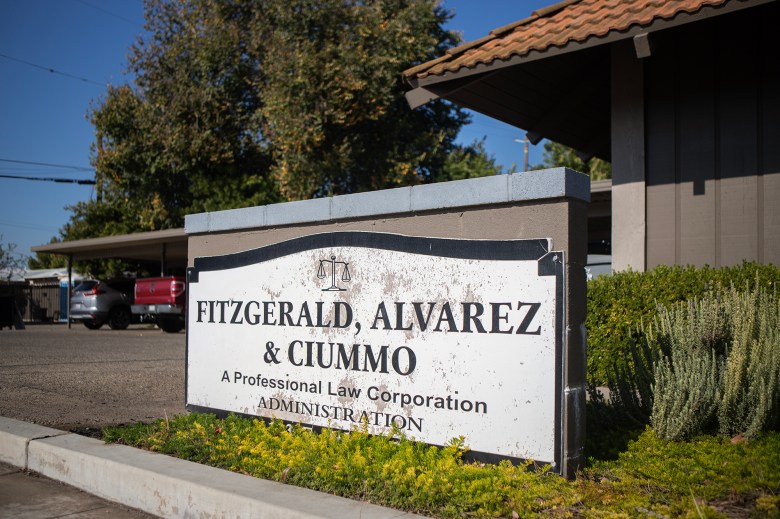
The front entrance of the Fitzgerald, Alvarez and Ciummo law firm in Madera on Oct. 20, 2025. Photo by Larry Valenzuela, CalMatters/CatchLight Local The law firm Fitzgerald, Alvarez and Ciummo has earned a nickname: The WalMart of public defense.  Over three decades, the firm has won county contracts to provide poor people with criminal defense in the state’s rural stretches. It’s done so by making aggressively low bids.  Old iterations of the firm’s website asked local politicians what they might do with all the money they could save on public defense: “Better schools? Better fire protection? More police? Improved roads? More parks?”  Today, nearly half of California counties pay private lawyers and firms to represent poor people in criminal cases. Most of them do it through what’s known as a “flat-fee” contract, meaning they pay a fixed amount, regardless of how many cases the attorneys handle or how much time they spend on each case.  As CalMatters investigative reporter Anat Rubin details, these arrangements so clearly disincentivize investigating and litigating cases that they’ve been banned in other parts of the country.  But they have flourished in California.  In San Benito County, for example, a state evaluation found that Ciummo attorneys barely spoke with their clients and seldom filed legal motions on their behalf.  Defendants asked them to contest the prosecution’s evidence, to interview witnesses, to do anything, really, to challenge law enforcement’s narrative of the crime. Instead, they ushered almost all of them to plea deals.  Even some law enforcement leaders — the people trying to put the Ciummo firm’s clients behind bars — are raising the alarm. They say they’re not being challenged like they should be in a functioning system.  Joel Buckingham, San Benito County District Attorney: “Police officers must make mistakes sometimes.”  Read the full story. This is the second part of Anat’s series examining the lack of key safeguards against wrongful conviction in California. Be sure to read her first piece, The Man Who Unsolved a Murder. Focus on Inland Empire: Each Wednesday, CalMatters Inland Empire reporter Aidan McGloin surveys the big stories from that part of California. Read his newsletter and sign up here to receive it. Become a member: Keep independent, trustworthy information in every Californian’s hands and hold people in power accountable for what they do, and what they don’t. Any gift makes you a member for a year, give $10+ for a limited edition tote. Please give now. Other Stories You Should Know GOP begins legal fight against Prop. 50 A “No on Prop. 50” sign at the Kern County Republican Party booth at the Kern County Fair in Bakersfield on Sept. 26, 2025. Photo by Larry Valenzuela, CalMatters/CatchLight Local On Monday the Trump administration and California Republicans made their arguments challenging Proposition 50 before a panel of federal judges, kicking off the court battle over California’s voter-approved gerrymandering efforts, write CalMatters’ Maya C. Miller and Mikhail Zinshteyn. Republicans say that Prop. 50’s congressional maps violate the 14th and 15th amendments because race, they argue, was used as a factor in determining district lines. They are seeking a preliminary injunction on the maps before Dec. 19 — the date when candidates can start collecting signatures to get on the 2026 primary ballot — to temporarily ban the use of the maps in an election. Prop. 50 supporters argue that the maps were drawn to create a partisan advantage for Democrats, and it was only incidental if the maps lent any outsized influence to certain ethnic or racial groups. Prop. 50 opponents face an uphill battle, given that the U.S. Supreme Court recently upheld Texas’ redrawn maps by overturning a lower court’s finding that the Texas GOP committed unconstitutional racial gerrymandering. Read more here. Seeking solutions to a sewage crisis A warning sign about sewage and chemical contamination is posted along the shore of Imperial Beach on Nov. 21, 2025. Photo by Adriana Heldiz, CalMatters Members of the California legislature brought together policymakers and scientists during a joint environmental committee hearing last week, which explored how the state can tackle the Tijuana River sewage crisis, reports CalMatters’ Deborah Brennan. During the hearing, lawmakers and others reviewed how neglect, failed infrastructure and industrial waste created the decadeslong environmental disaster. They discussed potential mitigating solutions such as updating air quality standards; improving working conditions for those who are exposed to the pollution; and holding companies accountable for their role in polluting the river.  State Sen. Catherine Blakespear, an Encinitas Democrat who led the hearing: “What is happening in the Tijuana River Valley is an international, environmental disaster that undermines everything that California stands for. … The sewage flowing into San Diego County’s coastline is poisoning our air and water, harming public health, closing beaches and killing marine life.” This year, the U.S. repaired and expanded a San Diego wastewater treatment plant, while Mexico repaired a plant near the border. But more work is still required, including at the Imperial Beach shoreline, which has remained closed for years. On Monday the U.S. and Mexico signed an agreement addressing the crisis.  Read more here. And lastly: Wiener’s bid for Congress State Sen. Scott Wiener during a Senate floor session at the state Capitol in Sacramento on Jan. 23, 2025. Photo by Fred Greaves for CalMatters In October state Sen. Scott Wiener announced his run for Nancy Pelosi’s congressional seat, entering a contest that highlights a broader debate over the future direction of Democratic leadership. Maya and CalMatters’ video strategy director Robert Meeks have a video segment on the San Francisco Democrat as part of our partnership with PBS SoCal. Watch it here. SoCalMatters airs at 5:58 p.m. weekdays on PBS SoCal. California Voices CalMatters columnist Dan Walters: Gov. Gavin Newsom champions pro-housing policies, but he’s tougher on Republican-leaning communities, like Huntington Beach, compared to Democratic ones, such as Marin County. A new report finds that California neighborhoods closest to oil wells and refineries disproportionately harm Latino and Black residents, underscoring how the environmental injustices of the oil age are being repackaged in the plastic economy, write Veronica Herrera and Daniel Coffee, UCLA professor and researcher, respectively.  Other things worth your time: Some stories may require a subscription to read. Dating app rape survivors file lawsuit accusing Hinge, Tinder of ‘accommodating rapists’ // The Markup Trump immigration raids take toll on child-care workers in CA and nationwide // Los Angeles Times CA sues Trump for blocking EV charging funds // The Mercury News CA lawmakers say they’ll keep pushing to regulate AI // The Sacramento Bee Newsom leads backlash to Trump’s unhinged response to Reiner killings // San Francisco Chronicle CA AG Bonta leads coalition opposing proposed collection of diversity data // EdSource National Guard troops under Trump’s command leave LA before court’s deadline // Los Angeles Times How some of LA’s biggest apartment owners avoid Section 8 tenants // Capital & Main

The law firm Fitzgerald, Alvarez and Ciummo has earned a nickname: The WalMart of public defense.  Over three decades, the firm has won county contracts to provide poor people with criminal defense in the state’s rural stretches. It’s done so by making aggressively low bids.  Old iterations of the firm’s website asked local politicians what […]
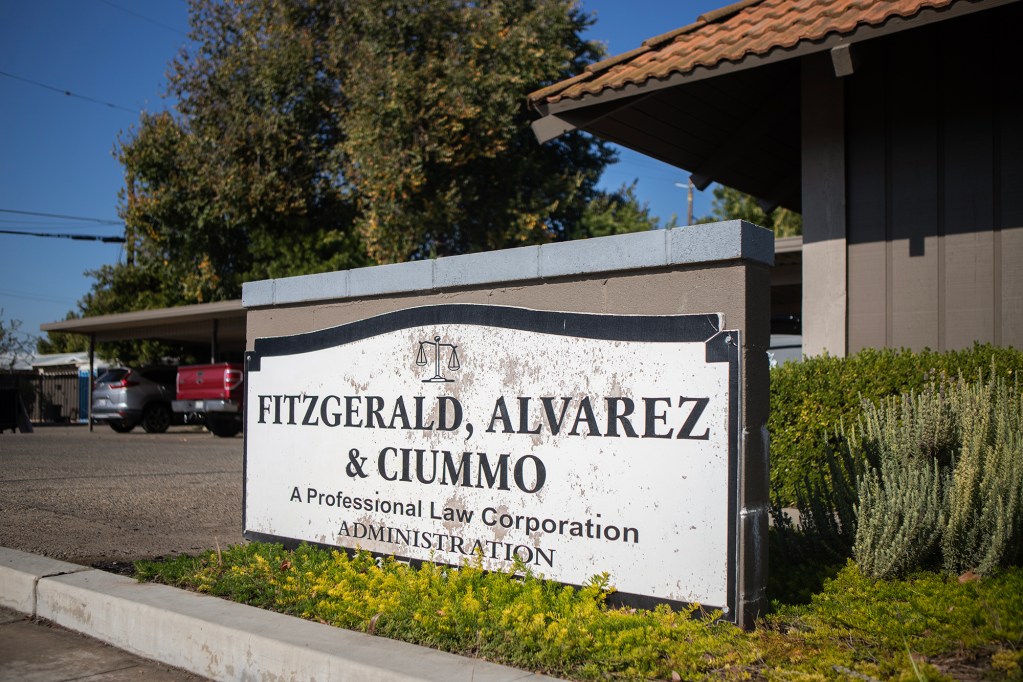
A worn outdoor sign for a law office reads “Fitzgerald, Alvarez & Ciummo – A Professional Law Corporation, Administration,” mounted in front of a low building with bushes and a small parking area in the background.
The front entrance of the Fitzgerald, Alvarez and Ciummo law firm in Madera on Oct. 20, 2025. Photo by Larry Valenzuela, CalMatters/CatchLight Local

The law firm Fitzgerald, Alvarez and Ciummo has earned a nickname: The WalMart of public defense. 

Over three decades, the firm has won county contracts to provide poor people with criminal defense in the state’s rural stretches. It’s done so by making aggressively low bids. 

Old iterations of the firm’s website asked local politicians what they might do with all the money they could save on public defense: “Better schools? Better fire protection? More police? Improved roads? More parks?” 

Today, nearly half of California counties pay private lawyers and firms to represent poor people in criminal cases. Most of them do it through what’s known as a “flat-fee” contract, meaning they pay a fixed amount, regardless of how many cases the attorneys handle or how much time they spend on each case. 

As CalMatters investigative reporter Anat Rubin details, these arrangements so clearly disincentivize investigating and litigating cases that they’ve been banned in other parts of the country. 

But they have flourished in California. 

In San Benito County, for example, a state evaluation found that Ciummo attorneys barely spoke with their clients and seldom filed legal motions on their behalf. 

Defendants asked them to contest the prosecution’s evidence, to interview witnesses, to do anything, really, to challenge law enforcement’s narrative of the crime. Instead, they ushered almost all of them to plea deals. 

Even some law enforcement leaders — the people trying to put the Ciummo firm’s clients behind bars — are raising the alarm. They say they’re not being challenged like they should be in a functioning system. 

  • Joel Buckingham, San Benito County District Attorney: “Police officers must make mistakes sometimes.” 

Read the full story.

This is the second part of Anat’s series examining the lack of key safeguards against wrongful conviction in California. Be sure to read her first piece, The Man Who Unsolved a Murder.


Focus on Inland Empire: Each Wednesday, CalMatters Inland Empire reporter Aidan McGloin surveys the big stories from that part of California. Read his newsletter and sign up here to receive it.

Become a member: Keep independent, trustworthy information in every Californian’s hands and hold people in power accountable for what they do, and what they don’t. Any gift makes you a member for a year, give $10+ for a limited edition tote. Please give now.


Other Stories You Should Know


GOP begins legal fight against Prop. 50

A red, white, and blue sign reading “No on 50: Defend Fair Elections” sits on a table beside jars filled with pistachios and a small display about California’s political priorities. The background shows blurred lights and a screen displaying a broadcast.
A “No on Prop. 50” sign at the Kern County Republican Party booth at the Kern County Fair in Bakersfield on Sept. 26, 2025. Photo by Larry Valenzuela, CalMatters/CatchLight Local

On Monday the Trump administration and California Republicans made their arguments challenging Proposition 50 before a panel of federal judges, kicking off the court battle over California’s voter-approved gerrymandering efforts, write CalMatters’ Maya C. Miller and Mikhail Zinshteyn.

Republicans say that Prop. 50’s congressional maps violate the 14th and 15th amendments because race, they argue, was used as a factor in determining district lines. They are seeking a preliminary injunction on the maps before Dec. 19 — the date when candidates can start collecting signatures to get on the 2026 primary ballot — to temporarily ban the use of the maps in an election.

Prop. 50 supporters argue that the maps were drawn to create a partisan advantage for Democrats, and it was only incidental if the maps lent any outsized influence to certain ethnic or racial groups.

Prop. 50 opponents face an uphill battle, given that the U.S. Supreme Court recently upheld Texas’ redrawn maps by overturning a lower court’s finding that the Texas GOP committed unconstitutional racial gerrymandering.

Read more here.

Seeking solutions to a sewage crisis

A yellow and red warning sign about sewage and chemical contamination is posted along the shore of a beach. A pier can be seen in the background as the sun begins to set.
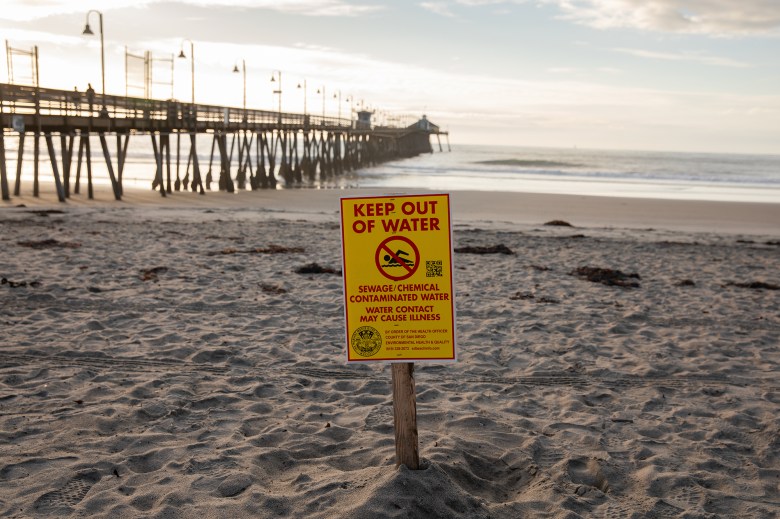
A warning sign about sewage and chemical contamination is posted along the shore of Imperial Beach on Nov. 21, 2025. Photo by Adriana Heldiz, CalMatters

Members of the California legislature brought together policymakers and scientists during a joint environmental committee hearing last week, which explored how the state can tackle the Tijuana River sewage crisis, reports CalMatters’ Deborah Brennan.

During the hearing, lawmakers and others reviewed how neglect, failed infrastructure and industrial waste created the decadeslong environmental disaster. They discussed potential mitigating solutions such as updating air quality standards; improving working conditions for those who are exposed to the pollution; and holding companies accountable for their role in polluting the river. 

  • State Sen. Catherine Blakespear, an Encinitas Democrat who led the hearing: “What is happening in the Tijuana River Valley is an international, environmental disaster that undermines everything that California stands for. … The sewage flowing into San Diego County’s coastline is poisoning our air and water, harming public health, closing beaches and killing marine life.”

This year, the U.S. repaired and expanded a San Diego wastewater treatment plant, while Mexico repaired a plant near the border. But more work is still required, including at the Imperial Beach shoreline, which has remained closed for years. On Monday the U.S. and Mexico signed an agreement addressing the crisis. 

Read more here.

And lastly: Wiener’s bid for Congress

A lawmaker, wearing a light blue suit and patterned tie, stands in front of a microphone, while surrounded by other lawmakers sitting at their desks inside a legislative room of the state Capitol.
State Sen. Scott Wiener during a Senate floor session at the state Capitol in Sacramento on Jan. 23, 2025. Photo by Fred Greaves for CalMatters

In October state Sen. Scott Wiener announced his run for Nancy Pelosi’s congressional seat, entering a contest that highlights a broader debate over the future direction of Democratic leadership. Maya and CalMatters’ video strategy director Robert Meeks have a video segment on the San Francisco Democrat as part of our partnership with PBS SoCal. Watch it here.

SoCalMatters airs at 5:58 p.m. weekdays on PBS SoCal.


California Voices

CalMatters columnist Dan Walters: Gov. Gavin Newsom champions pro-housing policies, but he’s tougher on Republican-leaning communities, like Huntington Beach, compared to Democratic ones, such as Marin County.

A new report finds that California neighborhoods closest to oil wells and refineries disproportionately harm Latino and Black residents, underscoring how the environmental injustices of the oil age are being repackaged in the plastic economy, write Veronica Herrera and Daniel Coffee, UCLA professor and researcher, respectively. 


Other things worth your time:

Some stories may require a subscription to read.


Dating app rape survivors file lawsuit accusing Hinge, Tinder of ‘accommodating rapists’ // The Markup

Trump immigration raids take toll on child-care workers in CA and nationwide // Los Angeles Times

CA sues Trump for blocking EV charging funds // The Mercury News

CA lawmakers say they’ll keep pushing to regulate AI // The Sacramento Bee

Newsom leads backlash to Trump’s unhinged response to Reiner killings // San Francisco Chronicle

CA AG Bonta leads coalition opposing proposed collection of diversity data // EdSource

National Guard troops under Trump’s command leave LA before court’s deadline // Los Angeles Times

How some of LA’s biggest apartment owners avoid Section 8 tenants // Capital & Main

Read the full story here.
Photos courtesy of

The plastic chemicals in our food

See the thousands of plastic chemicals in what we eat.

When Americans eat a burger, they aren’t just biting through bun, lettuce, tomato and cheese. Instead, the burger — or its packaging, or the utensil used to cook it — also likely contains a blend of chemicals scientists believe harm human health. PFAS. Phthalates. BPA. Flame retardants.These chemicals act on the body in multiple ways — confusing hormones, disrupting immune systems and boosting cancer cells. But they all have one thing in common: They are intimately linked to plastic.Couch cushions, rugs and carpets are made of polyester fibers; furniture and flooring is coated in plastic laminates. The vast majority of food is wrapped in plastic packaging, and Americans cook with plastic spatulas on plastic-coated pans.Plastic ushered in a new era of convenience and filled homes with cheap, disposable goods. But it also has exposed ordinary people to tens of thousands of chemicals that slip out of those items into household dust, food, water — and from there, into bodies. Some of these chemicals are known to disrupt pregnancies, triggering birth defects and fertility problems later in life; others have been linked to cancer and developmental problems.The Washington Post used a comprehensive database, built by scientists in Switzerland and Norway, of 16,000 chemicals linked to plastic materials to see how people interact with chemicals in their everyday lives. Of those, scientists say, more than 5,400 chemicals are considered hazardous to human health. Researchers believe that many of these chemicals are harming Americans even at typical levels of exposure.Here’s how some of the most dangerous chemicals go from everyday items in our kitchens into our bodies.Many plastic chemicals are found in utensils, food packaging and cookware that come in close contact with the food we eat. These chemicals are added to plastic to make it more flexible or hard, more slippery, or more stain-resistant.Flame retardants, for example, are generally found in household furniture or electronics. But thanks to plastic recycling, they are also increasingly coming in close contact with food.Black plastic — like the plastic that forms this tray or plastic spatula — is often made from recycled electronic waste. It can contain high concentrations of brominated flame retardants, which have been linked to lowered IQs and neurodevelopment problems in children.Nonstick pans and compostable plates and cutlery often contain per- and polyfluoroalkyl substances, known as PFAS or “forever chemicals.”Studies show that phthalates, a class of chemicals added to plastic to make it stretchy and soft, are present in the vast majority of foods purchased at a grocery store, especially highly processed foods.In one study by an independent research group in California, researchers found the chemicals in three-quarters of the food tested. Manufacturers say that they began phasing phthalates out of food packaging starting in the 2000s, but the chemicals can still be used in equipment used for storing or processing foods.Bisphenol A, or BPA, a chemical that was first used as an artificial form of estrogen, was once the main ingredient in plastic water bottles and the lining on the insides of cans.Despite manufacturer phaseouts, research shows that many foods, including canned foods and canned drinks, still contain BPA or other, similarly structured chemicals, like BPS or BPF. A study by Consumer Reports last year, for example, found these chemicals in 79 percent of foods tested, although the levels have fallen over the past two decades. They have been linked to fertility problems and obesity.Chemicals are what give plastic its unique and varied properties. A single type of plastic — say, polyvinyl chloride — could be treated with phthalates to make it soft and flexible, stabilizers to keep it from breaking down in high temperatures, flame retardants to prevent fire and colorants or dyes.Some of these chemicals have uses beyond plastic. PFAS, for example, can also be used in pesticides and firefighting foams. But researchers have found that the vast majority of their uses come back to plastic. According to one study led by researchers at New York University, 93 percent of the exposure to PFOA, one of the most widely studied PFAS, stems from plastics.Many of these chemicals have endocrine-disrupting properties — meaning they confuse the body’s hormones, particularly in developing children.“When you’re talking about endocrine-disrupting chemicals, a lot of it is plastic,” said Leonardo Trasande, a professor of pediatrics and population health at the NYU Grossman School of Medicine and one of the authors of that study.The chemical industry points out that these chemicals play key roles in human society. “Phthalates, bisphenols, PFAS, and flame retardants serve critical functions that help protect health and safety in everyday life,” Robert Simon, vice president of chemical products and technology at the American Chemistry Council, said in an email. “For example, some are used in critical healthcare applications, to improve product durability, or to provide essential fire protection.”Simon added that the FDA has found that phthalates and BPA are safe in the amounts found in Americans’ diets. “Typical consumer exposure to BPA in food packaging is far below safe limits set by government agencies,” he said.But scientists say that this blend of chemicals adds up to a stew of potentially toxic materials that fill our homes and the food we eat. The world produces an estimated 450 million metric tons of plastic every year; almost all of that plastic comes with some sort of chemical additive.“Something that is 1 percent of plastic or 0.1 percent of plastic is being produced in unfathomable volumes that are going into consumer products,” said Christos Symeonides, a developmental pediatrician at the Royal Children’s Hospital Melbourne. “Including food packaging and children’s toys and the clothing that we wear.”Phthalates, flame retardants, bisphenols and PFAS are some of the most widely known — and most concerning — plastic chemicals.But each of these groups can have dozens or hundreds of different chemicals within it — each with slightly different effects on the human body.According to data from the Centers for Disease Control, more than 90 percent of Americans are exposed to key chemicals in these groups.About half of those chemicals are listed as hazardous by governments or industry; only a small number are considered to pose no risk. The rest don’t have enough official hazard data to determine health effects.In total, there are more than 5,400 chemicals in plastics that meet the criteria for chemicals “of concern” to human health, according to government and industry data. That means chemicals that persist in the environment, accumulate in human and animal bodies, spread easily in the environment, or are known to be toxic to human or animal life.Just 161 are classified as not hazardous.Then there are more than 10,700 chemicals without enough information to judge their safety.“These chemicals haven’t been assessed by governments or by the industry itself,” said Martin Wagner, a professor of biology at the Norwegian University of Science and Technology and one of the creators of the plastic database. “Governments lack the capacity to keep up with all these chemicals.”Researchers once thought plastics were largely inert — not chemically reactive and so safe to have in close contact with food and the human body. But the chemicals added to plastics are not tightly bonded to the polymers. When plastic is heated — or in contact with fatty or acidic foods — those chemicals can spill out.The consequence is that virtually every person in the United States has measurable levels of plastic chemicals in their blood and urine. For example, according to data from the National Health and Nutrition Examination Survey, the median level of DEHP — one of the most dangerous phthalates — in urine in the United States is 13 micrograms per liter. But some patients can have levels as high as 60 micrograms. The higher the level, the greater the risk of birth defects or neurodevelopmental issues.Most of the evidence for harm from plastic chemicals comes from long-term, epidemiological research. Many studies look at how a mother’s exposure to chemicals can affect her children. A 10-fold increase in maternal levels of brominated flame retardants, for example, is associated with a 3.7-point IQ drop in her child. Women with the highest phthalate exposure are 12 to 16 percent more likely to have a premature birth. And BPA exposure during pregnancy is associated with a higher likelihood of obesity and diabetes.On their own, small amounts of these chemicals may pose only a minor risk. But in combination, the effects can be more dramatic. “We’re not exposed to these chemicals individually,” said Ryan Babadi, an environmental toxicologist and the science director for the group Toxic-Free Future. “We’re constantly being exposed to mixtures all the time.”When combined, chemicals that are individually below safe levels can create dangerous health effects.People are exposed to these chemicals from a range of different sources — flame retardants are in electronics and in household dust; PFAS can be found in tap water across the country.But one of the most concerning sources of exposure, according to many scientists, is food and food packaging.Historically, most plastic food packaging contained phthalates, to make the plastic more stretchy and flexible; plastic water bottles and lined metal cans contained BPA. But even after manufacturer phaseouts, studies show that chemicals are still deeply embedded in the food supply. One analysis by a group in California found that, of 312 foods tested from grocery stores and restaurants, 86 percent contained either phthalates or bisphenols — including baby formula and sourdough bread.Some of the highest concentrations appear to be in highly processed foods. According to one study, pregnant women who ate 10 percent more calories from ultra-processed foods had 13 percent higher levels of DEHP in their urine.Researchers say bisphenols, PFAS, and flame retardants can still be present in some food packaging, and highly processed foods are contaminated by plastic chemicals on their route from a factory onto a plate.“It’s also the materials that are used when you process foods — the filling lines, the storage containers, the processing equipment,” said Jane Muncke, chief scientific officer and managing director for the Zurich-based Food Packaging Forum.The food industry says that packaged foods help keep the contents safe. “Packaging exists to protect and keep food safe for consumption. Food contact substances go through a rigorous scientific risk-based review and approval process before they go to market,” Sarah Gallo, senior vice president of product policy at the Consumer Brands Association, a trade group that represents many large food companies, said in an email.For consumers, experts warn, it’s impossible to tell from packaging whether a product is actually chemical-free. A “BPA-free” can, for example, may still use other bisphenols, like BPS or BPF.Scientists advise people to avoid cooking with and heating plastic — as well as storing fatty or acidic foods in the material. Avoiding ultra-processed foods can help, as can preparing more foods from scratch at home. Those changes can particularly help lower exposure to the more short-lived chemicals, like phthalates or bisphenols.But “forever chemicals” and flame retardants persist in the environment and in human bodies — making them very difficult to remove from the food supply. PFAS, for example, can be found in soils in parts of North Carolina and Maine, where PFAS-treated sewage sludge has been dumped on agricultural land. “In some regions produce is contaminated, sometimes milk is contaminated,” said Heather Stapleton, an exposure scientist and professor in the Nicholas School of the Environment at Duke University.Ultimately, researchers argue that countries need stricter standards to regulate the chemicals that go into plastic. Pharmaceuticals, they argue, are held to high standards to prove safety — but the chemicals that reach our bodies through plastics are a dizzying maze of missing information. “The medicines that you put in your mouth are tightly regulated,” said Sarah Dunlop, an emeritus professor of biological sciences at the University of Western Australia and director of plastics and human health at the Minderoo Foundation. “Whereas the chemical industry has complete carte blanche.”“The problem is, none of the plastics that we have right now are safe,” said Wagner, of Norwegian University of Science and Technology. “That’s not a very nice thing to hear, but that’s what the data tell us.”About this storyPhotos by Marvin Joseph. Design and development by Emily Wright. Editing by Juliet Eilperin, Simon Ducroquet, Dominique Hildebrand, Virginia Singarayar and Gaby Morera Di Núbila.The Post interviewed more than a dozen scientists on the risks of plastic chemicals and how people are exposed to these chemicals in their everyday lives. Exposure numbers for BPA are from 2008 data from the National Health and Nutrition Examination Survey. Exposure numbers for PFOA are from 2020 data from the National Health and Nutrition Examination Survey.Chemicals listed as hazardous include those listed in the PlastChem database with a hazard score of 0.5 and above. The items displayed in this photo are representative and have not been tested for chemicals.

Scientists Devise New Plan to Study the Most Exciting Rock on Mars

New laboratory studies could shed light on a rock containing potential signs of alien life that’s stranded on Mars

The most exciting rock known to science is a school-desk-sized chunk of mudstone currently stuck on Mars.Formed from fine, water-washed sediments on the floor of a long-lost lake—some 3.5 billion years ago, when Mars was a warmer, wetter world—the rock was found in 2024 by scientists using NASA’s Perseverance rover to explore what’s now known as Jezero Crater. Dubbed Cheyava Falls, the mudstone stood out to the researchers because its surface was spangled with strange speckles and ring-shaped blobs, which they referred to as poppy seeds and leopard spots. They also discovered that it was packed with organic matter—chemical compounds of carbon, the elemental cornerstone of biology as we know it.Organic-rich rocks right here on Earth sometimes contain similar features, which tend to be created by microbial life. And after painstaking follow-up studies with the rover, the Perseverance team announced earlier this year that ancient alien microbes might be the best explanation for the Martian rock’s spots and seeds as well.On supporting science journalismIf you're enjoying this article, consider supporting our award-winning journalism by subscribing. By purchasing a subscription you are helping to ensure the future of impactful stories about the discoveries and ideas shaping our world today.To know for sure whether Cheyava Falls is proof of past life on Mars—or instead just a weird quirk of lifeless organic chemistry—astrobiologists want to bring some of the rock back to Earth for closer study. But the NASA-led international program to do just that, known as Mars Sample Return (MSR), is in political limbo, beset by ballooning costs and flagging federal support. Even if MSR does go ahead as planned, Perseverance’s hard-won samples of Cheyava Falls and other Martian materials wouldn’t arrive before 2040.Not content to sit idle, a cadre of scientists organized by NASA’s Jet Propulsion Laboratory (JPL) is pursuing an audacious plan B. Rather than wait for pieces of Cheyava Falls to reach Earth, the researchers will try growing the rock’s most mysterious features for themselves in carefully curated or manufactured mudstones. By subjecting these simulacra—some of which will bear terrestrial microbes, while others will be slow baked and sterilized—to lab-based conditions mimicking what’s known of early Mars, the team hopes to learn how Cheyava Falls really got its spots.“Take your best guess as to what was in the mud. Take your best guess as to what the nature of the organic matter is. Stir them up together, let it all settle to the bottom, and watch what happens,” says Joel Hurowitz, a geoscientist at Stony Brook University and a member of the Perseverance science team, who is familiar with the work.This approach won’t be able to definitively prove or disprove the existence of past life on Mars. But by mapping out every conceivable way to make the seeds and spots in a lab, scientists can determine whether it’s likelier that the features evident in Cheyava Falls were made with microbes or without them.Cooking Up Poppy Seeds and Leopard SpotsThe universe owes a lot to the behavior of electrons. Whether we are talking about the explosive deaths of stars, the formation of planets, the weather or the critters that live under it, electrons often drive the chemistry that makes things happen.One particularly important type of chemical drama is known as an oxidation-reduction, or redox, reaction. Oxidation involves the loss of electrons, while reduction is the gain of electrons. Redox reactions happen everywhere, all the time, in all sorts of environments—and they are essential to the normal functioning of living things, allowing organisms to obtain energy, to maintain basic cellular operations and even to shield themselves from external dangers.Nobody expected to see fossilized creatures, or even necessarily preserved microbial corpses, on the surface of Mars. But finding trace evidence of biologically driven redox reactions was far more plausible, and the Cheyava Falls outcrop—and its wider environment—is a near-perfect place to look.“They record an ancient, habitable environment,” says Sanjeev Gupta, an Earth scientist at Imperial College London and a member of the Perseverance rover team. Within it, Perseverance picked up a bounty of organic material. It also saw tiny nodules and larger, halolike features: the poppy seeds and leopard spots, respectively. Both the poppy seeds and leopard spots are the graffiti left behind by the redoxlike shuttling about of electrons.Potentially microbe-made small dark “poppy seed” speckles and larger dark-rimmed “leopard spot” blobs dot the surface of “Cheyava Falls,” one of the most intriguing rocks ever found on Mars.The poppy seeds contain a reduced form of iron, Fe(II), found in a mineral named vivianite (seen as black specks). Fe(II) is produced when preexisting Fe(III) gains an electron. Fe(III), the oxidized version of this iron, was found within the original Cheyava Falls muds.The leopard spots also have Fe(II) in two different mineral forms: vivianite (which appears as dark rims) and greigite (which is within the spots’ interior). The spots also contain sulfides, a reduced form of preexisting sulfates that is also found in the Cheyava Falls muds; the sulfides are also part of the mineral greigite.The seeds and spots are essentially “a fossilized chemical reaction,” Gupta says. And any experiments on Earth hoping to re-create them will take one of two possible pathways: one that deploys microbes and one that doesn’t.First, let’s look at the nonbiological options. One way to turn Fe(III) and sulfates into Fe(II) and sulfides is to heat up the ingredients found in those muds and wait. “That’s a reaction that can happen without life. But it’s incredibly slow,” says Michael Tice, a geobiologist at Texas A&M College of Arts and Sciences and a member of the Perseverance science team. And by slow, he means potentially millions of years.A good analogy is sugar and oxygen. The two can react to unleash bountiful chemical energy—but sustained, strong heat is what really makes that happen. Sugar doesn’t much react with oxygen just sitting on your kitchen table. Similarly, you wouldn’t get the Cheyava Falls features unless you baked the original muds at high temperatures—150 degrees Celsius or more. Yet NASA’s Perseverance rover has uncovered no evidence of such cooking for Cheyava Falls, and it seems the seeds and spots were created shortly after the mud was deposited.Now let’s look at the microbial route. If that mudstone had instead formed from a lake bed on Earth, one would expect prevalent microbes to “consume” the organic matter and gain energy effectively from the reduction of Fe(III) and the sulfates. This would happen relatively fast because Earthly microbes deploy potent enzymes that ease the reaction’s energetic thresholds; no high-temperature cookery is required. And “it’s exactly where you’d expect microbes to be living,” Gupta says.Whisper it: based on current evidence, it seems likelier that microbes made these seeds and spots than geological activity. But the problem is that the two chemical pathways “start with the same reactants and end up with the same products,” says Morgan Cable, a research scientist at the Laboratory Studies group at JPL and a member of the Perseverance science team. “The reaction is essentially the same. That’s where it gets tricky.”Laboratory Alchemy Thanks to orbital reconnaissance from spacecraft and ground truthing from rovers, we already have a pretty good idea of what Jezero Crater was like in its halcyon days eons ago. By Martian standards, it was an aquatic wonderland, with water flowing through channels to form and feed a crater lake, piling up sprawling deltas of swept-in sediments, all under a warmer, thicker carbon-dioxide-rich sky. Remarkably, scientists can re-create parts of this past realm in their state-of-the-art laboratories.Test chambers can be kept at the right temperatures to simulate Martian conditions and can be filled with myriad mixtures of gases to reproduce atmospheric pressures and compositions that prevailed on the planet in its deep past. Synthetic mudstones custom-concocted in labs or purchased premade can incorporate various recipes informed by Perseverance’s measurements, with fluctuating amounts of oxygen, organic matter, acidity, salinity, and so on.Over time, as these simulacra unfold under different environmental conditions, watchful scientists can see what happens—and adjust accordingly to explore the truly vast landscape of possibilities. For better or worse, “the range of experiments to engage with is endless,” Hurowitz says.On Earth, life famously gets everywhere. Heat can ensure certain mudstones are sterilized, Cable says, similar to how water can be boiled to deactivate any microscopic bugs. But you can’t just flambé the mudstones, as that would also alter their Mars-like starting chemistry.This video montage shows high-resolution imagery from a selection of Perseverance’s CacheCam of rock cores inside the rover’s sample tubes before being sealed. The montage includes a view of “Sapphire Canyon,” a sample drilled from the Cheyava Falls rock.A gentler, tried-and-tested method of microorganismal murder is known as dry heat microbial reduction, or DHMR. “It’s how we sterilize spacecraft,” Cable says. Things wouldn’t get scorching hot with this method; instead mudstones would be gradually warmed in dry conditions for hundreds of hours. “That usually kills or deactivates most forms of life, including bacterial spores,” she says. To be safe, experimenters using this technique can continuously assay the supposedly sterile soil to make sure there aren’t any microbes left in them.For the deliberately biological experiments, the JPL team is spoiled for choice. Microbe-mediated reaction patterns resembling the poppy seeds and leopard spots can be found all over Earth, where they are often still associated with the diverse microbial ecosystems that made them. “You’d find them in mud, underwater,” Hurowitz says—in both the present and the distant past, from freshly deposited marine sediments off the shores of Taiwan to extremely old rocks in Scotland. Whatever the terrestrial source, the team simply needs to inoculate some of its Mars-like mudstones with microbes able to rapaciously gorge themselves on Fe(III) and sulfates and spark a population boom.“We’ll start there and see where these reactions take us,” Cable says. “We’re going to go down so many different rabbit holes.” Besides trying to summon the poppy seeds and leopard spots into existence in fresh rocks, the team also want to know how to prevent them from growing in the first place.Reducing Fe(III) produces more energy than reducing sulfates. But if microbes were involved, they switched from Fe(III) reduction (making the mineral vivianite) to sulfate reduction (making the mineral greigite). It’s not clear why, but it’s certainly strange—scientists would expect hungry bugs to prefer more energy-rich fare, so why would they leave Fe(III) “candy” untouched to munch on sulfate “broccoli” instead? These experiments could offer answers and put constraints on the types of microbes—and ancient chemical concoctions—that may have been present on Mars 3.5 billion years ago.The Perseverance scientists expect that their work will eventually produce poppy seeds and leopard spots both with and without life’s help. But the environmental conditions leading to both will likely be radically different. Then the researchers can return their focus to Perseverance—still scooting around Jezero—to try sniffing out other rocks nearby that are closer geochemical matches to any mudstones they’ve coaxed into sprouting the telltale speckles, whether with biology—or without.Ideally, the rover will encounter another exciting site—and uncover additional tantalizing hints of ancient Martian life. “You don’t just want one line of evidence. You want something completely independent of it pointing in the same direction,” Tice says.But Cheyava Falls on its own is already a thrill to the Perseverance science team. Finding it was the easy part. “Now the hard work begins,” Hurowitz says.

Workers were exposed to toxic chemicals in firefighting foam

For decades it was 3M's biggest outside the US, and the factory made nappy fastenings and video tape.

Workers were exposed to toxic chemicals in firefighting foamAnna MeiselandEsme Stallard,BBC File on 4 InvestigatesGeograph/ Nigel DaviesThe 3M factory in Swansea was once its biggest outside the US, but it made the decision to close it two years ago Dozens of factory workers were exposed to toxic chemicals within firefighting foam over decades, BBC File on 4 Investigates can reveal.Multi-billion-pound US manufacturer, 3M, failed to tell employees at its Swansea site they were using foam containing two forever chemicals, now classed as carcinogenic, despite knowing for decades of the health risks.The company said it would stop manufacturing the forever chemicals – so called because they persist in the environment – in 2002, but failed to remove them from the factory resulting in an environmental accident four years later.3M said that the health and safety of its workers and their families were "critical priorities" for the company.The factory in Gorseinon, Swansea, opened in 1952 and for decades was 3M's largest outside of the US. It employed more than 1,000 people from across south Wales to manufacture nappy fastenings and video tape.In 2023, 3M made the decision to close the factory and applied for planning permission to redevelop the site.BBC File on 4 Investigates discovered a land contamination report amongst hundreds of documents 3M submitted to the local council - it said the site is polluted with two toxic forever chemicals, PFOS and PFOA.The company never manufactured the chemicals, part of the PFAS family of substances, at the site. Its report said the chemicals came from "historic firefighting activities" using aqueous film-forming foam (AFFF) - a type of firefighting foam.The BBC has tracked down those involved in firefighting on the site, who are speaking publicly for the first time.Every year, a dozen workers at the factory were selected to take on an additional responsibility as members of the "fire party" at the factory."We were on the emergency squad, like part-time firemen," said Ian (not his real name). He worked at the 3M factory for 40 years and was part of the fire party team."Once a month we did the training and we used to train putting out chemical fires," Ian added."They'd have a big tray full of chemicals, put a torch to it, set it up and then we used to use the light water then to put it out, it would come out like foam."Light water is the 3M product name for AFFF, with Ian saying workers were not told anything about chemicals it may contain. Levels of PFOS discovered in soil at the site in 2023 were listed in the report ranging from 50 to more than 1,500 micrograms per kilogram.These upper levels are 500 times greater than the average in British soils.Dr David Megson, an environmental scientist at Manchester Metropolitan University, told the BBC that these levels were a "cause for concern".In a commercial setting he said levels above 600 micrograms may pose a risk to human health because of inhalation of dust and contact with the skin.Members of the PFAS family of chemicals, specifically PFOA and PFOS, have been linked with a range of different adverse health conditions, Dr Megson said. He added: "[They] can cause damage to the liver, cardiovascular system, immune system and in the developing foetus."Both chemicals are now banned in the UK because they are toxic and do not break down easily in the environment. In 2024, the World Health Organization (WHO) determined PFOA was carcinogenic and PFOS "possibly" carcinogenic to humans.But 3M knew as early as the 1970s of the health risks of these chemicals to workers.Bastiaan Slabbers/Getty ImagesSome firefighting foam used in Swansea contained toxic forever chemicals - this is a similar type of foam at a site in the US In 1999, a major civil claim was made against 3M after people started becoming unwell from water contaminated with PFOS and PFOA in the United States.During the case, internal 3M documents were released which showed the company recording elevated levels of PFAS in the blood of its workers and possible increases in cancer."[It] understood, going back many decades, the dangers of these chemicals," said Rob Bilott, partner at US firm Taft Law, who led that litigation."Animal studies started being done by [3M] in the 1960s that was showing incredible toxicity in multiple different animal species. "Rats, mice, rabbits, guinea pigs, dogs, even monkeys were dropping dead by the late 1970s."Cheryl's father worked for decades at the factory in Swansea, starting back in the 70s, and was also on the fire party."He was the provider. He always worked hard. He was at his happiest when he was with his family and his friends," said Cheryl (not her real name).In his early 40s, he was diagnosed with kidney cancer and after treatment briefly returned to work before retiring at 50. A few years later the cancer returned and Cheryl's dad died at the age of 54.She said: "It was a shock because my father was always a big, strong man, so he was never ill. He never used to take time off sick from work."Many things can cause kidney cancer, but research compiled by the World Health Organization has concluded the risk of kidney cancer is probably increased by significant exposure to PFOS and PFOA.Dr Steve Hajioff is an epidemiologist and chairs an independent panel in Jersey looking into contamination of water supply by firefighting foam that also contains the chemicals manufactured by 3M.It was set up by the government after residents fell ill."I do not think you can ever say that [it] is impossible it might be caused or made more likely by PFAS exposure," he said. "But there are things where we can be pretty convinced, and those are things like kidney cancer, testicular cancer, less effective immunisations for children."Cheryl said she cannot understand why the company knew of the risks and failed to test the blood of workers, adding: "Maybe some people who have passed away could have been diagnosed earlier and had treatment earlier."This sentiment is echoed by Ian who said as the workers were never told of any risks, they did not wear breathing equipment and handled the foam in their factory overalls and wellies only."I'm not very happy about it," he said. "I've always said they were a bit blasé about all the chemicals they were really using."Ian also left the factory after being diagnosed with colon cancer after nearly four decades of service.We do not know if Ian's exposure to the foams caused this. The WHO said this year the evidence to link PFOS and PFOA to colon cancer remains unclear as there have not be enough cases identified.When litigation began in the US, 3M announced publicly that it would stop manufacturing PFOS and PFOA in the US, and globally by 2002.But BBC File on 4 Investigates found that even then workers in Swansea were not told of the health risks, and legacy foams were left on site.In October 2006, a major storm caused the system containing the foams to malfunction and release it on the site. At this point, it was just a liquid, and workers thinking it was rain water, pumped it into the aeration pond – used to store wastewater.John Bowers, the health and safety manager for the site at the time, said this suddenly created a serious problem."The aeration then created a huge amount of foam, which basically went from the pond basically up into the air," he said. Mr Bowers told the BBC the storm was so strong it blew the foam on to Gorseinon high street.He added: "It was described to me as if it was, excuse the phrase, like a foam party."Mr Bowers said the workers managed to contain the foam and the next day called 3M headquarters in Minnesota - it was only at this point the company told him the foam contained the toxic chemical PFOS."I found it surprising that 3M didn't contact existing customers to make them aware of the potential hazards and also even more surprising that they didn't contact the 3M facilities," he said. "I was disappointed."Rob Bilott has led legal action against 3M for decades over PFOS contamination in the USThe BBC submitted a freedom of information request to Swansea council and Natural Resources Wales, the environmental regulator, which revealed that this spill was not contained to the site but also contaminated a local waterway – Afon Lliw.Test results also released to the BBC show that PFOS levels in the pond were at 1800 ug/L and in the local river were at 20ug/L. Average levels above 0.00065ug/L in rivers and lakes are considered to be harmful to aquatic organisms – the levels in the river were 31,000 times higher than that.A local farmer was recorded as complaining to the council at the time after seeing foam in the river and raising concerns for her cattle.The company was warned by the regulator that it committed an offence under water regulations in force at the time, but was told it would not be prosecuted or fined.Mr Bowers told the BBC after this 2006 incident that the pond filled with contaminated foam on the site was cleaned and drained.But the planning application documents from 2023 say that the pond had filled back up and had very high levels of PFOS.The contamination report said the pond might "have the potential to act as an ongoing source to the water environment".In 2023, the pond's levels of PFOS were still at 21,000 times the recommended safe level for aquatic life.3M has now remediated the pond and surrounding soil again, which was completed in recent months.A 3M spokesperson told the BBC: "The health and safety of our employees, their families, and our communities, are critical priorities for 3M."It said it had long since phased PFOS and PFOA out of its operations and has permanently discontinued production of this firefighting foam.It told the BBC it would continue to deliver on its commitments – including remediating PFAS and collaborating with communities including by committing "to invest $1bn (£750m) globally in state-of-the-art water treatment technologies at sites where we have historically manufactured PFAS"."Over decades, 3M has shared significant information about PFAS, including by publishing many of its findings regarding PFAS in publicly available scientific journals," it added.Ian and Cheryl are not their real names. Because of their concerns about speaking publicly their names have been changed.

Ohio vineyard owner relied on toxic weed killer. Now facing Parkinson’s, he wants it banned

Dave Jilbert was diagnosed with Parkinson's after he used a paraquat product at his Ohio vineyard. He's now suing the pesticide manufacturer and trying to get paraquat banned.

Dave Jilbert always wanted to be a farmer. He went to agricultural school, moved to a homestead, started a winery and eventually purchased 16 acres of farmland in the central Ohio valley. He grew grapes for about five years, until he felt himself slowing down. It wasn’t long before the tremors started. Jilbert, at the age of 61, was diagnosed with Parkinson’s disease in 2021. “I’m not a doctor,” he said, “but all I know is I used paraquat and I got Parkinson’s.” There’s no definitive cause of Parkinson’s, a brain disease with no cure that gets worse over time, but researchers have found a majority of cases are environmental. Now Jilbert is suing. He argues that spraying a toxic pesticide called paraquat is to blame. And now he’s trying to get it banned. “I’m trying to keep people from doing what I did,” said Jilbert, now 66. “I don’t want people to be damaged like me.” With evidence of its harms stacking up, paraquat has already been banned in dozens of countries all over the world, including the United Kingdom and China, where it’s made. Yet last year, its manufacturer Syngenta, a subsidiary of a company owned by the Chinese government, continued selling paraquat in the United States and other nations that haven’t banned it. Paraquat is highly toxic, but one of the biggest concerns are the mounting allegations that low-level that exposure over a long period of time could be linked to Parkinson’s disease. Thousands of U.S. farmers have made this claim in court, but the cases are still pending.  Ramsey Archibald | rarchibald@al.com‘It’s degenerative’ When Jilbert started growing grapes, he did his research on weed control. He needed to contain suckers, shoots that quickly sprout at the base of the vine, strangling the fruit. It would either take weeks to clip the suckers by hand, or Jilbert could spend a couple of days spraying Gramoxone, a paraquat product manufactured by Syngenta. “It was a great herbicide,” he said. From 2014 through 2018, Jilbert loaded Gramoxone into a 50-gallon sprayer on the back of his tractor and wound through the vineyard, misting the seed bed of the vines. He needed a license to buy it from a farming co-op. But at the time, the only precautions involved wearing rubber gloves, a heavy shirt and goggles. Now, the regulators require respirators, enclosed cabs, among other safety measures. By 2020, Jilbert felt his hands stiffen as he changed the oil on his tractor. He chalked it up to getting older. When the tremors started, a doctor diagnosed Jilbert with Parkinson’s, telling him the brain disease is degenerative. Parkinson’s occurs when the brain cells that make dopamine, a chemical that controls movement, stop working or die. It’s the fastest growing neurodegenerative disease in the world with Parkinson’s Foundation research showing U.S. cases have risen by 50%. Ray Dorsey, a neurologist, says Parkinson’s disease is “largely preventable” with research showing that 87% of those with the disease do not have any genetic risk factors, or in other words, the cause “lies not within us but outside of us.” “If we clean up our environment, we get rid of Parkinson’s disease,” he said. Ohio farmer fights to ban pesticide after Parkinson's diagnosisBefore taking medication, Jilbert couldn’t fasten buttons, tuck in his shirt or tie his shoes. The next step was getting a DaTscan of his brain for a research trial. During that trial, a doctor explained that a healthy brain scan will light up with two bright commas. A brain scan with Parkinson’s will illuminate two periods. Jilbert walked out and looked at his scan results: two periods. “It’s degenerative,” he said. “That’s what keeps ringing back in my mind.” Almost five years in, Jilbert now takes 11 pills a day. His movements have improved, but his head bobs. He has off days and on days. “I’ve got a farm. I’ve got 26 acres. I’ve got the homestead,” Jilbert said. “It looks beautiful. The roads are straight and weeds in check. I followed all the labels. And then I get Parkinson’s.” Mass litigation After learning more about paraquat, Jilbert joined the mass action lawsuit against Syngenta and Chevron USA in 2021. He’s one of thousands of people who claim the chemical manufacturers knew about the dangers of paraquat but sold it anyway. The manufacturers “should have known that paraquat was a highly toxic substance that can cause severe neurological injuries,” the lawsuit argues, and should have taken steps “to ensure that people would not be harmed” by paraquat use. Jilbert’s suit argues he was exposed when mixing, loading and spraying paraquat on his vineyard. During that time, the lawsuit says he breathed in small droplets of the pesticide. “Once absorbed, the paraquat entered his bloodstream, attacked his nervous system and was a substantial factor in causing him to suffer Parkinson’s disease,” the suit claims. Jilbert did not comment on the lawsuit while it’s pending. Dave Jilbert bought a vineyard to grow grapes for his winery, Jilbert Winery, in Valley City, Ohio. After about five years, he felt himself starting to slow down. By 2021, Jilbert was diagnosed with Parkinson's disease. He has since retired from farming and winemaking, but he's now suing the manufacturer of a pesticide called Gramoxone, a paraquat product.  David Petkiewicz | cleveland.comA settlement agreement was reached earlier this year, which would resolve thousands of cases in Illinois, but the negotiations are still being worked out. Without a settlement, it could go to trial in 2026. Syngenta says settling does not imply paraquat causes Parkinson’s disease, but litigation can be costly and distracting. “We stand by the safety of paraquat,” a statement said. Syngenta has also rejected the claims, saying “despite decades of investigation and more than 1,200 epidemiological and laboratory studies of paraquat, no scientist or doctor has ever concluded in a peer-reviewed scientific analysis that paraquat causes Parkinson’s disease.” Chevron, which has never manufactured paraquat and has not sold it since 1986, also disputes the claims. Growing effort to ban In recent decades, more than 70 countries have banned paraquat because of its risks to human health. But it’s still allowed, and widely used, in the United States after the U.S. Environmental Protection Agency re-registered paraquat for another 15 years because it did not find a clear link between paraquat and Parkinson’s disease. “I’m not a doctor, but all I know is I used paraquat and I got Parkinson’s.”Dave Jilbert, an Ohio farmer Several advocacy groups sued the EPA over this decision. Jilbert, since getting diagnosed with Parkinson’s, has joined a growing movement to get paraquat banned. He’s been to Washington D.C. twice to lobby lawmakers. “I didn’t ask for this, so that’s what makes me mad,” he said. “I wanted to tell my story and maybe I can keep it off the market. Do my part to stop the nonsense.” A coalition of Democratic U.S. lawmakers, expressing “grave concern,” also urged the EPA last year to ban paraquat. And legislation has been floated in California and Pennsylvania that would prohibit it on a state level. In the meantime, Jilbert retired from making wine this summer. His future with Parkinson’s feels uncertain. But he knows he wants to spend his remaining time with his wife of 37 years. “I’m reinventing my future philosophy for what’s to come,” he said. “Because I don’t know what’s going to come.”

Like Many Holiday Traditions, Lighting Candles and Fireplaces Is Best Done in Moderation

The warm scents of gingerbread and pine are holiday favorites, but experts warn they can affect indoor air quality

The warm spices in gingerbread, the woodsy aroma of pine and fir trees, and the fruity tang of mulled wine are smells synonymous with the holiday season. Many people enjoy lighting candles, incense and fireplaces in their homes to evoke the moods associated with these festive fragrances.Burning scented products may create a cozy ambiance, and in the case of fireplaces, provide light and heat, but some experts want people to consider how doing so contributes to the quality of the air indoors. All flames release chemicals that may cause allergy-like symptoms or contribute to long-term respiratory problems if they are inhaled in sufficient quantities.However, people don't have to stop sitting by the hearth or get rid of products like perfumed candles and essential oil diffusers, said Dr. Meredith McCormack, director of the pulmonary and critical care medicine division at John Hopkins University’s medical school. Instead, she recommends taking precautions to control the pollutants in their homes.“Clean air is fragrance free,” said McCormack, who has studied air quality and lung health for more than 20 years. “If having seasonal scents is part of your tradition or evokes feelings of nostalgia, maybe think about it in moderation.” What to know about indoor air quality People in the Northern Hemisphere tend to spend more time indoors during the end-of-year holidays, when temperatures are colder. Indoor air can be significantly more polluted than outdoor air because pollutants get trapped inside and concentrated without proper ventilation or filtration, according to the American Lung Association.For example, active fireplaces and gas appliances release tiny airborne particles that can get into the lungs and chemicals like nitrogen dioxide, a major component of smog, according to the U.S. Environmental Protection Agency. Cleaning products, air fresheners and candles also emit air pollutants at varying concentrations.The risk fragrances and other air pollutants may pose to respiratory health depends on the source, the length and intensity of a person’s exposure, and individual health, McCormack said.It is also important to note that some pollutants have no smell, so unscented products still can affect indoor air quality, experts say. Some people are more vulnerable Polluted air affects everyone but not equally. Children, older adults, minority populations and people of low socioeconomic status are more likely to be affected by poor air quality because of either physiological vulnerabilities or higher exposure, according to the environmental agency.Children are more susceptible to air pollution because of their lung size, which means they get a greater dose of exposure relative to their body size, McCormack said. Pollutants inside the home also post a greater hazard to people with heart or lung conditions, including asthma, she said.Signs of respiratory irritation include coughing, shortness of breath, headaches, a runny nose and sneezing. Experts advise stopping use of pollutant-releasing products or immediately ventilating rooms if symptoms occur.“The more risk factors you have, the more harmful air pollution or poor air quality indoors can be,” McCormack said. Practical precautions to take Ellen Wilkowe burns candles with scents like vanilla and cinnamon when she does yoga, writes or when she is showering at her home in New Jersey. Her teenage daughter, on the other hand, likes more seasonally scented candles like gingerbread.“The candle has a calming presence. They are also very symbolic and used in rituals and many religions,” she said.Wilkowe said she leans toward candles made with soy-based waxes instead of petroleum-based paraffin. Experts note that all lit candles give off air pollutants regardless of what they are made of.Buying products with fewer ingredients, opening windows if the temperatures allow, and using air purifiers with HEPA filters are ways to reduce exposure to any pollutants from indoor fireplaces, appliances and candle displays, McCormack said. She also recommends switching on kitchen exhaust fans before starting a gas-powered stovetop and using the back burners so the vent can more easily suck up pollutants.Setting polite boundaries with guests who smoke cigarettes or other tobacco products is also a good idea, she said.“Small improvements in air quality can have measurable health benefits," McCormack said. "Similarly to if we exercise and eat a little better, we can be healthier.”Rachael Lewis-Abbott, a member of the Indoor Air Quality Association, an organization for professionals who identify and address air quality problems, said people don't usually notice what they are breathing in until problems like gas leaks or mold develop.“It is out of sight, out of mind,” she said.Copyright 2025 The Associated Press. All rights reserved. This material may not be published, broadcast, rewritten or redistributed.Photos You Should See – December 2025

Suggested Viewing

Join us to forge
a sustainable future

Our team is always growing.
Become a partner, volunteer, sponsor, or intern today.
Let us know how you would like to get involved!

CONTACT US

sign up for our mailing list to stay informed on the latest films and environmental headlines.

Subscribers receive a free day pass for streaming Cinema Verde.
Thank you! Your submission has been received!
Oops! Something went wrong while submitting the form.