Cookies help us run our site more efficiently.

By clicking “Accept”, you agree to the storing of cookies on your device to enhance site navigation, analyze site usage, and assist in our marketing efforts. View our Privacy Policy for more information or to customize your cookie preferences.

How eating oysters could help restore South Australia’s algal-bloom ravaged coast

News Feed
Tuesday, December 9, 2025

South Australians are suddenly hearing a lot about oyster reefs — from government, on the news and in conversations, both online and in person. It’s not accidental. Their state is grappling with an unprecedented and harmful algal bloom. The crisis has drawn attention to another, long-forgotten environmental disaster beneath the waves: the historical destruction of native shellfish reefs. Reefs formed by native oysters, mussels and other aquatic mollusks carpeted more than 1,500 kilometres of the state’s coastline, until 200 years ago. In fact, they went well beyond the state border, existing in sheltered waters of bays and estuaries from the southern Great Barrier Reef to Tasmania and all the way around to Perth. These vast communities of bivalves, which feed by drawing water over their gills, would have helped clean the ocean gulfs and supported a smorgasbord of marine life. Their destruction by colonial dredge fisheries — to feed the growing colony and supply lime for construction — has left our contemporary coastlines more vulnerable to events like this algal bloom. And their recovery is now a central part of South Australia’s algal bloom response. Dominic Mcafee snorkels over a restored oyster reef at Coffin Bay. Stefan Andrews, CC BY-ND Rebuilding reefs South Australia’s A$20.6 million plan aims to restore various marine ecosystems, with two approaches to restore shellfish reefs. The first is building large reefs with limestone boulders. These have been constructed over the past decade with some positive results. Four have been built in Gulf St Vincent near Adelaide. Boulder reefs provide hard, stable substrate for baby oysters to settle and grow on. When built at the right time in early summer, when oyster babies are abundant and searching for a home, oyster larvae can settle on them and begin growing. But these are large infrastructure projects – think cranes, barges and boulders – and therefore take years to plan and execute. So alongside these large reef builds, the public will have the chance to help construct 25 smaller community-based reefs over the next three years. From Kangaroo Island to the Eyre Peninsula, these reefs will use recycled shells collected from aquaculture farms, restaurants and households using dedicated shell recycling bins. There will soon be a dedicated website for the project. The donated shells will be cleaned, sterilised by months in the sun, and packaged into biodegradable mesh bags and degradable cages to provide many thousands of “reef units”. From these smaller units, big reefs can grow. This combined approach — industrial-scale reefs and grassroots restoration — reflects both the scale of the ecological problem and the appetite for public participation. A 3D model of a community-based reef underwater with panels to monitor oyster settlement. Manny Katz, EyreLab, CC BY-ND What about the algal bloom? Little can be done to disperse an algal bloom of this magnitude once it has taken root. Feeling like powerless witnesses to the disaster, the ecological grief and dismay among coastal communities is palpable. Naturally, attention turns to recovery – what can be done to repair the damage? This is where oysters come in. They cannot stop this bloom. And their restoration is not a silver bullet for addressing the many stressors facing the marine environment. But healthy ecosystems recover faster and are more resilient to future environmental shocks. For shellfish reefs, South Australia already has some impressive runs on the board. Over nearly a decade we have undertaken some of the largest shellfish restorations in the Southern Hemisphere. Millions of oysters have found a home on our extant reefs, providing filtration benefits and supporting diverse marine life. And although the algal bloom has decimated many bivalve communities, thankfully native oysters have been found to have a level of resilience. During a dive last week we witnessed new baby oysters that had recently settled on the reefs, seeding its recovery. In the past decade we have built a scientific evidence base, practical knowledge, and community enthusiasm for reef restorations that benefits the broader marine ecosystem. This is why shellfish reefs feature so prominently in the algal bloom response plan. A site of oyster reef restoration in South Australia. Stefan Andrews, CC BY-ND Where will these new reefs go? We need time to identify the best sites for big boulder reefs. For now, the priority is monitoring the ecological impacts and resilience to the ongoing algal bloom. But work on community-based reef projects has already begun . These reefs will broaden our scientific understanding of how underwater animals and plants find them. Sites will be chosen based on ecological knowledge and community interest in ongoing marine stewardship. There are many ways communities can take part. Community involvement and education is a cornerstone of the work, and individuals can recycle their oyster, scallop and mussel shells. The public can also volunteer time to join shell bagging and caging events, and even get involved building the reefs. In time, there will opportunities for the community to help with monitoring and counting the oysters and other critters settled on the recycled shell. A native oyster reef in Coffin Bay, South Australia. Stefan Andrews, CC BY-ND Future built from the past The impact of this harmful algal bloom is real and ongoing. But in responding to it, South Australians are rediscovering a forgotten marine ecosystem. Rebuilding shellfish reefs won’t fix it — but alongside catchment management, seagrass restoration, fisheries management and improved monitoring and climate action, it is a powerful tool. With the help of communities, reefs that were once broken, forgotten and functionally extinct, can be returned. It will take time for these reefs to support cleaner waters and richer marine life. But these community initiatives can show people that we all have a role to play in caring for coastlines. Dominic McAfee receives funding from the South Australian Department for Environment and Water. Sean Connell receives funding from The Australian Research Council and South Australian Department for Environment and Water. He is a Director of AusOcean, a non-profit organisation in South Australia that develops and deploys open-source, low-cost marine technology to help solve ocean science and conservation challenges.

South Australians are heartbroken about the state’s unprecedented algal bloom. But eating oysters, donating shells and restoring lost reefs will boost ocean health.

South Australians are suddenly hearing a lot about oyster reefs — from government, on the news and in conversations, both online and in person. It’s not accidental.

Their state is grappling with an unprecedented and harmful algal bloom. The crisis has drawn attention to another, long-forgotten environmental disaster beneath the waves: the historical destruction of native shellfish reefs.

Reefs formed by native oysters, mussels and other aquatic mollusks carpeted more than 1,500 kilometres of the state’s coastline, until 200 years ago. In fact, they went well beyond the state border, existing in sheltered waters of bays and estuaries from the southern Great Barrier Reef to Tasmania and all the way around to Perth.

These vast communities of bivalves, which feed by drawing water over their gills, would have helped clean the ocean gulfs and supported a smorgasbord of marine life.

Their destruction by colonial dredge fisheries — to feed the growing colony and supply lime for construction — has left our contemporary coastlines more vulnerable to events like this algal bloom. And their recovery is now a central part of South Australia’s algal bloom response.

Dominic Mcafee snorkels over a restored oyster reef at Coffin Bay. Stefan Andrews, CC BY-ND

Rebuilding reefs

South Australia’s A$20.6 million plan aims to restore various marine ecosystems, with two approaches to restore shellfish reefs.

The first is building large reefs with limestone boulders. These have been constructed over the past decade with some positive results. Four have been built in Gulf St Vincent near Adelaide.

Boulder reefs provide hard, stable substrate for baby oysters to settle and grow on. When built at the right time in early summer, when oyster babies are abundant and searching for a home, oyster larvae can settle on them and begin growing. But these are large infrastructure projects – think cranes, barges and boulders – and therefore take years to plan and execute.

So alongside these large reef builds, the public will have the chance to help construct 25 smaller community-based reefs over the next three years. From Kangaroo Island to the Eyre Peninsula, these reefs will use recycled shells collected from aquaculture farms, restaurants and households using dedicated shell recycling bins. There will soon be a dedicated website for the project.

The donated shells will be cleaned, sterilised by months in the sun, and packaged into biodegradable mesh bags and degradable cages to provide many thousands of “reef units”. From these smaller units, big reefs can grow.

This combined approach — industrial-scale reefs and grassroots restoration — reflects both the scale of the ecological problem and the appetite for public participation.

A visual representation of three stacked bags filled with oysters.
A 3D model of a community-based reef underwater with panels to monitor oyster settlement. Manny Katz, EyreLab, CC BY-ND

What about the algal bloom?

Little can be done to disperse an algal bloom of this magnitude once it has taken root. Feeling like powerless witnesses to the disaster, the ecological grief and dismay among coastal communities is palpable. Naturally, attention turns to recovery – what can be done to repair the damage?

This is where oysters come in. They cannot stop this bloom. And their restoration is not a silver bullet for addressing the many stressors facing the marine environment. But healthy ecosystems recover faster and are more resilient to future environmental shocks.

For shellfish reefs, South Australia already has some impressive runs on the board. Over nearly a decade we have undertaken some of the largest shellfish restorations in the Southern Hemisphere. Millions of oysters have found a home on our extant reefs, providing filtration benefits and supporting diverse marine life.

And although the algal bloom has decimated many bivalve communities, thankfully native oysters have been found to have a level of resilience. During a dive last week we witnessed new baby oysters that had recently settled on the reefs, seeding its recovery.

In the past decade we have built a scientific evidence base, practical knowledge, and community enthusiasm for reef restorations that benefits the broader marine ecosystem. This is why shellfish reefs feature so prominently in the algal bloom response plan.

An aerial photo of a small boat streaking across blue water.
A site of oyster reef restoration in South Australia. Stefan Andrews, CC BY-ND

Where will these new reefs go?

We need time to identify the best sites for big boulder reefs. For now, the priority is monitoring the ecological impacts and resilience to the ongoing algal bloom. But work on community-based reef projects has already begun .

These reefs will broaden our scientific understanding of how underwater animals and plants find them. Sites will be chosen based on ecological knowledge and community interest in ongoing marine stewardship.

There are many ways communities can take part. Community involvement and education is a cornerstone of the work, and individuals can recycle their oyster, scallop and mussel shells. The public can also volunteer time to join shell bagging and caging events, and even get involved building the reefs. In time, there will opportunities for the community to help with monitoring and counting the oysters and other critters settled on the recycled shell.
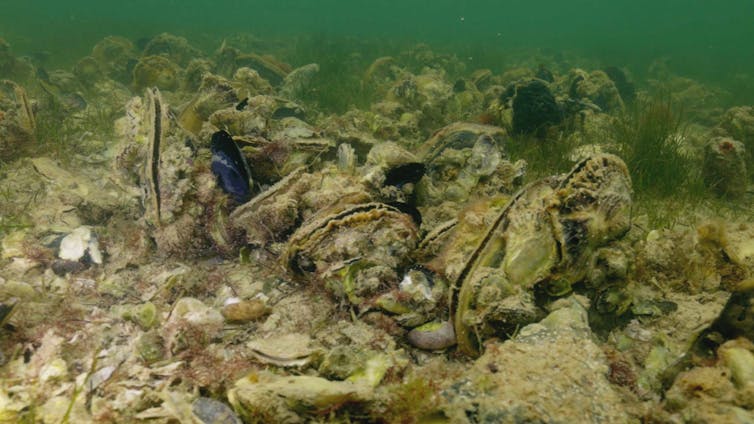
A native oyster reef in Coffin Bay, South Australia. Stefan Andrews, CC BY-ND

Future built from the past

The impact of this harmful algal bloom is real and ongoing. But in responding to it, South Australians are rediscovering a forgotten marine ecosystem. Rebuilding shellfish reefs won’t fix it — but alongside catchment management, seagrass restoration, fisheries management and improved monitoring and climate action, it is a powerful tool.

With the help of communities, reefs that were once broken, forgotten and functionally extinct, can be returned. It will take time for these reefs to support cleaner waters and richer marine life. But these community initiatives can show people that we all have a role to play in caring for coastlines.

The Conversation

Dominic McAfee receives funding from the South Australian Department for Environment and Water.

Sean Connell receives funding from The Australian Research Council and South Australian Department for Environment and Water. He is a Director of AusOcean, a non-profit organisation in South Australia that develops and deploys open-source, low-cost marine technology to help solve ocean science and conservation challenges.

Read the full story here.
Photos courtesy of

Tijuana River sewage still pollutes the San Diego Coast. She’s fighting to clean it up

The Tijuana River’s sewage contamination continues to sicken communities in southern San Diego County. San Diego County Supervisor Paloma Aguirre has become a leading force in pushing for binational fixes and emergency funding to protect public health.

In summary The Tijuana River’s sewage contamination continues to sicken communities in southern San Diego County. San Diego County Supervisor Paloma Aguirre has become a leading force in pushing for binational fixes and emergency funding to protect public health. Hours after a November storm, the Tijuana River flooded a grove of trees in Imperial Beach, gushed through a row of calverts and exploded into mounds of fetid foam.  This is ground zero for the contaminated river, which sickens thousands of people in southern San Diego County. “The Tijuana River is one of, if not the most polluted, river in the entire United States,” said San Diego County Supervisor Paloma Aguirre, who viewed the overflowing river wearing black rain boots and a hot pink respirator mask. “The river is carrying dangerous chemicals, pollutants, pathogens and toxic gases that are impacting South San Diego communities.” The site, known as the Saturn Boulevard hot spot, is part of a system of polluted waterways and failed sewage treatment plants in the cross-border region. In the ocean, the contamination leaves swimmers and surfers with breathing problems, digestive illness and rashes. Unsafe conditions have closed parts of the Imperial Beach shoreline for three years. Last year, researchers discovered that the pollution is airborne as well. Foul-smelling hydrogen sulfide emissions near the river sometimes rise hundreds of times higher than the state’s odor threshold. At those levels the gas triggers headaches, nausea, eye irritation and respiratory distress. And there are other chemicals, viruses and bacteria in the mix.  For children, the effects are worse, said Tom Csanadi, an Imperial Beach physician who has been active in the issue. Their lung surface area to body size is higher, which means they absorb more toxins. Children breathe faster than adults and they’re still growing, so it can affect their body tissues more severely. There are 11 schools within three kilometers of the hot spot. “It could lower IQ, stunt cognitive development,” Csanadi said. As a surfer, activist and elected leader, Aguirre has spent two decades tackling this problem, which she considers one of the worst environmental crises in the country. “She’s been at the forefront of the advocacy side of this for a long, long time, before her political career even started,” said Falk Feddersen, an oceanographer with Scripps Institution of Oceanography who has mapped sewage flows up the coast from Mexico. A cocktail of chemicals While storm water seeped across the road at the hot spot, a swiftwater rescue truck drove through puddles, scanning for stranded motorists. The culverts under the crossing were installed to keep flooding under control, but they also churn the water, spewing noxious gas and other pollutants.  “The unintended consequence is that it’s exacerbating the release of all the molecules and aerosols into the air,” Aguirre said. “It’s literally rocketing them into the environment.” Hydrogen sulfide, with its distinctive rotten egg odor, is an indicator of that toxic brew, said Kim Prather, an atmospheric chemist at Scripps Institution of Oceanography. She raised the alarm about airborne pollution from the Tijuana River last year. Flooding caused by the Tijuana River covers a section of Saturn Boulevard after a rainy day in San Diego on Nov. 21, 2025. Photo by Adriana Heldiz, CalMatters Layers of foam caused by sewage and chemicals bubble up along a section of the Tijuana River after a rainy day in San Diego on Nov. 21, 2025. Photo by Adriana Heldiz, CalMatters Layers of foam caused by sewage and chemicals bubble up along a section of the Tijuana River after a rainy day in San Diego on Nov. 21, 2025. Photo by Adriana Heldiz, CalMatters “That’s one in a cocktail of thousands of compounds,” she said. “It’s a blessing that it smells. I know it sounds strange, but it tells you to get away.” Aguirre described her own struggles with Tijuana River pollution, including migraines, chest pain, shortness of breath, and waking in the middle of the night to an odor she likened to a “porta potty.” Recent improvements to wastewater treatment plants in the U.S. and Mexico have reduced water pollution by keeping tens of millions of gallons of sewage out of the ocean each day. Aguirre and others celebrate that news, but note the river still contaminates surrounding areas. More big upgrades are in the works on both sides of the border, but fixing the Saturn Boulevard hot spot quickly could offer immediate relief, Aguirre said. “This is a very specific and low hanging fruit that will at least begin to mitigate the amount of gases being released into the air and benefit tens of thousands of people that live here,” she said. Waves of pollution Tijuana River pollution dates back to at least the 1930s, when the U.S. and Mexican governments built the first cross-border sewage plants. As Tijuana’s population soared with its booming industry, the city’s waste outstripped its treatment systems. Plant failures and sewage spills became common in the early 2000s, along with frequent beach closures along the south San Diego coast. That’s when Aguirre encountered cross-border pollution in the surf at Imperial Beach. Growing up in Puerto Vallarta Mexico, she was used to surfing in muddy water after rains, so the discolored waves didn’t seem worrisome.  “I remember going out here in Imperial Beach while the water was chocolate brown, not knowing that it’s nothing like what I was used to, because that was sewage,” she said. She was the only one at the beach that day, except for a man posting signs stating “Clean water now.” He was Serge Dedina, executive director of the environmental group WildCoast, and he enlisted her in the fight against sewage pollution. Aguirre first volunteered for the organization and soon joined its staff. She worked there for more than a decade, while earning a master’s degree in marine biodiversity and conservation at Scripps Institution of Oceanography. At WildCoast she organized a citizens’ group, advocated for improved water testing using DNA analysis, and served on working groups for a binational agreement on cross-border pollution, called Minute 320. When Dedina was elected mayor of Imperial Beach in 2014, Aguirre saw a path to solving the sewage problem. “I thought, well, if he can do it I can do it,” she said. “And I built on the momentum that he was able to create on this issue.” San Diego County Supervisor Paloma Aguirre wears a respiratory filter mask while standing near a section of the Tijuana River in San Diego on Nov. 21, 2025. Photo by Adriana Heldiz, CalMatters A warning sign about sewage and chemical contamination is posted along the shore of Imperial Beach on Nov. 21, 2025. Photo by Adriana Heldiz, CalMatters Aguirre won a seat on the Imperial Beach City Council in 2018 and was elected mayor in 2022, when Dedina left office. With a bigger platform, she called on California and the federal government to declare a state of emergency over the border pollution problem and lobbied to classify the area as a Superfund site. Those efforts haven’t gained traction, but other angles yielded results. Imperial Beach sued the International Boundary and Water Commission with the city of Chula Vista and Port of San Diego in 2018, alleging that it violated the Clean Water Act and other federal laws by failing to control coastal sewage pollution. They settled the lawsuit in 2023 with a promise of more resources and binational cooperation.  “My tenure as mayor of IB really focused on advocating and working in a bipartisan fashion to secure the additional funding that was needed,” to fix cross-border pollution, she said. A person walks their dog near the Imperial Beach Pier in Imperial Beach on Nov. 21, 2025. Photo by Adriana Heldiz, CalMatters Aguirre led delegations of local officials to Washington, D.C. to drum up money for costly infrastructure upgrades needed to get the sewage problem under control. She met with White House officials in both the Biden and Trump administrations, and with lawmakers who had served as Navy SEALS and had experienced the pollution problem at BUD/S, the Navy SEAL training program in Coronado. In July, Aguirre won a special election for an open San Diego County Board of Supervisors seat. She immediately led county plans to study the health effects of cross-border pollution and asked the state for $50 million to fix the Saturn Boulevard hot spot.  “She’s moved a problem that has been stuck, when other people could not,” Prather, the Scripps atmospheric chemist, said. Sewage spills prompt quick fixes The long-standing pollution problem came under new scrutiny in 2017, when a spill from a damaged line in Mexico dumped an estimated 143 million gallons of wastewater into the Tijuana River, sending foul odors wafting through the region. That accident revealed just how dilapidated the aging infrastructure had become. “That’s one of the reasons why things are so horrific, because they’re playing catch up on fixing these things when they have catastrophic failures,” said Feddersen, the Scripps oceanographer. In early 2022, another major spill released hundreds of millions of gallons of sewage-tainted water across the border for two and a half weeks.  That summer, San Diego congress members freed up more than $300 million that had been authorized for wastewater treatment upgrades through the United States-Mexico-Canada Agreement. Mexico committed $144 million to replace failing sewage treatment facilities in Tijuana, with an updated treaty between the two countries known as Minute 328. In 2024, the lawmakers persuaded the Biden administration to add another $370 million to repair the aging South Bay International Wastewater Treatment Plant near the border, Rep. Scott Peters said. After decades of deterioration, major improvements came online this year. The South Bay International Wastewater Treatment Plant, which was barely operable, is now fully functioning and expanded its capacity from 25 million to 35 million gallons of wastewater per day. The project was expected to take two years, but was completed in 100 days, according to the U.S. International Boundary and Water Commission. An aerial view shows a treated wastewater river heading to the Pacific Ocean near Real Del Mar in Tijuana, Baja California, Mexico on Aug. 12, 2025. Photo by Guillermo Arias, AFP via Getty Images By the end of next year that will climb to 50 million gallons per day, with higher capacity for peak wastewater surges. The commission, which manages the wastewater systems, has spent $122 million on the first series fixes, and the full project will cost $650 million. Although the Trump administration has clawed back federal funding for many projects, it has doubled down on the cross-border sewage problem, Aguirre said. In July U.S. Environmental Protection Agency Administrator Lee Zeldin met with his Mexican counterpart to seal the environmental deal. In April Mexico repaired its Punta Bandera plant, located on the coast about six miles south of the border. The plant had failed completely in 2020 and was dumping raw sewage into the ocean. It now handles 18 million gallons of wastewater per day. That’s a big boost for beach safety, said Feddersen, whose research tracked the flow of sewage in ocean currents and modeled scenarios for reducing it. “The best bang for the buck, the greatest reduction in beach closure and reduction in human illness, was fixing Punta Bandera,” he said. Yet, the Tijuana River still threatens residents in its watershed with untreated sewage and industrial chemicals from maquiladoras in Tijuana. That includes solvents, heavy metals and toxins known as PFAS, or “forever chemicals,” Prather said. “The river right now is a wastewater treatment plant without any processing,” she said. Removing the culverts would eliminate the turbulence that sprays out hydrogen sulfide and other toxins. The county plans to finish a feasibility study on the project by January. That project would keep contaminants out of the air, but not out of the water. Aguirre also wants new infrastructure to clean up the Tijuana River on the U.S. side. The recent binational Treaty, Minute 328, includes that option, and the International Boundary and Water Commission is exploring what it would take to divert and treat the river flows. There’s no funding for the project yet, but Aguirre says it’s on her agenda. “Rivers are diverted up and down,” she said.  “It’s doable. Is it expensive? Yes. Are our lives in South San Diego worth it? Yes.”

Germophobes Can Breathe Easy On Airplanes, In Hospitals, Experts Say

By Dennis Thompson HealthDay ReporterFRIDAY, Dec. 5, 2025 (HealthDay News) — Germophobes can breathe a little easier when visiting a hospital...

By Dennis Thompson HealthDay ReporterFRIDAY, Dec. 5, 2025 (HealthDay News) — Germophobes can breathe a little easier when visiting a hospital or taking an airplane trip, a new study says.The ambient air on planes and in hospitals mostly contains harmless microbes typically associated with human skin, researchers reported Dec. 4 in the journal Microbiome.The cutting-edge study analyzed germ samples captured on the outer surface of face masks worn by air travelers and health care workers, researchers said.“We realized that we could use face masks as a cheap, easy air-sampling device for personal exposures and general exposures,” senior researcher Erica Hartmann, an associate professor of civil and environmental engineering at Northwestern University in Evanston, Illinois, said in a news release.“We extracted DNA from those masks and examined the types of bacteria found there,” Hartmann said.Overall, the team analyzed germs drawn from masks worn by 10 air travelers and 12 health care professionals. Travelers turned in their masks following a flight, hospital workers following a shift.Researchers also analyzed germs captured by an aircraft cabin filter that had been used for more than 8,000 hours.Overall, the team found 407 distinct species of microbes.“Somewhat unsurprisingly, the bacteria were the types that we would typically associate with indoor air,” Hartmann said. “Indoor air looks like indoor air, which also looks like human skin.”A few potentially disease-causing germs did show up, but they were in extremely low amounts and without signs of active infection, researchers said.Hartmann’s team came up with the study idea in January 2022, amid the COVID pandemic.“At the time, there was a serious concern about COVID transmission on planes,” Hartmann said. “HEPA filters on planes filter the air with incredibly high efficiency, so we thought it would be a great way to capture everything in the air.”“But these filters are not like the filters in our cars or homes,” Hartmann added. “They cost thousands of dollars and, in order to remove them, workers have to pull the airplane out of service for maintenance. This obviously costs an incredible amount of money, and that was eye opening.”To beef up their project, the team turned to a much cheaper alternative: face masks.They also decided to include hospitals as another study locale.“As a comparison group, we thought about another population of people who were likely wearing masks anyway,” Hartmann said. “We landed on health care providers.”The results indicate that people themselves are the main source of airborne microbes in enclosed settings, and that most of the germs come from people’s skin rather than from any illnesses, researchers said.Although the results show indoor air is relatively safe, researchers noted that infectious germs also spread through other routes — most importantly, touch.“For this study, we solely looked at what’s in the air,” Hartmann said. “Hand hygiene remains an effective way to prevent diseases transmission from surfaces. We were interested in what people are exposed to via air, even if they are washing their hands.”SOURCES: Northwestern University, news release, Dec. 3, 2025; Microbiome, Dec. 4, 2025Copyright © 2025 HealthDay. All rights reserved.

The Case for Growth

For the past few years, American politics have been organized around a simple, unnerving feeling: Life is getting too expensive, and no one seems to know what to do about it. Rent and home prices feel out of reach. Child care feels like it costs as much as a second mortgage. Groceries, utilities, and health […]

For the past few years, American politics have been organized around a simple, unnerving feeling: Life is getting too expensive, and no one seems to know what to do about it. Rent and home prices feel out of reach. Child care feels like it costs as much as a second mortgage. Groceries, utilities, and health care have all climbed faster than people’s paychecks. Politicians have reached for familiar tools — blaming corporate “greedflation,” flirting with price controls and tariffs, promising to “take on” whoever is convenient in an election year — but none of that gets to the deeper question: How do we make it genuinely easier to build, to work, and to live well in America? For most of this country’s history, we thought we knew the answer: growth. That means a bigger economy, higher productivity, cheaper and cleaner energy, new technology, and more people able to participate in all of the above. Growth was the background assumption — not a panacea, but the thing that made every other problem a little easier to solve.  Then, beginning in the 1970s, that consensus started to break. Economic growth slowed. Concerns about inequality, consumerism, and environmental damage mounted. A certain anti-growth mentality took root on both the left and the right, and “more” became something to be eyed with suspicion rather than embraced and steered. There were real reasons people were wary of a political project organized around “more” — the environmental damage of fossil fuels, the experience of being left out of past booms, the sense that consumerism had filled our lives with stuff instead of meaning. But, in overcorrecting for the very real mistakes of the past, the US inadvertently locked itself into a low-growth, high-friction status quo that has only made our hardest problems harder. That’s why we need to take sustainable growth seriously again, to move from zero-sum fights over who gets what slice of a fixed pie to a world where the pie is actually bigger. Not growth at all costs, but growth the smart way. That is the animating idea behind this project, The Case for Growth. Over the coming weeks, in explainers, features, and podcast episodes, we’ll look at why our most productive cities have been effectively locking out families and what it would take to open them up. We’ll imagine what an era of clean energy abundance could unlock, from vertical farming to sci-fi climate solutions. We’ll explore how advances in artificial intelligence might finally shake us out of a prolonged productivity slump and how our addiction to cars and meat is choking off more sustainable growth. We’ll talk to experts who make the case that growth can run side by side with policies that prevent the worst of global warming.  In an era when so much of our politics has been reduced to zero-sum arguments over who loses so someone else can win, we want to reopen the possibility of positive-sum progress — of building more; inventing more; and including more people in that story, while taking care of the planet. Growth won’t solve everything, but without it, almost nothing gets solved at scale. The Case for Growth is our attempt to put that idea back into conservation as part of a serious effort to make life more affordable, more sustainable, and more abundant in the US and far beyond. This series was supported by a grant from Arnold Ventures. Vox had full discretion over the content of this reporting. Cities made a bet on millennials — but forgot one key thing We can have growth while fighting climate change The long, fun list of things we could do with unlimited clean energy Why owning a house is overrated The massive stakes of the big federal housing bill, explained

Suggested Viewing

Join us to forge
a sustainable future

Our team is always growing.
Become a partner, volunteer, sponsor, or intern today.
Let us know how you would like to get involved!

CONTACT US

sign up for our mailing list to stay informed on the latest films and environmental headlines.

Subscribers receive a free day pass for streaming Cinema Verde.
Thank you! Your submission has been received!
Oops! Something went wrong while submitting the form.