

Trail Cameras in Vermont Captured Something Strange: Moths Sipping a Moose's Tears
Trail Cameras in Vermont Captured Something Strange: Moths Sipping a Moose’s Tears Tear-drinking, known as lachryphagy, has mostly been observed in the tropics, so scientists were somewhat surprised to find the unusual behavior so far north Sarah Kuta - Daily Correspondent December 16, 2025 8:49 a.m. A trail camera in Vermont captured 80 photos of moths fluttering around a moose's head, likely slurping up its tears. Vermont Fish and Wildlife Department Laurence Clarfeld was sifting through images captured by a trail camera in Vermont when he came across a photo that stopped him in his tracks. Clarfeld, an environmental scientist at the University of Vermont, knew he was looking at a moose. But, beyond that, he was totally perplexed. “It almost looked like the moose had two [additional] eyes,” he tells Scientific American’s Gennaro Tomma. When he flipped through more photos in the sequence, Clarfeld finally understood what he was seeing: Moths were sipping tears straight from the ungulate’s eyes. Scientists have observed this unusual phenomenon, known as lachryphagy, among other types of animals. But, as far as anyone knows, the photos represent the first documented evidence of moths drinking moose tears. Clarfeld and his colleagues describe the encounter in a new paper published November 20 in the journal Ecosphere. Moths seen drinking moose tears for first time ever The photos were captured in the early morning hours of June 19, 2024, in the Green Mountain National Forest, a large swath of protected woodlands in southern Vermont. Researchers had deployed them as part of an ongoing wildlife survey by the Vermont Fish and Wildlife Department. In total, the camera captured 80 snapshots of the moths fluttering around a moose’s head. The photos don’t specifically show the moths’ proboscises, the long, slender, straw-like mouthparts they use to suck nectar from flowers. But lachryphagy is the “most plausible explanation,” the researchers write in the paper. Roughly a year later, a colleague captured video footage that appeared to show the same thing—moths hovering around a moose’s eyes, per Scientific American. Scientists have previously observed moths, bees and butterflies feeding on the tears of other animals. They’ve documented solitary bees drinking the tears of yellow-spotted river turtles in Ecuador, stingless bees harvesting human tears in Thailand, erebid moths feasting on the tears of ringed kingfishers in Colombia and erebid moths slurping up the tears of sleeping black-chinned antbirds in Brazil. But most of these instances have occurred in subtropical and tropical regions. Only one known case of lachryphagy has been documented outside the tropics, according to the researchers: a moth eating the tears of a horse in Arkansas. At first, researcher Laurence Clarfeld didn't know what he was seeing when he spotted moths hovering around a moose's eyes. Vermont Fish and Wildlife Department It may be that lachryphagy is simply more common in the tropics. But it’s also possible that “not a lot of scientists are looking in [other] places,” Akito Kawahara, an entomologist at the Florida Museum of Natural History who was not involved with the research, tells Scientific American. Why do moths and other insects feed on tears? It’s not entirely clear, but scientists suspect they may be seeking out certain essential nutrients, like sodium, during periods when those substances may be harder to find elsewhere. They may also be looking for protein boost. Insects typically get protein from plant nectar, but tears may be a handy backup. “Vertebrate fluids are the main alternative source for obtaining proteins,” Leandro Moraes, a biologist at the University of São Paulo who observed tear-feeding moths in Brazil, told National Geographic’s Sandrine Ceurstemont in 2018. Did you know? Resourceful insects Aside from tears, butterflies and moths have been known to take advantage of whatever resources are available, gathering up nutrient-rich liquids in and around soil, feces and carrion, including sweat and blood. Scientists call this feeding behavior “puddling.” Though lachryphagy appears to be relatively rare in nature, researchers still want to learn more about this unusual behavior. The tear drinker obviously benefits, but what about the tear supplier? For now, the relationship appears to be fairly one-sided—and might even be harmful to the host. In moose, for instance, eye-visiting moths could be transmitting pathogens that cause keratoconjunctivitis, which can lead to eye lesions and “significant health impacts,” the researchers write in the paper. For now, though, that’s just a hypothesis. Now that tear-drinking has been observed outside its typical range, the researchers are curious to know where else this behavior might be taking place, and among which other species. They’re encouraging wildlife scientists to keep an eye out because lachryphagy might ultimately be “more widespread than the lack of past records would suggest,” they write. Get the latest stories in your inbox every weekday.
Tear-drinking, known as lachryphagy, has mostly been observed in the tropics, so scientists were somewhat surprised to find the unusual behavior so far north
Trail Cameras in Vermont Captured Something Strange: Moths Sipping a Moose’s Tears
Tear-drinking, known as lachryphagy, has mostly been observed in the tropics, so scientists were somewhat surprised to find the unusual behavior so far north
Sarah Kuta - Daily Correspondent

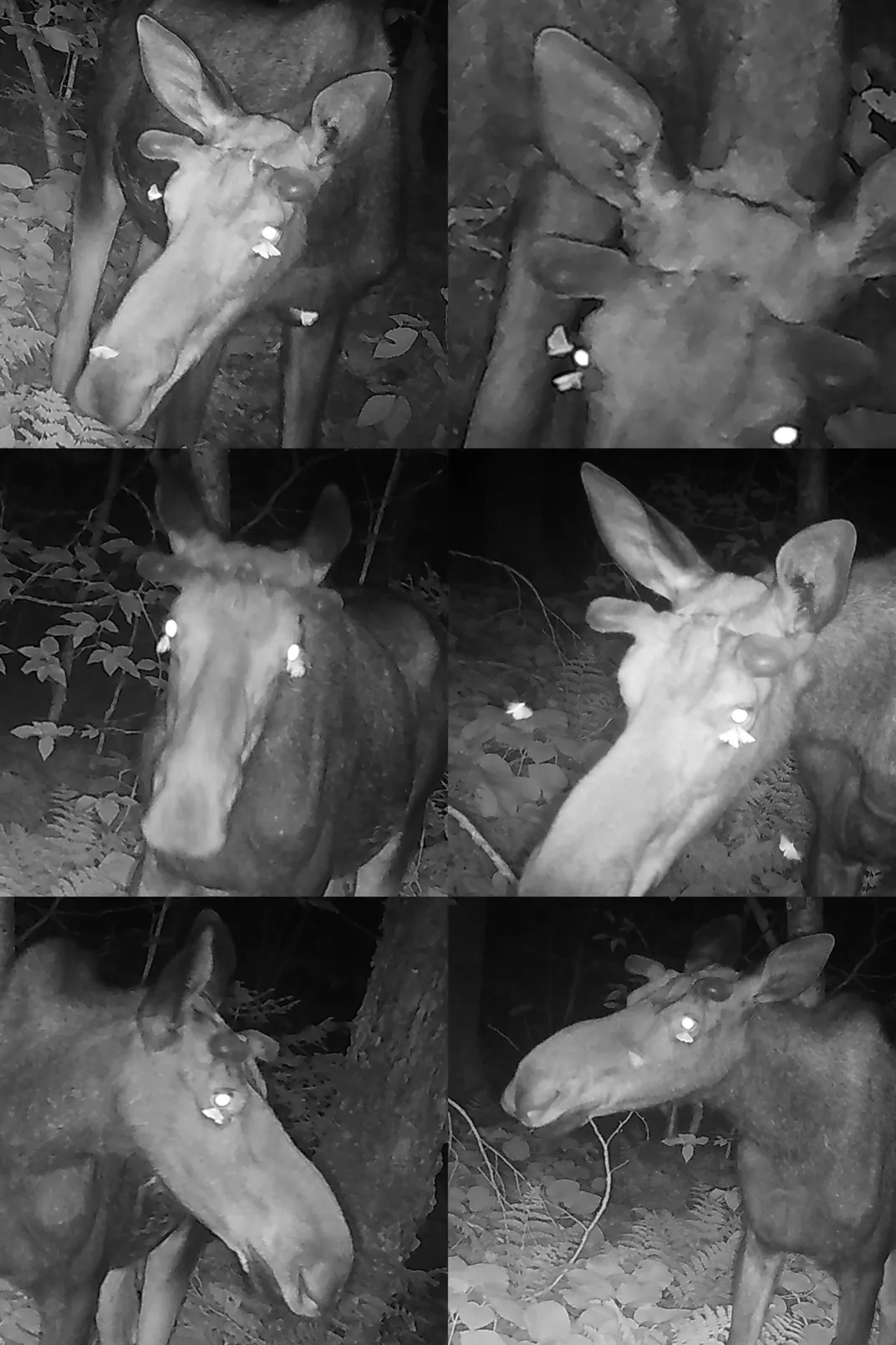
Laurence Clarfeld was sifting through images captured by a trail camera in Vermont when he came across a photo that stopped him in his tracks.
Clarfeld, an environmental scientist at the University of Vermont, knew he was looking at a moose. But, beyond that, he was totally perplexed. “It almost looked like the moose had two [additional] eyes,” he tells Scientific American’s Gennaro Tomma.
When he flipped through more photos in the sequence, Clarfeld finally understood what he was seeing: Moths were sipping tears straight from the ungulate’s eyes.
Scientists have observed this unusual phenomenon, known as lachryphagy, among other types of animals. But, as far as anyone knows, the photos represent the first documented evidence of moths drinking moose tears. Clarfeld and his colleagues describe the encounter in a new paper published November 20 in the journal Ecosphere.
Moths seen drinking moose tears for first time ever
The photos were captured in the early morning hours of June 19, 2024, in the Green Mountain National Forest, a large swath of protected woodlands in southern Vermont. Researchers had deployed them as part of an ongoing wildlife survey by the Vermont Fish and Wildlife Department. In total, the camera captured 80 snapshots of the moths fluttering around a moose’s head.
The photos don’t specifically show the moths’ proboscises, the long, slender, straw-like mouthparts they use to suck nectar from flowers. But lachryphagy is the “most plausible explanation,” the researchers write in the paper.
Roughly a year later, a colleague captured video footage that appeared to show the same thing—moths hovering around a moose’s eyes, per Scientific American.
Scientists have previously observed moths, bees and butterflies feeding on the tears of other animals. They’ve documented solitary bees drinking the tears of yellow-spotted river turtles in Ecuador, stingless bees harvesting human tears in Thailand, erebid moths feasting on the tears of ringed kingfishers in Colombia and erebid moths slurping up the tears of sleeping black-chinned antbirds in Brazil.
But most of these instances have occurred in subtropical and tropical regions. Only one known case of lachryphagy has been documented outside the tropics, according to the researchers: a moth eating the tears of a horse in Arkansas.
It may be that lachryphagy is simply more common in the tropics. But it’s also possible that “not a lot of scientists are looking in [other] places,” Akito Kawahara, an entomologist at the Florida Museum of Natural History who was not involved with the research, tells Scientific American.
Why do moths and other insects feed on tears? It’s not entirely clear, but scientists suspect they may be seeking out certain essential nutrients, like sodium, during periods when those substances may be harder to find elsewhere.
They may also be looking for protein boost. Insects typically get protein from plant nectar, but tears may be a handy backup. “Vertebrate fluids are the main alternative source for obtaining proteins,” Leandro Moraes, a biologist at the University of São Paulo who observed tear-feeding moths in Brazil, told National Geographic’s Sandrine Ceurstemont in 2018.
Did you know? Resourceful insects
Aside from tears, butterflies and moths have been known to take advantage of whatever resources are available, gathering up nutrient-rich liquids in and around soil, feces and carrion, including sweat and blood. Scientists call this feeding behavior “puddling.”
Though lachryphagy appears to be relatively rare in nature, researchers still want to learn more about this unusual behavior. The tear drinker obviously benefits, but what about the tear supplier? For now, the relationship appears to be fairly one-sided—and might even be harmful to the host. In moose, for instance, eye-visiting moths could be transmitting pathogens that cause keratoconjunctivitis, which can lead to eye lesions and “significant health impacts,” the researchers write in the paper. For now, though, that’s just a hypothesis.
Now that tear-drinking has been observed outside its typical range, the researchers are curious to know where else this behavior might be taking place, and among which other species. They’re encouraging wildlife scientists to keep an eye out because lachryphagy might ultimately be “more widespread than the lack of past records would suggest,” they write.