

Data centers are the desert’s thirsty new neighbor
Words by Annie Rosenthal | Edited by Kate SchimelSunland Park, New Mexico, is not a notably online community. Retirees have settled in mobile homes around the small border town, just over the state line from El Paso. Some don’t own computers — they make their way to the air-conditioned public library when they need to look something up.Soon, though, the local economy could center around the internet: County officials have approved up to $165 billion in industrial revenue bonds to help developers build a sprawling data center campus just down the road.“Project Jupiter” is the latest in a tidal wave of data center projects popping up across the country. Once built, the giant buildings full of computer hardware work 24/7 to power artificial intelligence and web searches for tech companies. Developers BorderPlex Digital Assets and STACK Infrastructure have been the public faces of Project Jupiter — but last week, after local officials voted to support the effort, tech giants OpenAI, Oracle, and SoftBank revealed that they’ll be the clients for the campus. In a press release, they announced that the project is part of their Stargate initiative, which includes plans to invest $500 billion in new AI infrastructure in the next few years. The agreement approved by Doña Ana County commissioners on September 19 will allow developers to avoid paying property taxes on Project Jupiter for 30 years. In exchange, the companies are pledging $360 million in payments to the county over that period — plus more than $50 million for local infrastructure improvements. They say they’ll hire 2,500 people to build the campus, starting later this year, and then 750 for permanent roles, all prioritizing locals.That’s a big deal for Doña Ana County. Here, where the Rio Grande peels away from the Mexican border, a quarter of the population lives below the poverty line. Sunland Park’s most prominent business is a racetrack and casino complex that looks out on a long string of strip malls leading into the desert below Mount Cristo Rey. To the west, the small town of Santa Teresa — the proposed home for Project Jupiter — has worked for decades to court development around its port of entry to rural Chihuahua.But in a few short weeks, the deal has generated intense controversy. Like the residents of dozens of other U.S. communities facing the arrival of a data center, many in Doña Ana County are wary. A large data center could use millions of gallons of drinking water a day to keep its equipment cool, and the industry already accounts for more than 4% of total U.S. electricity consumption in a given year.Project Jupiter’s developers have promised to build their own microgrid and said they’ll use a small fraction of that water, but residents are urging caution.Residents of Sunland Park, New Mexico, gathered in August at the local library to discuss the effects that a proposed $165 billion data center might have on their community. Photo by Alberto Silva Fernandez/Puente News Collaborative & High Country NewsPalabraIn late August, about 15 people from Sunland Park and organizers from the nonprofit Empowerment Congress of Doña Ana County met at the library to discuss the proposal. “I don’t understand much of the technology,” said attendee Alma Márquez, in Spanish. “But we have a lot of basic needs here in Sunland Park.”The city started as a group of colonias — unplanned settlements that emerged along the border in the 1980s and ’90s when developers sold off plots for low prices, often without ensuring that residents would have basic services. Decades later, people here and in Santa Teresa are still struggling to access clean water.“This thing that’s coming consumes a lot of power, a lot of water,” Márquez said. “What’s going to happen with us, with that water we need (to be) clean?” Looking around the room, she asked, “And why here?”Santa Teresa has long harbored dreams of becoming a hub for cross-border industry. BorderPlex Digital says its location on the edge of two states and two countries makes it a particularly attractive place to invest. “We firmly believe that the next wave of frontier tech belongs on the American frontier,” the company’s CEO said in a press release.But the county’s colonia residents aren’t convinced. Even as their leaders give developers the green light, they’re joining a growing number of communities around the country that see data centers as a threat, not a boon.‘I don’t want a PowerPoint presentation that just says, ‘Don’t worry, we’re not going to use that much water.’ And I think the community deserves to know.’The proposed site for Project Jupiter is a flat stretch of scrub along the highway just north of the port of entry. Its closest neighbors include a set of industrial parks built to complement the maquiladoras across the border, and a new solar plant where thousands of panels point skyward.As data centers proliferate, many are landing in rural or exurban areas like this, where open space abounds. And local leaders are often eager to welcome them. When Gov. Michelle Luján Grisham first announced a partnership with BorderPlex Digital in February, she called it an opportunity to “position New Mexico as a leader in digital infrastructure.” In the same press release, Davin López, president of the Mesilla Valley Economic Development Alliance, wrote that Project Jupiter is “precisely the type of development we’ve been working to attract — one that leverages innovation to strengthen our position as a key player in global trade.”In the earliest phases of the AI boom, such developments were often quietly approved, with limited public input or outcry. But that’s changing. Data Center Watch, an industry research firm, has counted $64 billion of data center projects that have been delayed or paused in just two years amid local opposition.Construction near a housing development in Santa Teresa, New Mexico, not far from the proposed site for “Project Jupiter.” Photo by Alberto Silva Fernandez/Puente News Collaborative & High Country NewsPalabraProtests started in Virginia, currently the data center capital of the world. But as the industry moves west, it’s facing increasing backlash in states from Texas to Oregon to California. In Cascade Locks, Oregon, voters recalled two local officials for supporting a $100 million data center. In Mesa, Arizona, the city government just passed new regulations restricting data center construction. The California legislature is currently considering multiple bills focused on data center energy use.As the research group Data Center Watch notes, opposition cuts across party lines, with frustrated neighbors criticizing everything from tax breaks and rising utility costs to noise pollution and decreasing property values. In the arid Borderlands, water use tops the list of concerns. This summer, when Amazon attempted to quietly push through a massive data center near Tucson, hundreds of people showed up to city council meetings, bearing pamphlets that said, “Protect our water future.”In Doña Ana County, the opposition has been led by colonia residents focused on an already too-dry present. In early 2024, after residents reported slimy water coming from their taps, a state investigation found dozens of violations by the Camino Real Regional Utility Authority (CRRUA) — including evidence that the utility had been bypassing arsenic treatment for over a year, selling contaminated water to more than 19,000 customers. The county has since announced plans to end its relationship with CRRUA, and the state has sued the utility over a decade of mismanagement. But residents cite continued issues with their water: yellow discoloration, sediment in the stream, and taps that barely drip despite escalating bills.Paulina Reyna speaks at a gathering of Doña Ana County residents in Sunland Park. Photo by Alberto Silva Fernandez/Puente News Collaborative & High Country NewsPalabraAt the library in Sunland Park, Joe Anthony Martínez, 76, pointed to scars on his neck, where a surgeon removed skin cancer that he believes was caused by the water. Unwilling to trust the tap, he and his wife have spent years paying for filtered water. Now, as the county and city work towards establishing a new utility system, they worry that even if the water improves, it will go to the data center.“We don’t want any of that,” Martínez said in Spanish. “What we want is quality water.”As concerns about data centers’ resource use gain traction, the industry is working quickly to demonstrate its environmental consciousness. BorderPlex Digital says Project Jupiter will minimize water use by employing a cooling system that recycles water, rather than the more traditional system that evaporates it. A company spokesperson said in an email that their partner firm, STACK, currently operates data centers in Oregon using the same technology. “The closed-loop cooling system requires only a one-time fill-up and will therefore limit ongoing water use to domestic needs of employees (similar to an office building with 750 employees),” he wrote. According to documents detailing the agreement between developers and the county, “ongoing operations” for the campus will rely on treated drinking water provided by the county and CRRUA, the utility that county officials plan to replace. In a public meeting, developers said that the initial fill would require about 10 million gallons of water, and that the system would use 7.2 million gallons annually. Daily water use for the campus will average around 20,000 gallons a day, capped at 60,000. Daisy Maldonado, director of the civic engagement group Empowerment Congress, remains skeptical. “I want scientific reports about how a closed-loop system works and what is the level of water evaporation and recharge needed every year,” she said. “I don’t want a PowerPoint presentation that just says, ‘Don’t worry, we’re not going to use that much water.’ And I think the community deserves to know.”Empowerment Congress director Daisy Maldonado says she is concerned that the massive infrastructure complex will cause more issues with the local water supply. Photo by Alberto Silva Fernandez/Puente News Collaborative & High Country NewsPalabraWhile the state of New Mexico announced the BorderPlex Digital partnership in February, many in Doña Ana County didn’t learn about Project Jupiter until details of the plan were unveiled in late August, just weeks before commissioners planned a final vote on the bond proposal.At a county meeting on August 26, commissioners tried to assuage residents’ concerns. “One of the things that we insist on as part of this discussion is that … this data center is not going to have a negative impact on the water situation down in Santa Teresa and in Sunland Park,” County Commissioner Shannon Reynolds said, according to El Paso Matters. “If it does, then I promise you, we will be on top of it.”Over the following weeks, however, local tensions around the project rose. Early last month, Reynolds posted on Facebook the names of dozens of people who submitted public comments in opposition to the project.In a press release, the New Mexico Environmental Law Center called the post “An act of intimidation intended to deter participation and silence community members exercising their right to participate in public and government processes.” Reynolds did not respond to a request for comment, but said on Facebook that he was naming the residents to thank them publicly.Leading up to the scheduled vote, developers launched a website outlining their pitch and hosted a series of community meetings around the county. Dozens of people showed up to ask questions — and as the public hearing neared, residents on both sides of the issue pushed for more time to get answers. On September 16, the city of Sunland Park joined calls to delay the vote, saying its leaders hadn’t had a chance to fully assess the proposal.But developers reportedly said postponing the decision would mean losing the development altogether. On September 19, after hours of heated debate in public comment and multiple requests from one commissioner to delay, county commissioners went ahead with the vote, approving the bond proposal 4-1.To Daisy Maldonado, the decision wasn’t a surprise — but it did feel like a betrayal. She said she had hoped the county would ask more questions about the kinds of development it seeks. Driving down McNutt Road, the main thoroughfare through Sunland Park, she pointed out more than a dozen cannabis dispensaries. A total of 43 have filled vacant storefronts and warehouses in the city since New Mexico legalized the drug in 2021, catering to customers from across the state line.“You know how many grocery stores are in the city of Sunland Park, in Santa Teresa?” she asked. “It might be one. For a community of almost 20,000 people.”She sighed.“So how is New Mexico taking care of its residents? They’re failing the people in Sunland Park, in Santa Teresa, because all they can see is the dollar signs.”—Annie Rosenthal is the Virginia Spencer Davis fellow at High Country News, where she covers migration, rural communities, and life in the borderlands. She was previously the border reporter at Marfa Public Radio, and her work has appeared in or on NPR, Marketplace, Politico Magazine, and the Washington Post, among other publications. She’s based in Marfa, Texas. @AnnieRosenthal8Alberto Silva Fernandez is a bilingual photojournalist based in El Paso, Texas. He has worked at the student newspaper The Prospector as the Photo Editor and as Editor in Chief, and was a photojournalism intern with the El Paso Times from April 2023 to December 2023. His coverage of events includes the Aug. 3rd, 2019, Walmart mass shooting, and high school and collegiate sports. His goal is to capture moments of his community through photography, and to continue the efforts of honest and passionate journalism. @albert.sf08Kate Schimel is the news and investigations editor at High Country News. She lives in Bozeman, Montana. @kateschimelIf you purchase a product or register for an account through a link on our site, we may receive compensation. By using this site, you consent to our User Agreement and agree that your clicks, interactions, and personal information may be collected, recorded, and/or stored by us and social media and other third-party partners in accordance with our Privacy Policy.
In arid New Mexico, a massive data center campus promises jobs, but residents fear it will drain their most precious resource: water
Words by Annie Rosenthal | Edited by Kate Schimel
Sunland Park, New Mexico, is not a notably online community. Retirees have settled in mobile homes around the small border town, just over the state line from El Paso. Some don’t own computers — they make their way to the air-conditioned public library when they need to look something up.
Soon, though, the local economy could center around the internet: County officials have approved up to $165 billion in industrial revenue bonds to help developers build a sprawling data center campus just down the road.
“Project Jupiter” is the latest in a tidal wave of data center projects popping up across the country. Once built, the giant buildings full of computer hardware work 24/7 to power artificial intelligence and web searches for tech companies. Developers BorderPlex Digital Assets and STACK Infrastructure have been the public faces of Project Jupiter — but last week, after local officials voted to support the effort, tech giants OpenAI, Oracle, and SoftBank revealed that they’ll be the clients for the campus. In a press release, they announced that the project is part of their Stargate initiative, which includes plans to invest $500 billion in new AI infrastructure in the next few years.
The agreement approved by Doña Ana County commissioners on September 19 will allow developers to avoid paying property taxes on Project Jupiter for 30 years. In exchange, the companies are pledging $360 million in payments to the county over that period — plus more than $50 million for local infrastructure improvements. They say they’ll hire 2,500 people to build the campus, starting later this year, and then 750 for permanent roles, all prioritizing locals.
That’s a big deal for Doña Ana County. Here, where the Rio Grande peels away from the Mexican border, a quarter of the population lives below the poverty line. Sunland Park’s most prominent business is a racetrack and casino complex that looks out on a long string of strip malls leading into the desert below Mount Cristo Rey. To the west, the small town of Santa Teresa — the proposed home for Project Jupiter — has worked for decades to court development around its port of entry to rural Chihuahua.
But in a few short weeks, the deal has generated intense controversy. Like the residents of dozens of other U.S. communities facing the arrival of a data center, many in Doña Ana County are wary. A large data center could use millions of gallons of drinking water a day to keep its equipment cool, and the industry already accounts for more than 4% of total U.S. electricity consumption in a given year.
Project Jupiter’s developers have promised to build their own microgrid and said they’ll use a small fraction of that water, but residents are urging caution.

In late August, about 15 people from Sunland Park and organizers from the nonprofit Empowerment Congress of Doña Ana County met at the library to discuss the proposal. “I don’t understand much of the technology,” said attendee Alma Márquez, in Spanish. “But we have a lot of basic needs here in Sunland Park.”
The city started as a group of colonias — unplanned settlements that emerged along the border in the 1980s and ’90s when developers sold off plots for low prices, often without ensuring that residents would have basic services. Decades later, people here and in Santa Teresa are still struggling to access clean water.
“This thing that’s coming consumes a lot of power, a lot of water,” Márquez said. “What’s going to happen with us, with that water we need (to be) clean?” Looking around the room, she asked, “And why here?”
Santa Teresa has long harbored dreams of becoming a hub for cross-border industry. BorderPlex Digital says its location on the edge of two states and two countries makes it a particularly attractive place to invest. “We firmly believe that the next wave of frontier tech belongs on the American frontier,” the company’s CEO said in a press release.
But the county’s colonia residents aren’t convinced. Even as their leaders give developers the green light, they’re joining a growing number of communities around the country that see data centers as a threat, not a boon.
‘I don’t want a PowerPoint presentation that just says, ‘Don’t worry, we’re not going to use that much water.’ And I think the community deserves to know.’
The proposed site for Project Jupiter is a flat stretch of scrub along the highway just north of the port of entry. Its closest neighbors include a set of industrial parks built to complement the maquiladoras across the border, and a new solar plant where thousands of panels point skyward.
As data centers proliferate, many are landing in rural or exurban areas like this, where open space abounds. And local leaders are often eager to welcome them. When Gov. Michelle Luján Grisham first announced a partnership with BorderPlex Digital in February, she called it an opportunity to “position New Mexico as a leader in digital infrastructure.” In the same press release, Davin López, president of the Mesilla Valley Economic Development Alliance, wrote that Project Jupiter is “precisely the type of development we’ve been working to attract — one that leverages innovation to strengthen our position as a key player in global trade.”
In the earliest phases of the AI boom, such developments were often quietly approved, with limited public input or outcry. But that’s changing. Data Center Watch, an industry research firm, has counted $64 billion of data center projects that have been delayed or paused in just two years amid local opposition.
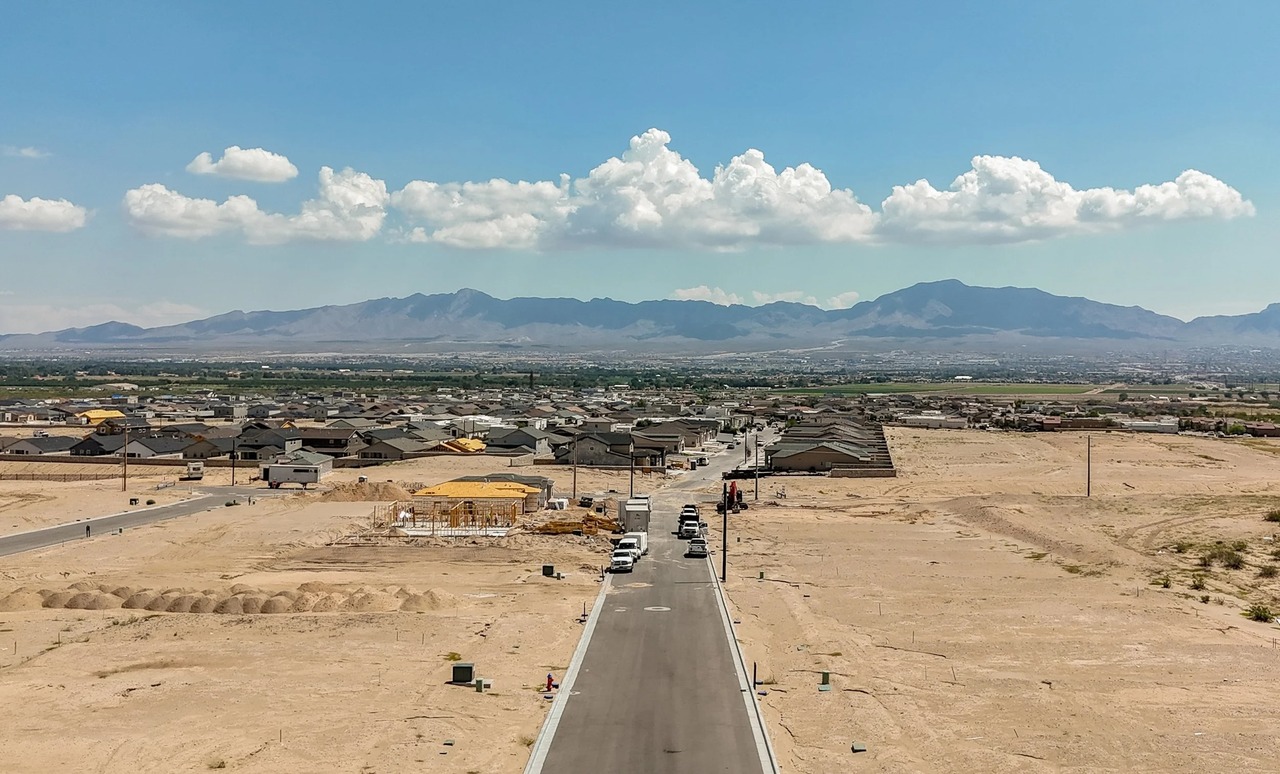
Protests started in Virginia, currently the data center capital of the world. But as the industry moves west, it’s facing increasing backlash in states from Texas to Oregon to California. In Cascade Locks, Oregon, voters recalled two local officials for supporting a $100 million data center. In Mesa, Arizona, the city government just passed new regulations restricting data center construction. The California legislature is currently considering multiple bills focused on data center energy use.
As the research group Data Center Watch notes, opposition cuts across party lines, with frustrated neighbors criticizing everything from tax breaks and rising utility costs to noise pollution and decreasing property values. In the arid Borderlands, water use tops the list of concerns. This summer, when Amazon attempted to quietly push through a massive data center near Tucson, hundreds of people showed up to city council meetings, bearing pamphlets that said, “Protect our water future.”
In Doña Ana County, the opposition has been led by colonia residents focused on an already too-dry present. In early 2024, after residents reported slimy water coming from their taps, a state investigation found dozens of violations by the Camino Real Regional Utility Authority (CRRUA) — including evidence that the utility had been bypassing arsenic treatment for over a year, selling contaminated water to more than 19,000 customers. The county has since announced plans to end its relationship with CRRUA, and the state has sued the utility over a decade of mismanagement. But residents cite continued issues with their water: yellow discoloration, sediment in the stream, and taps that barely drip despite escalating bills.

At the library in Sunland Park, Joe Anthony Martínez, 76, pointed to scars on his neck, where a surgeon removed skin cancer that he believes was caused by the water. Unwilling to trust the tap, he and his wife have spent years paying for filtered water. Now, as the county and city work towards establishing a new utility system, they worry that even if the water improves, it will go to the data center.
“We don’t want any of that,” Martínez said in Spanish. “What we want is quality water.”
As concerns about data centers’ resource use gain traction, the industry is working quickly to demonstrate its environmental consciousness. BorderPlex Digital says Project Jupiter will minimize water use by employing a cooling system that recycles water, rather than the more traditional system that evaporates it. A company spokesperson said in an email that their partner firm, STACK, currently operates data centers in Oregon using the same technology.
“The closed-loop cooling system requires only a one-time fill-up and will therefore limit ongoing water use to domestic needs of employees (similar to an office building with 750 employees),” he wrote.
According to documents detailing the agreement between developers and the county, “ongoing operations” for the campus will rely on treated drinking water provided by the county and CRRUA, the utility that county officials plan to replace.
In a public meeting, developers said that the initial fill would require about 10 million gallons of water, and that the system would use 7.2 million gallons annually. Daily water use for the campus will average around 20,000 gallons a day, capped at 60,000.
Daisy Maldonado, director of the civic engagement group Empowerment Congress, remains skeptical. “I want scientific reports about how a closed-loop system works and what is the level of water evaporation and recharge needed every year,” she said. “I don’t want a PowerPoint presentation that just says, ‘Don’t worry, we’re not going to use that much water.’ And I think the community deserves to know.”

While the state of New Mexico announced the BorderPlex Digital partnership in February, many in Doña Ana County didn’t learn about Project Jupiter until details of the plan were unveiled in late August, just weeks before commissioners planned a final vote on the bond proposal.
At a county meeting on August 26, commissioners tried to assuage residents’ concerns. “One of the things that we insist on as part of this discussion is that … this data center is not going to have a negative impact on the water situation down in Santa Teresa and in Sunland Park,” County Commissioner Shannon Reynolds said, according to El Paso Matters. “If it does, then I promise you, we will be on top of it.”
Over the following weeks, however, local tensions around the project rose. Early last month, Reynolds posted on Facebook the names of dozens of people who submitted public comments in opposition to the project.
In a press release, the New Mexico Environmental Law Center called the post “An act of intimidation intended to deter participation and silence community members exercising their right to participate in public and government processes.” Reynolds did not respond to a request for comment, but said on Facebook that he was naming the residents to thank them publicly.
Leading up to the scheduled vote, developers launched a website outlining their pitch and hosted a series of community meetings around the county. Dozens of people showed up to ask questions — and as the public hearing neared, residents on both sides of the issue pushed for more time to get answers. On September 16, the city of Sunland Park joined calls to delay the vote, saying its leaders hadn’t had a chance to fully assess the proposal.
But developers reportedly said postponing the decision would mean losing the development altogether. On September 19, after hours of heated debate in public comment and multiple requests from one commissioner to delay, county commissioners went ahead with the vote, approving the bond proposal 4-1.
To Daisy Maldonado, the decision wasn’t a surprise — but it did feel like a betrayal. She said she had hoped the county would ask more questions about the kinds of development it seeks. Driving down McNutt Road, the main thoroughfare through Sunland Park, she pointed out more than a dozen cannabis dispensaries. A total of 43 have filled vacant storefronts and warehouses in the city since New Mexico legalized the drug in 2021, catering to customers from across the state line.
“You know how many grocery stores are in the city of Sunland Park, in Santa Teresa?” she asked. “It might be one. For a community of almost 20,000 people.”
She sighed.
“So how is New Mexico taking care of its residents? They’re failing the people in Sunland Park, in Santa Teresa, because all they can see is the dollar signs.”
—
Annie Rosenthal is the Virginia Spencer Davis fellow at High Country News, where she covers migration, rural communities, and life in the borderlands. She was previously the border reporter at Marfa Public Radio, and her work has appeared in or on NPR, Marketplace, Politico Magazine, and the Washington Post, among other publications. She’s based in Marfa, Texas. @AnnieRosenthal8
Alberto Silva Fernandez is a bilingual photojournalist based in El Paso, Texas. He has worked at the student newspaper The Prospector as the Photo Editor and as Editor in Chief, and was a photojournalism intern with the El Paso Times from April 2023 to December 2023. His coverage of events includes the Aug. 3rd, 2019, Walmart mass shooting, and high school and collegiate sports. His goal is to capture moments of his community through photography, and to continue the efforts of honest and passionate journalism. @albert.sf08
Kate Schimel is the news and investigations editor at High Country News. She lives in Bozeman, Montana. @kateschimel
If you purchase a product or register for an account through a link on our site, we may receive compensation. By using this site, you consent to our User Agreement and agree that your clicks, interactions, and personal information may be collected, recorded, and/or stored by us and social media and other third-party partners in accordance with our Privacy Policy.