Cookies help us run our site more efficiently.

By clicking “Accept”, you agree to the storing of cookies on your device to enhance site navigation, analyze site usage, and assist in our marketing efforts. View our Privacy Policy for more information or to customize your cookie preferences.

California wildlife officials quietly shift on killing a high-profile predator

News Feed
Wednesday, December 10, 2025

In a move that reverses nearly a decade of practice, California wildlife officials have quietly begun to allow killing mountain lions in order to protect another iconic native — bighorn sheep.Though limited to the Eastern Sierra — the steep, rugged home of a rare type of the wild sheep — it marks a sea change for California, where legislators and voters have heaped protections on the big, charismatic cats that suffered decades of persecution.It’s a complex story — a lesson in ecosystems that involves three linked species and efforts to do right by all of them.While some are thrilled, many are dismayed. Some think it’s the wrong tack while others say it doesn’t go far enough to safeguard yet another beloved animal: deer. The policy change came into relief recently. In the craggy Sierra Nevada mountains, late last year, a male lion hunted down several bighorn. They GPS-collared him and he killed another sheep.He was young enough that he hadn’t started breeding or fully established a home range, so wildlife officials caught him and hauled him to what was supposed to be his new home.But about six months later, he wandered back to sheep country and killed again.So this summer they put him down by lethal injection, according to Tom Stephenson, who leads the Sierra Nevada bighorn recovery program for the California Department of Fish and Wildlife.How we got hereThe moment lies at the intersection of politics and biology. And it wouldn’t have happened without an important Eastern Sierra contingent — hunters.In February of last year, Brian Tillemans submitted a petition to the California Fish and Game Commission spotlighting concerns about dwindling numbers of Eastern Sierra mule deer, as well as bighorn sheep. The local hunter, who is also a former watershed resource manager for the L.A. Department of Water and Power, told commissioners the mountain lion population had “exploded” in the region. Hundreds of area residents signed the petition. Brian Tillemans, a hunter and former watershed resource manager for the L.A. Department of Water and Power, sits outside the town of Bishop, near Mt. Tom, in an area where Sierra Nevada bighorn visit. (Jason Armond / Los Angeles Times) “The emotional biopolitics of protecting mountain lions is leading to the demise of two iconic species,” Tillemans told commissioners. His plea hit a nerve. It sparked a series of discussions that led the state to revise its approach to managing lions.Mountain lions in California are a “specially protected species” and it’s illegal to hunt them for sport. But they can be lawfully killed in limited situations. One is when the hefty cats are threatening Sierra Nevada bighorn, one of two subspecies of the sheep that live in the Golden State. (The other type, desert bighorn, prefer the arid Mojave Desert and mountains of Southern California over snowy Sierra peaks.) California lawmakers gave that right to state wildlife officials in 1999, the same year Sierra Nevada bighorn landed on the federal endangered species list.In 2017 though, wildlife officials stopped killing lions preying on sheep and began relocating them instead, Stephenson said. That has turned out to be successful for female lions and young ones. But males that have already established a home range proved tougher. They try their darndest to return to their mates. In what would become a highly publicized fail, two male lions from the Eastern Sierra died after being trucked more than 200 miles to a remote area of the desert.Bighorn, it seemed, were left vulnerable. Sierra Nevada bighorn began to recover after being listed as federally endangered in the late 1990s, but recent severe winters knocked the population down. At such low numbers, lions can take a heavy toll on them. (Stephen Osman / Los Angeles Times ) By the time bighorn sheep were listed under the Endangered Species Act, they had been driven to the brink of extinction by decades of hunting and diseases spread by domestic sheep. Once protected, they began to make gains. But several severe winters starting in 2016 knocked the fragile population down. At such low numbers, hungry lions can devastate herds. Their total population was about 400 last year. The lions in the Eastern Sierra area, meanwhile, are doing well for themselves. There are about 70 to 80 roaming the craggy mountains, which Stephenson described as a “relatively large” number. They feed on wild horses that roam the region, which may boost their ranks. Moving lions will still be the primary protection tool when feasible. But with bighorn in a precarious way, “we just recognize that we need to do everything we can to try to get this animal recovered,” Stephenson said. So lethal removal was put back on the table.John Wehausen, an applied population ecologist who has studied bighorn for more than half a century, is thrilled by the recent policy changes. He expects the bighorn to start to bounce back. Data support the effectiveness of removing lions to help the sheep, he said.He said it’s key for the agency to act quickly to move or euthanize a lion that’s feeding on sheep, to prevent it from harming more. He believes the agency was previously sluggish, but is now moving efficiently.“I’ve as much as said to them, ‘I don’t really care how you get [the lions] out of there. You just need to get them out of there in a timely way to protect these sheep because that’s what your job is,’” he said.But Beth Pratt, California regional executive director for the National Wildlife Federation, questions whether killing lions to protect sheep makes sense. Beth Pratt, of the National Wildlife Federation, hikes just outside the eastern entrance of Yosemite National Park, near the town of Lee Vining. (Jason Armond / Los Angeles Times) “Do you keep blowing away an animal for being an animal, when it’s clearly just not working?” she said. Many people “understand that predators have a place in healthy ecosystems.”Pratt wonders if there are creative solutions, such as bolstering the sheep population by bringing in animals raised elsewhere or stationing guard dogs around the herds.Disappearing deerFor Eastern Sierra natives such as Danny McIntosh, of Bishop, a small community about a four-hour drive north of Los Angeles beloved by hunters, climbers and hikers, deer represent a way of life.McIntosh has watched mule deer since he was a kid. He’s “infatuated” with bucks, which battle each other during mating season. Around his teen years, he started photographing the animals, named for their large, mule-like ears. He’s an avid hunter and also enjoys collecting “sheds,” antlers dropped annually by deer and elk.After the severe winter of 2018, he noticed a marked decline in the deer population that he said has only worsened.That observation largely tracks with state Department of Fish and Wildlife findings. According to a 2023 paper, what’s known as the Round Valley herd dropped 33% from 2016 to 2022. “What disheartens me the most is that my children will never get to experience, on the same level as I did, flourishing deer herds and the numerous traditional activities that surround them,” McIntosh told state wildlife commissioners during a meeting in June 2024.He largely blames lions and black bears, and isn’t satisfied with the state’s willingness to kill the big cats on behalf of bighorn. Though he acknowledged it will help the sheep, it’s not expected to have a meaningful impact on deer. “It’s still not enough,” McIntosh said. “Our deer were the healthiest and the herds were the strongest when there was trapping going on and there were no restrictions.”State wildlife officials don’t have the authority to control lions for the benefit of deer. Hunters want more deer, “and if someone can’t snap their fingers and make that happen, it’s frustrating” for them, said Stephenson, the state Department of Fish and Wildlife bighorn recovery leader. “There’s a limit to how many knobs we can turn to effect any sort of rapid change. It’s a long, slow process.”According to Stephenson, it’s complicated. Yes, bears and lions snack on deer. But fires can wipe out vegetation they rely on for food, too. Harsh winters, punctuated by drought, also take a toll.When there are so many factors, it’s hard to know which are most important in influencing the population, he said.Mule deer are dwindling not just here but across the West. In September, animal tracks dot the mud in a wildlife crossing installed under Highway 395 near the Eastern Sierra community of Bridgeport. (Jason Armond / Los Angeles Times) “We’re not concerned that the deer population is going to disappear over here,” Stephenson said. “I think it’s a concern from the perspective of a hunter who wants hunting opportunities, and who has seen that hunting opportunity change over the decades.”The promise of crossingsThere may be one solution everyone can get behind — something that could offer a lifeline to mule deer without the need to knock out lions. Hunters and conservationists alike support building a wildlife crossing in the top roadkill hot spot in the Eastern Sierra — a deadly stretch of Highway 395 that runs past the Mammoth Yosemite Airport. Car collisions are the second highest cause of death for deer, not counting unknown causes. On a sunny morning in September, a dead doe lay on the side of a small road just off 395, as cars whizzed by on the artery that connects communities along the Eastern Sierra.Scavengers had so far only ripped into her backside. Tillemans, the hunter from Bishop, who provided a tour of the area, said it meant she hadn’t been dead long.From 2002 to 2018, about 675 vehicles collided with deer in less than nine miles of roadway. It’s smack dab in the middle of the migration routes for the Round Valley and Casa Diablo herds, according to a recent study.A project is underway to build safe passage for fauna here. As envisioned, two overcrossings and two undercrossings would function as bridges across four lanes of traffic. But its future depends on lining up money — a lot of it. Additional planning and construction is estimated to cost more than $65 million, according to the California Department of Transportation, which is leading the effort. Ben Carter, a senior environmental scientist with the state Department of Fish and Wildlife, looks at animal tracks at a recently completed wildlife crossing in Bridgeport called the Sonora Junction Shoulders Project. (Jason Armond / Los Angeles Times) It could save the lives of untold deer. And it may be more plausible than allowing a lion hunting season, as some would like. That would require a change in state law.“If there’s ever a spot for a deer crossing, it’s up here,” Tillemans said while driving to the proposed project area.A recently completed crossing about 70 miles to the north may offer an example of what the other one could provide.In early fall, Ben Carter checked a camera positioned to capture the goings-on in a corrugated metal tunnel installed beneath a breathtaking stretch of the 395 north of the town of Bridgeport.Carter, a senior environmental scientist with the state Department of Fish and Wildlife, had pulled the SD card for the first time to see what critters might have been early adopters of the new wildlife undercrossing — one of two constructed as part of a shoulder-widening project.Tracks told their own tale. Cloven hooves had pressed into the soft mud. Deer had been there.

California wildlife officials are now allowing mountain lions to be killed to protect endangered bighorn sheep, changing a nearly decade-long practice of just moving them.

In a move that reverses nearly a decade of practice, California wildlife officials have quietly begun to allow killing mountain lions in order to protect another iconic native — bighorn sheep.

Though limited to the Eastern Sierra — the steep, rugged home of a rare type of the wild sheep — it marks a sea change for California, where legislators and voters have heaped protections on the big, charismatic cats that suffered decades of persecution.

It’s a complex story — a lesson in ecosystems that involves three linked species and efforts to do right by all of them.

While some are thrilled, many are dismayed. Some think it’s the wrong tack while others say it doesn’t go far enough to safeguard yet another beloved animal: deer.

The policy change came into relief recently. In the craggy Sierra Nevada mountains, late last year, a male lion hunted down several bighorn. They GPS-collared him and he killed another sheep.

He was young enough that he hadn’t started breeding or fully established a home range, so wildlife officials caught him and hauled him to what was supposed to be his new home.

But about six months later, he wandered back to sheep country and killed again.

So this summer they put him down by lethal injection, according to Tom Stephenson, who leads the Sierra Nevada bighorn recovery program for the California Department of Fish and Wildlife.

How we got here

The moment lies at the intersection of politics and biology. And it wouldn’t have happened without an important Eastern Sierra contingent — hunters.

In February of last year, Brian Tillemans submitted a petition to the California Fish and Game Commission spotlighting concerns about dwindling numbers of Eastern Sierra mule deer, as well as bighorn sheep. The local hunter, who is also a former watershed resource manager for the L.A. Department of Water and Power, told commissioners the mountain lion population had “exploded” in the region. Hundreds of area residents signed the petition.
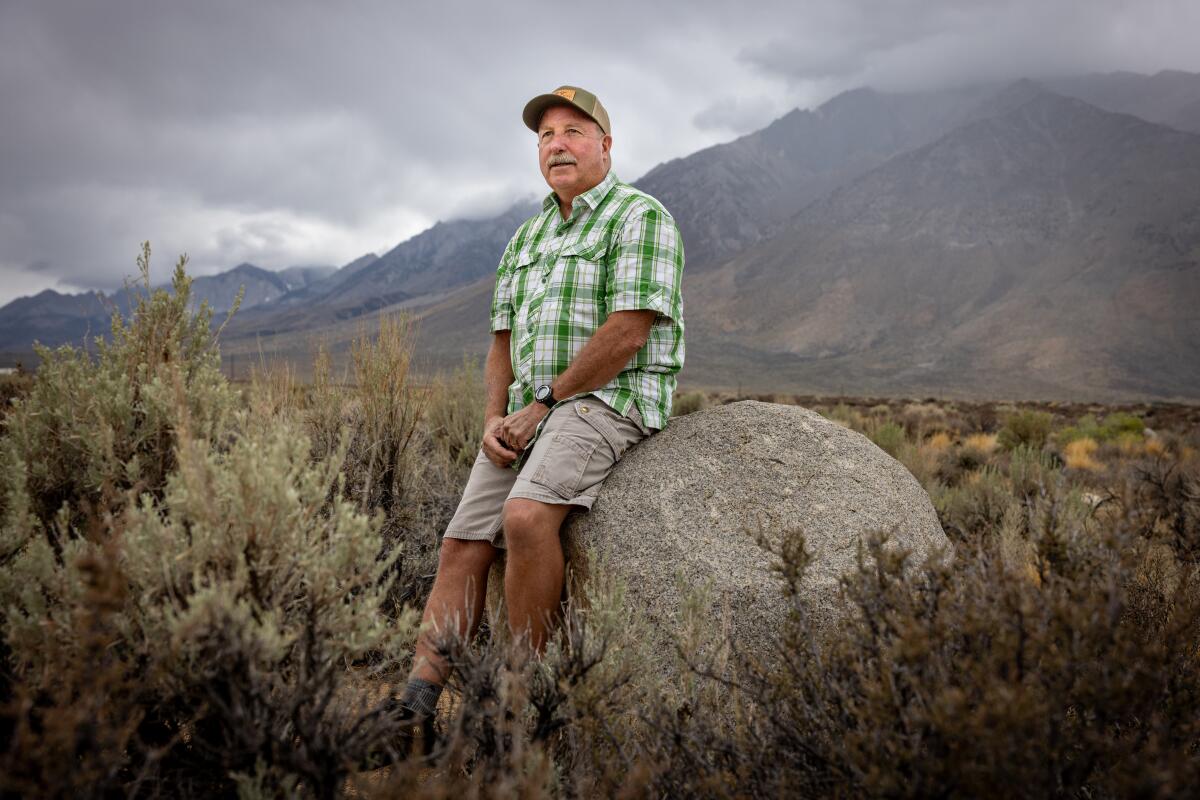
Brian Tillemans sits near Mt. Tom, in an area where bighorn visit.

Brian Tillemans, a hunter and former watershed resource manager for the L.A. Department of Water and Power, sits outside the town of Bishop, near Mt. Tom, in an area where Sierra Nevada bighorn visit.

(Jason Armond / Los Angeles Times)

“The emotional biopolitics of protecting mountain lions is leading to the demise of two iconic species,” Tillemans told commissioners. His plea hit a nerve. It sparked a series of discussions that led the state to revise its approach to managing lions.

Mountain lions in California are a “specially protected species” and it’s illegal to hunt them for sport. But they can be lawfully killed in limited situations. One is when the hefty cats are threatening Sierra Nevada bighorn, one of two subspecies of the sheep that live in the Golden State. (The other type, desert bighorn, prefer the arid Mojave Desert and mountains of Southern California over snowy Sierra peaks.)

California lawmakers gave that right to state wildlife officials in 1999, the same year Sierra Nevada bighorn landed on the federal endangered species list.

In 2017 though, wildlife officials stopped killing lions preying on sheep and began relocating them instead, Stephenson said.

That has turned out to be successful for female lions and young ones. But males that have already established a home range proved tougher. They try their darndest to return to their mates.

In what would become a highly publicized fail, two male lions from the Eastern Sierra died after being trucked more than 200 miles to a remote area of the desert.

Bighorn, it seemed, were left vulnerable.
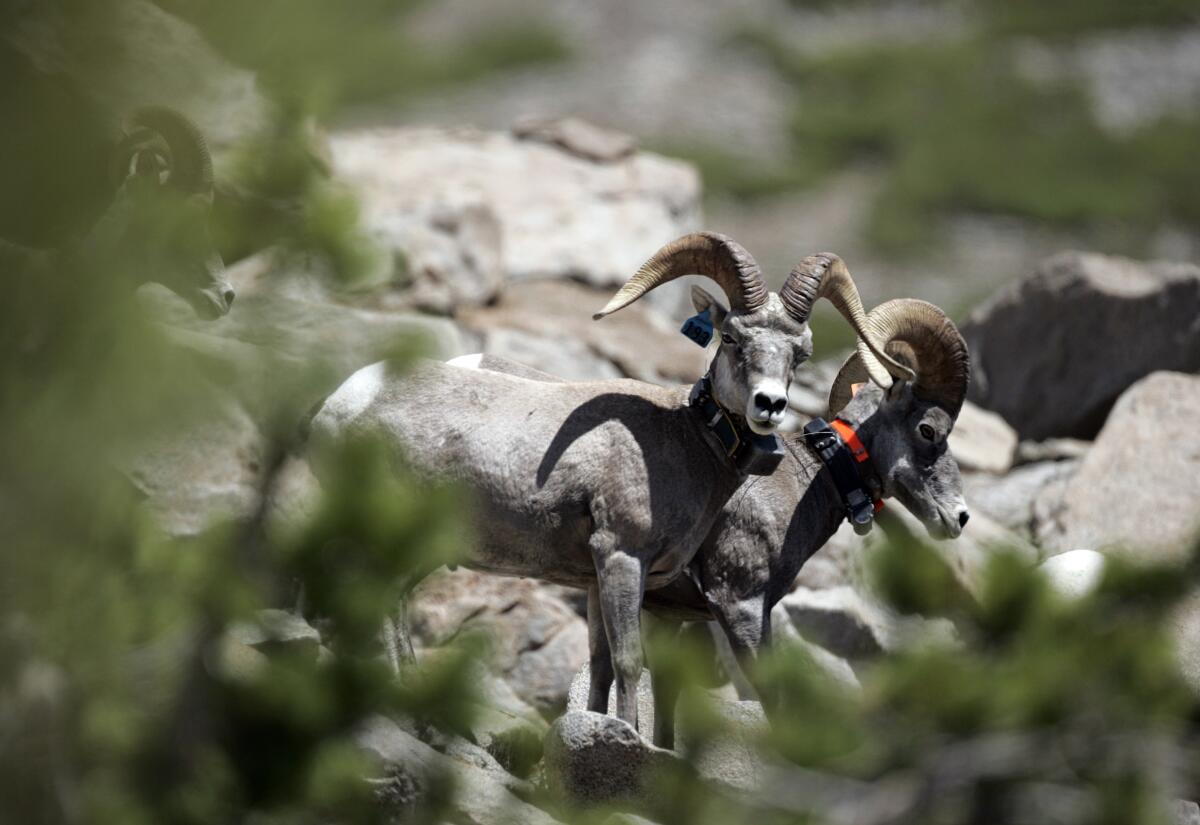
Big horn sheep near the town of Lee Vining in the Eastern Sierra

Sierra Nevada bighorn began to recover after being listed as federally endangered in the late 1990s, but recent severe winters knocked the population down. At such low numbers, lions can take a heavy toll on them.

(Stephen Osman / Los Angeles Times )

By the time bighorn sheep were listed under the Endangered Species Act, they had been driven to the brink of extinction by decades of hunting and diseases spread by domestic sheep. Once protected, they began to make gains. But several severe winters starting in 2016 knocked the fragile population down. At such low numbers, hungry lions can devastate herds. Their total population was about 400 last year.

The lions in the Eastern Sierra area, meanwhile, are doing well for themselves. There are about 70 to 80 roaming the craggy mountains, which Stephenson described as a “relatively large” number. They feed on wild horses that roam the region, which may boost their ranks.

Moving lions will still be the primary protection tool when feasible. But with bighorn in a precarious way, “we just recognize that we need to do everything we can to try to get this animal recovered,” Stephenson said. So lethal removal was put back on the table.

John Wehausen, an applied population ecologist who has studied bighorn for more than half a century, is thrilled by the recent policy changes. He expects the bighorn to start to bounce back. Data support the effectiveness of removing lions to help the sheep, he said.

He said it’s key for the agency to act quickly to move or euthanize a lion that’s feeding on sheep, to prevent it from harming more. He believes the agency was previously sluggish, but is now moving efficiently.

“I’ve as much as said to them, ‘I don’t really care how you get [the lions] out of there. You just need to get them out of there in a timely way to protect these sheep because that’s what your job is,’” he said.

But Beth Pratt, California regional executive director for the National Wildlife Federation, questions whether killing lions to protect sheep makes sense.

Beth Pratt, of the National Wildlife Federation, just outside of Yosemite National Park

Beth Pratt, of the National Wildlife Federation, hikes just outside the eastern entrance of Yosemite National Park, near the town of Lee Vining.

(Jason Armond / Los Angeles Times)

“Do you keep blowing away an animal for being an animal, when it’s clearly just not working?” she said. Many people “understand that predators have a place in healthy ecosystems.”

Pratt wonders if there are creative solutions, such as bolstering the sheep population by bringing in animals raised elsewhere or stationing guard dogs around the herds.

Disappearing deer

For Eastern Sierra natives such as Danny McIntosh, of Bishop, a small community about a four-hour drive north of Los Angeles beloved by hunters, climbers and hikers, deer represent a way of life.

McIntosh has watched mule deer since he was a kid. He’s “infatuated” with bucks, which battle each other during mating season. Around his teen years, he started photographing the animals, named for their large, mule-like ears. He’s an avid hunter and also enjoys collecting “sheds,” antlers dropped annually by deer and elk.

After the severe winter of 2018, he noticed a marked decline in the deer population that he said has only worsened.

That observation largely tracks with state Department of Fish and Wildlife findings. According to a 2023 paper, what’s known as the Round Valley herd dropped 33% from 2016 to 2022.

“What disheartens me the most is that my children will never get to experience, on the same level as I did, flourishing deer herds and the numerous traditional activities that surround them,” McIntosh told state wildlife commissioners during a meeting in June 2024.

He largely blames lions and black bears, and isn’t satisfied with the state’s willingness to kill the big cats on behalf of bighorn. Though he acknowledged it will help the sheep, it’s not expected to have a meaningful impact on deer.

“It’s still not enough,” McIntosh said. “Our deer were the healthiest and the herds were the strongest when there was trapping going on and there were no restrictions.”

State wildlife officials don’t have the authority to control lions for the benefit of deer.

Hunters want more deer, “and if someone can’t snap their fingers and make that happen, it’s frustrating” for them, said Stephenson, the state Department of Fish and Wildlife bighorn recovery leader. “There’s a limit to how many knobs we can turn to effect any sort of rapid change. It’s a long, slow process.”

According to Stephenson, it’s complicated. Yes, bears and lions snack on deer. But fires can wipe out vegetation they rely on for food, too. Harsh winters, punctuated by drought, also take a toll.

When there are so many factors, it’s hard to know which are most important in influencing the population, he said.

Mule deer are dwindling not just here but across the West.
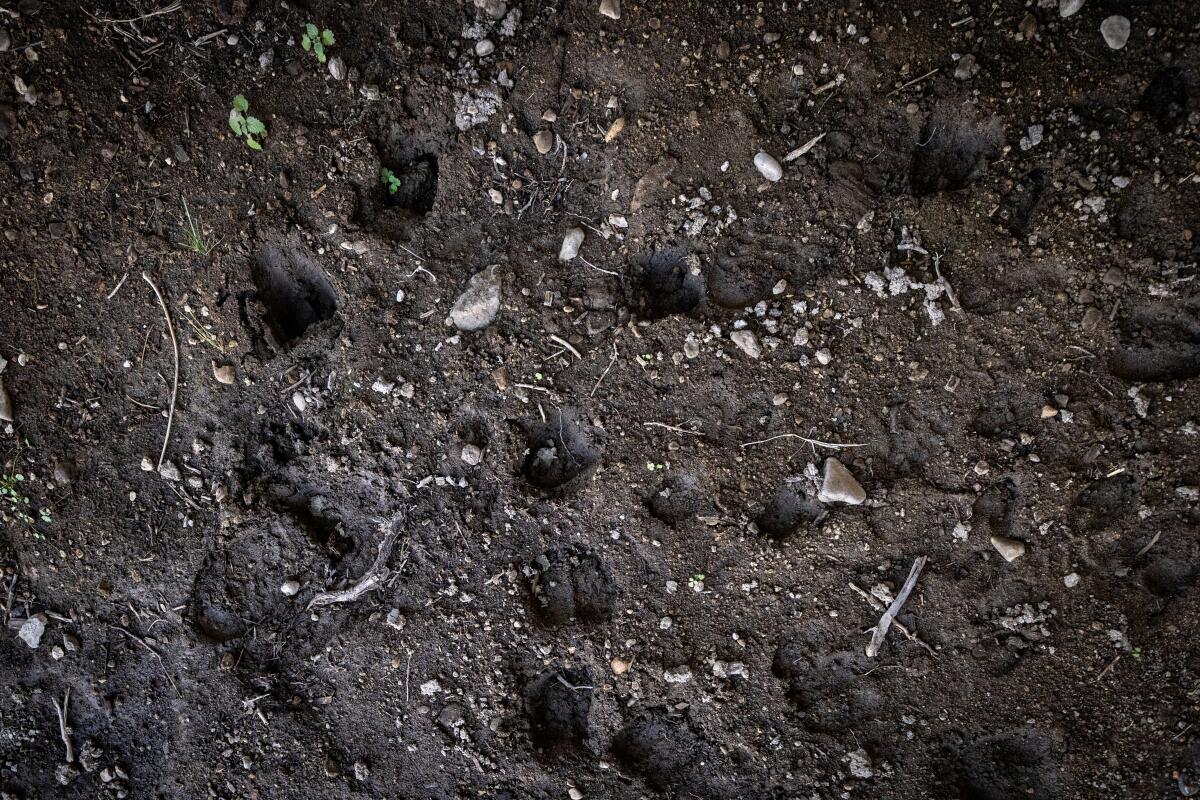
Animal tracks dot the mud in a wildlife crossing

In September, animal tracks dot the mud in a wildlife crossing installed under Highway 395 near the Eastern Sierra community of Bridgeport.

(Jason Armond / Los Angeles Times)

“We’re not concerned that the deer population is going to disappear over here,” Stephenson said. “I think it’s a concern from the perspective of a hunter who wants hunting opportunities, and who has seen that hunting opportunity change over the decades.”

The promise of crossings

There may be one solution everyone can get behind — something that could offer a lifeline to mule deer without the need to knock out lions.

Hunters and conservationists alike support building a wildlife crossing in the top roadkill hot spot in the Eastern Sierra — a deadly stretch of Highway 395 that runs past the Mammoth Yosemite Airport. Car collisions are the second highest cause of death for deer, not counting unknown causes.

On a sunny morning in September, a dead doe lay on the side of a small road just off 395, as cars whizzed by on the artery that connects communities along the Eastern Sierra.

Scavengers had so far only ripped into her backside. Tillemans, the hunter from Bishop, who provided a tour of the area, said it meant she hadn’t been dead long.

From 2002 to 2018, about 675 vehicles collided with deer in less than nine miles of roadway. It’s smack dab in the middle of the migration routes for the Round Valley and Casa Diablo herds, according to a recent study.

A project is underway to build safe passage for fauna here. As envisioned, two overcrossings and two undercrossings would function as bridges across four lanes of traffic. But its future depends on lining up money — a lot of it. Additional planning and construction is estimated to cost more than $65 million, according to the California Department of Transportation, which is leading the effort.
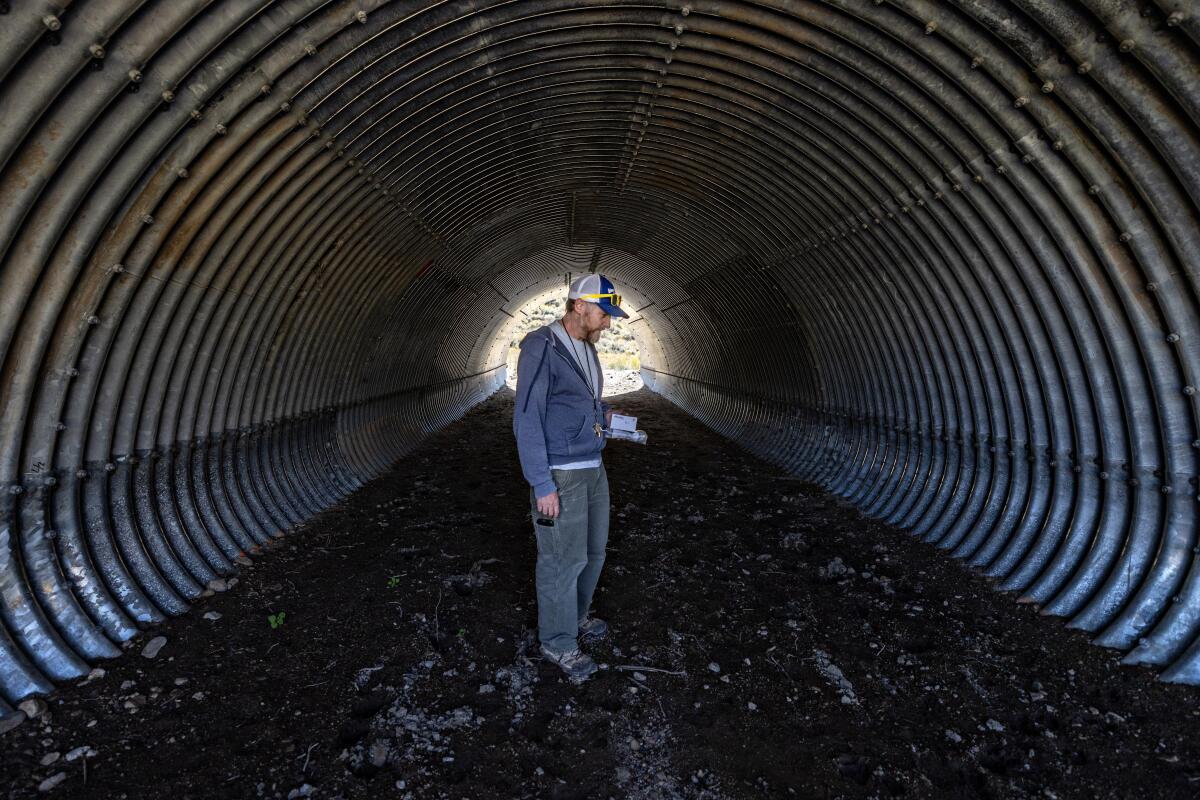
A man looking at animal tracks at a wildlife crossing

Ben Carter, a senior environmental scientist with the state Department of Fish and Wildlife, looks at animal tracks at a recently completed wildlife crossing in Bridgeport called the Sonora Junction Shoulders Project.

(Jason Armond / Los Angeles Times)

It could save the lives of untold deer. And it may be more plausible than allowing a lion hunting season, as some would like. That would require a change in state law.

“If there’s ever a spot for a deer crossing, it’s up here,” Tillemans said while driving to the proposed project area.

A recently completed crossing about 70 miles to the north may offer an example of what the other one could provide.

In early fall, Ben Carter checked a camera positioned to capture the goings-on in a corrugated metal tunnel installed beneath a breathtaking stretch of the 395 north of the town of Bridgeport.

Carter, a senior environmental scientist with the state Department of Fish and Wildlife, had pulled the SD card for the first time to see what critters might have been early adopters of the new wildlife undercrossing — one of two constructed as part of a shoulder-widening project.

Tracks told their own tale. Cloven hooves had pressed into the soft mud. Deer had been there.

Read the full story here.
Photos courtesy of

Colorado has wolves again for the first time in 80 years. Why are they dying?

On a sunny morning two years ago, a group of state officials stood in the mountains of northwestern Colorado in front of a handful of large metal crates. With a small crowd watching them, the officials began to unlatch the crate doors one by one. Out of each came a gray wolf — arguably the […]

Wildlife officials release five gray wolves on public land in northwestern Colorado on December 18, 2023. | Jerry Neal/Colorado Parks and Wildlife On a sunny morning two years ago, a group of state officials stood in the mountains of northwestern Colorado in front of a handful of large metal crates. With a small crowd watching them, the officials began to unlatch the crate doors one by one. Out of each came a gray wolf — arguably the nation’s most controversial endangered species.  This was a massive moment for conservation.  While gray wolves once ranged throughout much of the Lower 48, a government-backed extermination campaign wiped most of them out in the 19th and 20th centuries. By the 1940s, Colorado had lost all of its resident wolves.  But, in the fall of 2020, Colorado voters did something unprecedented: They passed a ballot measure to reintroduce gray wolves to the state. This wasn’t just about having wolves on the landscape to admire, but about restoring the ecosystems that we’ve broken and the biodiversity we’ve lost. As apex predators, wolves help keep an entire ecosystem in balance, in part by limiting populations of deer and elk that can damage vegetation, spread disease, and cause car accidents.  In the winter of 2023, state officials released 10 gray wolves flown in from Oregon onto public land in northwestern Colorado. And in January of this year, they introduced another 15 that were brought in from Canada. Colorado Parks and Wildlife (CPW) — the state wildlife agency leading the reintroduction program — plans to release 30 to 50 wolves over three to five years to establish a permanent breeding population that can eventually survive without intervention.  “Today, history was made in Colorado,” Colorado Governor Jared Polis said following the release. “For the first time since the 1940s, the howl of wolves will officially return to western Colorado.” Fast forward to today, and that program seems, at least on the surface, like a mess. Ten of the transplanted wolves are already dead, as is one of their offspring. And now, the state is struggling to find new wolves to ship to Colorado for the next phase of reintroduction. Meanwhile, the program has cost millions of dollars more than expected.  The takeaway is not that releasing wolves in Colorado was, or is now, a bad idea. Rather, the challenges facing this first-of-its-kind reintroduction just reveal how extraordinarily difficult it is to restore top predators to a landscape dominated by humans. That’s true in the Western US and everywhere — especially when the animal in question has been vilified for generations.  Why 10 of the reintroduced wolves are already dead One harsh reality is that a lot of wolves die naturally, such as from disease, killing each other over territory, and other predators, said Joanna Lambert, a wildlife ecologist at the University of Colorado Boulder. Of Colorado’s new population, one of the released wolves was killed by another wolf, whereas two were likely killed by mountain lions, according to Colorado Parks and Wildlife.  The changes that humans have made to the landscape only make it harder for these animals to survive. One of the animals, a male found dead in May, was likely killed by a car, state officials said. Another died after stepping into a coyote foothold trap. Two other wolves, meanwhile, were killed, ironically, by officials. Officials from CPW shot and killed one wolf — the offspring of a released individual — in Colorado, and the US Department of Agriculture killed another that traveled into Wyoming, after linking the wolves to livestock attacks. (An obscure USDA division called Wildlife Services kills hundreds of thousands, and sometimes millions, of wild animals a year that it deems dangerous to humans or industry, as my colleague Kenny Torella has reported.)  Yet, another wolf was killed after trekking into Wyoming, a state where it’s largely legal to kill them. Colorado Parks and Wildlife has, to its credit, tried hard to stop wolves from harming farm animals. The agency has hired livestock patrols called “range riders,” for example, to protect herds. But these solutions are imperfect, especially when the landscape is blanketed in ranchland. Wolves still kill sheep and cattle.  This same conflict — or the perception of it — is what has complicated other attempts to bring back predators, such as jaguars in Arizona and grizzly bears in Washington. And wolves are arguably even more contentious. “This was not ever going to be easy,” Lambert said of the reintroduction program.  Colorado is struggling to find more wolves to ship in  There’s another problem: Colorado doesn’t have access to more wolves.  The state is planning to release another 10 to 15 animals early next year. And initially, those wolves were going to come from Canada. But in October, the Trump administration told CPW that it can only import wolves from certain regions of the US. Brian Nesvik, director of the US Fish and Wildlife Service, a federal agency that oversees endangered species, said that a federal regulation governing Colorado’s gray wolf population doesn’t explicitly allow CPW to source wolves from Canada. (Environmental legal groups disagree with his claim). So Colorado turned to Washington state for wolves instead.  But that didn’t work either. Earlier this month, Washington state wildlife officials voted against exporting some of their wolves to Colorado. Washington has more than 200 gray wolves, but the most recent count showed a population decline. That’s one reason why officials were hesitant to support a plan that would further shrink the state’s wolf numbers, especially because there’s a chance they may die in Colorado.  Some other states home to gray wolves, such as Montana and Wyoming, have previously said they won’t give Colorado any of their animals for reasons that are not entirely clear. Nonetheless, Colorado is still preparing to release wolves this winter as it looks for alternative sources, according to CPW spokesperson Luke Perkins.  Ultimately, Lambert said, it’s going to take years to be able to say with any kind of certainty whether or not the reintroduction program was successful.  “This is a long game,” she said.  And despite the program’s challenges, there’s at least one reason to suspect it’s working: puppies. Over the summer, CPW shared footage from a trail camera of three wolf puppies stumbling over their giant paws, itching, and play-biting each other. CPW says there are now four litters in Colorado, a sign that the predators are settling in and making a home for themselves. View this post on Instagram “This reproduction is really key,” Eric Odell, wolf conservation program manager for Colorado Parks and Wildlife, said in a public meeting in July. “Despite some things that you may hear, not all aspects of wolf management have been a failure. We’re working towards success.”

Selfies as William begins Brazil visit for environment prize

The prince has key environmental work planned with the Earthshot Prize and a speech at the COP30 summit - but started with a cable car trip up Sugarloaf Mountain.

Sugarloaf selfies as William begins Brazil visitDaniela Relph,Senior royal correspondent, Rio de Janeiro and John HandPA MediaPrince William found time to pose with members of the public who gathered at Sugarloaf MountainThe Prince of Wales was presented with the keys to Rio de Janeiro as he began a five-day visit to Brazil.Prince William was on the city's Sugarloaf Mountain, with a bird's eye view of the iconic Christ the Redeemer statue, as he received the honour from the city's mayor, Eduardo Paes.The prince had travelled to the top of the mountain by cable car, to the surprise of several groups of tourists queuing to travel up the mountain. As he came down again, he posed for selfies with several of the people who had waited to catch a glimpse of him.He is visiting Brazil for the first time with two key environmental missions. On Wednesday he is presenting the Earthshot Prize, the annual award from the charity he set up himself.The following day he will travel to Belem, in the Amazon rainforest, where he is scheduled to deliver a speech as part of COP30, the annual UN climate meeting where governments discuss how to limit and prepare for further climate change.PA MediaThe prince received the award of the keys to Rio from Mayor Eduardo Paes at a helipad platform on Sugarloaf Mountain...PA Media...but it is only a wider shot of the same moment that shows the majestic background of the city those symbolic keys represent.It is the first time that Prince William has travelled internationally for a COP summit, as his father, King Charles, has previously led the way for the royals, making several keynote speeches to world leaders over the years.Prince William did attend, along with his father, when it was held in Glasgow 2021, two weeks after the first Earthshot Prize.The prize annually awards a £1m grant in five different categories for projects that aim to repair the world's climate - and Prince William has committed himself to it for10 years, with Rio marking a halfway point for the venture.This year's shortlist includes an upcycled skyscraper in Sydney, the entire island of Barbados and a Bristol based company that filters microplastics from washing machines.When he announced the nominees, the prince spoke of the optimism and courage he was looking for."The people behind these projects are heroes of our time, so let us back them. Because, if we do, we can make the world cleaner, safer and full of opportunity - not only for future generations, but for the lives we want to lead now."PA MediaPrince William's first visit to Brazil was scheduled for five days to give him the chance to carry out other engagements before his more formal duties later in the weekAfter the ceremony, Mayor Paes said Prince William has been "amazed with the beauty of the city" and he joked: "So he's got the keys, he can do whatever he wants in the next 72 hours. The city belongs to Prince William. I'm still the king, but it will belong to him!"Prince William's visit to Rio de Janeiro is the most significant royal engagement he will make this year and also mark the first time he will be seen representing the Royal Family since the crisis surrounding his uncle Andrew.There has been speculation that Prince William was heavily involved in the King's announcement last week to sanction Andrew by removing his remaining titles and asking him to leave his home in Windsor - but those close to the situation say that was not the case. Although William would have had a powerful, influential voice as the future monarch, the decision was ultimately the King's working with his private team of advisers and in conjunction with the government.PA MediaCafu lined up 142 times for his national team and moved to Italy to play for Roma and AC Milan in the second half of his illustrious careerThe visit to Brazil will include the two key environment-based events but will also allow him to take in some of Rio's other famous sights.As an avid football fan and chairman of the English Football Association, it was no surprise that a pilgrimage was arranged on his first day to the Maracana Stadium, the stage of some of the football-mad nation's most famous moments.Once there, he was greeted by the player who wore the yellow and green kit more than any other, Brazil's most capped-star Cafu, who presented him with a signed number 2 Brazil shirt.The legendary right back, who is the only player in history to appear in three World Cup finals, was scheduled to join the prince leading training drills involving local children. Cafu has also agreed to be one of the star presenters of the Earthshot Prize, alongside former F1 driver Sebastian Vettel, Olympic gymnast Rebeca Andrade and Brazilian environmental activist Txai Suruí.

How El Jefe, the Lone Arizona Jaguar Who Captivated a Nation in 2016, Became a 'Rock Star'

Once called “America’s last jaguar,” the solitary male wandered across the southern border in 2011 and became the centerpiece of a campaign to protect habitat in the Santa Rita Mountains

How El Jefe, the Lone Arizona Jaguar Who Captivated a Nation in 2016, Became a ‘Rock Star’ Once called “America’s last jaguar,” the solitary male wandered across the southern border in 2011 and became the centerpiece of a campaign to protect habitat in the Santa Rita Mountains James Campbell - Author, Heart of the Jaguar November 4, 2025 8:00 a.m. A camera trap image of El Jefe, a male jaguar who made international news as the only known jaguar in the United States. USFWS When the jaguar who came to be known as El Jefe crossed the United States-Mexico border in 2011 and entered Arizona, he had no idea he was walking onto a stage where he would be the star performer.  He had been on the move for days, or possibly weeks, having left his home 125 miles south of the border, in the 90-square-mile Northern Jaguar Reserve in the Sierra Madres of northwestern Mexico, where teams of American and Mexican conservationists were struggling to protect a waning population of the world’s northernmost jaguars. El Jefe had likely fled to save his life. At 2 years of age, and weighing just 120 pounds, staying put had become dangerous. Larger, more territorial males, unwilling to tolerate an adolescent intruder, prowled the countryside. But unlike the others, who escaped with their lives by traveling south, El Jefe responded to the magnetic pull of his internal compass by fleeing north, becoming just the fourth documented male jaguar in two decades to make the border crossing into Arizona and what was once jaguar country. There, he was utterly alone—perhaps the loneliest jaguar in the history of the species—but content for a time.  In 1963, the last known female jaguar in the U.S. was killed by a hunter at 9,000 feet in the Apache-Sitgreaves National Forests of eastern Arizona. The hunter, who thought he was zeroing in on a big bobcat, shot her at 80 yards in the evening’s dwindling light. Two years later, the last legally killed jaguar, a male, was shot by a hunter in the Patagonia Mountains of southern Arizona. In 1969, Arizona finally outlawed most jaguar hunting, but with no known females roaming the state, the prospects for a rebounding population of indigenous big cats were exceedingly dim.  No one knows exactly when El Jefe entered the U.S., but it’s possible that a Border Patrol helicopter pilot who had reported seeing a jaguar in the Santa Rita Mountains in June 2011 was the first one to spot him. The first clearly documented sighting of El Jefe was in November 2011, east of the Santa Ritas in the Whetstone Mountains, 25 miles north of the Mexican border, by an Arizona man named Donnie Fenn. Fenn ran a part-time business, Chasin’ Tail Guide Service, that specialized in mountain lion hunts. He and his 10-year-old daughter, Alyson, already an accomplished horsewoman, left their home on a Saturday morning bound for the Whetstones.  Once they saddled their mules, they rode with a pack of eight dogs up ahead singing. They were about to call it a day when the strike hound cut a trail. The Fenns followed the dogs as they ran through the canyon in full cry. After a short chase, Fenn saw his hounds 200 yards ahead, bellowing frantically. Calming his mule, he approached slowly. Assuming his dogs had treed a mountain lion, he used his telephoto lens to zoom in on the tree. As he got closer, he saw it. He was astounded by its size. He guessed that it was twice as big as a mountain lion. Then he dismounted. His heart was pounding, but he was mesmerized. He could sense the jaguar’s power. He watched as the big cat slowly climbed down the tree. When its feet hit the ground, he thought for a moment it might turn to pounce on him. Instead, it took off at a high speed in the opposite direction, and his dogs gave chase.  About two miles down the trail, the hounds brought the jaguar to bay. It was growling in a raw and aggressive way, making sounds Fenn had never heard from an animal. His hounds, excited to the point of frenzy, had encircled the jaguar, and it was swiping at them. He worried that the big cat would tear his dogs apart. But the jaguar made its final escape, and Fenn shouted to his crazed hounds, commanding them to hold hard. “It’s the most amazing thing that’s ever happened to me,” Fenn later told the Arizona Daily Star. “I got to see it in real life, my daughter got to see it, but I hope never to encounter it again.”  James Campbell tells the story of the extraordinary undertaking to save the jaguar, as well as the impassioned conservationist Alan Rabinowitz, who dedicated his life to the species. Fenn alerted Arizona Game and Fish Department officials, who found hair samples left behind by the animal and obligingly told his tale to the media.  What El Jefe did after encountering Fenn and his hounds, no one really knows. Having learned from his experience in the Whetstones, he likely grew even more stealthy, moving largely at night. He wasn’t seen again until late 2012, when some of the hundreds of remote wireless infrared cameras operated by the University of Arizona’s Jaguar Survey and Monitoring Project captured photos of a male jaguar lurking in the Santa Rita Mountains—the perfect hiding place for a lone jaguar. A wildlife camera automatically snapped this photo of El Jefe on October 25, 2012. USFWS / UA / DHS The wild Santa Ritas, just 28 miles southeast of Tucson, had everything El Jefe needed: high country, with its narrow ridges and steep slopes, swathed in pine forests, where he could move unseen; mid-elevations scattered with live oaks, Gambel oaks and junipers; and fecund washes thick with walnuts, hackberry, willows and cottonwoods. And an impressive array of wild game was there for the taking—deer, javelinas, coatis, skunks, turkeys, jackrabbits and raccoons. He was able to find water in streams, ephemeral ponds and springs. Mountain lions inhabited the area, but they seemed to know, instinctively, who the boss was.  The primary danger for El Jefe was that he was fond of space and was partial to wandering. In his next encounter with people—or perhaps a busy highway—he might not be so lucky.  Among the handful who knew of El Jefe’s presence, no one was better acquainted with the jaguar than wildlife biologist Chris Bugbee. Along with his 65-pound Belgian Malinois Mayke—who had failed as a Border Patrol drugs and explosives dog and whom he had carefully trained to be a jaguar scent detection dog—the burly and rugged Bugbee had been steadily tracking El Jefe’s movements across the Santa Ritas for the University of Arizona.  It took a long time for Bugbee to turn the skittish canine into a dependable jaguar scat detection dog. But at some point, Mayke blossomed. She’d scent over puma scat and would drive off impudent black bears, but when she found jaguar scat, she would stand over it and bark repeatedly. The longer Bugbee and Mayke tracked El Jefe, the more curious the big cat became. Often, when they would return to a camera that they had checked days before, the time code would show that El Jefe had visited that same camera just minutes after they had. In other words, the big cat was tracking them. At first, it made Bugbee break out in an anxious sweat, but he told me that as they became more familiar with each other, it turned into a “special relationship,” one that Bugbee came to “cherish”—just him, his faithful dog and the United States’ only wild jaguar. Fun fact: A jaguar’s spots A jaguar’s tan-and-black spots are called “rosettes,” and each animal has its own unique pattern of these markings. That’s how scientists can recognize an individual jaguar in camera trap images, even years later. By 2015, El Jefe—though not yet enmeshed in a thicket of complicated and conflicting human ambitions—was becoming a local legend and something of a household name as media attention to the “Santa Rita jaguar” or “America’s last jaguar” intensified. But the charismatic big cat was still an anonymous jaguar who had taken up residence some 200 miles north of where he was born. For some biologists, his presence was a thrilling development, signifying the auspicious return of jaguars to an area where for millennia big cats had thrived. However, Alan Rabinowitz, an American zoologist and big cat expert, was not especially impressed and went on record saying that a lone big cat, especially a male, wandering the mountains of southern Arizona, was nothing more than a fortuitous exception and had little or no ecological significance. If anything, he argued, jaguars dispersing from a fragile population in Sonora, Mexico, were acting as desperate organisms might, searching for a way to survive.  The Center for Biological Diversity wasn’t buying Rabinowitz’s indifference. The gutsy and contentious Tucson-based nonprofit environmental organization, with a reputation for filing lawsuits based on the Endangered Species Act since its founding in 1989, began a campaign in May 2015, focusing on the big cat and on Arizona jaguars in general. Not long afterward, Mike Stark and Russ McSpadden, from the center’s communication department, and Randy Serraglio, a magnetic and outspoken conservation advocate for the center, began laying plans for a considerably more aggressive publicity campaign with the ambitious goal of branding jaguars as icons of wildness in southern Arizona. But perhaps their greatest dream, one they were reluctant even to whisper about outside the confines of the conference room, was to turn the Santa Ritas jaguar into a national cynosure and, dare they hope, even a rock star.  While brainstorming, Serraglio, McFadden and Stark hit on the notion of holding a naming contest for the big cat. An anonymous apex predator on the loose in Tucson’s remote outskirts was exciting, but a jaguar with a resonant moniker could be a powerful symbol. Further refining the idea, they decided to enlist the help of local schoolkids. They settled on Valencia Middle School in Tucson, composed largely of Indigenous and Mexican American students, which had a jaguar as its mascot. Serraglio took the lead, contacting Valencia’s principal, who embraced the idea. Together she and Serraglio established a jaguar curriculum. Following the study unit, their plan was to hold a schoolwide vote to determine the jaguar’s name. Simultaneously, the center ran an online vote for their members and supporters across the country, using the teaser: “Cast your vote: ProtectOurJaguars.org.”  The program was even more successful than Serraglio imagined. On the final day of the study unit, the school staged a huge pep rally, replete with a large, 12-by-14-­foot Chinese-dragon-style jaguar puppet, operated by five people; music and singing; and a relay race where kids, emulating jaguars, had to secure “resources” around the school grounds while avoiding “threats” (a mine, roads and the border wall). Serraglio described the celebration as a “jaguar frenzy.” McFadden filmed and did interviews with the students about what name they chose and why. Later he spliced together the video clips, which the center used on its website.  In early October 2015, Serraglio tallied all the votes from the school and the online campaign. The top five names were: O’oshad (the Tohono O’odham word for jaguar); Rito, in honor of the Santa Ritas; Scout; Spirit; and El Jefe. The winner was El Jefe, Spanish for “the Boss,” by a whisker. One month later, on November 2, Serraglio and the center staged a live press event at the school to announce El Jefe as the winner of the jaguar naming contest. Meanwhile, in the months leading up to November 2, Chris Bugbee had grown frustrated with the University of Arizona’s resistance to making public his stirring and unprecedented footage of El Jefe. From his perspective, the footage was “gold” for jaguar conservation in the U.S. that the directors of the project refused to use. He’d also become deeply upset with the Forest Service, which had issued a preliminary permit for a copper mine in the Santa Rita Mountains that would challenge the inviolability of the Endangered Species Act, which protected jaguars like El Jefe and their habitat. One of Bugbee’s videos showed El Jefe just a half-mile from the proposed mine site. “We wanted to show the world that we still have jaguars in Arizona,” Bugbee told the Arizona Daily Star. “We wanted to get the American public involved in this question: Do we want to recover jaguars, or do we want them to just become a piece of local history?” Bugbee later spoke of his frustration: “Nobody wanted to do any advocacy for jaguars or say a word against this mine … not the university, not the wildlife agencies. El Jefe was like a dirty little secret they wanted to keep quiet. It didn’t sit right with me. It kept me up at night.” El Jefe, caught on camera in 2013 United States Fish and Wildlife Service via Wikimedia Commons So Bugbee and his wife, Aletris Neils, a fellow biologist who had studied black bears in Florida, contemplated going public with the photos and the video footage of El Jefe that Bugbee had collected under the aegis of the University of Arizona’s Jaguar Survey and Monitoring Project. Though Bugbee hadn’t intended to mix science with advocacy, both he and Neils sensed that the big cat could be a galvanizing publicity tool in the fight against the copper mine. They also feared for him. Rural Arizona could be hostile territory for a jaguar. Someone filled with hate might try to track down El Jefe and shoot him.  Bugbee and Neils agonized over the decision, knowing, too, the kind of discord it could create in the academic and conservation community. Some would applaud it, but most would regard the move as roguish, and it would alienate colleagues who believed that the university had proprietary rights to the footage or that under no circumstances should a vulnerable jaguar’s movements ever be made public. The University of Arizona and the U.S. Fish and Wildlife Service (FWS) would eventually employ a federal agent and a prosecutor to investigate Bugbee’s and Neils’ conduct for allegedly stealing intellectual property and cameras; five years later, it ended with no convictions.  At the same time, the University of Arizona’s money for Bugbee’s camera program ran out. Bugbee tried to convince the FWS, the Arizona Game and Fish Department and even the Forest Service to pick up the funding, but when they balked, he approached the Center for Biological Diversity. The center ponied up the money to keep Bugbee’s research going, but it negotiated a promise from him that he would provide footage it could use in its ongoing PR campaign for jaguars.  Bugbee and Mayke then resumed tracking El Jefe, using an expired university research permit. By the fall of 2015, Bugbee realized that after appearing regularly and reliably on cameras for several years, El Jefe was nowhere to be found. Mayke hadn’t barked in months.  In late January 2016, Serraglio alerted Bugbee that McSpadden had cut a 41-second video clip, which the center was planning to release on the Conservation CATalyst website, an organization Bugbee and Neils had established hoping to educate the public about big cats and promote their protection. The center had picked a day that would precede the local Barrio Brewing Company’s much-anticipated rollout of its El Jefe Hefeweizen, infused with catnip. Bugbee and Neils held their breath. On February 3, according to plan, the center released the video—actually a compilation of three separate videos—showing El Jefe, now a robust 150-pound male in his prime, moving like a ghost through the forest and up a creek bed. Midway through, El Jefe walks, broad-shouldered and muscular, right into the camera. El Jefe: Americas Only Known Wild Jaguar According to Bugbee, once the video hit and legend merged with reality, “all hell broke loose.” The following weeks were nothing but a “blur.” The press coverage was preponderantly positive, but the FWS field supervisor for the Southwest, unaware that El Jefe had likely decamped for new territory, accused Bugbee of blatantly violating the terms of the research permit and endangering the big cat’s life.  The video went viral. Twenty-one million television viewers in the U.S. saw it, and El Jefe, the incarnation of beauty and wildness, became an object of adoration and admiration, a national—and international—sensation. He was Arizona’s version of the iconic Yellowstone wolf, O-Six, or Los Angeles’ beloved puma, P-22, and as close to a natural cause célèbre as the state had ever seen. Within just 48 hours, the video had reportedly appeared on ABC’s “Good Morning America,” NBC’s “Today Show,” CBS “This Morning” and nearly 830 other TV segments in the U.S. Millions more saw the video on national newspaper websites. The center’s rough estimate was that 100 million people globally viewed the video. El Jefe was indeed a rock star. But by the time El Jefe became famous, he was already gone. He likely did what jaguars sometimes do—disappear. Some claimed he went east into the Patagonia Mountains. Others said he followed his sun compass hundreds of miles back into the foothills of the Sierra Madres. Bugbee, who in almost four years of tracking El Jefe never had the good fortune of laying his eyes on the big cat, recalls some of the last photos of El Jefe, in the fall of 2015, his testicles bulging. He thinks the big lusty cat, obeying a biological imperative, went south in search of a mate, knowing that his sojourn in Arizona was reproductively doomed. What exactly happened to El Jefe, no one knows. But for a few years he graced Arizona with his presence, and for a brief time, he captivated a nation. Excerpted from Heart of the Jaguar: The Extraordinary Conservation Effort to Save the Americas’ Legendary Cat. Copyright ©2025 by James Campbell. Used with permission of the publisher, W. W. Norton & Company, Inc. All rights reserved. Get the latest Science stories in your inbox.

Man, machine and mutton: Inside the plan to prevent the next SoCal fire disaster

Local fire crews are launching a sweeping effort to prevent future wildfires in the Santa Monica Mountains. It entails using both animals and machines to create fire breaks — a controversial solution in Southern California.

Nine months after one of the worst fires the region has seen in recorded history, a helicopter carrying two of the most consequential politicians in the fight against Southern California’s wildfires soared over the Santa Monica Mountains. Rows of jagged peaks slowly revealed steep canyons. The land was blotchy: some parts were covered in thick, green and shrubby native chaparral plants; others were blackened, comprised mostly by fire-stricken earth where chaparral used to thrive; and still others were blanketed by bone-dry golden grasses where the land had years ago been choked out by fire.Amid this tapestry was a scattering of homes and businesses with only a handful of roads snaking out: Topanga. The dangers, should a fire roar down the canyon, were painfully clear at a thousand feet.“If there are any issues on the Boulevard…” County Supervisor Lindsey Horvath said into her headset, trailing off.“The community is trapped,” said Wade Crowfoot, California Secretary for Natural Resources, finishing the thought.Over the same mountains where the Palisades fire roared, the supervisor and secretary were observing the state’s nearly 675-acre flagship project to stop the Santa Monica Mountains’ next firestorm from devouring homes and killing residents. Crews from the Los Angeles County Fire Department and the Mountains Recreation and Conservation Authority, a local land management agency, were cutting a miles-long web of fuel breaks in the Northern Santa Monicas between Topanga and Calabasas. In the spring, they hope to perform a prescribed burn along the break. Just northwest, on the other side of Calabasas, Ventura County Fire Department deployed 500 goats and 100 sheep to eat acres of invasive grasses that are prone to conflagration. A fire crew walks in the Santa Monica Mountains during a wildfire risk reduction project on Oct. 8. (Myung J. Chun / Los Angeles Times) It’s just a fraction of the work state leaders and local fire crews hope to someday accomplish, yet the scale and speed of the effort has already made some ecology and fire experts uneasy. (The goats, however, have enjoyed virtually universal praise.) While many firefighters and fire officials support the creation of fuel breaks, which offer better access to remote areas during a fire fight, fire ecologists warn that if not done carefully, fuel breaks can make the landscape even more fire-prone by inadvertently replacing chaparral with flammable invasive grasses.Yet, after the Palisades fire last January, many state leaders and residents in the Santa Monicas feel it’s better to act now — even if the plan is a bit experimental — given the mountains will almost certainly burn again, and likely soon. Goats help clear vegetation in the Upper Las Virgenes Canyon Open Space Preserve as part of a wildfire risk reduction project. (Myung J. Chun / Los Angeles Times) In March, Gov. Gavin Newsom signed an executive order streamlining the approval process for these projects. Instead of seeking multiple permits through separate lengthy processes — via the California Environmental Quality Act, Coastal Act, Endangered Species Act, and Native Plant Protection Act (among others) — applicants can now submit projects directly to the California Natural Resources Agency and California Environmental Protection Agency, which ensures compliance with all of the relevant laws.Consequently, the state has approved well over 100 projects in mere months. Before, it was not uncommon for projects to sit in limbo for years awaiting various approvals.In April, the state legislature and Newsom approved the early release of funds from a $10 billion climate bond that California voters approved last November for these types of projects. The Santa Monica Mountains Conservancy, which received over $31 million of that funding, awarded just over $3 million to L.A. County and Ventura County fire departments and the MRCA to complete the project.On Oct. 8, Horvath and Crowfoot watched from a ridgeline northwest of Topanga as crews below maneuvered a remote-controlled machine — named the Green Climber after its color and ability to navigate steep slopes — to chew up shrubs on the hillsides. Others used a claw affixed to the arm of a bright-red excavator to rip out plants. Los Angeles County Supervisor Lindsey Horvath flies over the Malibu coastline during a tour of a wildfire risk reduction project in the Santa Monica Mountains. (Myung J. Chun/Los Angeles Times) The goal was to create a new fuel break on a plot of land that is one of the few areas in the Santa Monicas that hasn’t burned in the last seven years, said Drew Smith, assistant fire chief with the L.A. County Fire Department. “Going into the fall, our biggest vulnerabilities are all this right here.”Left alone, chaparral typically burns every 30 to 130 years, historically due to lightning strikes. But as Westerners began to settle the region, fires became more frequent. For example, Malibu Canyon — which last burned in the Franklin fire, just a month before the Palisades fire — now experiences fire roughly every eight years.As the fire frequency chokes out the native chaparral ecosystem, fast growing, extremely flammable invasive grasses take over, making it even more likely that a loose cigarette or downed power line will ignite a devastating blaze. Scientists call this death spiral the human-grass-fire cycle. Stopping it is no simple task. And reversing it, some experts fear, may be borderline impossible.The state’s current approach, laid out by a panel of independent scientists working with California’s wildfire task force, is three-pronged.First: home hardening, defensible space and evacuation planning to ensure that if a monster fire starts, it causes the smallest amount of death and destruction. Second: Techniques to prevent fire ignitions in the first place, such as deploying arson watch teams on high-wind days.Third: Creating a network of fuel breaks. Fuel breaks are the most hotly debated, in part because fuel breaks alone do little to stop a wind-driven fire throwing embers miles away.But fire officials who have relied on fuel breaks during disasters argue that such fuel breaks can still play “a significant tactical role,” said Smith, allowing crews to reach the fire — or a new spot fire ignited by an ember — before it blows through a community. A Los Angeles County Fire Department excavator with a claw grapple clears vegetation in the Santa Monica Mountains. (Myung J. Chun/Los Angeles Times) But Dan Cooper, principal conservation biologist with the Resource Conservation District of the Santa Monica Mountains, said there’s little scientific evidence yet that indicates fuel breaks are effective.And because creating fuel breaks harms ecosystems and, at worst, can make them even more fire prone, fire ecologists warn they need to be deployed strategically. As such, the speed at which the state is approving projects, they say, is concerning.Alexandra Syphard, senior research scientist at the Conservation Biology Institute and a leading Southern California fire ecologist, noted that the fuel break the Santa Monica Mountains team is creating near Topanga seems to cut right through healthy chaparral. If the fire crews do not routinely maintain the fuel break, it will be flammable golden grasses that grow back, not more ignition-resistant chaparral. A remote controlled masticator — called the “Green Climber” — mulches flammable vegetation in Topanga to keep flames at a low height. (Myung J. Chun / Los Angeles Times) And the choices land managers make today can have significant consequences down the line: While fire crews and local conservationists are experimenting with how to restore chaparral to grass-filled areas, in the studies Syphard has looked at, once chaparral is gone, it seldom comes back.For Cooper, the trade-offs of wildfire risk reduction get at a fundamental tension of living in the Santa Monicas. People move to places like Topanga, in part, because they love the chaparral-dotted vistas, the backyard oak woodlands and the privacy of life in the canyon. Yet, it’s that same environment that imperils them. “What are you going to do about it? Pave the Santa Monicas? A lot of the old fire guys want to make everything grass in the Santa Monicas because grass fires are just easier to put out,” he said. “We need to learn how to live with fire — in a lot more sober way.”

Merrily we bring microplastics into the wilderness with our hiking shoes, study shows

Research comparing Adirondack mountain lakes in New York suggests foot traffic is significant source of pollutionHiking shoes and outdoor gear are likely a significant source of microplastic pollution in the wilderness, new research that checked for the pernicious material in several Adirondack mountain lakes in upstate New York suggests.Researchers measured microplastic levels in two lakes that are the among highest sources of water for the Hudson River – one that sees heavy foot traffic from hikers, and another lake that is far away from a path and rarely touched by human activity. Continue reading...

Hiking shoes and outdoor gear are likely a significant source of microplastic pollution in the wilderness, new research that checked for the pernicious material in several Adirondack mountain lakes in upstate New York suggests.Researchers measured microplastic levels in two lakes that are the among highest sources of water for the Hudson River – one that sees heavy foot traffic from hikers, and another lake that is far away from a path and rarely touched by human activity.The samples from the lake that sees heavier foot traffic showed levels that were about 23 times higher.Soft-soled trail shoes and synthetic clothing “appear to be significant contributors to microplastics finding their way into these remote, otherwise pristine waters”, said Tim Keyes, a Sacred Heart University data scientist, who independently worked on the project with his company, Evergreen Business Analytics, and the Adirondack Hamlet to Huts non-profit.Microplastics are tiny bits of plastic either intentionally added to consumer goods, or which are products of larger plastics breaking down. The particles may contain any number of 16,000 plastic chemicals, of which many, such as BPA, phthalates and Pfas, present serious health risks.The substance has been found throughout the human body, and can cross the placental and brain barriers. Among other issues, microplastics are linked to chronic pulmonary inflammation, which can lead to lung cancer.Previous research found that as much as 70% of microplastics in ocean samples were from apparel. Meanwhile, the substance has been found in clouds and in precipitation samples.Keyes in 2023 sampled for microplastics in Lake Tear of the Clouds, which sits at about 4,300ft (1,300 meters). It sees heavy hiker traffic because it is adjacent to a trail segment that is part of several larger trails.Keyes sent the sample to an independent lab that found 9.45 particles per milliliter (mL). Because the area only had hiker traffic, “it was surmised that microplastic pollution was being brought to the area largely by airborne deposition”, the authors wrote, meaning primarily via precipitation.Now they suspect they were wrong. The authors returned two years later in early 2025 to sample Lake Tear, as well as Moss Pond, which the paper describes as “a remote, trailless body of water” at a similar elevation.The independent lab detected about 0.73 particles per mL in Moss Pond, and about 16.54 particles per mL in Lake Tear – a roughly 23-fold difference that suggests the hiker traffic is playing a major role. Lightweight trail shoes can shed microplastics similar to tires, which are another source of pollution, Keyes said.“It’s a pretty clear indication given the stark difference in microplastic levels between the sister body of water that’s a bushwack away compared to Lake Tear, which is on this thoroughfare for hikers that sees tens of thousands of people annually,” Keyes said.Sami Romanick, a microplastics researcher with the Environmental Working Group non-profit who was not involved with the study, said the research’s methodology and design were sound. She agreed with the conclusion that the contamination was likely caused by hiking gear.“It’s a reasonable explanation that’s supported by the data,” Romanick said.The authors say the findings are meant to generate awareness and underscore why industry should produce clothing and shoes that will shed fewer microplastics. Hikers should consider wearing hard-rubber-sole shoes that release less plastic compared with soft soles, and wear synthetic fiber clothing underneath those made with natural fibers.

Suggested Viewing

Join us to forge
a sustainable future

Our team is always growing.
Become a partner, volunteer, sponsor, or intern today.
Let us know how you would like to get involved!

CONTACT US

sign up for our mailing list to stay informed on the latest films and environmental headlines.

Subscribers receive a free day pass for streaming Cinema Verde.
Thank you! Your submission has been received!
Oops! Something went wrong while submitting the form.