Cookies help us run our site more efficiently.

By clicking “Accept”, you agree to the storing of cookies on your device to enhance site navigation, analyze site usage, and assist in our marketing efforts. View our Privacy Policy for more information or to customize your cookie preferences.

A Michigan town hopes to stop a data center with a 2026 ballot initiative

News Feed
Tuesday, October 14, 2025

Early this year, Augusta Charter Township resident Travis Matts had seen a few headlines about the problems data centers caused in towns across the country. He thought the impacts on water, air and utility bills sounded awful, but it also seemed like a far-away issue. Until it suddenly hit home in May.  That is when Matts learned, through his group of volunteers that cleans up area litter, that a data center was proposed for an 822-acre property largely in Augusta Township, a small farming community southeast of Ann Arbor. Township leadership fully supported it.  Matts and others responded by quickly forming a new residents group in opposition, and began collecting ballot initiative signatures to put a rezoning for the data center in front of voters. The debate consumed local politics and bitterly divided some residents in this town of about 8,000 people, leading to accusations of harassment and threats.  “It’s sad that we residents have to fight as hard as we do to keep these facilities out of our backyards, but if we don’t then who will?” he asked. “We’re taking it into our own hands.”  By August, the group, Protect Augusta Charter Township (PACT), had collected enough signatures for a referendum, and PACT is confident residents will vote the project down, Matts added. An aerial view of Google’s New Albany data center campus in Central Ohio. Courtesy of Google The grassroots effort is part of a growing number of municipal fights that are playing out in towns throughout Michigan—and across the U.S.—that could derail data center plans. The centers are opposed by people from across the political spectrum, and the controversy here is unfolding as neighboring Saline Township rejected a similar data center plan in September.  In Augusta Township, the proposal has pitted nearly 1,000 residents who signed the ballot initiative against the township Board of Trustees, which in July unanimously approved the rezoning, and the developer behind the proposal, New York City-based real estate firm Thor Equities. Thor builds data centers but has not announced a client, though a planning report noted tech companies like Google and Microsoft use the type of facility that is proposed here. The centers typically house infrastructure for artificial intelligence and other computing uses.  Few details on how the center would look are yet available, but it would include at least five large buildings on what is currently farmland and wetlands, according to plans. The center may consume 1 million gallons of water daily, local news outlet MLive reported, and would include large generators. The Board of Trustees and supporters point to potential benefits, including increased tax revenue for the financially struggling township, and water and sewer infrastructure improvements.  “It would just be so huge for us,” said Augusta Township Clerk Kim Gonczy. The level of tax revenue is still unclear, she said, but added it is likely “millions of dollars.”  “It could make such a big difference for the township,” she added. The project’s opponents questioned the economic impact. They fear an increase in noise and light pollution, and that the massive facility would destroy Augusta’s rural character while pushing up utility bills and causing brownouts. PACT’s effort is about preserving the “sense of place,” said Matts, whose family has lived in Augusta for 100 years.  “With this data center plan they’re basically saying, ‘We know that, but business is more important,’” Matts said. “Landscape and preserving the identity of a place does not register on their needs list.” Residents needed to collect 561 signatures to get the issue on the ballot, and they turned in 957 gathered during an approximately two-week period in August. Township officials must certify the signatures, then develop language for the ballot that will be voted on during a special election in May 2026 at the earliest. Matts estimated PACT spoke with 1,200 to 1,400 residents, and a strong majority signed the petition. As data centers’ financial and environmental tolls have become clearer, the public is broadly growing more concerned. In many communities, their massive electricity and water consumption has increased residential utility bills. In Michigan and elsewhere, they have already required more fossil fuel plants to be built or stay open, and threaten to derail the transition to clean energy. Meanwhile, they can be a source of light, noise, water and air pollution.  The local battles playing out across the state are residents’ best line of defense, said Tim Minotas, legislative coordinator for the Sierra Club of Michigan. “This is where people live and raise their family so in the absence of state or federal protections, it’s really the responsibility of our local communities to take a stand to protect themselves,” Minotas said.  “That’s harassment” An incident detailed in a previous news report and confirmed by four residents to Inside Climate News described how a township official in August allegedly called police on PACT members. PACT had set up a canopy and table on the side of the road to collect signatures for the ballot initiative near the township hall. The responding officer allegedly found the campaigners had done nothing wrong, but asked them to move the table back from the road. PACT questioned the township’s intent.  “Calling the cops, that’s harassment,” resident Deborah Fuqua-Frey, who is opposed to the project, said during a public comment session after the incident.  Gonczy did not respond to Inside Climate News questions about the incident. In a late-August statement to the news outlet Planet Detroit, Gonczy said the campaigners were set up too close to a dangerous intersection.  Read Next Data centers gobble Earth’s resources. What if we took them to space instead? Sophie Hurwitz Meanwhile, residents said they have received anonymous handwritten notes in their mailboxes that they perceived as threats. Video shows the township supervisor, Todd Waller, would not allow residents to talk about the data center during public comment at board meetings. Some residents questioned the ethics of Waller’s rule, and said it was part of a larger pattern of officials trying to silence the project’s critics. Waller did not respond to requests for comment.  The local issues came after a battle in the state legislature in which progressive legislators sought to add consumer and environmental protections to incentives for data centers. Those were not included in the bills that passed, and may have helped alleviate some of the problems now being dealt with at the local level, said Denise Keele, director of the nonprofit Michigan Climate Action Network.  “It’s one thing if there is NIMBY-ism, and people saying ‘I don’t want this in my community,’ but with data centers the fears are real,” Keele said. “The centers suck up energy and more importantly they will raise our energy rates.”  Merits and drawbacks Township officials have downplayed PACT’s litany of issues with the project. Responding to concerns about light pollution, Gonczy said the property’s lights will be pointed toward the ground, so they won’t flood the surrounding region. She also told Inside Climate News that officials traveled to Toledo to visit a data center, used a noise meter to measure the decibels, and found the level would not violate Augusta Township ordinances.  Moreover, the project would be built in the township’s southwest corner, far away from most residents, Gonczy said. She added that she has not seen any evidence that it would decrease grid reliability or increase bills.  “I don’t understand all of that, and I don’t know where it’s coming from,” Gonczy told Inside Climate News.  The project’s opponents see it differently. They argue that the financial benefit is not worth the cost, and still suspect the lights will be a problem.  Read Next A coal-fired plant in Michigan was supposed to close. But Trump forced it to keep running at $1M a day. Oliver Milman, The Guardian “It won’t be dark at night because there are going to be acres and acres of lights,” said one township resident who declined to use her name for fear of retribution. “It’s no longer your dark cornfield because there’s a glow that never goes away.” The project’s opponents also questioned the accuracy of the sound meter readings, and said those do not take into account the effects of a steady din. Data centers include generators that frequently run on diesel fuel, and those are used monthly as routine maintenance to ensure they work, which could contribute to air and noise pollution.  More important, Matts said, is the loss of the rural character. State leaders didn’t consider these issues, nor has Augusta Township’s Board of Trustees, Matts said, which he called “frustrating.”  “People have lived here for a long time and we understand that things come and go and there’s change and development, but something of this scale and magnitude—1,000 industrial acres—is asinine in a community like this,” Matts said. This story was originally published by Grist with the headline A Michigan town hopes to stop a data center with a 2026 ballot initiative on Oct 14, 2025.

Local officials see millions of dollars in tax revenue, but more than 950 residents who signed ballot petitions fear endless noise, pollution and higher electric rates.

Early this year, Augusta Charter Township resident Travis Matts had seen a few headlines about the problems data centers caused in towns across the country. He thought the impacts on water, air and utility bills sounded awful, but it also seemed like a far-away issue.

Until it suddenly hit home in May. 

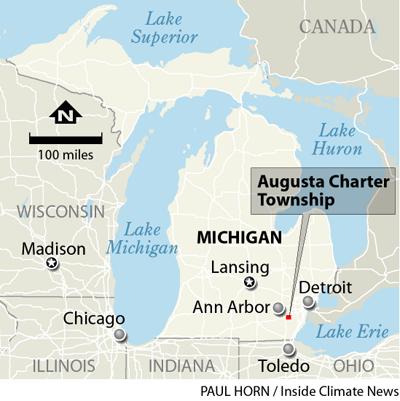
That is when Matts learned, through his group of volunteers that cleans up area litter, that a data center was proposed for an 822-acre property largely in Augusta Township, a small farming community southeast of Ann Arbor. Township leadership fully supported it. 

Matts and others responded by quickly forming a new residents group in opposition, and began collecting ballot initiative signatures to put a rezoning for the data center in front of voters. The debate consumed local politics and bitterly divided some residents in this town of about 8,000 people, leading to accusations of harassment and threats. 

“It’s sad that we residents have to fight as hard as we do to keep these facilities out of our backyards, but if we don’t then who will?” he asked. “We’re taking it into our own hands.” 

By August, the group, Protect Augusta Charter Township (PACT), had collected enough signatures for a referendum, and PACT is confident residents will vote the project down, Matts added.
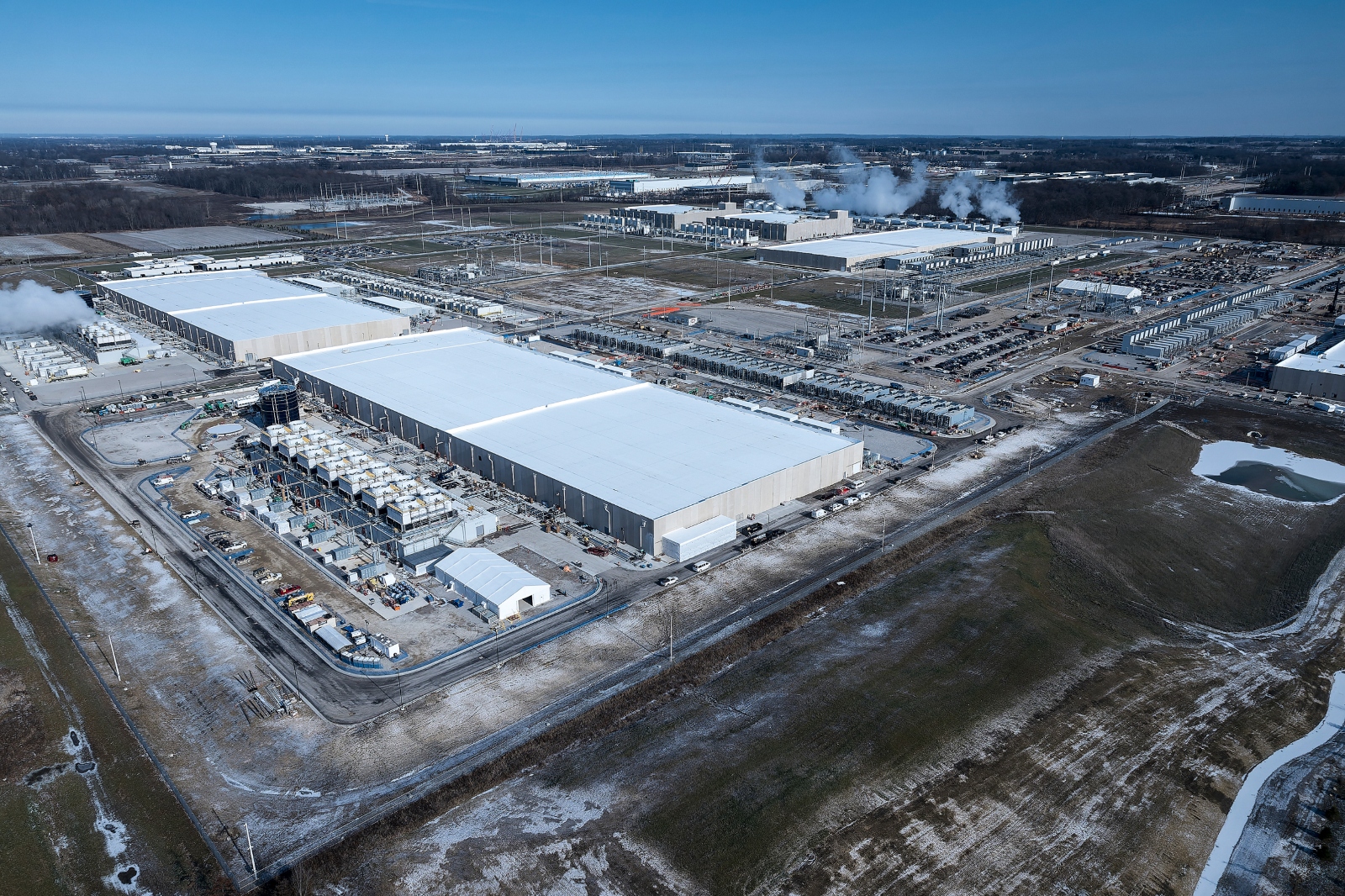
An aerial view of Google’s New Albany data center campus in Central Ohio. Courtesy of Google

The grassroots effort is part of a growing number of municipal fights that are playing out in towns throughout Michigan—and across the U.S.—that could derail data center plans. The centers are opposed by people from across the political spectrum, and the controversy here is unfolding as neighboring Saline Township rejected a similar data center plan in September. 

In Augusta Township, the proposal has pitted nearly 1,000 residents who signed the ballot initiative against the township Board of Trustees, which in July unanimously approved the rezoning, and the developer behind the proposal, New York City-based real estate firm Thor Equities.

Thor builds data centers but has not announced a client, though a planning report noted tech companies like Google and Microsoft use the type of facility that is proposed here. The centers typically house infrastructure for artificial intelligence and other computing uses. 

Few details on how the center would look are yet available, but it would include at least five large buildings on what is currently farmland and wetlands, according to plans. The center may consume 1 million gallons of water daily, local news outlet MLive reported, and would include large generators.

The Board of Trustees and supporters point to potential benefits, including increased tax revenue for the financially struggling township, and water and sewer infrastructure improvements. 
“It would just be so huge for us,” said Augusta Township Clerk Kim Gonczy. The level of tax revenue is still unclear, she said, but added it is likely “millions of dollars.” 

“It could make such a big difference for the township,” she added.

The project’s opponents questioned the economic impact. They fear an increase in noise and light pollution, and that the massive facility would destroy Augusta’s rural character while pushing up utility bills and causing brownouts. PACT’s effort is about preserving the “sense of place,” said Matts, whose family has lived in Augusta for 100 years. 

“With this data center plan they’re basically saying, ‘We know that, but business is more important,’” Matts said. “Landscape and preserving the identity of a place does not register on their needs list.”

Residents needed to collect 561 signatures to get the issue on the ballot, and they turned in 957 gathered during an approximately two-week period in August. Township officials must certify the signatures, then develop language for the ballot that will be voted on during a special election in May 2026 at the earliest. Matts estimated PACT spoke with 1,200 to 1,400 residents, and a strong majority signed the petition.

As data centers’ financial and environmental tolls have become clearer, the public is broadly growing more concerned. In many communities, their massive electricity and water consumption has increased residential utility bills.

In Michigan and elsewhere, they have already required more fossil fuel plants to be built or stay open, and threaten to derail the transition to clean energy. Meanwhile, they can be a source of light, noise, water and air pollution. 

The local battles playing out across the state are residents’ best line of defense, said Tim Minotas, legislative coordinator for the Sierra Club of Michigan.

“This is where people live and raise their family so in the absence of state or federal protections, it’s really the responsibility of our local communities to take a stand to protect themselves,” Minotas said. 

“That’s harassment”

An incident detailed in a previous news report and confirmed by four residents to Inside Climate News described how a township official in August allegedly called police on PACT members. PACT had set up a canopy and table on the side of the road to collect signatures for the ballot initiative near the township hall.

The responding officer allegedly found the campaigners had done nothing wrong, but asked them to move the table back from the road. PACT questioned the township’s intent. 

“Calling the cops, that’s harassment,” resident Deborah Fuqua-Frey, who is opposed to the project, said during a public comment session after the incident. 

Gonczy did not respond to Inside Climate News questions about the incident. In a late-August statement to the news outlet Planet Detroit, Gonczy said the campaigners were set up too close to a dangerous intersection. 

Meanwhile, residents said they have received anonymous handwritten notes in their mailboxes that they perceived as threats. Video shows the township supervisor, Todd Waller, would not allow residents to talk about the data center during public comment at board meetings. Some residents questioned the ethics of Waller’s rule, and said it was part of a larger pattern of officials trying to silence the project’s critics. Waller did not respond to requests for comment. 

The local issues came after a battle in the state legislature in which progressive legislators sought to add consumer and environmental protections to incentives for data centers. Those were not included in the bills that passed, and may have helped alleviate some of the problems now being dealt with at the local level, said Denise Keele, director of the nonprofit Michigan Climate Action Network. 

“It’s one thing if there is NIMBY-ism, and people saying ‘I don’t want this in my community,’ but with data centers the fears are real,” Keele said. “The centers suck up energy and more importantly they will raise our energy rates.” 

Merits and drawbacks

Township officials have downplayed PACT’s litany of issues with the project. Responding to concerns about light pollution, Gonczy said the property’s lights will be pointed toward the ground, so they won’t flood the surrounding region. She also told Inside Climate News that officials traveled to Toledo to visit a data center, used a noise meter to measure the decibels, and found the level would not violate Augusta Township ordinances. 

Moreover, the project would be built in the township’s southwest corner, far away from most residents, Gonczy said. She added that she has not seen any evidence that it would decrease grid reliability or increase bills. 

“I don’t understand all of that, and I don’t know where it’s coming from,” Gonczy told Inside Climate News. 

The project’s opponents see it differently. They argue that the financial benefit is not worth the cost, and still suspect the lights will be a problem. 
“It won’t be dark at night because there are going to be acres and acres of lights,” said one township resident who declined to use her name for fear of retribution. “It’s no longer your dark cornfield because there’s a glow that never goes away.”

The project’s opponents also questioned the accuracy of the sound meter readings, and said those do not take into account the effects of a steady din. Data centers include generators that frequently run on diesel fuel, and those are used monthly as routine maintenance to ensure they work, which could contribute to air and noise pollution. 

More important, Matts said, is the loss of the rural character. State leaders didn’t consider these issues, nor has Augusta Township’s Board of Trustees, Matts said, which he called “frustrating.” 

“People have lived here for a long time and we understand that things come and go and there’s change and development, but something of this scale and magnitude—1,000 industrial acres—is asinine in a community like this,” Matts said.

This story was originally published by Grist with the headline A Michigan town hopes to stop a data center with a 2026 ballot initiative on Oct 14, 2025.

Read the full story here.
Photos courtesy of

England’s water industry issued £10.5bn in ‘green bonds’ despite pollution record

River Action says use of issuance tied to environmental benefits is ‘corporate greenwash on steroids’Water companies have issued a fifth of the UK’s “green bonds” since 2017, despite a consistently poor record of sewage pollution during that time, research has shown.Privately owned water companies in England have together issued £10.5bn in bonds tied to projects that offer “environmental benefits”, according to analysis of financial market data by Unearthed, which is part of Greenpeace UK. Continue reading...

Water companies have issued a fifth of the UK’s “green bonds” since 2017, despite a consistently poor record of sewage pollution during that time, research has shown.Privately owned water companies in England have together issued £10.5bn in bonds tied to projects that offer “environmental benefits”, according to analysis of financial market data by Unearthed, which is part of Greenpeace UK.Anglian Water has been the biggest issuer in the water industry, at £3.5bn, with struggling Thames Water second at £3.1bn. The two companies were the third- and sixth-largest issuers of corporate green bonds overall since 2017.Issuers of green bonds are expected to use the proceeds for defined purposes such as renewable energy, greenhouse gas control and clean transportation such as electric vehicles. Sustainable water and wastewater management is also included. This means many water companies’ standard operations qualify. In return, companies tend to be able to borrow more cheaply, because they attract investors hoping to benefit the environment while also profiting.Yet the privatised water industry in England and Wales has faced persistent criticism over its environmental record in recent decades, after years of alleged underinvestment and payment of large dividends to shareholders.The first green bond issued by a UK water company was in 2017, when Anglian, which supplies much of the east of England, raised £250m. However, the UK government’s Environment Agency last month said environmental progress across the sector had declined in the last year. Critics of the water industry said the poor performance raised questions over possible “greenwashing” in relation to the bonds.James Wallace, the chief executive of River Action, a clean water campaign group, said: “This is corporate greenwash on steroids. UK water companies are raising billions through green bonds while failing to deliver the environmental improvements these funds are supposed to support.“Their crumbling infrastructure continues to kill rivers and put communities at risk while investors are rewarded. True green finance should deliver real benefits for the environment and public health, not mask ongoing pollution.”Water companies accounted for 19% of all corporate issuance between 2017 and 2025. If issuance by the Thames Tideway “super sewer” developer is taken into account, that proportion rises to 22%.Thames Water’s effective owners are pushing for the government to grant it leniency on environmental standards for as long as 15 years as part of a rescue plan. Unearthed also revealed that Thames has failed to publish impact reports detailing its bonds’ environmental benefit for two years. Although not a legal requirement, the failure to publish the reports contravenes the industry standard.The company said it was still committed to publishing the impact reports for its green bonds. A spokesperson said: “The impact report for 2022-23 and 2023-24, which will detail the allocation of the £1.65bn raised through our January 2023 green bond issuance, has not yet been published. We take our reporting responsibilities seriously, and on this occasion we have fallen short of meeting expectations.”skip past newsletter promotionSign up to Business TodayGet set for the working day – we'll point you to all the business news and analysis you need every morningPrivacy Notice: Newsletters may contain information about charities, online ads, and content funded by outside parties. If you do not have an account, we will create a guest account for you on theguardian.com to send you this newsletter. You can complete full registration at any time. For more information about how we use your data see our Privacy Policy. We use Google reCaptcha to protect our website and the Google Privacy Policy and Terms of Service apply.after newsletter promotionAn Anglian spokesperson said growing the economy while reducing pollution required “significant and sustained investment in infrastructure”, adding that the funds raised “helped to deliver significant environmental improvements”.“We know there is more still to do, particularly on issues like pollution, but environmental performance is broader than just that one measure,” the spokesperson said, pointing to carbon emission reductions.They said it was vital that the government create the conditions for an “investable sector” through regulatory reform.Water UK, a lobby group for the industry, declined to comment.

Where others saw litter, he saw a bird: Galveston artist crafts reddish egret from washed-up debris

The artwork, which will be displayed at Moody Gardens and other locations on the island, was created to increase awareness about plastic pollution in the ocean.

Julianna Washburn/HPMGalveston artist Evan McClimans shows the eye of his sculpture made out of marine debris on Nov. 25, 2025.When artist Evan McClimans saw broken garbage bins, a discarded kayak and blue bottle caps that littered Galveston’s beaches, he didn't see it as trash. He saw a vision. McClimans transformed the waste bins into what now looks like bird feathers, the kayak came to resemble sand and the bottle caps were made into what looks like ocean water. Sign up for the Hello, Houston! daily newsletter to get local reports like this delivered directly to your inbox. After four months of creating, McClimans finished his work of art. He'd pieced together thousands of pieces of marine debris from Galveston to create a 7-foot sculpture of a reddish egret, the official bird of Galveston and a threatened species nicknamed "Gerde of the Gulf." "It’s been a lot of blood, sweat and tears on this thing and I’m just so grateful that I got to do it," McClimans said. The project was part of a partnership between the Galveston Park Board and Washed Ashore, an Oregon-based organization that works to encourage recycling and educate the public about plastic pollution in the ocean. Sculptures are made out of washed-up debris and represent marine life affected by plastic pollution. "When you’re looking at these different artworks, you’re understanding that these are things ending up in the ocean that we use every single day," said Elizabeth Walla, environmental programs manager at the Galveston Park Board. Walla said the Galveston Park Board, which is responsible for maintaining all 32 miles of beach front on the island south of Houston, has a crew of 36 members who clean the beaches by hand every day, picking up trash and emptying trash barrels. "It is hard to imagine, but we are picking up at least 2 million pounds of trash from our beach front every year," Walla said. Walla said marine debris in Galveston isn't just from people leaving trash on the beach, however, as a study by the National Oceanic and Atmospheric Administration (NOAA) found that marine debris accumulation rates were 10 times higher in Texas than the other states along the Gulf, because of where Texas sits in relation to wind directions and currents. "When that was released, it made sense to me because a lot of the trash that we see, especially the bigger stuff, has barnacles on it. It has algae on it. You can tell it’s been in the water for quite a while," Walla said. To help create “Gerte,” Walla said in addition to the crew that typically cleans the beaches, volunteers from around the community came together to help pick up marine debris. Items such as lighters, beach toys and sand buckets now help make up the sculpture. Julianna Washburn, HPM“Gerte of the Gulf,” a sculpture made out of marine debris, sits inside artist Evan McClimans’ shop on Nov. 25, 2025.Julianna Washburn/HPMGalveston artist Evan McClimans shows a children’s toy that sits on his sculpture made out of marine debris on Nov. 25, 2025. "My favorite is the Texas volleyball," McClimans said about one of the items on the sculpture. "I have a whole bin full of beach balls that they found out in random places, but that one had Texas on it and since this [sculpture] is staying in Galveston, I thought it’d be appropriate to put that one on there." While each piece of marine debris turned into its own artform, McClimans, who once focused his energy entirely on welding, said creating Gerte changed him, too. "I’ve definitely taken a bigger interest in making sure that I do my part and preach to others to do theirs," McClimans said. "When I go to the beach, I make sure [to] pick up 10 pieces when you’re there, pick up 10 pieces when you leave," McClimans said. At a Galveston City Council meeting in November, "Gerde of the Gulf" was given the 2025 Galveston Planning & Design Award in the environmental category. Gerte will be displayed at Moody Gardens starting Monday, then the sculpture will continue to move to different locations around the island.

Brazil Prosecutors Sue Agencies Over Haidar Shipwreck, Environmental Risk

By Ana ManoSAO PAULO (Reuters) -Brazilian federal prosecutors in Para state have filed a lawsuit to demand the removal of the hull and oily...

SAO PAULO (Reuters) -Brazilian federal prosecutors in Para state have filed a lawsuit to demand the removal of the hull and oily residues from the Haidar ship, which sank 10 years ago near Vila do Conde port, Brazil's biggest for live cattle shipments.In a statement on Wednesday, Para federal prosecutors recalled the Haidar wreck caused the death of 5,000 cattle and a spill of 700,000 liters of oily residues.A subsequent spill from the Haidar wreck was reported in 2018, prosecutors said, showing that remaining residues inside the hull represent "a constant threat."Some 215,000 liters of oil, diesel, fuel, and lubricant could still be inside the ship, prosecutors added, warning of potentially "catastrophic water pollution" if new spills occur.The sunken vessel still contains carcasses and skeletal remains of the cattle drowned in 2015, they said. Prosecutors are seeking at least 5 million reais ($936,873) in compensation, in addition to 91,400 reais for environmental damages related to the 2018 spill.Defendants include the federal infrastructure department DNIT, Para's environment agency SEMAS, the Para Port Authority CDP, and the companies that owned the ship.They did not immediately comment on the lawsuit.Para, Brazil's biggest live cattle-exporting state, shipped 370,000 head of cattle worth $344 million mainly to Egypt, Morocco, and Algeria in the year through July, according to trade data compiled by state authorities.Beefpacker Minerva owned the cattle ferried on the Haidar in 2015, but it is not a defendant, according to court filings.       (Reporting by Ana ManoEditing by Rod Nickel)Copyright 2025 Thomson Reuters.

Data centers are putting new strain on California’s grid. A new report estimates the impacts

A new report estimates that California’s data centers are driving increases in electricity use, water demand and pollution even as lawmakers stall on oversight.

In summary A new report estimates that California’s data centers are driving increases in electricity use, water demand and pollution even as lawmakers stall on oversight. California is a major hub for data centers — the facilities that store and transmit much of the internet. But just how much these power-hungry operations affect the state’s energy use, climate and public health remains an open question for researchers. A new report released this week by the environmental think tank Next 10 and a UC Riverside researcher attempts to quantify that impact — but its authors say the report is only an estimate without harder data from the centers themselves. “We are just making these reports pretty much in the dark — since there’s almost zero information,” said Shaolei Ren, an AI researcher at UC Riverside and co-author of the report. “We have extremely little information about data centers in California.” Ren and his coauthors conclude that between 2019 and 2023, electricity use and carbon emissions by California data centers nearly doubled, while on-site water consumption slightly more than doubled. Much of the increases were attributable to the electricity required to run artificial intelligence computations. But many of the report’s estimates, including its health impacts, are based on limited data — a key issue researchers said they encountered repeatedly when crafting the report. The report underscores a growing tension in the industry: advocates who support clean energy and experts who study energy demand agree the days of steady, flat energy use at data centers are over, but there’s far less consensus on just how sharply electricity demand will climb. “In very simple terms, a lot of the uncertainty comes from: what is our life going to look like with AI in the next five years, 10 years, 20 years — how integrated is it going to become?” said Maia Leroy, a Sacramento-based advocate who focuses on clean energy and the grid.  “Are we reaching a point where the use is going to plateau, or is it going to continue?” Experts say more transparency is essential to better understand what resources data centers demand in California. Liang Min, who manages the Bits and Watts Initiative at Stanford University, says the state should improve its forecasts for energy demand to support clean energy goals. Min, who investigates AI’s growing strain on the electric grid, told CalMatters that demand at power centers rises in rapid, unpredictable phases and can shift quickly with each new generation of hardware. The California Energy Commission, which plans for energy use and the growth in demand, “can play a pivotal role,” in understanding and adapting to the demands of AI. As demand grows, policy responses lag In Sacramento, efforts to add transparency and guardrails around data centers have struggled this year. California lawmakers shelved most consumer and environmental proposals aimed at data centers, even as they approved a plan to regionalize California’s power grid to help meet demand from the sector. They set aside two bills focused on curbing data centers’ energy use — one requiring operators to disclose their electricity use and another that offered clean power incentives. Gov. Gavin Newsom vetoed a separate proposal that would have required data center operators to report their water use, even after the bill was weakened. In the end, Newsom — who has often highlighted California’s dominance in the artificial intelligence sector — signed only one measure, allowing regulators to determine whether data centers are driving up costs. Mark Toney, who leads The Utility Reform Network and supported the transparency measure, has questioned whether data centers justify the costs they’re pushing onto ratepayers. He warned of the centers’ “voracious consumption of energy and water, increased carbon emissions, and jacking up ratepayer bills.” Hard facts about data centers are tough to find in California because most rent out power, cooling and floor space to other companies, said Ren, the UC Riverside researcher. Such colocation facilities don’t run their own servers or technology, so they report less information publicly than data centers built by major tech companies in other states. While estimates vary, California has the third-most data centers in the country, after Texas and Virginia. DataCenterMap, a commercial directory that tracks data centers worldwide, lists 321 sites across the state. More in California are expected in coming years. The centers operate around the clock and often rely on diesel backup generators to maintain service during power failures — a practice that adds both greenhouse gases and local air pollutants. They also consume energy and water depending on their cooling methods. Rising data-center demand, and rising questions F. Noel Perry, the businessman and philanthropist who founded Next 10, said his organization’s report shines light on what is fundamentally a black box. “To solve a problem, we have to understand what the problem is,” he said.  “We’ve seen the proliferation of data centers in California, in the U.S. and across the world — and we also are seeing major implications for the environment,” Perry told CalMatters. “The real issue has to do with transparency — and the ability of elected officials and regulators to create some rules that will govern reductions in emissions, water consumption.” The report estimated that data centers used 10.8 terawatt-hours of electricity in 2023, up from 5.5 terawatt-hours in 2019, accounting for 6% of the nation’s total data center energy use. Unless growth is curbed or better managed, the report’s authors project demand could rise to as high as 25 terawatt-hours by 2028, equal to the power use of roughly 2.4 million U.S. homes. Carbon emissions from the sector nearly doubled during the same period, climbing from 1.2 million to 2.4 million tons, researchers estimated, while on site water use grew from 1,078 acre feet in 2019 to 2,302 acre feet in 2023. That’s enough to meet the annual water needs of almost seven thousand California households. The report’s authors also estimated the public health costs from air pollution associated with data centers have potentially risen, from $45 million in 2019 to more than $155 million in 2023, with the burden expected to reach as high as $266 million by 2028. Most of those costs stem from indirect pollution produced by fossil-fueled power plants that supply the grid. But authors pointed out that regions dense with data centers — particularly Santa Clara County, home to Silicon Valley — could face higher localized risks from diesel backup generators. Dan Diorio, vice president of state policy for the Data Center Coalition, said the report exaggerates the impact of backup diesel generators, which are tightly regulated and rarely used in California, minimizing their contributions to air pollution. Data centers don’t control the water used in electricity generation, said Diorio. Since those water impacts don’t happen on site, it’s not fair to blame that on the centers themselves.  “It paints a skewed picture of this critical 21st-century industry,” Diorio said in a statement. Diorio said the report also overlooks how cooling technology varies by region and has become more efficient in recent years. But the authors say their findings underscore the need for uniform reporting standards for data centers’ energy and water use. The report said California should establish ongoing local monitoring and review of data centers — and make the findings public. Ren, the UC Riverside researcher, said that California’s cleaner grid and stricter pollution rules are helping blunt some environmental impacts of data centers already. “California — versus the national average — is doing a better job due to the cleaner grid,” he said.

Suggested Viewing

Join us to forge
a sustainable future

Our team is always growing.
Become a partner, volunteer, sponsor, or intern today.
Let us know how you would like to get involved!

CONTACT US

sign up for our mailing list to stay informed on the latest films and environmental headlines.

Subscribers receive a free day pass for streaming Cinema Verde.
Thank you! Your submission has been received!
Oops! Something went wrong while submitting the form.