Cookies help us run our site more efficiently.

By clicking “Accept”, you agree to the storing of cookies on your device to enhance site navigation, analyze site usage, and assist in our marketing efforts. View our Privacy Policy for more information or to customize your cookie preferences.

Fish Kill at Clear Lake Reveals a Seven-Foot Sturgeon Surprise 

News Feed
Thursday, October 9, 2025

Tiny silver fish float up at Clear Lake in August. Big Valley Band of Pomo Indians records indicate this was the biggest fish kill since 2017. (Courtesy of Luis Santana)As Luis Santana motored out onto Clear Lake this August, it seemed at first like a normal summer day out on the water: warm air, cloudy skies, and the wide lake waters full of what seemed like bubbles from the waves.  “Then I stopped, and I was like, Oh my god,” Santana, a fisheries biologist with the Robinson Rancheria tribe, recalls. Those weren’t bubbles; they were millions of dead threadfin shad, and others. “I saw literally every species of fish found in the lake,” except for the Clear Lake tule perch, Santana says. The measurements he took that day revealed what likely killed them: a near-total lack of oxygen in the lake. The fish had, essentially, suffocated. Amid the silver-lined shores, one fish washed up that no one had known to be a resident: a dead seven-foot-long white sturgeon. It was Clear Lake’s first on record. No one knows for sure how it got into the waters, but Santana thinks it died with the shad. White sturgeon (Acipenser transmontanus), the biggest freshwater fish in North America, live in the Bay-Delta. They became a candidate for listing as a threatened species under the California Endangered Species Act after a 2022 harmful algal bloom that killed hundreds of them.  Big ’un: A white sturgeon—in Clear Lake? CDFW says the average sturgeon caught in the Delta these days is about 3.6 feet long, and it is rare to encounter fish larger than 6.5 feet long in California. This one was seven feet. (Courtesy of Luis Santana)This fall’s fish die-off is the lake’s largest since at least 2017, according to records from the Big Valley Band of Pomo Indians. And it is yet another environmental black mark for a lake—California’s largest freshwater body—that has been consistently troubled by poor water quality. Now, scientists are uncovering the exact cause of the die-off—and analyzing the sturgeon for more answers. For Angela DePalma-Dow, a lake scientist and executive director of the Lake County Land Trust, the event reminds her: “There’s so much we can learn from Clear Lake.”  As a five-year-old, Santana spent every summer day swimming in Clear Lake. That’s a distant dream now. The summer lake—despite the name—is rarely clear; more often, it’s clouded dirty green as harmful algal blooms take over the waters. Sometimes, Santana thinks the water smells like sewage. “I don’t think my kids have ever swam in Clear Lake,” Santana says.  Fish die-offs and fish kills are a consequence of these impaired conditions, especially the frequent harmful algal blooms (HABs), during which algae decompose and strip the water of oxygen (while also filling the water with cyanotoxins). The Big Valley Band of Pomo Indians has tracked harmful algal blooms in Clear Lake since 2014. The program started after five years of “thick, noxious blooms covering [Clear Lake’s] surface” (as the tribe writes in a history of the program) and no regular monitoring from the state, despite recommendations from the California Office of Environmental Health Hazard Assessment. “We just needed to have more data,” says Sarah Ryan, the environmental director at the Big Valley Band of Pomo Indians.  “It seems like they have fish kills every year,” says Ben Ewing, who studies the endemic Clear Lake hitch, a large minnow, at the California Department of Fish and Wildlife. “I lost track with how many.” In 2017, the state Legislature formed a committee to restore the lake, citing high mercury levels, dangerous contaminants in fish, and the regular HABs; to date, it has led to tens of millions in state funding for research, restoration, and education projects on Clear Lake, including helping sustain water quality monitoring cut by the state during the Covid pandemic.  Cyanobacteria bloom at Redbud Park, in Clear Lake’s southeast arm, in July 2020. Big Valley Pomo EPA’s sampling found toxins at a “warning” level. The lake is frequently beset by harmful algal blooms. (Courtesy of Big Valley Band of Pomo Indians)This die-off, Ewing says, caught lake-watchers off guard because 2025 seemed like the year Clear Lake might escape a fish kill. The characteristic pea soup of harmful algal blooms had been noticeably absent. Instead, the cause was likely a perfect storm of other conditions, says Ewing. “Everything had to line up correctly for this to happen,” he says.  Two bountiful water seasons laid the ground for it, DePalma-Dow explains. Fish populations—especially nonnative bait fish like shad—boomed with the increased water, which also meant some fish naturally died. She speculates that as their bodies decomposed, they stripped oxygen from the water column. Then, this fall, heavy winds came and distributed the low-oxygen water throughout the water column. A series of cloudy mornings arrived, during which the lake’s aquatic plants couldn’t respire oxygen back into the water. So more fish likely died, triggering oxygen levels to further plummet. Eventually, conditions became fatal for all species of fish. Santana says he measured “basically zeroes on every level” for dissolved oxygen through the water column. DePalma-Dow says this process is just the lake self-regulating, as fish populations outstrip the oxygen available. “This is totally not surprising for a lake cycle event,” she says. “This is a big, huge, natural system.” Santana blames human disturbance for the die-off. “We took away all the habitat that could potentially negate any of these effects,” he says. Clear Lake has lost up to 90 percent of its wetlands, he says, and creeks that might once have provided an infusion of oxygen-rich water into the lake now run dry in May and June. “There’s just so many things we’re taking and taking and not giving back,” he says.  A satellite image of Clear Lake during a May 2024 algal bloom. The emerald color doesn’t tell you whether toxins are present, though. That requires water sampling, which the Big Valley Band of Pomo Indians EPA has been doing since 2014. (Sentinel-2 satellite, via the Copernicus browser)In lieu of those natural processes, technological solutions are being considered: Researchers from UC Davis are exploring installing oxygenators in Clear Lake that could trap nutrients in the sediment under a thin layer of oxygen, theoretically reducing the number of harmful algal blooms—and, possibly, keeping oxygen levels higher so more fish can breathe. “That would be one of the hopeful outcomes,” says DePalma-Dow. Neither the state nor county put out a press release about the die-off, Ryan notes. “It’s always better if you can anticipate the questions and try to get information out.” For now, those living by the lake watch (and smell) the dead fish decompose. “There’s really no post support,” she says.  The August die-off on Clear Lake silvered the shoreline. It claimed fish of “literally every species,” says Luis Santana, a Robinson Rancheria fisheries biologist. (Larger fish on shore courtesy of Luis Santana; silvery shoreline by Shawna McEwan; closeup by Sophia Zesati) Fish populations will likely recover, scientists say. Many fish probably survived, in nooks and crannies. With good winter rains, they can breed and repopulate the waters by spring. This die-off is just another challenge for a beleaguered lake.  As for the sturgeon? USGS scientists were trying to figure out how old it was, and hoping to answer when it got to the lake, but the government shutdown has since paused their work. And they cannot answer questions about their research until the shutdown ends. Santana’s observations of the sturgeon showed it was a female with eggs. For now, the giant fish is a reminder of the treasures that may hide in Clear Lake’s murky waters. “Every year is a mystery and surprise,” DePalma-Dow says.

A problem lake was doing pretty well this year. Then came a series of unfortunate water-quality events. The post Fish Kill at Clear Lake Reveals a Seven-Foot Sturgeon Surprise  appeared first on Bay Nature.
Dead fish at lake surface
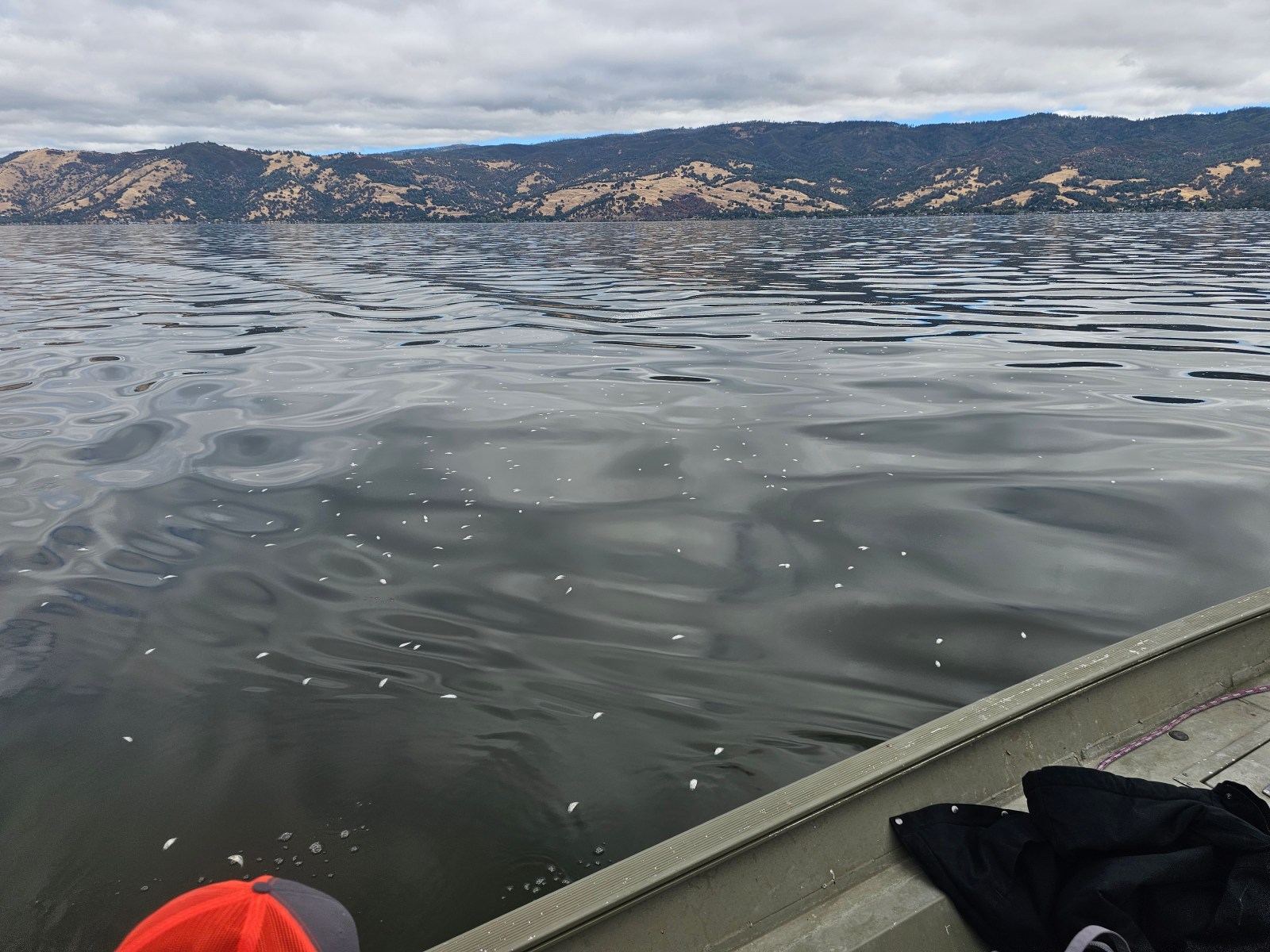
Tiny silver fish float up at Clear Lake in August. Big Valley Band of Pomo Indians records indicate this was the biggest fish kill since 2017. (Courtesy of Luis Santana)

As Luis Santana motored out onto Clear Lake this August, it seemed at first like a normal summer day out on the water: warm air, cloudy skies, and the wide lake waters full of what seemed like bubbles from the waves. 

“Then I stopped, and I was like, Oh my god,” Santana, a fisheries biologist with the Robinson Rancheria tribe, recalls. Those weren’t bubbles; they were millions of dead threadfin shad, and others. “I saw literally every species of fish found in the lake,” except for the Clear Lake tule perch, Santana says. The measurements he took that day revealed what likely killed them: a near-total lack of oxygen in the lake. The fish had, essentially, suffocated.

Amid the silver-lined shores, one fish washed up that no one had known to be a resident: a dead seven-foot-long white sturgeon. It was Clear Lake’s first on record. No one knows for sure how it got into the waters, but Santana thinks it died with the shad. White sturgeon (Acipenser transmontanus), the biggest freshwater fish in North America, live in the Bay-Delta. They became a candidate for listing as a threatened species under the California Endangered Species Act after a 2022 harmful algal bloom that killed hundreds of them. 

A sturgeon
Big ’un: A white sturgeon—in Clear Lake? CDFW says the average sturgeon caught in the Delta these days is about 3.6 feet long, and it is rare to encounter fish larger than 6.5 feet long in California. This one was seven feet. (Courtesy of Luis Santana)

This fall’s fish die-off is the lake’s largest since at least 2017, according to records from the Big Valley Band of Pomo Indians. And it is yet another environmental black mark for a lake—California’s largest freshwater body—that has been consistently troubled by poor water quality. Now, scientists are uncovering the exact cause of the die-off—and analyzing the sturgeon for more answers. For Angela DePalma-Dow, a lake scientist and executive director of the Lake County Land Trust, the event reminds her: “There’s so much we can learn from Clear Lake.” 

As a five-year-old, Santana spent every summer day swimming in Clear Lake. That’s a distant dream now. The summer lake—despite the name—is rarely clear; more often, it’s clouded dirty green as harmful algal blooms take over the waters. Sometimes, Santana thinks the water smells like sewage. “I don’t think my kids have ever swam in Clear Lake,” Santana says. 

Fish die-offs and fish kills are a consequence of these impaired conditions, especially the frequent harmful algal blooms (HABs), during which algae decompose and strip the water of oxygen (while also filling the water with cyanotoxins). The Big Valley Band of Pomo Indians has tracked harmful algal blooms in Clear Lake since 2014. The program started after five years of “thick, noxious blooms covering [Clear Lake’s] surface” (as the tribe writes in a history of the program) and no regular monitoring from the state, despite recommendations from the California Office of Environmental Health Hazard Assessment. “We just needed to have more data,” says Sarah Ryan, the environmental director at the Big Valley Band of Pomo Indians. 

“It seems like they have fish kills every year,” says Ben Ewing, who studies the endemic Clear Lake hitch, a large minnow, at the California Department of Fish and Wildlife. “I lost track with how many.” In 2017, the state Legislature formed a committee to restore the lake, citing high mercury levels, dangerous contaminants in fish, and the regular HABs; to date, it has led to tens of millions in state funding for research, restoration, and education projects on Clear Lake, including helping sustain water quality monitoring cut by the state during the Covid pandemic. 
Algae in lake
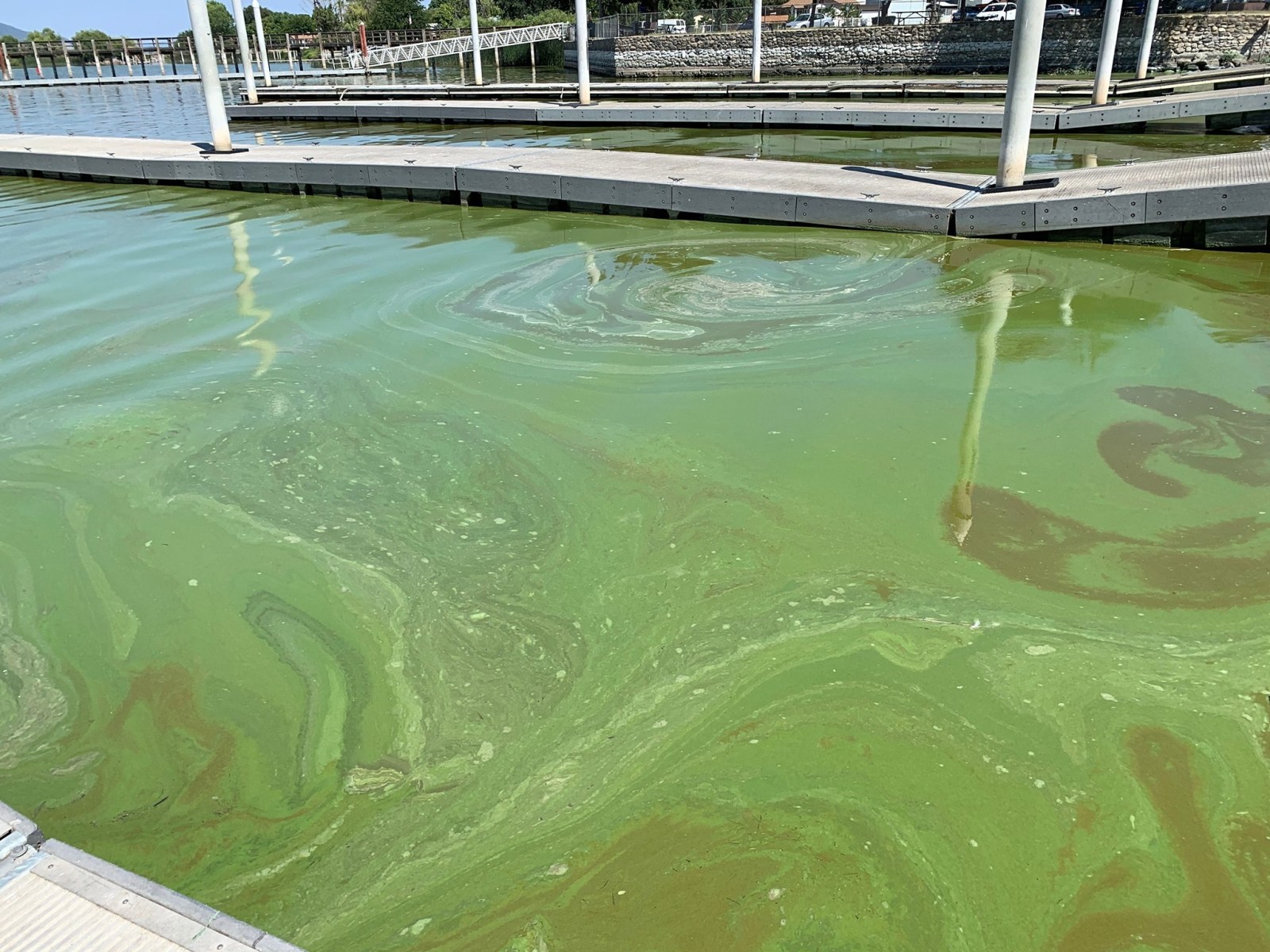
Cyanobacteria bloom at Redbud Park, in Clear Lake’s southeast arm, in July 2020. Big Valley Pomo EPA’s sampling found toxins at a “warning” level. The lake is frequently beset by harmful algal blooms. (Courtesy of Big Valley Band of Pomo Indians)

This die-off, Ewing says, caught lake-watchers off guard because 2025 seemed like the year Clear Lake might escape a fish kill. The characteristic pea soup of harmful algal blooms had been noticeably absent. Instead, the cause was likely a perfect storm of other conditions, says Ewing. “Everything had to line up correctly for this to happen,” he says. 

Two bountiful water seasons laid the ground for it, DePalma-Dow explains. Fish populations—especially nonnative bait fish like shad—boomed with the increased water, which also meant some fish naturally died. She speculates that as their bodies decomposed, they stripped oxygen from the water column. Then, this fall, heavy winds came and distributed the low-oxygen water throughout the water column. A series of cloudy mornings arrived, during which the lake’s aquatic plants couldn’t respire oxygen back into the water. So more fish likely died, triggering oxygen levels to further plummet. Eventually, conditions became fatal for all species of fish. Santana says he measured “basically zeroes on every level” for dissolved oxygen through the water column.

DePalma-Dow says this process is just the lake self-regulating, as fish populations outstrip the oxygen available. “This is totally not surprising for a lake cycle event,” she says. “This is a big, huge, natural system.”

Santana blames human disturbance for the die-off. “We took away all the habitat that could potentially negate any of these effects,” he says. Clear Lake has lost up to 90 percent of its wetlands, he says, and creeks that might once have provided an infusion of oxygen-rich water into the lake now run dry in May and June. “There’s just so many things we’re taking and taking and not giving back,” he says. 

a satellite image of clear lake
A satellite image of Clear Lake during a May 2024 algal bloom. The emerald color doesn’t tell you whether toxins are present, though. That requires water sampling, which the Big Valley Band of Pomo Indians EPA has been doing since 2014. (Sentinel-2 satellite, via the Copernicus browser)

In lieu of those natural processes, technological solutions are being considered: Researchers from UC Davis are exploring installing oxygenators in Clear Lake that could trap nutrients in the sediment under a thin layer of oxygen, theoretically reducing the number of harmful algal blooms—and, possibly, keeping oxygen levels higher so more fish can breathe. “That would be one of the hopeful outcomes,” says DePalma-Dow.

Neither the state nor county put out a press release about the die-off, Ryan notes. “It’s always better if you can anticipate the questions and try to get information out.” For now, those living by the lake watch (and smell) the dead fish decompose. “There’s really no post support,” she says. 

The August die-off on Clear Lake silvered the shoreline. It claimed fish of “literally every species,” says Luis Santana, a Robinson Rancheria fisheries biologist. (Larger fish on shore courtesy of Luis Santana; silvery shoreline by Shawna McEwan; closeup by Sophia Zesati)

Fish populations will likely recover, scientists say. Many fish probably survived, in nooks and crannies. With good winter rains, they can breed and repopulate the waters by spring. This die-off is just another challenge for a beleaguered lake. 

As for the sturgeon? USGS scientists were trying to figure out how old it was, and hoping to answer when it got to the lake, but the government shutdown has since paused their work. And they cannot answer questions about their research until the shutdown ends. Santana’s observations of the sturgeon showed it was a female with eggs. For now, the giant fish is a reminder of the treasures that may hide in Clear Lake’s murky waters. “Every year is a mystery and surprise,” DePalma-Dow says.

Read the full story here.
Photos courtesy of

‘Mad fishing’: the super-size fleet of squid catchers plundering the high seas

Every year a Chinese-dominated flotilla big enough to be seen from space pillages the rich marine life on Mile 201, a largely ungoverned part of the South Atlantic off ArgentinaIn a monitoring room in Buenos Aires, a dozen members of the Argentinian coast guard watch giant industrial-fishing ships moving in real time across a set of screens. “Every year, for five or six months, the foreign fleet comes from across the Indian Ocean, from Asian countries, and from the North Atlantic,” says Cdr Mauricio López, of the monitoring department. “It’s creating a serious environmental problem.”Just beyond Argentina’s maritime frontier, hundreds of foreign vessels – known as the distant-water fishing fleet – are descending on Mile 201, a largely ungoverned strip of the high seas in the South Atlantic, to plunder its rich marine life. The fleet regularly becomes so big it can be seen from space, looking like a city floating on the sea. Continue reading...

In a monitoring room in Buenos Aires, a dozen members of the Argentinian coast guard watch giant industrial-fishing ships moving in real time across a set of screens. “Every year, for five or six months, the foreign fleet comes from across the Indian Ocean, from Asian countries, and from the North Atlantic,” says Cdr Mauricio López, of the monitoring department. “It’s creating a serious environmental problem.”Just beyond Argentina’s maritime frontier, hundreds of foreign vessels – known as the distant-water fishing fleet – are descending on Mile 201, a largely ungoverned strip of the high seas in the South Atlantic, to plunder its rich marine life. The fleet regularly becomes so big it can be seen from space, looking like a city floating on the sea.The distant-water fishing fleet, seen from space, off the coast of Argentina. Photograph: AlamyThe charity Environmental Justice Foundation (EJF) has described it as one of the largest unregulated squid fisheries in the world, warning that the scale of activities could destabilise an entire ecosystem.“With so many ships constantly fishing without any form of oversight, the squid’s short, one-year life cycle simply is not being respected,” says Lt Magalí Bobinac, a marine biologist with the Argentinian coast guard.There are no internationally agreed catch limits in the region covering squid, and distant-water fleets take advantage of this regulatory vacuum.Steve Trent, founder of the EJF, describes the fishery as a “free for all” and says squid could eventually disappear from the area as a result of “this mad fishing effort”.The consequences extend far beyond squid. Whales, dolphins, seals, sea birds and commercially important fish species such as hake and tuna depend on the cephalopod. A collapse in the squid population could trigger a cascade of ecological disruption, with profound social and economic costs for coastal communities and key markets such as Spain, experts warn.“If this species is affected, the whole ecosystem is affected,” Bobinac says. “It is the food for other species. It has a huge impact on the ecosystem and biodiversity.”She says the “vulnerable marine ecosystems” beneath the fleet, such as deep-sea corals, are also at risk of physical damage and pollution.An Argentinian coast guard ship on patrol. ‘Outside our exclusive economic zone, we cannot do anything – we cannot board them, we cannot survey, nor inspect,’ says an officer. Photograph: EJFThree-quarters of squid jigging vessels (which jerk barbless lures up and down to imitate prey) that are operating on the high seas are from China, according to the EJF, with fleets from Taiwan and South Korea also accounting for a significant share.Activity on Mile 201 has surged over recent years, with total fishing hours increasing by 65% between 2019 and 2024 – a jump driven almost entirely by the Chinese fleet, which increased its activities by 85% in the same period, according to an investigation by the charity.The lack of oversight in Mile 201 has enabled something darker too. Interviews conducted by the EJF suggest widespread cruelty towards marine wildlife in the area. Crew reported the deliberate capture and killing of seals – sometimes in their hundreds – on more than 40% of Chinese squid vessels and a fifth of Taiwanese vessels.Other testimonies detailed the hunting of marine megafauna for body parts, including seal teeth. The EJF shared photos and videos with the Guardian of seals hanging on hooks and penguins trapped on decks.One of the huge squid-jigging ships. They also hunt seals, the EJF found. Photograph: EJFLt Luciana De Santis, a lawyer for the coast guard, says: “Outside our exclusive economic zone [EEZ], we cannot do anything – we cannot board them, we cannot survey, nor inspect.”An EEZ is a maritime area extending up to 200 nautical miles from a nation’s coast, with the rules that govern it set by that nation. The Argentinian coast guard says it has “total control” of this space, unlike the area just beyond this limit: Mile 201.But López says “a significant percentage of ships turn their identification systems off” when fishing in the area beyond this, otherwise known as “going dark” to evade detection.Crews working on the squid fleet are also extremely vulnerable. The EJF’s investigation uncovered serious human rights and labour abuses in Mile 201. Workers on the ships described physical violence, including hitting or strangulation, wage deductions, intimidation and debt bondage – a system that in effect traps them at sea. Many reported working excessive hours with little rest.Much of the squid caught under these conditions still enters major global markets in the European Union, UK and North America, the EJF warns – meaning consumers may be unknowingly buying seafood linked to animal cruelty, environmental destruction and human rights abuse.The charity is calling for a ban on imports linked to illegal or abusive fishing practices and a global transparency regime that makes it possible to see who is fishing where, when and how, by mandating an international charter to govern fishing beyond national waters.Cdr Mauricio López says many of the industrial fishing ships the Argentinian coastguard monitors turn off their tracking systems when they are in the area. Photograph: Harriet Barber“The Chinese distant-water fleet is the big beast in this,” says Trent. “Beijing must know this is happening, so why are they not acting? Without urgent action, we are heading for disaster.”The Chinese embassies in Britain and Argentina did not respond to requests for comment.

EPA Says It Will Propose Drinking Water Limit for Perchlorate, but Only Because Court Ordered It

The Environmental Protection Agency says it will propose a drinking water limit for perchlorate, a chemical in certain explosives

WASHINGTON (AP) — The Environmental Protection Agency on Monday said it would propose a drinking water limit for perchlorate, a harmful chemical in rockets and other explosives, but also said doing so wouldn't significantly benefit public health and that it was acting only because a court ordered it.The agency said it will seek input on how strict the limit should be for perchlorate, which is particularly dangerous for infants, and require utilities to test. The agency’s move is the latest in a more than decade-long battle over whether to regulate perchlorate. The EPA said that the public benefit of the regulation did not justify its expected cost.“Due to infrequent perchlorate levels of health concern, the vast majority of the approximately 66,000 water systems that would be subject to the rule will incur substantial administrative and monitoring costs with limited or no corresponding public health benefits as a whole,” the agency wrote in its proposal.Perchlorate is used to make rockets, fireworks and other explosives, although it can also occur naturally. At some defense, aerospace and manufacturing sites, it seeped into nearby groundwater where it could spread, a problem that has been concentrated in the Southwest and along sections of the East Coast.Perchlorate is a concern because it affects the function of the thyroid, which can be particularly detrimental for the development of young children, lowering IQ scores and increasing rates of behavioral problems.Based on estimates that perchlorate could be in the drinking water of roughly 16 million people, the EPA determined in 2011 that it was a sufficient threat to public health that it needed to be regulated. Under the Safe Drinking Water Act, this determination required the EPA to propose and then finalize regulations by strict deadlines, with a proposal due in two years.It didn’t happen. First, the agency updated the science to better estimate perchlorate’s risks, but that took time. By 2016, the nonprofit Natural Resources Defense Council sued to force action.During the first Trump administration, the EPA proposed a never-implemented standard that the NRDC said was less restrictive than any state limit and would lead to IQ point loss in children. It reversed itself in 2020, saying no standard was necessary because a new analysis had found the chemical was less dangerous and its appearance in drinking water less common than previously thought. That's still the agency's position. It said Monday that its data shows perchlorate is not widespread in drinking water.“We anticipate that fewer than one‑tenth of 1% of regulated water systems are likely to find perchlorate above the proposed limits,” the agency said. A limit will help the small number of places with a problem, but burden the vast majority with costs they don't need, officials said.The NRDC challenged that reversal and a federal appeals court said the EPA must propose a regulation for perchlorate, arguing that it still is a significant and widespread public health threat. The agency will solicit public comment on limits of 20, 40 and 80 parts per billion, as well as other elements of the proposal.“Members of the public deserve to know whether there’s rocket fuel in their tap water. We’re pleased to see that, however reluctantly, EPA is moving one step closer to providing the public with that information,” said Sarah Fort, a senior attorney with NRDC.EPA Administrator Lee Zeldin has sought massive rollbacks of environmental rules and promoted oil and gas development. But on drinking water, the agency’s actions have been more moderate. The agency said it would keep the Biden administration's strict limits on two of the most common types of harmful “forever chemicals” in drinking water, while giving utilities more time to comply, and would scrap limits on other types of PFAS.The Associated Press receives support from the Walton Family Foundation for coverage of water and environmental policy. The AP is solely responsible for all content. For all of AP’s environmental coverage, visit https://apnews.com/hub/climate-and-environmentCopyright 2026 The Associated Press. All rights reserved. This material may not be published, broadcast, rewritten or redistributed.Photos You Should See – December 2025

New Navy Report Gauges Training Disruption of Hawaii's Marine Mammals

Over the next seven years, the U.S. Navy estimates its ships will injure or kill just two whales in collisions as it tests and trains in Hawaiian waters

Over the next seven years, the U.S. Navy estimates its ships will injure or kill just two whales in collisions as it tests and trains in Hawaiian waters, and it concluded those exercises won’t significantly harm local marine mammal populations, many of which are endangered.However, the Navy also estimates the readiness exercises, which include sonar testing and underwater explosions, will cause more than 3 million instances of disrupted behavior, hearing loss or injury to whale and dolphin species plus monk seals in Hawaii alone.That has local conservation groups worried that the Navy’s California-Training-and-Testing-EIS-OEIS/Final-EIS-OEIS/">detailed report on its latest multi-year training plan is downplaying the true impacts on vulnerable marine mammals that already face growing extinction threats in Pacific training areas off of Hawaii and California.“If whales are getting hammered by sonar and it’s during an important breeding or feeding season, it could ultimately affect their ability to have enough energy to feed their young or find food,” said Kylie Wager Cruz, a senior attorney with the environmental legal advocacy nonprofit Earthjustice. “There’s a major lack of consideration,” she added,” of how those types of behavioral impacts could ultimately have a greater impact beyond just vessel strikes.”The Navy, Cruz said, didn’t consider how its training exercises add to the harm caused by other factors, most notably collisions with major shipping vessels that kill dozens of endangered whales in the eastern Pacific each year. Environmental law requires the Navy to do that, she said, but “they’re only looking at their own take,” or harm.The Navy, in a statement earlier this month, said it “committed to the maximum level of mitigation measures” that it practically could to curb environmental damage while maintaining its military readiness in the years ahead. The plan also covers some Coast Guard operations.Federal fishery officials recently approved the plan, granting the Navy the necessary exemptions under the Marine Mammal Protection Act to proceed despite the harms. It’s at least the third time that the Navy has had to complete an environmental impact report and seek those exemptions to test and train off Hawaii and California.In a statement Monday, a U.S. Pacific Fleet spokesperson said the Navy and fishery officials did consider “reasonably foreseeable cumulative effects” — the Navy’s exercises plus unrelated harmful impacts — to the extent it was required to do so under federal environmental law.Fishery officials didn’t weigh those unrelated impacts, the statement said, in determining that the Navy’s activities would have a negligible impact on marine mammals and other animals.The report covers the impacts to some 39 marine mammal species, including eight that are endangered, plus a host of other birds, turtles and other species that inhabit those waters.The Navy says it will limit use of some of its most intense sonar equipment in designated “mitigation areas” around Hawaii island and Maui Nui to better protect humpback whales and other species from exposure. Specifically, it says it won’t use its more intense ship-mounted sonar in those areas during the whales’ Nov. 15 to April 15 breeding season, and it won’t use those systems there for more than 300 hours a year.However, outside of those mitigation zones the Navy report lists 11 additional areas that are biologically important to other marine mammals species, including spinner and bottle-nosed dolphins, false killer whales, short-finned pilot whales and dwarf sperm whales.Those biologically important areas encompass all the waters around the main Hawaiian islands, and based on the Navy’s report they won’t benefit from the same sonar limits. For the Hawaii bottle-nosed dolphins, the Navy estimates its acoustic and explosives exercises will disrupt that species’ feeding, breeding and other behaviors more than 310,000 times, plus muffle their hearing nearly 39,000 times and cause as many as three deaths. The report says the other species will see similar disruptions.In its statement Monday, U.S. Pacific Fleet said the Navy considered the extent to which marine mammals would be affected while still allowing crews to train effectively in setting those mitigation zones.Exactly how the Navy’s numbers compare to previous cycles are difficult to say, Wager Cruz and others said, because the ocean area and total years covered by each report have changed.Nonetheless, the instances in which its Pacific training might harm or kill a marine mammal appear to be climbing.In 2018, for instance, a press release from the nonprofit Center For Biological Diversity stated that the Navy’s Pacific training in Hawaii and Southern California would harm marine mammals an estimated 12.5 million times over a five-year period.This month, the center put out a similar release stating that the Navy’s training would harm marine mammals across Hawaii plus Northern and Southern California an estimated 35 million times over a seven-year period.“There’s large swaths of area that don’t get any mitigation,” Wager Cruz said. “I don’t think we’re asking for, like, everywhere is a prohibited area by any means, but I think that the military should take a harder look and see if they can do more.”The Navy should also consider slowing its vessels to 10 knots during training exercises to help avoid the collisions that often kill endangered whales off the California Coast, Cruz said. In its response, U.S. Pacific Fleet said the Navy “seriously considered” whether it could slow its ships down but concluded those suggestions were impracticable, largely due to the impacts on its mission.Hawaii-based Matson two years ago joined the other major companies who’ve pledged to slow their vessels to those speeds during whale season in the shipping lanes where dozens of endangered blue, fin and humpback whales are estimated to be killed each year.Those numbers have to be significantly reduced, researchers say, if the species are to make a comeback.“There are ways to minimize harm,” Center for Biological Diversity Hawaii and Pacific Islands Director Maxx Phillips added in a statement, “and protect our natural heritage and national security at the same time.”This story was originally published by Honolulu Civil Beat and distributed through a partnership with The Associated Press.Copyright 2025 The Associated Press. All rights reserved. This material may not be published, broadcast, rewritten or redistributed.Photos You Should See – December 2025

Hungary's 'Water Guardian' Farmers Fight Back Against Desertification

Southern Hungary landowner Oszkár Nagyapáti has been battling severe drought on his land

KISKUNMAJSA, Hungary (AP) — Oszkár Nagyapáti climbed to the bottom of a sandy pit on his land on the Great Hungarian Plain and dug into the soil with his hand, looking for a sign of groundwater that in recent years has been in accelerating retreat. “It’s much worse, and it’s getting worse year after year,” he said as cloudy liquid slowly seeped into the hole. ”Where did so much water go? It’s unbelievable.”Nagyapáti has watched with distress as the region in southern Hungary, once an important site for agriculture, has become increasingly parched and dry. Where a variety of crops and grasses once filled the fields, today there are wide cracks in the soil and growing sand dunes more reminiscent of the Sahara Desert than Central Europe. The region, known as the Homokhátság, has been described by some studies as semiarid — a distinction more common in parts of Africa, the American Southwest or Australian Outback — and is characterized by very little rain, dried-out wells and a water table plunging ever deeper underground. In a 2017 paper in European Countryside, a scientific journal, researchers cited “the combined effect of climatic changes, improper land use and inappropriate environmental management” as causes for the Homokhátság's aridification, a phenomenon the paper called unique in this part of the continent.Fields that in previous centuries would be regularly flooded by the Danube and Tisza Rivers have, through a combination of climate change-related droughts and poor water retention practices, become nearly unsuitable for crops and wildlife. Now a group of farmers and other volunteers, led by Nagyapáti, are trying to save the region and their lands from total desiccation using a resource for which Hungary is famous: thermal water. “I was thinking about what could be done, how could we bring the water back or somehow create water in the landscape," Nagyapáti told The Associated Press. "There was a point when I felt that enough is enough. We really have to put an end to this. And that's where we started our project to flood some areas to keep the water in the plain.”Along with the group of volunteer “water guardians,” Nagyapáti began negotiating with authorities and a local thermal spa last year, hoping to redirect the spa's overflow water — which would usually pour unused into a canal — onto their lands. The thermal water is drawn from very deep underground. Mimicking natural flooding According to the water guardians' plan, the water, cooled and purified, would be used to flood a 2½-hectare (6-acre) low-lying field — a way of mimicking the natural cycle of flooding that channelizing the rivers had ended.“When the flooding is complete and the water recedes, there will be 2½ hectares of water surface in this area," Nagyapáti said. "This will be quite a shocking sight in our dry region.”A 2024 study by Hungary’s Eötvös Loránd University showed that unusually dry layers of surface-level air in the region had prevented any arriving storm fronts from producing precipitation. Instead, the fronts would pass through without rain, and result in high winds that dried out the topsoil even further. Creation of a microclimate The water guardians hoped that by artificially flooding certain areas, they wouldn't only raise the groundwater level but also create a microclimate through surface evaporation that could increase humidity, reduce temperatures and dust and have a positive impact on nearby vegetation. Tamás Tóth, a meteorologist in Hungary, said that because of the potential impact such wetlands can have on the surrounding climate, water retention “is simply the key issue in the coming years and for generations to come, because climate change does not seem to stop.”"The atmosphere continues to warm up, and with it the distribution of precipitation, both seasonal and annual, has become very hectic, and is expected to become even more hectic in the future,” he said. Following another hot, dry summer this year, the water guardians blocked a series of sluices along a canal, and the repurposed water from the spa began slowly gathering in the low-lying field. After a couple of months, the field had nearly been filled. Standing beside the area in early December, Nagyapáti said that the shallow marsh that had formed "may seem very small to look at it, but it brings us immense happiness here in the desert.”He said the added water will have a “huge impact” within a roughly 4-kilometer (2½-mile) radius, "not only on the vegetation, but also on the water balance of the soil. We hope that the groundwater level will also rise.”Persistent droughts in the Great Hungarian Plain have threatened desertification, a process where vegetation recedes because of high heat and low rainfall. Weather-damaged crops have dealt significant blows to the country’s overall gross domestic product, prompting Prime Minister Viktor Orbán to announce this year the creation of a “drought task force” to deal with the problem.After the water guardians' first attempt to mitigate the growing problem in their area, they said they experienced noticeable improvements in the groundwater level, as well as an increase of flora and fauna near the flood site. The group, which has grown to more than 30 volunteers, would like to expand the project to include another flooded field, and hopes their efforts could inspire similar action by others to conserve the most precious resource. “This initiative can serve as an example for everyone, we need more and more efforts like this," Nagyapáti said. "We retained water from the spa, but retaining any kind of water, whether in a village or a town, is a tremendous opportunity for water replenishment.”The Associated Press’ climate and environmental coverage receives financial support from multiple private foundations. AP is solely responsible for all content. Find AP’s standards for working with philanthropies, a list of supporters and funded coverage areas at AP.org.Copyright 2025 The Associated Press. All rights reserved. This material may not be published, broadcast, rewritten or redistributed.Photos You Should See – December 2025

Suggested Viewing

Join us to forge
a sustainable future

Our team is always growing.
Become a partner, volunteer, sponsor, or intern today.
Let us know how you would like to get involved!

CONTACT US

sign up for our mailing list to stay informed on the latest films and environmental headlines.

Subscribers receive a free day pass for streaming Cinema Verde.
Thank you! Your submission has been received!
Oops! Something went wrong while submitting the form.